
Although most of my professional life has been spent working in technologies like telecommunications and targeted advertising, as well as managing and monetizing patent portfolios, I’ve had a parallel path in music. Nothing very significant mind you, but music has been an important part of my life since childhood.
My journey has taken me from piano to trombone to bass, from etudes to jazz to blues rock. Along the way I studied electronic music and learned to use Ableton, a Digital Audio Workstation (DAW) that allows one to readily compose, produce and even perform electronic music. In 2018, I put together the Bushwick Blooze Band. That ended up teaching me more about the music industry than I expected, much of which remains a somewhat painful memory.
In that journey, I also met some fantastic and interesting people, one of them being Raz Mesinai, who was a teacher and lecturer in electronic music, sound design, experimental media and composition at the Underground Producers Alliance (UPA), UCSD, NYU, The New School, Dubspot, Bard College and other institutions nationwide.
Raz, a prolific record producer, composer and artist, began developing his sound at a young age. While studying at the Harlem School of the Arts as a child, Raz was spending time in the streets of NYC, developing ways of producing independent music as early as age 10, hacking boom boxes and other equipment to create analog cassette multi track systems, and break dance beats. At thirteen, his abilities with sound equipment led him to meet legendary jazz and rock musician, Juma Sultan (Jimi Hendrix, Aboriginal Music Society), who took him under his wing, passing along analog recording equipment used during the “Loft Jazz era” with the intend of having Raz help to preserve underground culture going back to the 1960, since the loft jazz era and punk explosions of the 1960s and 1970s, which Juma Sultan had meticulously recorded and kept locked up in a garage upstate.
Raz grew to become influential in sound design, experimental electronic music and sound system culture with his many projects and monikers, including Psy Co. (1988-1993), Sub Dub (1992-1999) and Badawi (1994-). In the late 80s Raz took on the moniker “Psycho” and release productions under the umbrella “Psy Co.” and “Ruff Riddim Productions”. These cassette only productions combined a wide range of styles and became known as early blueprints of many sub genres of experimental dub. He later got into film scoring and sound design for film, along the way working on films by Ridley Scott and Darren Aronofsky.
What most stood out to me when I met Raz for the first time at Dubspot, as my instructor, was that he was focused on teaching us the underpinnings of sound, and being able to manipulate the individual samples, all harvested from instruments or natural environments, to produce what we were looking for. In other classes students traded packs of sound samples in search of the perfect kick or snare, but under Raz we were told to find a drum kit and harvest our own sounds, later learning to shape them into what we needed through careful filtering, tuning, and the addition of resonances and highly honed effects.
When I stumbled across the AI music generator Suno a year or so ago, I immediately understood that AI was going to hit music hard. It also made me think of Raz, the way he treats and manipulates sound, and how that might or might not relate to the engine behind AI music machines like Suno.
What struck me was not just that it could generate songs. It was how little it seemed to need. A drum groove, a bass riff, a vocal fragment, or even just a text prompt could be turned almost instantly into a fully arranged, mixed, and mastered track. You could ask for instruments, moods, genres, emotional textures, or some strange combination of all of the above, and within seconds Suno would produce something that sounded less like a sketch and more like a finished record.
One of my own experiments is a track I made on Suno called “Eccentrica,” which may or may not be pioneering a genre I have started calling swamp house. Or maybe that is exactly the point: did I create a new genre, or did Suno simply generate a convincing musical hallucination from patterns it had already absorbed?
That is the unsettling part. Suno seems able to take almost any input and return something polished, familiar, and emotionally legible. But what is it actually doing? Is it helping create something new, or is it carefully regurgitating fragments of pop vocabulary it has learned at scale? Is this a new instrument, a new collaborator, or a machine designed to satisfy our growing appetite for instantaneous creativity?
Seeing what was going on with Suno inspired me to reach out to Raz, and our initial discussions blossomed into a collaboration to not only figure out exactly what is going on with these tools, but also the impact they are going to have in the music and entertainment worlds. The music world is already polarized with some musicians embracing it and incorporating its power into their workflow, others rejecting it as the devil itself.
These tools are no longer curiosities. Suno, Udio, Stable Audio, Google’s MusicFX, ElevenLabs Music, Boomy, and Soundraw are just some of the platforms now allowing users to turn prompts, lyrics, loops, melodies, moods, and stylistic references into finished or semi-finished music. Some are built for complete songs with vocals; others focus on beats, background cues, stems, royalty-free production music, or soundtracks. But taken together, they point in the same direction: the creation of plausible, distribution-ready music is becoming fast, cheap, and ubiquitous. Deezer recently reported that nearly 75,000 AI-generated tracks are uploaded to its platform every day, representing roughly 44% of daily uploads—although those tracks still account for only 1–3% of total streams on Deezer, which suggests that supply is exploding faster than listener demand.
The technology varies, and companies rarely reveal exactly how their systems work. But many AI music tools can be understood as diffusion-style generators: they learn by breaking sound down into noise, then learning how to reverse that process, turning noise, guided by a prompt, lyric, melody, or mood, back into coherent music.
And this is no longer just demo material. AI-generated or AI-assisted tracks have already reached real audiences: Butterbro’s “Verknallt in einen Talahon,” made with Udio, entered Germany’s Top 50; King Willonius’s “BBL Drizzy” became a mainstream hip-hop reference point; Xania Monet’s Suno-made “How Was I Supposed to Know?” reached a Billboard radio chart; and Breaking Rust’s “Walk My Walk” topped Billboard’s Country Digital Song Sales chart. In other words, AI music has moved from novelty to market signal.
What were these models trained with, and exactly what can they do besides create pieces that are stunningly perfect and very reminiscent of say, every piece of music that is already out there? More importantly, are they just one big copyright infringement machine, spitting out compositions based on having been trained on every piece of music available, or is the randomness in their statistically generated output enough to exceed the threshold for “copying”. Is Suno’s “fair use” argument sound?
AI music systems are increasingly being built around an idea of what makes pop music pop: what makes a hook feel inevitable, what makes a drop work, what makes a crowd move, what makes a cue sound like the most emotional scene in an indie film. In that sense, they are getting very good at recognizing and reproducing the surface language of music: genre, mood, arrangement, polish, familiarity.
But they have not yet gone very deep into the underlying craft of synthesis and sound design. They can imitate the recognizable outcome of a style without necessarily understanding the physical, technical, and artistic decisions that produced it. AI knows what a guitar sample is, but not what a guitar with one with a broken string, or a piano with a cracked soundboard, sounds like.
Raz is working with me through CAsE Analysis to develop tools and techniques for testing these AI music systems in a more rigorous way. We are not just interested in seeing what they can generate when given a clever prompt. We want to understand how they behave, where their limits are, what kinds of musical patterns they reproduce, and what their outputs may reveal about their architecture and training.
That means moving beyond the usual demo culture around AI music and the “look what I made in thirty seconds” reaction and asking harder questions. How closely can these systems approximate existing styles, artists, genres, or recordings? What kinds of prompts cause them to drift toward familiar musical territory? Are they synthesizing genuinely new combinations, or are they simply echoing recognizable features of the music they were trained on?
The goal is not simply to attack or defend the technology. It is to test it. To treat these systems as objects of analysis rather than magic tricks. They are impressive, but impressiveness is not the same thing as understanding. Raz and I are trying to build a framework that can help musicians, technologists, lawyers, and industry people have a more grounded conversation about what these tools are actually doing and what their arrival means for the future of music.
Stay tuned and keep your ears (and mind) open.
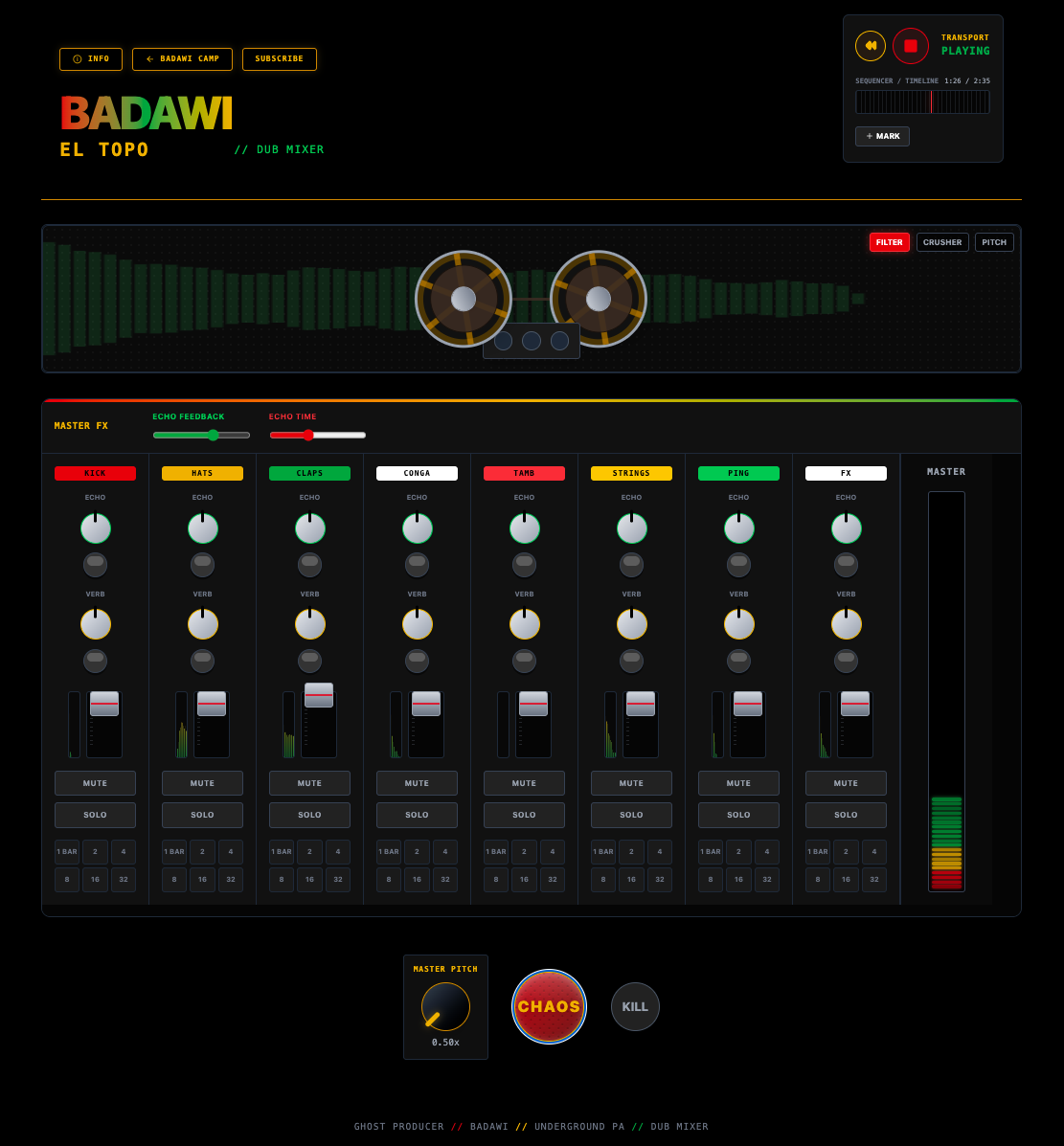
Check out Raz’s Badawi Dub Mixer.
No posts
Comments
Nothing yet. Say the first thing.
Sign in to join the conversation.