
Of all of my memories from Vietnam — the smell of the food, the sound of the language, the thick humidity, the sprawling alleyways of Ho Chi Minh City, the surprisingly scarce leeches, the breath-stealing hike through the montane rainforests, the knee-deep mud we traversed to find the critically endangered spoon-billed sandpiper — the one that comes to mind most vividly might be the gibbons.
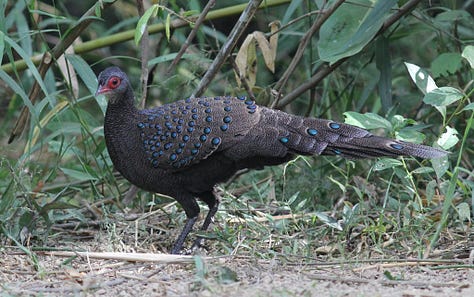

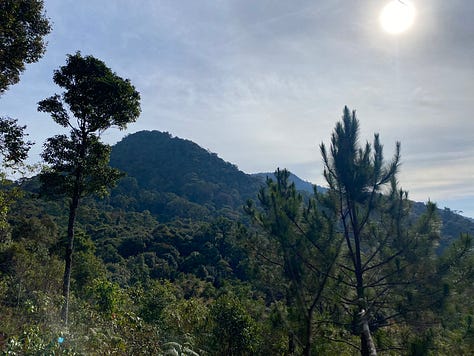

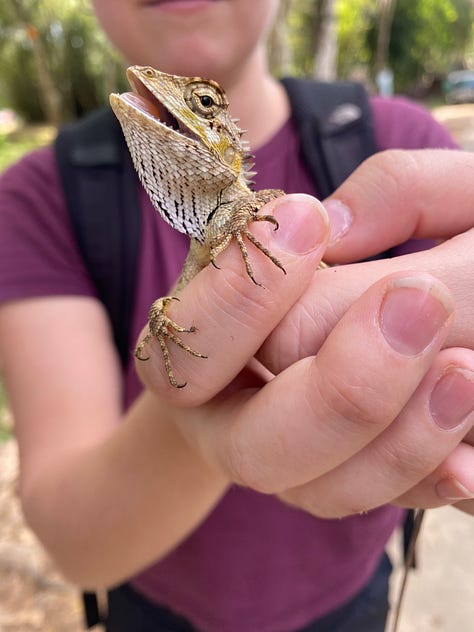


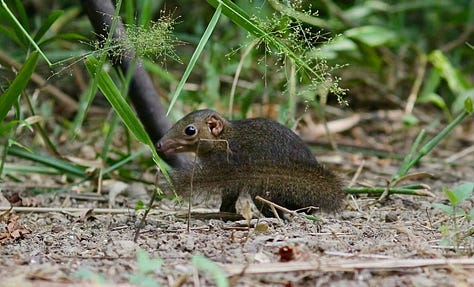
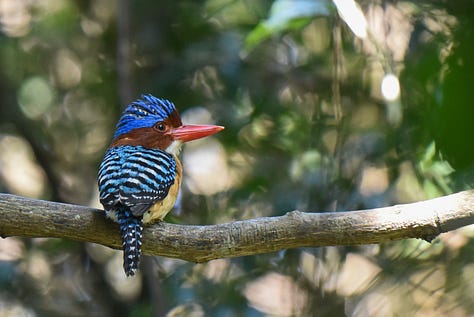
This was in 2024, and I was traveling with my girlfriend, Cassie, and my friend, Aidan. They had both been to Southeast Asia before. Cassie visited Laos in college to work on an elephant research project, and Aidan had been to Indonesia and Malaysia to travel and look for birds. Meanwhile, I had never been to the region at all, nor anywhere else in Asia. Everything was brand-new.
There were plenty of animals I wanted to see on this trip, but gibbons might have held the top spot. I’d dreamed of seeing these apes since I was a kid. Any time they appeared in a nature documentary, I was awed by the strange, effortless way they moved through the trees. They swung between branches with their long arms, body held steady, like a camera attached to a stabilizing rig. It looked more like surfing through the trees than swinging.
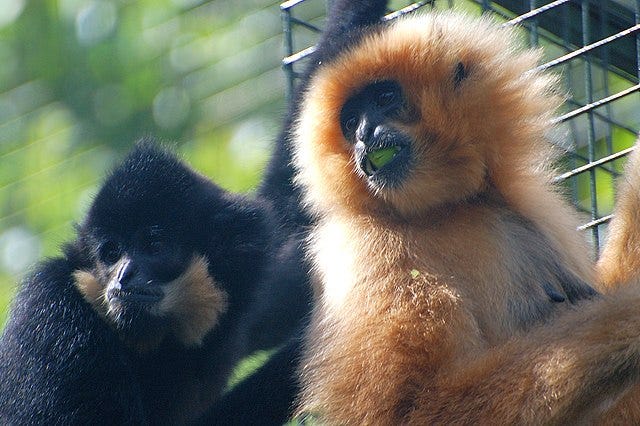
A few days into our trip, we finally reached Cat Tien National Park, where we hoped to see gibbons in the wild. This park is arguably the best place in the world to see the yellow-cheeked gibbon, an endangered species found only in Vietnam, Laos, and Cambodia. Throughout the park, gibbon troupes roam, and behind the park headquarters, there’s a primate research center that houses a handful of gibbons that were injured or seized from poachers, where they are rehabilitated and returned to the wild. Indeed, some of those wild troupes have formerly captive gibbons in them.
We were hoping we’d luck into seeing one of these wild troupes. On the first morning, within minutes of stepping out of our cabin at dawn, it became clear we wouldn’t need much luck.
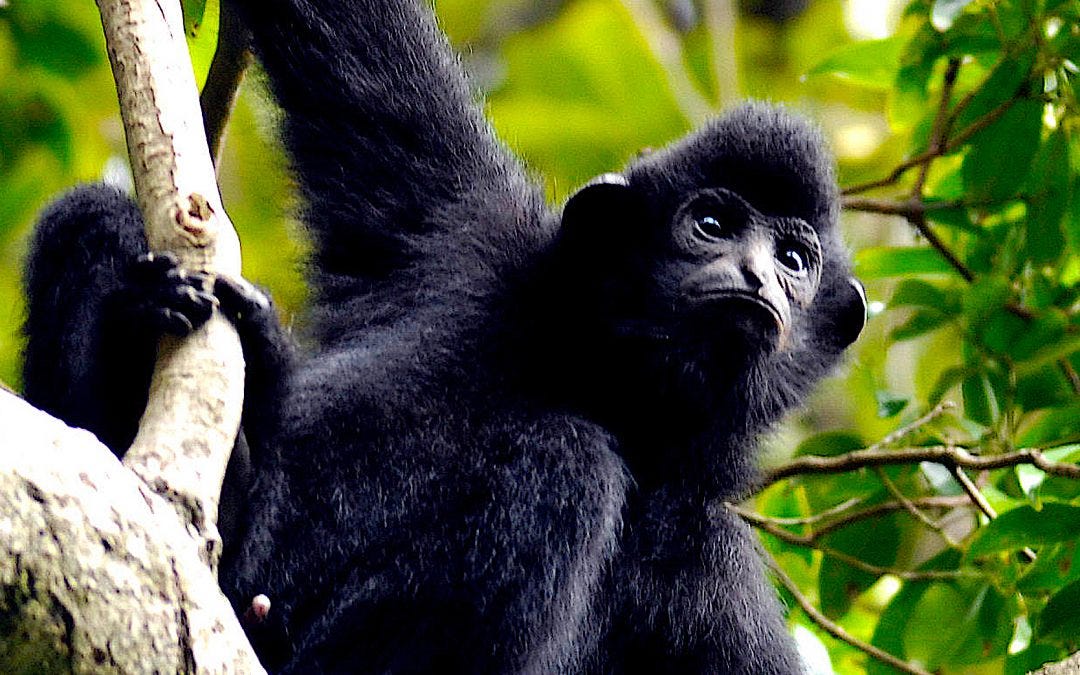
The air was filled with the hollering of gibbons (see Aidan’s recording below). It was an otherworldly sound, a chorus of rising whistles crescendoing in dramatic wails and a series of descending chirps that sounded like a laser firing. The sounds were loud — we could hear them from half a mile away. As we approached the source of the sound near the park headquarters, the whole group became visible in the massive dipterocarp trees. Black males with white jowls hung from branches and yellow females with soft dark faces sat with babies clinging to their backs, all hollering. They weren’t just calling to each other, though. The troupe seemed to have come here to perch above the outdoor enclosures of the primate research center where the captive apes were held. They called down to their captive kin, who joined in the chorus in return. It seemed that the wild gibbons had come to check in on them. “We’re here,” they seemed to be saying. "It’s going to be okay.”
0:00
-2:03
For the rest of our time in Cat Tien, this daily din of gibbon sounds was our alarm clock, and we came to watch them most mornings. Cassie began to refer it as “the Gibboning Hour.” I looked forward to hearing the sound every morning we spent in the park.
I was reminded of the Gibboning Hour recently because of a new study that looked at another species of gibbon — one that is far more endangered than the yellow-cheeked — and tried to understand how its population has tripled in the last two decades.
In 2003, there were only 13 Hainan black crested Gibbons on the planet. This made them the rarest primate on Earth, and one of the rarest mammals altogether. This rarity is relatively recent, though — into the middle of the 20th century, around 2,000 of these apes lived in tropical lowland rainforests across the island of Hainan off the southern coast of mainland China. Then, in the wake of Mao’s death, Chairman Deng Xiaoping began “opening up” China to outside business. Hainan proved to be a fertile ground for forestry and rubber plantations. Workers came in to work these industries, and the population of the island tripled, turning forests into houses, roads, factories, and farms. Within a few decades, 95% of Hainan’s forests were destroyed, and the remaining gibbons were pushed into a few hard-to-develop mountain slopes.
These remaining gibbons faced another threat, too — they’re worth a lot of money. To this day, Hainan has a lot of poverty, and in the early 2000s the average annual income sat around 60$ USD. A female Hainan black crested gibbon, meanwhile, sold for 300$. Even dead gibbons fetch a high price, as their bones are ground into a traditional arthritis cream called Houzi. Because of all these incentives, there have been a few particularly brutal episodes of gibbon slaughter on Hainan, including one instance where an entire mountain’s worth of gibbons were eradicated by employees of the Jianfengling Forestry Bureau’s 5th Logging Company.
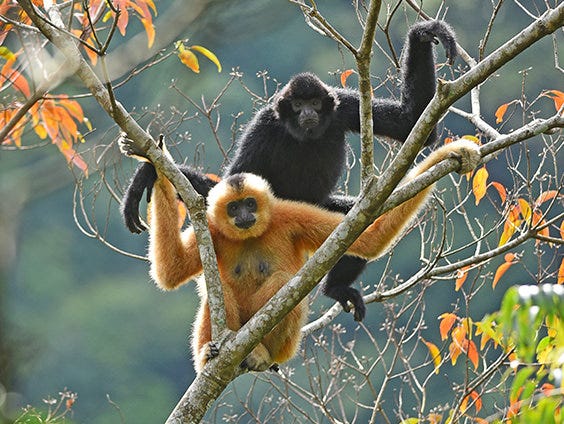
In 1995, the government of Hainan finally ended the timber harvest on the island and declared it illegal for anyone to approach wild gibbons. The population stabilized, but it was as close to too late as you could get — those 13 gibbons were all that remained, and only two of them were males. A 2005 paper about the species (from which I drew many of these historical details), declared simply that “Hainan Black-crested Gibbon Is Headed For Extinction.”
But that’s not what happened. Thanks to intensive habitat protection, anti-poaching measures, and awareness campaigns by the Chinese government (plus a controversial campaign to resettle people living in Hainan’s mountains — for more on the human component see this great feature in bioGraphic), the Hainan black-crested gibbon population grew from 13 to 46 in the last 20 years. It’s still an extremely low number, but it’s evidence that, with the proper protections, these gibbons might be able to recover.
The problem with this extreme recovery, though, is that it leaves the population susceptible to inbreeding. Every single gibbon alive today is descended from just 13 individuals, including only two males. Typically, inbred animals have very similar genetics, which can lead to the accumulation of detrimental mutations.
Mutations can be dangerous even for animals with no inbreeding, but inbreeding makes the problem far worse. To understand why, imagine genes as instruction manuals for the body, and when they are mutated, they become a little bit harder to read. Every offspring gets one copy of each gene from its mother and one from its father. If, say, one copy of a father’s gene is mutated, but his female partner has the healthy gene, all of their offspring that inherit their father’s mutated gene will still be able to refer to their mother’s unmutated gene. But then, if these siblings breed with each other, they each might pass on their mutated copy of the gene, and their offspring will have no unmutated copy. All of a sudden, that offspring has a less legible instruction manual for that trait — if it happens a few more times, that trait could be lost entirely. Repeat this process over and over, and before long you’ll have a whole population with missing traits, making them less fit and more susceptible to disease.
This scenario is exactly what scientists figured would happen with Hainan black-crested gibbon. Then, this week, a study actually looked at their genetics (by following the gibbons around, waiting for them to poop, and collecting their droppings — field work is rarely glamorous). They found that, yes, the gibbons have low genetic diversity, but they weren’t particularly inbred, nor did they have very many negative mutations. In fact, their inbreeding levels were the lowest of 19 studied threatened primates, and on par with most unthreatened primates. For some traits, they were actually less inbred than their unthreatened counterparts.
In other words, Hainan black-crested gibbon appears to have solved inbreeding entirely. How?
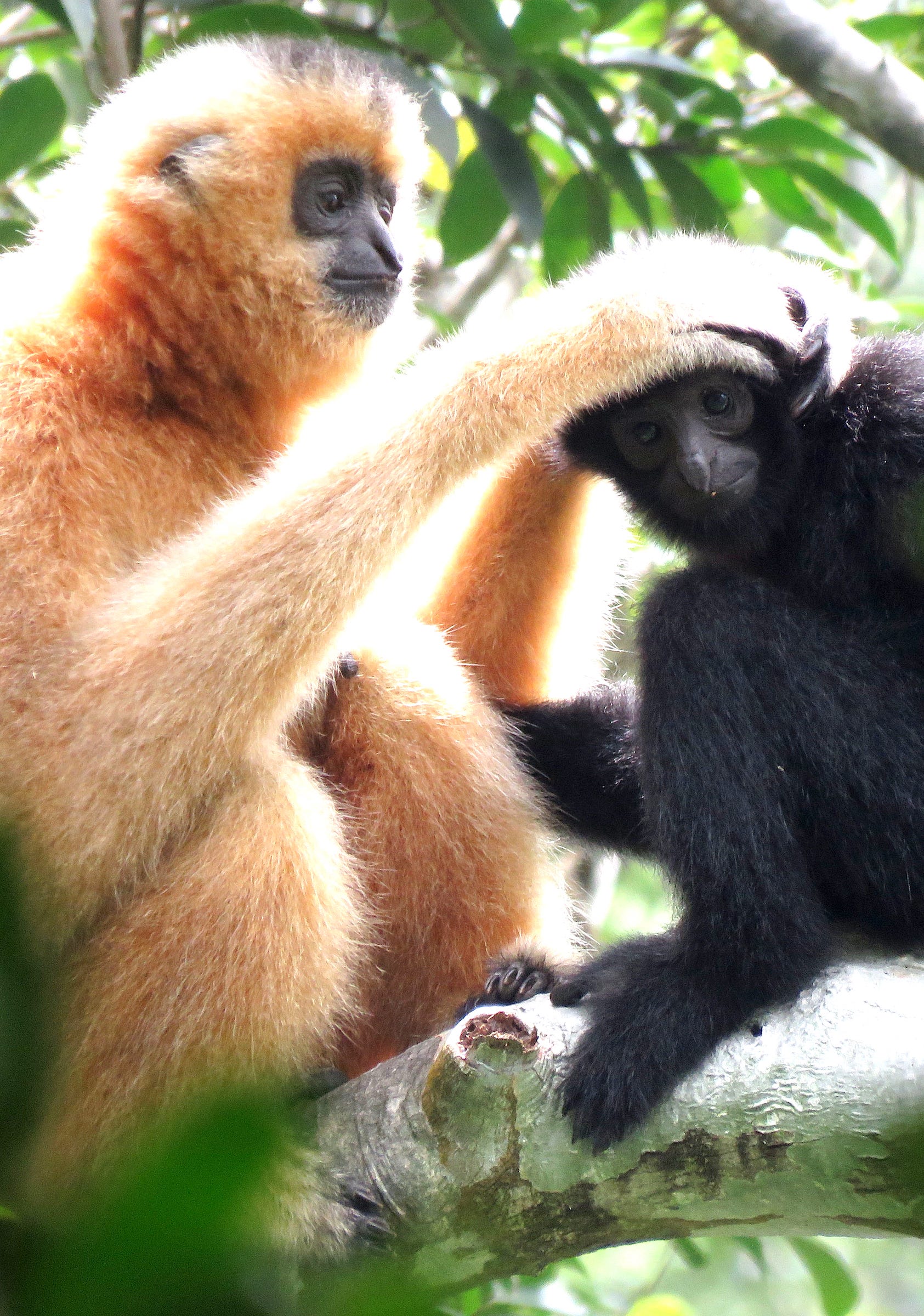
First of all, it turns out that today’s gibbons weren’t actually descended from one group, but two. At the population nadir 20 years ago, those two males and their respective harems of females were each from a different population that had been separated for 450 years. In other words, before only a few decades ago, Hainan’s gibbons experienced little-to-on inbreeding.
But there’s more to the puzzle than that. These researchers also found that this population collapse was not the first time Hainan black-crested gibbons had weathered such a crisis.
In their DNA, the studies authors found evidence that Hainan black-crested gibbon populations plummeted down to as little as 100 individuals about a million years ago. This massive decline was probably due to the Ice Age turning rainforest into savannah, leaving gibbons with very little habitat. In order to survive, these gibbons had to take a more active role in their genetic variation.
During this crisis, evolution began selecting for gibbons that “recombined” their DNA a lot before passing it on to their offspring — essentially mixing up the two copies of each gene a bunch. This way, if one gene had a handful of mutations, those mutations didn’t all accumulate on one copy of the gene and were instead evenly spread across each copy of these apes’ genes. This process kept most of the “instruction manuals” readable, and ensured that each ape didn’t have too many mutations in its genes.
The researchers found that this “balancing selection” — the tendency to select for multiple versions of a gene within a population instead of one — operated particularly strongly on genes for sperm strength and the protein that digest diverse carbohydrates. These traits likely meant that Hainan black-crested gibbons were particularly good at breeding and adapting to rapidly-changing food sources, which may have been the key to their success during their population collapse a million years ago. As the Ice Age waned and the forest returned, the gibbons bounced back, and their population recovered to the 10s of 1000s across the island.
Today’s gibbons are the inheritors of these adaptations. In all probability, inbreeding should have wiped them out, too, just like it should have wiped out their Ice Age ancestors. But thanks to this past population collapse — and the resiliency of their ancestors — Hainan black-crested gibbon are recovering. Like the gibbons held at the primate research center at Cat Tien National Park, they need human help to survive. But they have on their side the guiding hand of their ancestors, calling out to them across a million years of time. “We’re here,” they seem to say. “It’s going to be okay.”
No posts
Comments
Nothing yet. Say the first thing.
Sign in to join the conversation.