
I began planting bare root trees and shrubs a little over a year ago, when I purchased some fruit trees and native plants from nearby county DEC sales. I’ve since learned much more about the process of acquiring and growing bare root trees, and wanted to share this information with other people interested in organic or permaculture-oriented home fruit cultivation.
In short, these are trees (or shrubs) that are sold while still dormant, either in early spring or fall. The soil is removed from the roots, and the roots are wrapped in damp paper and packed in a moist medium like sawdust or rice hulls. As a result they weigh very little and can be transported easily. When you receive a bare root tree it will look a bit like a craggy witch’s broom, or a dead stick, because it doesn’t have any green leaves.
Most bare root nurseries are mail order operations. Shipping varies by retailer but often costs around 15% of the cost of the order. Because the trees themselves cost much less than your average nursery or big box tree, the total cost is usually lower than buying trees in pots.
Most people are only familiar with buying potted nursery plants, but the advantages of getting a bare root tree over a potted tree are significant. There’s no heavy pot or root ball to massage, and no transplant shock. There’s less risk of soil-borne diseases since there’s no soil being transported. Trees tend to be healthier and grow faster when they are moved while dormant.
I think this is one of the things that keeps traditional gardeners from growing bare root — the belief that one can reduce the risk of plant failure by carefully choosing a healthy specimen in person. But this is false confidence — you won’t find out if a tree is healthy until you actually plant it in your own environment. Pot grown trees can be propped up by synthetic fertilizers and may never thrive when placed in more natural growing conditions. (I have a pot grown peach tree that has limped along for a few years in the ground, but has never looked as good as it did in the Osmocote-filled pot.)
With bare root, the plant never experiences transplant shock because it’s “asleep” when you move it to its new location. As the weather warms, the tree either leafs out or doesn’t, so it’s easy to identify potential issues quickly. Reputable sellers typically have guarantees for the first year, usually for credit for the following season. I’ve had some trees take longer to leaf out the first year, but very few true failures.
Preparing the site for a bare root tree is easy. It’s a much smaller hole to dig with no root ball to massage, and no heavy soil-filled pot to drag around. I planted around 17 trees and shrubs this spring, digging nearly all the holes myself with a toddler in tow.
The only caveat is bare root trees are only shipped in early spring (or less commonly, fall). You have to order far in advance in order to get what you want, and make sure you have a plan to get it in the ground quickly when it arrives. Within a few days is ideal. I usually try to shoot for the same day, if at all possible.
Preparing your planting area in advance makes things a lot easier. We have a high water table in the spring, so for those with wetter properties I recommend what I did: remove the sod in a few feet of grass in a circle, then dig a trench with a 5 feet diameter (from the center of your circle where you stripped the sod). Throw the dirt from the trench into the circle where you removed sod. This creates a nice raised mound that’s easy to dig. Once I’ve done that prep work (which, once I got used to it, took about 20 minutes), planting a tree takes 5-10 minutes at most. A trenching shovel (e.g., Root Slayer) can make this process faster and less labor intensive. I did this as soon as the ground was workable in the spring, but it could also be done the fall before, if you plan ahead.
My focus has been on fruit and nut trees, but you can buy shade trees and woody ornamentals this way as well. I have a beautiful redbud tree I planted last spring, along with some beach roses. All are doing very well.
I got into bare root trees and shrubs through our local Department of Conservation sales, which are common in many States. However, I’ve found the quality to generally be mixed to poor. That said, one DEC office a county over from us always has excellent heirloom apple trees that are often over 6 feet tall, so investigating your local sales might be worth the risk. I would not bother with the Arbor Day Foundation sales, those are advertised relentlessly but they aren’t a serious supplier, and their “trees” are usually teeny tiny seedlings (4-5 inches tall).
Below are some retailers I consider reputable.
A top choice, this grower specializes in cold hardy plants with a strict organic/permaculture approach (not certified but they are very transparent and just use neem oil on their trees). They don’t do any dwarf rootstock because they focus on very cold hardy varieties, and dwarf rootstocks are not as vigorous as full size stock. They have an absolutely massive selection of apple trees, as well as lots of native shrubs. They also sell open pollinated asparagus crowns. They are in zone 3 and grow everything outdoors, so if you are in a colder climate you can be assured their plants are well suited to chillier winters. While everything is available for purchase on their website, I recommend requesting their free, hand drawn catalog which is both informative and interesting.
We ordered from them this spring and everything arrived with only one day of shipping because they’re relatively close by in Potsdam, New York. For those who want to make the drive, they also offer pick up on-site. They carry several varieties of disease resistant black and white currant bushes, which have recently become legal to grow in several states where they were previously prohibited. I am trialing those this year on our property, to see how they do. All the plants we received were large and healthy.
https://www.foodforestnursery.com/
The website is very professional looking but this is a small, family run nursery in Arkansas. They have organic nursery practices, and a huge selection of fruit trees and berries in addition to lots of unusual things like hardy kiwi vines. Great selection of native/permaculture shrubs as well. I got my beautiful Forest Pansy Redbud tree from them, as well as a few grape vines. Absolutely the most seamless customer service, we had one tree that didn’t leaf out and the owner was quick to provide a credit card refund. No synthetic nursery gels are used, trees are packed in wet sawdust or rice hulls. Very professionally packaged and well labeled, and nothing arrived damaged. I will definitely buy from them again.
This is a larger commercial-type nursery, with conventional (not organic) practices. That said, they carry some hard to find things — I bought from them because they’re one of few suppliers of lingonberry bushes, and I really wanted to try those. The only thing I really don’t like about them — and this is true of a lot of the larger nurseries — is they use polymer-based nursery gel to keep roots wet during transport. I prefer to avoid anything “industrial modern” in gardening, when possible, but nursery gel is pretty easily rinsed off with water before planting, so I don’t consider it an absolute dealbreaker.
Their shipping practices and customer service aren’t as good as St. Lawrence Nurseries or Food Forest Nursery — it took 5 days for the plants to get to us because they’re on the West Coast and shipped our order out right before a weekend. This seemed to me to be an unnecessary risk to take with live plants but, to their credit, everything arrived healthy and undamaged. If they have a rare variety of something you really want, I think it’s worth it to deal with them. They also carry a large selection of dwarf fruit trees if you are looking for a tree that yields in only a few years.
This is an Amish bare root nursery so there is no website, you have to call 866-600-5203 to request a paper catalog and mail a check. I haven’t bought from them yet but I’ve heard good things and they carry a lot of unusual, heirloom fruit tree stock. They store their bare root trees in old fashioned ice houses, with ice cut from their pond, to ensure the trees stay dormant until shipped. They aren’t strictly organic, but they claim to steer towards natural sprays like liquid copper or micronized sulfur whenever they can. They grow all of their own stock, so it’s possible to call their nursery line and ask more specific questions about growing practices and use of pesticides. They are in New York State so the shipping for East Coast buyers would be much faster than a West Coast nursery like Raintree.
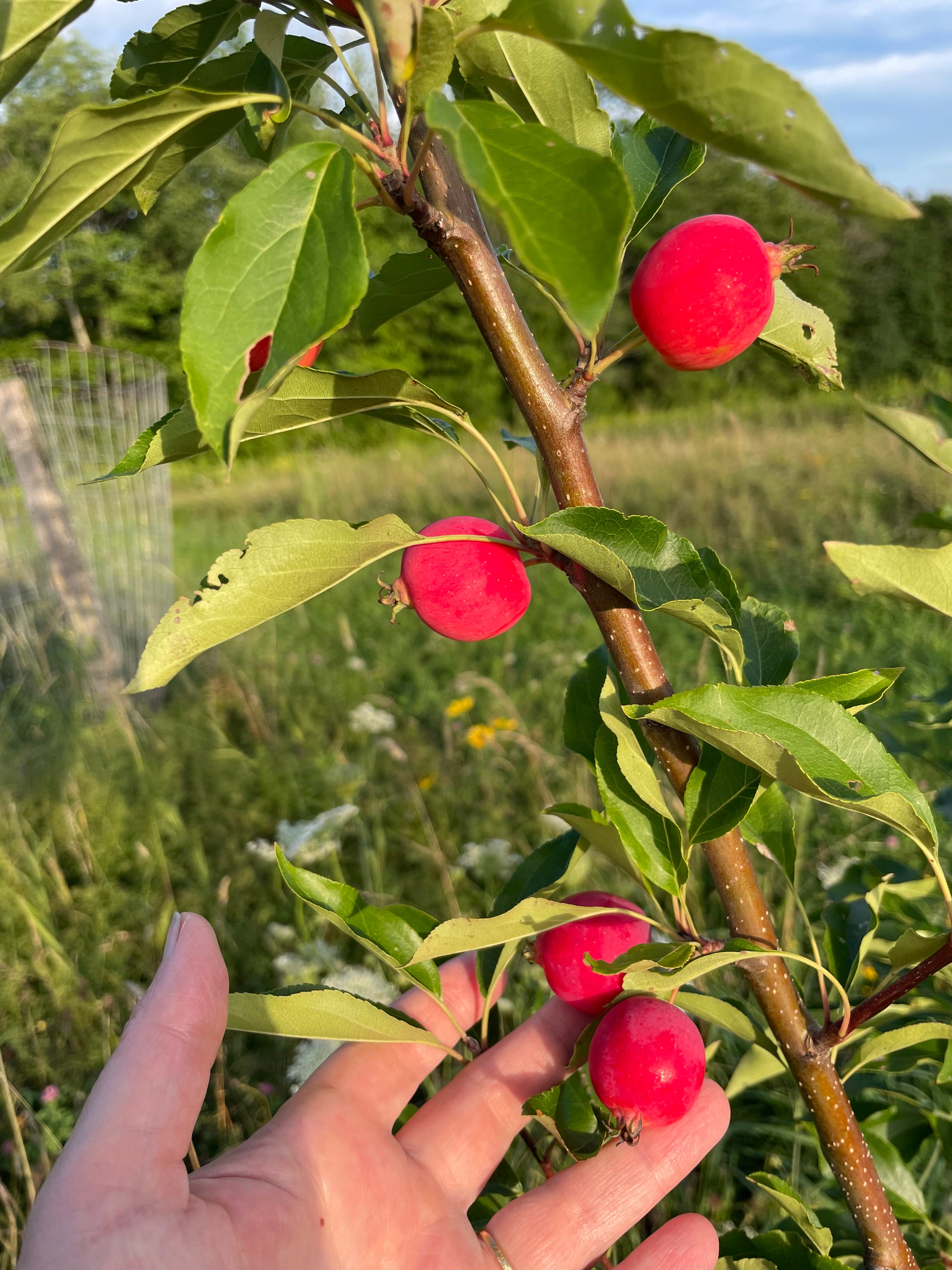
Out of all of our homestead hobbies, I think I like fruit cultivation the most. This week I picked a tiny batch of Dolgo crab apples from one of our young trees. It was a tree I chose without a lot of thought — it was available from a local county bare root sale and I figured we could use it to pollinate some of our sweet apples. But it’s one of our loveliest trees, absolutely bursting with pretty blossoms in the spring, and then dotted with neon red apples in the summer that are surprisingly sweet. In general, I’ve been pleasantly surprised much more than I’ve been disappointed, and that’s a special thing when it comes to farm life, where success is never a sure thing.
August is upon us and, whether we like it or not, fall is right around the corner. Internet-focused nurseries like Raintree and Food Forest already have their spring pre-orders open, and smaller print-focused nurseries like St. Lawrence Nursery typically release their catalogs in December. As the growing season winds down, now is a good time to look around and consider locations for trees and shrubs. There are options for nearly every location and growing zone.
What do you want to grow?
Comments
Nothing yet. Say the first thing.
Sign in to join the conversation.