
By David Happe
ChalkTalk.ai
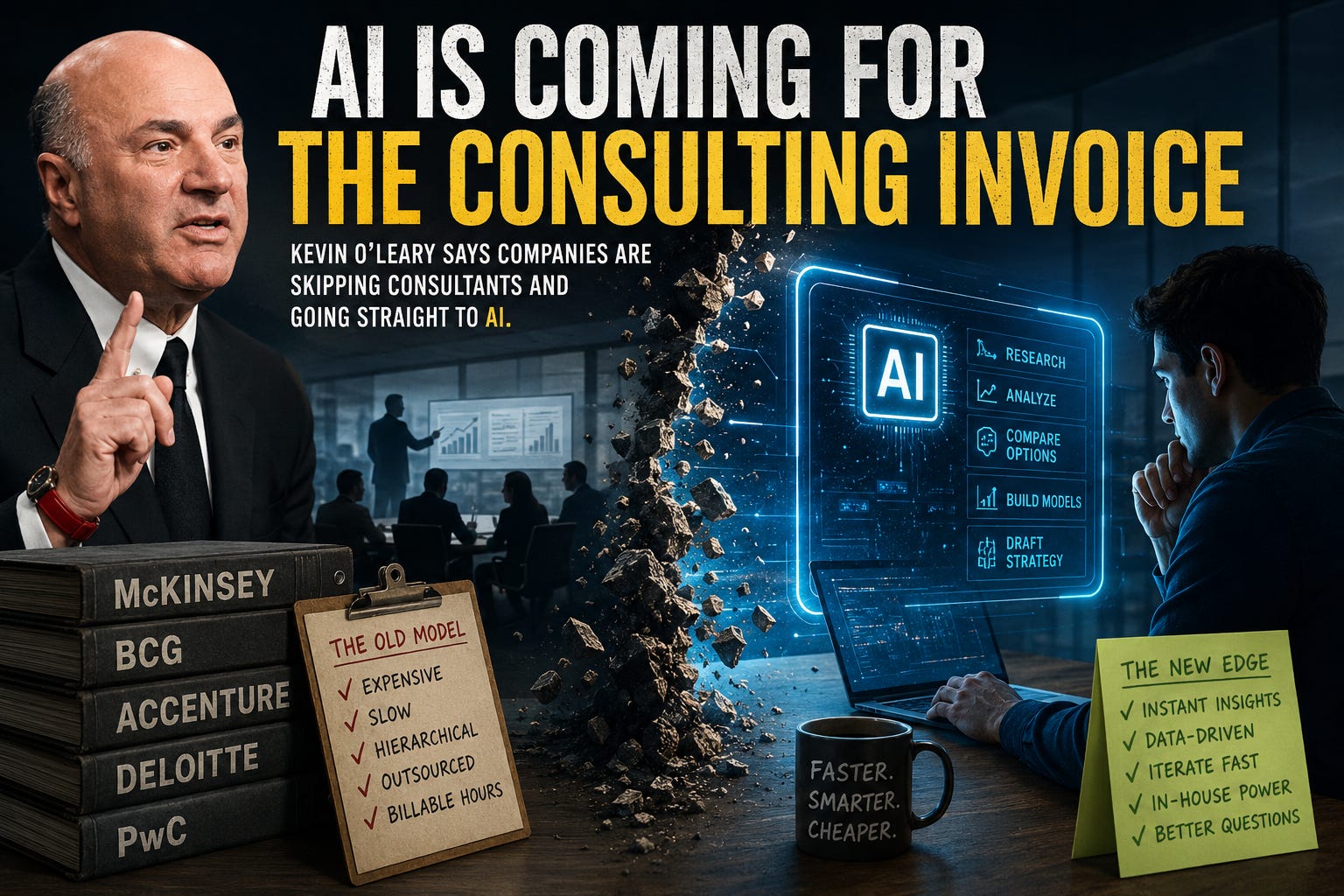
Kevin O’Leary is not known for soft warnings. When the “Shark Tank” investor says companies he backs are already skipping consultants and going straight to AI, business owners should pay attention.
In a recent Business Insider report, O’Leary said companies in his portfolio that once hired consultants for narrow strategy questions are now asking AI first. His example was not futuristic. It was ordinary business work: changing retail distribution, deciding whether a company should keep two layers of distribution or three, and testing basic strategic options before paying outsiders to weigh in.[1]
That is the part of the story executives should not miss.
AI does not need to replace every consultant to damage the consulting industry. It only needs to replace the first expensive layer of consulting work: the research memo, the market scan, the option tree, the executive summary, the first pass at the deck, and the “here are three strategic alternatives” meeting.
That work used to be sold as scarce expertise. Now, a good internal manager with strong prompts, company data, and enough judgment to verify the output can get a credible first pass in an afternoon.
For decades, consulting firms built a premium business around information asymmetry. They had frameworks, benchmarks, polished decks, industry databases, armies of analysts, and partners who could walk into a boardroom with authority. That model worked because most companies did not have the time, talent, or tools to rapidly structure a complicated business question.
AI changes the starting line.
A founder, CEO, operating executive, or department head can now ask a model to compare distribution models, identify margin risks, summarize competitive positioning, draft a go-to-market plan, pressure-test pricing, or build a board-level outline. The answer may not be perfect. It may require verification. It may still need human judgment. But it is often good enough to move the conversation forward before a consulting firm ever gets invited into the room.
That is a serious threat to billable hours.
The big firms know it. McKinsey, BCG, Accenture, Deloitte, PwC, and others are not sitting still. Business Insider noted that McKinsey says about 40% of its work now comes from AI-related projects, while BCG said 20% of its work was AI-related in 2024.[2] Accenture has gone even further structurally, combining strategy, consulting, Song, technology, and operations into a single integrated business unit called Reinvention Services, explicitly built around embedding data and AI into client work.[3]
That sounds defensive because it is.
The consulting giants are trying to turn AI from a threat into a product line. They want to be the people companies hire to implement the same technology that may reduce the need to hire them. In the short term, that can be lucrative. Big companies still need help with data infrastructure, security, governance, process redesign, and enterprise deployment. AI is easy to demo and hard to operationalize.
But there is a difference between getting paid to help companies adopt AI and preserving the old consulting model.
The old model depends on leverage. Senior partners sell the work. Junior consultants do much of the research, analysis, benchmarking, formatting, and slide production. Clients pay premium rates because the finished product feels authoritative, polished, and board-ready.
AI attacks that pyramid from the bottom.
If software can generate the first research pass, summarize the market, draft the deck, compare options, and build a financial model outline, then clients will begin asking a brutally simple question: Why am I paying a full consulting team for work my own people can now produce with AI?
That does not mean consultants disappear. It means the lazy consulting invoice gets harder to defend.
The firms that survive will move up the value chain. They will be paid for judgment, implementation, accountability, regulatory navigation, change management, proprietary data, and work that requires real executive trust. They will be paid when the answer has consequences and someone credible needs to stand behind it.
The firms that struggle will be the ones selling expensive homework.
This is also a warning for white-collar workers more broadly. Consulting has always been one of the most prestigious training grounds in business because it taught smart young professionals how to analyze problems, structure arguments, build decks, and speak the language of executives. But those are exactly the workflows AI is learning to assist, accelerate, or partially automate.
PwC’s global chairman Mohamed Kande recently argued that AI does not simply eliminate jobs; it changes them. He said workers become more valuable when they use AI well, and Business Insider reported that PwC’s own research found companies more exposed to AI have seen stronger headcount and wage growth since 2018 than less-exposed companies.[4]
That may be true at the macro level. But for junior professional workers, the message is harsher. The entry-level work is being “seniorized.” Employers increasingly expect younger workers to show up with better judgment, stronger technical fluency, and the ability to use AI without blindly trusting it.
In plain English: AI may not take your job, but it may take away the training wheels.
For business owners, O’Leary’s point is practical. Before hiring a consultant, ask whether the first phase of the project can be done internally with AI. Can your team define the question, gather the documents, run the first analysis, identify the options, and expose the obvious tradeoffs before you spend real money?
If the answer is yes, do that first.
Then, if you still need outside help, hire for the part AI cannot responsibly own: judgment, execution, accountability, and domain-specific experience.
That flips the consulting relationship. Instead of paying consultants to discover what the problem is, companies can increasingly use AI to walk into the first meeting with a sharper question, a working hypothesis, and a draft plan.
That makes the buyer smarter. It also makes the consultant more accountable.
The consulting industry is not dead. But the easy version of it is under pressure. O’Leary’s warning matters because it reflects what buyers are already doing, not what technologists are promising. Companies are not waiting for perfect AI. They are using imperfect AI to avoid unnecessary spending.
That is the part consultants should fear most.
The future of consulting will not belong to the firm with the prettiest deck. It will belong to the people who can prove they add something beyond what a capable manager and an AI model can already produce.
[1] Business Insider, Lakshmi Varanasi, “‘Shark Tank’ investor Kevin O’Leary says the companies he backs are skipping consultants and going straight to AI,” June 21, 2026.
[2] Business Insider reported that McKinsey says roughly 40% of its work now comes from AI-related projects and that BCG said 20% of its work was AI-related in 2024.
[3] Accenture announced in June 2025 that it would combine Strategy, Consulting, Song, Technology, and Operations into a single integrated business unit called Reinvention Services, effective September 1, 2025.
[4] Business Insider, reporting on PwC Global Chairman Mohamed Kande and PwC’s 2026 global jobs barometer, June 2026.
Comments
Nothing yet. Say the first thing.
Sign in to join the conversation.