
Walk into almost any small business ten years ago and ask how they created their marketing materials, and you’d hear roughly the same story.
They hired a graphic designer or creative agency. They explained what they wanted. A week later, they received a proof. They asked for revisions, waited again, approved the artwork, and then either sent it to a commercial printer or had the agency manage the production. Every step in the process added value, but every step also added time and cost.
There was nothing wrong with that workflow. It reflected the tools available at the time.
Today, I think we’re witnessing something much larger than a new way to generate images or write copy. We’re watching a decades-old business model begin to give way to a fundamentally different one, and I don’t believe enough entrepreneurs appreciate how significant that shift really is.
Much of the public conversation around AI asks whether it will replace graphic designers, copywriters, or marketing agencies. I think those questions miss the point. Most entrepreneurs aren’t looking to replace talented creative professionals. They’re trying to solve a much more practical problem: how to develop good ideas quickly, refine them without spending a fortune, and get them into customers’ hands before the opportunity passes.
That’s where AI changes everything.
The greatest value AI brings to creative work isn’t speed. It isn’t lower cost. It isn’t even the first draft.
It’s iteration.
For decades, iteration carried a price tag. Every additional concept required more billable time. Every revised headline, every packaging change, every adjustment to a brochure or product label represented another investment. Business owners naturally became selective about asking for revisions because revisions weren’t free. Over time, “good enough” became an acceptable destination, not because the work couldn’t be improved, but because improving it became increasingly expensive. I knew a product designer that used to bemoan client changes.
Think about the automotive industry. Everyone hated “used car sales” processes and slimebag processes that benefited the business at the expense of the consumer. Along comes a company like Carvana that automates it, takes the pain points away, and makes it fun to buy a car. Now bring it back to what we’re talking about. Boutique designers were overpriced, sometimes a pain in the ass to work with, didn’t want to do revisions, charged you for things that were “beyond scope” and generally not great to work with.
AI removes that economic penalty. There is NO “beyond scope” for AI. It will iterate with you all day until you have the perfect masterpiece, and it will thank you instead of charge you when you’re done.
Instead of choosing between two concepts because a third will cost more money, entrepreneurs can explore twenty. They can compare radically different branding directions, test multiple audiences, experiment with different calls to action, rewrite product descriptions, and rethink entire layouts without worrying that another revision will trigger another invoice. The creative process becomes an exercise in exploration rather than compromise.
That may be the single biggest shift AI has introduced into marketing.
The conversation changes from, “Can we afford another revision?” to, “Have we found the best idea yet?” The creative process is no longer a function of cost.
I’ve noticed something else as I’ve incorporated AI into my own businesses. The quality of my work has improved, not because AI is somehow more creative than experienced designers, but because it allows me to spend far more time exploring possibilities before making a decision. When every new idea costs almost nothing to evaluate, you’re far more willing to discard average ideas in pursuit of exceptional ones.
That’s an entirely different creative mindset.
It also changes the role of the entrepreneur.
Years ago, business owners often acted as clients. They described what they wanted and hoped someone else could translate that vision into a finished product. Today, entrepreneurs can become active participants in the creative process. They can experiment, question assumptions, challenge their own thinking, and continue refining until the work genuinely reflects what they envisioned. It also eliminated the friction of designers that conveyed the attitude that they knew better than the clients.
The entrepreneur doesn’t replace the designer.
The entrepreneur becomes a better creative director.
That evolution doesn’t stop when the artwork is finished.
For decades, there was another layer in the workflow that many business owners simply accepted as part of the process. Once the creative was approved, it still had to become something tangible. Business cards had to be printed. Product labels had to be manufactured. Brochures, banners, postcards, presentation folders, trade show graphics, and sales collateral all required another vendor, another timeline, and often another markup.
Modern online print companies have transformed that experience just as dramatically as AI has transformed creative development. I am about to give you the final piece of the puzzle.
Over the past several months, I’ve been relying heavily on VistaPrint as the production side of my AI workflow. Once I’ve refined an idea and produced print-ready files, I can upload them directly and have finished materials delivered within days. Business cards, banners, stickers, brochures, product labels, and promotional materials have all arrived quickly, consistently, and at a quality that honestly exceeded my expectations.
What impressed me most wasn’t simply the printing at VistaPrint.
It was how little I had to think about the printing. I’m not a print expert, but you no longer need one. That’s what THEY do. And, it eliminates yet another upcharge. In the old model, there were several steps to a final print job, each with an upcharge. Especially, if you bought the printing from your creative agency, they never printed anything. They just charged you more to send your file to a printer. Now, you can go directly to the mass production printer without a middle man.
The best technology disappears into the background. It removes friction instead of adding it, and that’s exactly what VistaPrint has done for me. Their ordering process is simple, their turnaround times have been excellent, and on the handful of occasions where I made mistakes in my own files, their customer service treated me like a valued customer instead of pointing me toward a policy manual. They’ve fixed problems I created!
That experience reinforced something I’ve been thinking about for months.
AI and companies like VistaPrint aren’t disrupting the same part of the market. They’re completing each other.
AI dramatically reduces the cost of developing great ideas. Modern online printing dramatically reduces the effort required to bring those ideas into the physical world. Together, they create a workflow that simply didn’t exist a decade ago.
I am getting projects done now for a couple hundred dollars that 6 years ago might have cost me a couple grand.
An entrepreneur can now move from a rough concept to professionally printed marketing materials in a matter of hours, often without hiring outside creative services or paying multiple layers of markup along the way.
That’s an extraordinary shift.
It also raises an uncomfortable question for parts of the marketing industry.
If entrepreneurs can perform much of the creative iteration themselves and move directly to production, what happens to the business model that existed primarily to connect those two activities? You have people that have built their entire livelihood on what I can now do 100% without them, and even without expertise.
Routine marketing projects no longer require the same number of people, meetings, approvals, and intermediaries, upcharges, friction and expense they once did. Entrepreneurs now have access to tools that dramatically increase both their creative capacity and their speed of execution.
One important disclosure before I close.
This article is not sponsored. VistaPrint didn’t ask me to write it. They’re not paying me, I’m not an affiliate, and I don’t earn a commission if someone places an order because they read this article. I’m sharing my experience because I think entrepreneurs benefit when we talk about tools that genuinely improve the way we build businesses.
If someone from VistaPrint happens to come across this article, however, I’d welcome the opportunity to connect. Through my former Mind Your Business media platform and my work today with ChalkTalk.ai, I’ve built a community of thousands of entrepreneurs who are actively exploring practical applications of AI. I believe the story isn’t about printing. It’s about a new entrepreneurial workflow that combines AI-driven creativity with seamless production, and I think that’s a conversation worth having. If you want to get a hold of me and send me some free stuff, email strategylabs@chalktalk.ai
Every so often, technology doesn’t just improve an existing process. It quietly eliminates the assumptions that process was built upon. I believe that’s what’s happening here. The assumption that creative work requires expensive iteration is disappearing. The assumption that professional marketing materials require multiple intermediaries is disappearing. The assumption that entrepreneurs must choose between professional quality and affordable execution is disappearing.
That’s why I don’t believe AI merely disrupted creative agencies.
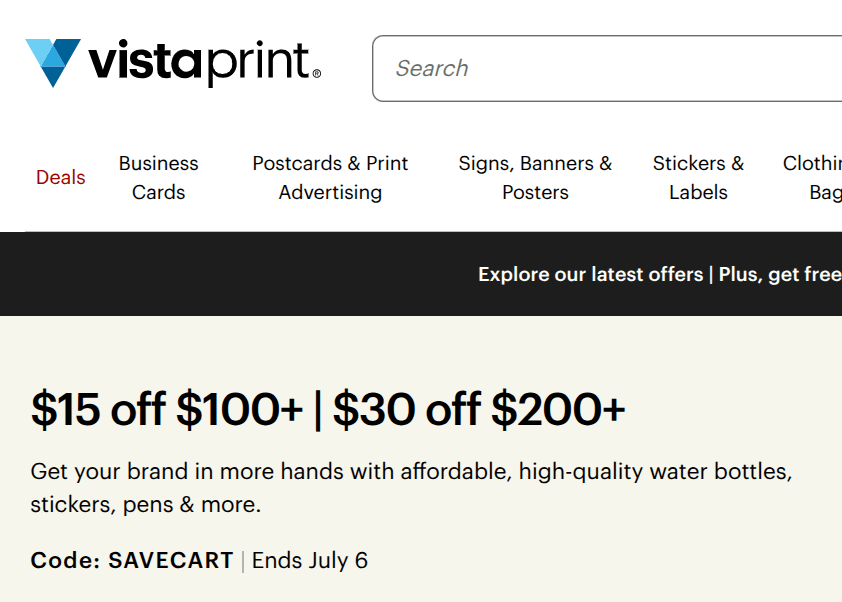
I believe it collapsed an entire business model. This is already done. Now you, readers, just need to learn how to use the tools. If you need help, message me but the whole point here is you don’t need anything other than a subscription to ChatGPT and maybe a promo code from VistaPrint. Here’s the one they have on their home page right now, this morning :
The entrepreneurs who recognize that shift early won’t win because they spend less.
They’ll win because they’ll think more freely, iterate more relentlessly, and turn ideas into reality faster than ever before.
Comments
Nothing yet. Say the first thing.
Sign in to join the conversation.