
These visitors are ready to buy. They’ve completed their research, arrived on your page with a specific product in mind, and are actively looking to make a purchase now.
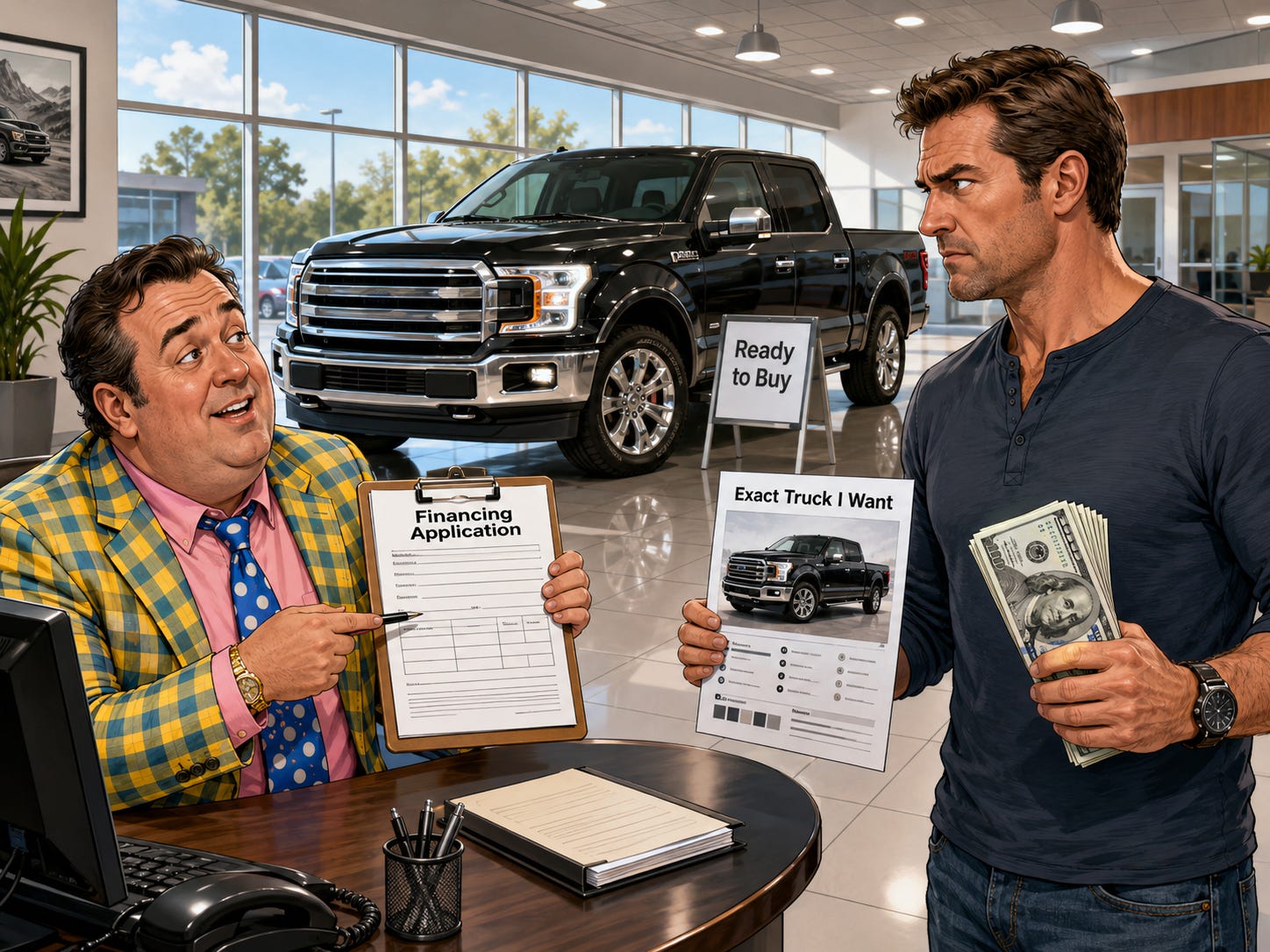
Imagine a customer walking onto a car lot with cash in hand, research complete and a decision all but made. He knows the model he wants, the trim package he prefers, the price range he is willing to accept and the competing options he has already ruled out. He is not wandering around hoping a salesperson will educate him from the beginning. He has already done that work. He is there to confirm the final details and buy the pickup truck he came for.
An inexperienced salesperson can still lose that customer. Instead of recognizing the buying signal, he starts at the beginning of the sales script. He asks basic qualifying questions the customer has already answered for himself. He misses the point of what the customer is saying. Worse, he tries to steer him toward a minivan when the customer has already decided on a pickup. What should have been a straightforward sale becomes an exercise in frustration.
Eventually, the customer leaves. He does not leave because he was unqualified, undecided or uninterested. He leaves because the business put unnecessary friction between his intent and the purchase. He knows there are other lots, other dealers and other ways to get the truck he wants without being forced to start over.
That is the mistake many websites are now making with customers arriving from AI search. A visitor who comes from Google AI Mode, ChatGPT, Gemini, Perplexity, Claude or another AI assistant may not be at the beginning of the buying journey. That person may have already researched the category, compared providers, narrowed the options, weighed the trade-offs and followed a recommendation to a specific product or service page. Yet too many websites still treat that visitor like a cold prospect who needs to be introduced to the company from scratch.
The disconnect is becoming more expensive. A customer arrives ready to buy, book, call, compare plans, request a quote or confirm availability. The website responds with generic branding language, vague service descriptions, hidden pricing, buried product details and a slow march through an old sales funnel. In the traditional search era, that was inefficient. In the AI search era, it may be enough to lose the sale.
AI is changing how people find websites, but the larger issue is what happens before they arrive. A customer referred by an AI assistant is often more informed, more specific and further along in the decision process than a customer who came through a traditional keyword search. A website built for the old journey may be asking the new customer to repeat work they have already done.
For years, businesses optimized their websites around the short keyword search. A customer typed “best running shoes,” “Florida divorce forms,” “pepper spray keychain” or “CRM for small business,” and the website’s job was to intercept that broad interest and begin the process of education and persuasion. Search queries were short because the search box trained people to compress their real question into a few searchable words.
AI search changes that behavior. Google reported in May 2026 that AI Mode had surpassed one billion monthly active users globally and that AI Mode queries had more than doubled every quarter since launch. Google also said the average AI Mode search is three times longer than a traditional Search query. Planning-related AI Mode queries grew 80% faster than AI Mode queries overall during the prior six months, while brainstorming queries grew 30% faster than AI Mode queries overall since launch.[1]
That matters because query length is a signal of intent. A search for “best running shoes” tells a business very little. A conversational query about “the best stability running shoes for overpronation, humid weather and walking five miles a day” tells a business much more. That customer has context, constraints and a use case. The customer is not asking for a category introduction. The customer is asking for a fit.
The same pattern is moving across categories. A customer can ask which pepper spray is best for a college student, which local contractor can handle a specific repair, which insurance product makes sense for a particular family budget, which ecommerce platform allows certain products or which software solves a narrow workflow problem. The customer is no longer searching like a keyword machine. The customer is describing a real-life situation and asking an AI assistant to sort through the first layer of options.
That first layer used to belong to the website, the salesperson or the search results page. Increasingly, it belongs to the AI assistant. The assistant compares, summarizes, filters and recommends. By the time the customer lands on a business website, the question may no longer be, “What do you do?” It may be, “Can you sell me the exact thing I came here to buy?”
In traditional marketing, prequalification usually happened after the lead arrived. A salesperson asked questions. A landing page educated the visitor. A form collected information. A follow-up email sequence moved the prospect along. The company controlled more of the early journey.
AI search pushes much of that prequalification outside the company’s walls. The customer may ask the AI assistant the questions that previously would have been asked on the website, in a store aisle or during a sales call. The assistant may help define the problem, compare providers, identify price ranges, explain trade-offs and recommend the type of solution that fits the customer’s circumstances.
Adobe’s retail data shows why this matters. In April 2026, Adobe reported that traffic from AI sources to U.S. retail websites grew 393% year over year during the first three months of 2026. Adobe also found that AI traffic converted 42% better than non-AI traffic in March 2026, a reversal from March 2025, when AI traffic converted worse than other traffic. Visitors from AI sources also spent more time on retail sites, viewed more pages and showed higher engagement.[2]
The trend continued in Adobe data reported by Reuters in June 2026. According to that report, U.S. shoppers referred to retail websites from large language models generated 53% more revenue per visit than shoppers from non-AI sources. AI-referred visitors converted at a 54% higher rate in May and spent 53% more time on ecommerce sites than other visitors.[3]
Those numbers should get the attention of any company that depends on web traffic. AI-referred visitors are not merely curiosity clicks. They are increasingly high-intent visitors who may have used an AI assistant to do the comparison work before they ever touched the business website. They may have spent several minutes asking the kinds of questions a website would normally try to answer across multiple pages.
That does not mean every AI visitor is ready to purchase. It does mean businesses should stop assuming that every new visitor is uninformed. The better assumption is that a growing share of these visitors have already been shaped by a recommendation engine before they arrive. They may know the product they want, the problem they need solved and the reason they clicked.
Most business websites were built around a familiar sequence. The homepage introduced the brand. The service page explained the offering. The testimonial section built confidence. The FAQ handled objections. The purchase button, contact form or booking link appeared after the company had walked the visitor through its preferred path.
That structure made sense when the visitor arrived early in the journey. It makes less sense when the visitor arrives after the research, comparison and objection-handling have already happened somewhere else. AI search can move the customer deeper into the buying process before the website ever loads.
That is where many companies are exposed. A prequalified visitor clicks through with a specific action in mind, but the site behaves as if the visitor is starting from zero. It opens with a broad brand promise instead of useful product details. It makes pricing hard to find. It buries availability. It forces the visitor to navigate multiple pages to answer a practical question. It treats shipping restrictions, specifications, appointment options, service areas or purchase details as secondary information.
The website may be doing what it was designed to do, but the visitor’s expectations have changed. The more informed the customer becomes before arrival, the less patience that customer has for a website that makes the next step harder than it needs to be.
A useful test is whether a high-intent visitor can complete the next step within 30 seconds. Can the customer buy the product, schedule the call, check availability, compare plans, request a quote or confirm the details that brought them to the page? If not, the website may be losing the very visitors most likely to convert.
Some business owners hear about AI search and assume websites are becoming less important. That is the wrong lesson. The website may become more important, but its role is changing.
Google has said that AI Overviews and AI Mode may use a query fan-out technique, issuing multiple related searches across subtopics and data sources to develop a response and surface supporting links. Google’s guidance also says the fundamentals still matter: websites need to be crawlable, useful, eligible for search features, readable in text and supported by accurate product, business and structured data where appropriate.[4]
That means a website now has to serve several audiences at once. It must serve the human visitor who wants to act quickly. It must serve the AI systems that need to understand what the business sells, who it serves, where it operates and why it is relevant. It must also serve the search and analytics systems that determine whether the business is visible and measurable in an AI-shaped search environment.
A vague, thin or overly visual website can struggle in that world. If important information is trapped inside images, hidden behind scripts, scattered across pages or buried under generic marketing copy, both people and machines may miss it. A clearer site gives AI systems more to understand and gives customers fewer reasons to leave.
This is not a call to stuff pages with AI language or chase another acronym. It is a call to make the website more specific, more useful and more direct.
For ecommerce businesses, the single item listing is becoming more important than the homepage. AI assistants are not always sending customers to a brand story, category page or general product collection. They may send a buyer directly to the item that appears to match the customer’s question. When that happens, the product page has to do the work of a good salesperson at the closing counter.
A prequalified customer should not have to browse the rest of the site to find the information needed to make a purchase. Shipping terms, warranty coverage, return policy, product specifications, size, compatibility, legal restrictions, safety features, delivery speed, trust badges and customer proof should be visible on or near the item listing itself. The buyer who followed AI research to a specific product page is not casually exploring the company. That buyer is trying to confirm the details and complete the purchase.
This is where many ecommerce sites still fall short. They treat the product page as a catalog entry instead of a closing page. The photo may be strong and the brand copy may be polished, but the practical buying information is scattered across footer links, FAQ pages, shipping policy pages and customer service sections. That might work for a casual browser with time to wander. It is a poor experience for a buyer who already knows what they want.
The better approach is to assume the visitor will not go looking for purchase-closing information. Put the trust points and easy specifications directly on the product page. Show whether the item is in stock. Explain how fast it ships. Clarify the warranty. State the return policy in plain language. List the core specs in a way a buyer can scan quickly. Add trust signals where the decision is being made, not three clicks away.
Consider a customer who used AI research to find a pepper spray product for a college student. That person may arrive with practical questions already in mind. What size is it? How far does it spray? Is it legal to ship to the customer’s state? Is it easy to carry? Does it attach to a keychain or lanyard? Is it made in the United States? Is it in stock? How fast can it ship? If the page opens with lifestyle copy but hides those answers, the visitor may leave before the brand gets a second chance.
The same principle applies to apparel, electronics, supplements, tools, home goods, auto parts and almost any product with meaningful buying criteria. The product page still needs photography, brand voice and persuasive copy, but those elements should support the transaction rather than slow it down. A buyer who arrives from AI search is often looking for confirmation, not a scavenger hunt.
In the old search model, a website could afford to make the customer browse. In the AI search model, the buyer may already have browsed somewhere else. The product page is where the recommendation becomes a decision. If the closing information is missing, vague or buried, the customer may simply go back to the AI assistant and ask for another option.
The same issue applies to service companies, even when there is no shopping cart. A customer may use an AI assistant to identify the type of help they need, compare service providers and narrow the field to a few options. When that customer lands on a service page, the page has to confirm fit quickly.
A law-related document preparation company, home services contractor, medical office, financial professional or consulting firm may all face the same challenge. The visitor needs to know whether the company handles the specific problem, serves the customer’s location, offers the right appointment type and provides a clear next step.
Too many service pages still read as if every visitor has the same question. They open with broad statements about quality, commitment and experience, then make the visitor dig for the details that determine whether the company is even relevant. A prequalified visitor will not always do that work. If the AI assistant helped narrow the choice, the page should validate that choice and make action easy.
For B2B companies, the problem is often language. Many B2B websites use polished copy that sounds impressive but says very little. A serious buyer does not need another promise to “unlock growth” or “transform the future.” The buyer needs to know what the product does, who it is for, what it replaces, how it integrates, how long implementation takes and what happens after the first call.
AI search rewards clarity because users are asking clearer questions. Websites should answer with the same precision.
Publishers face a different version of the same shift. If AI systems are summarizing basic information, commodity articles become easier to bypass. A local news site, trade publication or niche media brand has to offer more than rewritten public information. The value is in reporting, context, judgment, original framing, local knowledge and a recognizable editorial point of view.
That does not mean every article needs to be long. It means the article has to be worth landing on. Clear headlines, accurate sourcing, useful structure and internal links help readers and machines understand what the publication knows. Thin content that merely repeats what is available elsewhere will have a harder time earning attention when AI systems can summarize the same facts directly.
Local businesses face an equally practical test. AI assistants are increasingly suited for real-life questions: who is open now, who serves my area, who has this item in stock, who can come this week, who handles this kind of repair, who offers appointments today. If a business website does not make those answers clear, the business may never make it into the recommendation set.
Hours, location, service area, booking links, inventory status, phone number, reviews, directions and current business details all become part of the customer journey. A website that is out of date or vague creates a trust problem before the customer ever calls.
This shift will also complicate measurement. Google announced in June 2026 that Search Console would begin rolling out dedicated Search Generative AI performance reports to a subset of websites. The reports are designed to show how often URLs appear in generative AI features on Search and Discover, including AI Overviews and AI Mode, while keeping the data within broader Search Console performance reporting.[5]
That is a useful step, but businesses should expect the analytics picture to remain incomplete. An AI assistant may influence a decision before a click happens. It may summarize a business, compare it with competitors, quote a page or help a customer rule out alternatives. In some cases, the website may receive fewer low-intent clicks. In other cases, the clicks that remain may be more valuable because they occur later in the decision process.
Raw traffic will not tell the whole story. Companies should pay attention to whether AI systems are describing them accurately, whether the right pages are being surfaced, whether AI-referred visitors behave differently and whether those visitors convert at a higher rate. A smaller number of better visitors may be more valuable than a larger number of casual visitors who never intended to buy.
The old search dashboard was built around rankings, impressions and clicks. The AI search dashboard needs to include visibility, accuracy and conversion quality. It is no longer enough to ask whether people found the website. The better question is whether the right people found the right page at the right moment.
The most important lesson for business owners is that AI search is not just a search issue. It is a sales issue. It is a website issue. It is a customer-experience issue.
A company can spend years improving visibility and still lose the customer at the moment of arrival. That is what happens when the customer has already done the research and the website insists on starting over. It is the digital equivalent of the car-lot salesperson ignoring the pickup buyer and launching into the wrong sales pitch.
The better approach is to recognize the buying signal. A visitor who arrives from an AI assistant may already understand the category, the alternatives, the price range and the reasons one option may be better than another. The website should be ready to confirm the choice, answer the remaining questions and make the next step obvious.
That means clearer headlines, stronger product pages, more specific service pages, better comparison content, visible calls to action, accurate business information and fewer obstacles between intent and completion. It also means writing for real customer questions instead of generic keywords. The customer is no longer asking only for the “best option.” The customer is asking for the best option for a specific situation, with specific constraints, at a specific moment.
The businesses that adapt will not simply chase AI traffic. They will build websites ready for AI-referred customers. They will understand that a visitor coming from AI search may be prequalified, informed and impatient. They will treat that visitor less like a stranger and more like a customer who has walked onto the lot with a decision already in mind.
AI may introduce the customer. AI may narrow the choices. AI may send the customer to your page with unusual clarity about what they want.
Your website still has to close the loop.
If the customer arrives ready to buy, book, call, compare, schedule or request a quote, your website cannot afford to make them start over.
[1] Google, “A new era for AI Search,” May 19, 2026.
[2] Adobe Digital Insights, “AI traffic grows but retail sites lag in AI search visibility,” April 16, 2026.
[3] Reuters, “AI-referred US shoppers browse longer, spend more per visit, data shows,” June 15, 2026.
[4] Google Search Central, “AI features and your website.”
[5] Google Search Central Blog, “Introducing Search Generative AI performance reports in Search Console,” June 3, 2026.
If your website was built for the old Google journey, it may not be ready for the customer arriving from AI search. If your team isn’t talking about this, they don’t know they need this. If you use platforms like Shopify, it isn’t going to update anything for you. Shopify is a DIY platform, and you need to do this.
ChalkTalk.ai’s Strategy Labs can review your website, landing pages, product pages, content structure and conversion flow to identify where AI-era visitors may be getting lost. We’re a fractional, sharpshooter expert that reports directly to your senior executive team and fixes problems to get you ready for the next level of eCommerce.
Email StrategyLabs@chalktalk.ai for a free 15-minute consulting call.
Comments
Nothing yet. Say the first thing.
Sign in to join the conversation.