
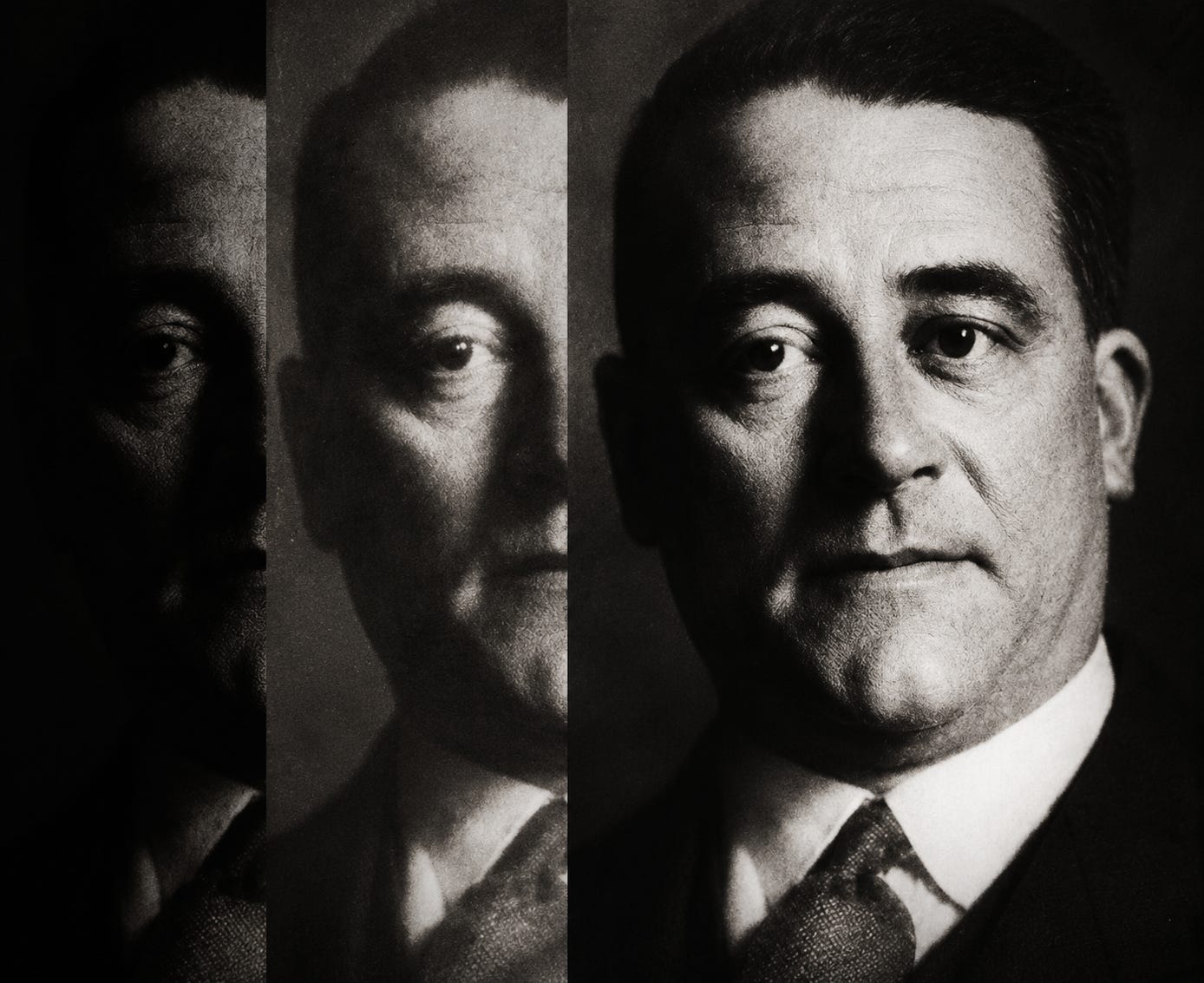
In recent years, Carl Schmitt’s concept of “the political” has attracted increasing attention as the failures of liberal “politics” have become more difficult to ignore amid the growing instability of the Western world.
The political must, of course, be distinguished from “politics” in the conventional sense of the term today: the contests of parties and elections, together with the pursuit of private or factional interests, above all those of money power, through the institutions of liberal democracy.
Politics in its present degenerate form is dominated by rationalism and materialism, both of which are subordinated to an economism operating under the aegis of Mammon. These forces subject authority and tradition to the merchant’s ledger, reducing collective existence to the arithmetic of private interest.
“The political” is revealed most fully in the state as the sovereign power that secures internal peace and defends the community against external danger.
Only when liberal society transformed the state into an arena of private competition, in which atomized individuals and factions maneuvered for control, did politics begin to separate from the political. Once particular interests superseded the common interest of the polity, the state ceased to stand above society as the preeminent authority and became an instrument for the pursuit of private power. In the United States, the first truly liberal state, politics was a business from the outset.
Against this background, Schmitt sought in the 1932 edition of The Concept of the Political to determine the criterion proper to the political, as distinct from politics in its ordinary sense. Schmitt defines the state as “the political status of an organized people in an enclosed territorial unit.” The state gives the political its clearest institutional expression when it stands apart from and above society. Its essential character is tested when a suprapersonal movement or power threatens it with destruction and compels it to defend both itself and the community entrusted to its protection.
Accordingly, the defining distinction of the political is that between friend and enemy. It denotes a concrete antagonism grounded in the real possibility of a life-and-death struggle between organized collectivities, extending in the final instance to physical killing. This antithesis is proper to the political, just as good and evil are proper to morality, beauty and ugliness to aesthetics, and profit and loss to economics.
Who, then, is the enemy?
For Schmitt, the enemy is the other who stands beyond the circle of political friendship and confronts the community as an organized power. Personal antipathy is insufficient. One man may despise another without their hostility becoming politically significant, for enmity assumes a political character only when it acquires a public form and places the continued existence of the community in danger. Schmitt expresses this distinction through the difference between the inimicus, the private adversary, and the hostis, the public enemy. The former concerns the individual and the injuries arising within private life. The latter confronts the political community as a whole and possesses the power to imperil the form of life embodied within it.
The contemporary liberal regime habitually obscures this distinction because it refuses to acknowledge political enmity openly. Hostility is therefore translated into the language of morality, and the enemy is condemned as wicked rather than recognized as a hostile power. Political judgment disappears beneath moral accusation even when the conflict itself remains unmistakably political. The enemy is existential in character because his hostility reaches beyond temporary injury or material loss. He threatens the survival of the political community and the historical form through which it understands itself. Such an enemy appears wherever another organized collectivity possesses the power and resolve to bring that existence into question.
Such an enemy can be recognized only in the concrete. No permanent physical characteristic or ideological formula can determine in advance where political enmity will arise, nor can a universal norm relieve a people of the judgment demanded when its existence is threatened. That judgment cannot be delegated entirely to theory. It belongs ultimately to the people that feels the ground of its existence beginning to give way beneath it and must determine whether the danger before it has passed beyond the ordinary limits of rivalry. The threat may have existed long before a people becomes conscious of it, yet the political moment arrives when continued evasion is no longer possible.
A merely symbolic adversary cannot give rise to political enmity in Schmitt’s sense. Rhetoric may imitate the language of existential conflict, yet political reality begins only where the possibility of actual struggle has arisen. “What always matters is only the possibility of conflict.”
Traditionally, the enemy was the alien other, the racial enemy whose threat came from beyond the borders of the state. Today, amid the radical demographic transformation and corresponding civilizational decline unfolding throughout the Western world, driven in large measure by “liberal politics” and by the increasingly zero-sum struggle among rival racial and ideological blocs within multicultural societies, the political enemy emerges from within the state itself. Internal divisions have attained such intensity that rival groups no longer recognize one another as members of the same political community, bringing domestic conflict to the threshold of civil war.
When the internal unity of the state begins to decay, antagonisms once contained within the political order acquire an existential intensity of their own. Under multiculturalism, the state no longer governs a single people divided by ordinary disagreements, but a collection of disparate peoples whose interests increasingly diverge and whose loyalties extend toward different collective destinies. These groups do not merely compete for influence within a political order they recognize as common to them all. They seek possession of the state so that its authority may be made to serve their own people and directed against rival populations occupying the same territory. Institutions outwardly charged with preserving a common order consequently become weapons in a struggle among competing peoples, whose true character is denied precisely because the antagonists remain enclosed within the borders of the same state.
The internal enemy consequently acquires institutional form. Offices that formally belong to the state are redirected away from the historic political community they claim to represent, while authority continues to speak in the traditional language of public duty after its animating purpose has been transformed. Once the state loses the capacity to distinguish friend from enemy, and therefore “us” from “them,” it can no longer determine whom its authority exists to protect. Public power survives, though the political orientation that once governed it has been reversed. The machinery of the state remains intact while its force is turned against the people from whom its legitimacy originally arose. This is the condition Francis Parker Yockey described as the rule of an “inner enemy.”
Against this disintegration stands political friendship.
Political friendship arises from consciousness of belonging to a common world. Its bond reaches deeper than temporary agreement because it rests upon a form of life rooted in the racial family, whose meaning does not depend upon the personal acquaintance of every member with every other. Men recognize one another as political friends when they understand themselves as members of the same historical community, inhabiting a world that preceded their individual lives and may continue beyond them. Their relationship is shaped by an obligation that cannot be reduced to private advantage or dissolved whenever immediate interest points elsewhere.
The political community is never simply a collection of persons residing beneath the same administration. It is a people conscious of itself as a unity extended through time. Its members receive a world they did not create and become responsible for whether that world is transmitted or permitted to perish. Political friendship gives form to this responsibility. It binds men who may never meet because each recognizes in the other a bearer of the same patrimony. Their solidarity stands above the merchant’s ledger, since the value of the community cannot be measured by the immediate benefit it confers upon each isolated individual.
Friends are bound by common descent and by a shared commitment to the way of life that has arisen from it. This bond rests upon an inherited racial and cultural identity extending beyond the narrow imperatives of private existence, uniting those who belong to the same people even when they remain strangers to one another in ordinary life. Political friendship therefore precedes enmity. Before a people can recognize those who threaten it, it must possess some consciousness of the existence being threatened. The distinction between “them” and “us” presupposes an “us” capable of recognition.
There can be no life-threatening “them” without there first being a life-affirming “us.”
The threat of destruction often awakens this consciousness with exceptional force. Peace permits a people to forget the boundaries of its existence, while danger reveals them anew. What appeared obsolete during an age of security suddenly discloses itself as the condition upon which survival depends. A people may therefore discover itself most fully at the moment when its continued existence has become uncertain. The enemy compels a people to confront questions that comfort had postponed, forcing it to remember who belongs to the community and what historical substance gives that membership meaning.
Political friendship consequently accords priority to the obligations arising from collective existence over appeals advanced in the name of an abstract and ever-nebulous “humanity.” Humanity cannot substitute for the concrete community because it possesses no unified historical will. It inherits no particular civilization and assumes responsibility for the survival of none. The invocation of humanity may obscure political distinctions, yet it cannot dissolve them. A people confronted by an enemy capable of destroying it cannot be preserved by the discovery that both sides share a universal human essence. The antagonism remains concrete because the danger remains concrete.
The political is ultimately a question of life and death.
This does not mean that political life consists in ceaseless warfare. Schmitt neither glorifies war nor regards it as the ordinary condition of every political order. War marks the extreme possibility toward which political enmity may develop when the existence of the community is placed in peril. The political character of the enemy does not depend upon his moral depravity. He may possess virtues, and his civilization may even command admiration. None of this removes the danger he presents when his organized power threatens the existence of another people.
Political judgment therefore cannot be replaced by moral judgment. To condemn an enemy as evil may intensify hatred, yet it does nothing to explain the specifically political character of the conflict. The decisive question concerns the danger he poses and whether the community possesses the will to resist it. The political retains an autonomous criterion of judgment because it concerns the preservation of collective existence under conditions in which every other consideration becomes subordinate.
The state reveals its highest character when it assumes responsibility for this decision. Ordinary government may concern itself with administration and the socioeconomic ordering of society, but sovereignty emerges when the existence of the whole has been placed in question. The state’s preeminence rests upon its authority to determine whether the community must fight, a prerogative that receives its most severe expression in the jus belli, the right to wage war. Through it, the state may command its members to take life while accepting the possibility that their own lives will be lost.
No private association possesses a comparable authority. Other institutions may demand obedience within a limited sphere, yet the state alone claims the right to summon men into a struggle undertaken on behalf of the political whole. This right reveals the gravity of political membership. The state does more than administer benefits to a population. It presides over a community whose continued existence may require sacrifice, and its claim to obedience reaches its highest point where the individual is called upon to hazard his life for something extending beyond it.
A people unwilling to accept this burden may continue to exist biologically while gradually ceasing to exist politically. It may retain the outward institutions of sovereignty after losing the will upon which sovereignty depends, leaving behind a shell inhabited by administrators who govern a population no longer capable of understanding why anything should be defended at ultimate cost. Weak peoples do not escape the severity of history by renouncing it. Their refusal merely ensures that others will decide their fate.
The power to identify the enemy and determine whether resistance has become necessary constitutes the decisive expression of sovereignty. Schmitt gives this principle its most famous formulation at the opening of Political Theology: “Sovereign is he who decides on the exception.” The exception arises when the ordinary legal order can no longer preserve the conditions upon which its operation depends. Law presupposes peace, together with an authority capable of maintaining it. When these conditions begin to collapse, the norm cannot restore itself through its own operation.
Someone must judge that the ordinary situation has ended and accept responsibility for acting where the law no longer supplies an adequate answer. The sovereign is the power that makes this judgment. The exception therefore reveals what normality conceals. Beneath the visible legal order stands an authority that cannot be reduced entirely to the laws it enforces. The norm may govern the ordinary course of life, yet it cannot determine whether the conditions of normality still exist.
Liberal thought recoils from this conclusion because it wishes to imagine an order that governs itself through procedure. It hopes to replace authority with rules and transform decision into administration, creating a system whose operations continue without the intervention of sovereign will. Yet no legal order can sustain itself through legal reason alone. Every norm depends upon conditions it did not create, and when those conditions disappear, the survival of the order rests upon a power capable of acting before legality itself can be restored.
The sovereign decision does not intrude upon political order as an arbitrary force imposed from without. It reveals the foundation upon which the order had always rested. Normality conceals this dependence because obedience appears automatic while institutions remain secure. The exception removes the concealment and exposes the authority whose decision makes the continuation of lawful order possible.
Once ordinary conditions return, the political does not vanish. War may recede and the state may resume the quieter work of government, yet the possibility of conflict remains latent within every independent political order. Because war marks the extreme horizon of political life, its possibility gives sovereign judgment its gravity. A decision concerning the enemy cannot be treated as one administrative choice among others, for it may determine whether the community will continue to exist in the form through which it has known itself.
To be political in Schmitt’s sense therefore demands more than attachment to domestic peace and the solidarity it engenders. It presupposes allegiance to a form of life in which the continued existence of one’s people is valued, in the final instance, above the physical survival of the individual.
Schmitt’s assertion that the political “neither favors nor opposes war” places war at the outer boundary of political existence. War is not the purpose of the political, yet its possibility cannot be removed without abolishing the political distinction itself. Bellicose nihilism misunderstands this relation because it mistakes destruction for vitality. Schmitt does not worship conflict for its own sake. The decisive element is the enduring possibility that hostility may attain an intensity at which the community must defend itself through force.
That possibility remains even when belligerents conceal the concrete character of their struggle beneath the abstractions permeating the modern West. “Freedom” and “humanity” become moral banners beneath which political interests continue to operate. The language changes while the underlying antagonism endures. The denial of the political therefore produces no escape from political conflict. It merely deprives the conflict of honesty, allowing powers unwilling to name their interests openly to present themselves as the executors of universal principles.
Yet if war arises principally in defense of a political community confronted by an existential threat, what does this reveal about the character of political existence itself?
The question becomes more difficult when Schmitt is considered alongside Nietzsche, whose influence upon his thought remains unmistakable even where the two ultimately diverge. Both have been reduced to caricatures of violence and domination that obscure their deeper concern with the creation and preservation of form. Schmitt’s defensive conception of war may initially appear to separate him from Nietzsche’s account of the will to power, yet this apparent opposition rests upon an impoverished understanding of Nietzschean affirmation.
For Nietzsche, the will to power names the capacity through which life overcomes formlessness and imposes order upon forces that would otherwise remain chaotic and without direction. Its characteristic expression is creative. The higher type does more than dominate what stands before him. He transforms the conditions of existence by bringing a new order into being, shaping the world according to the vision of a commanding will.
Schmittian sovereignty rests upon a similar understanding of power as the capacity to impose order upon disorder. The sovereign does more than administer an order already complete. He appears at the point where order can no longer be assumed and where its survival depends upon decision. He draws the boundary separating political existence from dissolution and determines what must be defended because he accepts responsibility for what may otherwise be lost. Authority becomes visible when hesitation would surrender the community to forces that procedure alone cannot master.
In Nietzsche, power creates new forms of life. In Schmitt, sovereign power preserves the political order and the people embodied within it.
The distinction is real, although it must not be overstated. Preservation is never wholly passive. A political order cannot survive simply because it once possessed vitality. Its form must be renewed when the substance beneath its institutions has weakened. To defend a community is already to decide what within it deserves to endure and what must be excluded if its character is to survive. The sovereign must recognize which traditional forms still express the life of the people and which have become empty shells. Preservation therefore contains an element of creation because renewal cannot be accomplished without judgment.
The sovereign who restores political order does more than protect existing offices. He recovers the distinctions upon which those offices depend and compels the community to remember the substance its institutions were created to embody. Through decision, he may restore an order whose inner principle has weakened and renew a people that has ceased to understand itself politically.
Schmitt therefore approaches Nietzschean affirmation more closely than his defensive account of war initially suggests. Decision gives form to political reality by separating what belongs to the community from what threatens its existence. Yet Schmitt binds this creative power to a political unity received through history. Nietzsche’s higher type may seek possibilities extending beyond the moral world of his people, whereas Schmitt’s sovereign remains responsible for a community already given through history.
The sovereign does not create his people from nothing. He receives a political substance shaped before his arrival and assumes responsibility for whether it will endure. His freedom remains inseparable from obligation. Whether this restraint reflects Schmitt’s Catholic inheritance or arises from the nature of the political itself cannot be resolved easily. A power liberated from every historical obligation may become creative, though it may also cease to be sovereign in any specifically political sense. Without a people for whom responsibility is assumed, decision risks becoming an empty assertion of will.
The contrast with liberalism now comes into sharper focus.
Liberalism begins from the individual abstracted from racial and cultural belonging, and therefore from the civilization in which those forms of belonging find their highest historical expression. Political membership appears secondary because the individual is understood to possess an identity prior to the community in which he lives. The obligations attached to history consequently appear suspect. They bind the individual to a world he did not choose and impose duties whose authority cannot be derived from private consent. Liberalism therefore seeks to weaken such obligations by subordinating them to universal rights.
An organic people is gradually transformed into an artificial population, while political membership becomes a legal status administered by institutions. The historical substance that once distinguished the community is treated as an accident of birth whose public authority should diminish with time. Political life is then interpreted through the categories of commerce and morality. Political enemies are redescribed as competitors when compromise remains possible, or as criminals when antagonism can no longer be concealed.
Liberalism cannot acknowledge that certain conflicts arise from incompatible forms of existence. It assumes that antagonism proceeds from misunderstanding or from an imperfect arrangement of material interests. Procedure is therefore expected to reconcile what political judgment would recognize as irreconcilable. The liberal state seeks to dissolve conflict into negotiation because its premises deny that membership in a concrete political community can impose obligations higher than private judgment or the universal claims of humanity.
Yet liberalism cannot finally escape the political.
When circumstances compel liberalism to identify an enemy, the political reality it has denied returns in moralized form. The enemy cannot be recognized as a legitimate political adversary because liberalism has already declared such enmity obsolete. He must therefore be condemned as an enemy of humanity and placed beyond the moral boundary liberalism claims to have made universal. His existence becomes a crime rather than a political fact, while war against him assumes the character of punishment.
The denial of political enmity thus produces a more absolute hostility. An enemy recognized as a political enemy may be defeated and afterward permitted to survive. An enemy cast beyond humanity can no longer be granted legitimacy because the moral claims invoked against him admit no natural limit. He is transformed into an inhuman criminal whose continued existence appears as an offense against mankind and whose annihilation consequently assumes the character of a moral necessity.
Liberal wars therefore tend toward unlimited moral purposes even when conducted by states pursuing concrete interests. The political aim is concealed beneath a universal vocabulary, allowing power to act while denying the particularity of the ends it serves. The belligerent presents himself as the agent of humanity while his enemy is deprived of any recognized political standing.
This moralization follows from liberalism’s deeper understanding of the state. The state becomes an instrument of civil society whose legitimacy depends upon its protection of private interests. Its authority is accepted so long as it secures the material conditions within which individuals may pursue their chosen ends. Political obligation loses its independent force because the community may claim nothing that cannot be justified through the welfare of the individual.
A demand for sacrifice made solely on behalf of the continued existence of the political community therefore appears illegitimate. It binds the individual to a historical world he did not choose and places the fate of the whole above his private judgment. The state is reduced to the guardian of personal security, while men conceptually severed from concrete forms of belonging are gathered beneath the universal appellation of humanity. Economic power meanwhile expands beyond the political boundaries that once confined it.
The consequences of this depoliticization extend far beyond constitutional theory, for they eventually transform the social order itself. The older hierarchical world represented by the ancien régime disappears, taking with it the visible hierarchy and reciprocal obligations sustained by tradition. In its place arise formless masses whose political passivity leaves them susceptible to economic manipulation. Quantity reigns over quality, while authority once embodied openly in sovereignty passes into the hands of financial power, which governs without acknowledging that it rules.
The older ruler stood in a visible relation to the order over which he presided. His authority could be named, and the obligations attached to it were publicly understood. Financial power operates through mechanisms that obscure responsibility. Money commands without assuming the burdens historically attached to command. Its decisions reshape the life of the nation, yet its dominion appears as the neutral operation of contracts and markets.
Under this dispensation, the usurer invokes property rights to dispossess the farmer of his land, while private interests acquire control of parliamentary institutions and present their advantage as the general welfare of the nation. The same universalism that dissolves concrete political loyalty then invokes the “brotherhood of man” to justify wars against peoples that refuse submission to its abstractions. Liberalism leaves power intact while concealing the identity of those who wield it and obscuring the political character of the ends they pursue.
The political cannot be abolished through commerce or evaded through procedure, for it remains inseparable from the nature of sovereignty itself. Schmitt gives this relation its most concise expression: “The protego ergo obligo [I protect, therefore I oblige] is the cogito ergo sum [I think, therefore I am] of the state.”
Protection is the ground of political obligation. The state claims the highest authority because it assumes responsibility for the continued existence of the community. From this responsibility arises its right to demand obedience and, in the final instance, the sacrifice of life itself. A state incapable of protecting its people forfeits its claim to their allegiance. Its institutions may remain standing, yet the bond from which obedience arises has already begun to dissolve.
The same bond imposes an obligation upon the people. A community that desires protection while refusing every burden political existence may impose eventually loses the capacity to sustain sovereignty. Protection and obligation cannot be separated without destroying both. The state that abandons protection becomes predatory, while the people that rejects obligation becomes politically helpless.
The possibility of death gives this relation its ultimate seriousness. Confronted by an enemy capable of destroying the form of life to which he belongs, man must take sides and accept responsibility for its fate. Political membership then reveals itself as an ancestral trust, binding man to those who preceded him and making him answerable to those who will receive it after him.
The liberal ideal of a universal world state seeks to extinguish this seriousness altogether. Once concrete peoples have been dissolved into an undifferentiated humanity, the distinction between friend and enemy disappears with them. What remains is an administrative order populated by isolated individuals whose material desires must be satisfied while their conduct is regulated by institutions that no longer embody a shared historical purpose.
Public life collapses into management and spectacle. Sovereign judgment gives way to technical administration, while private enrichment assumes the place once occupied by a common conception of historical destiny. A civilization may retain its government and legal institutions while losing all understanding of the purpose they exist to serve. Its political forms persist after the principle that animated them has died.
Its people cease to regard themselves as the living bond between their forefathers and generations yet unborn. They become temporary occupants of a territory whose history imposes no binding claim upon them.
Meaning is the first victim of this depoliticization.
A people that no longer recognizes the boundary separating itself from those outside it eventually loses consciousness of its own character. Difference reveals the form of life a people inhabits because it makes visible what would otherwise remain unexamined. Through such recognition, a people comes to understand the conditions required for its survival and the obligations imposed by political existence. Without this consciousness, loyalty becomes preference, while inheritance declines into sentiment. History survives as an object of curiosity after ceasing to exercise authority over the present.
If Whites are ever to regain command of their destiny, they must first recover consciousness of themselves as a distinct people and political community. They must again recognize their racial and civilizational inheritance as an ancestral patrimony held in trust, whose continued existence depends upon the willingness of successive generations to preserve and defend it.
Such a civilizational regeneration must begin with the restoration of the friend-enemy distinction. Through it, we must determine where our loyalty belongs and identify the powers seeking the dissolution of our collective existence. In recovering consciousness of who we are, we will recover the memory of the heights once attained by our people and the civilization they created, together with the confidence and creative force required to rise again.
Everything else is merely the bastard “politics” of a dying civilization.
No posts
Comments
Nothing yet. Say the first thing.
Sign in to join the conversation.