
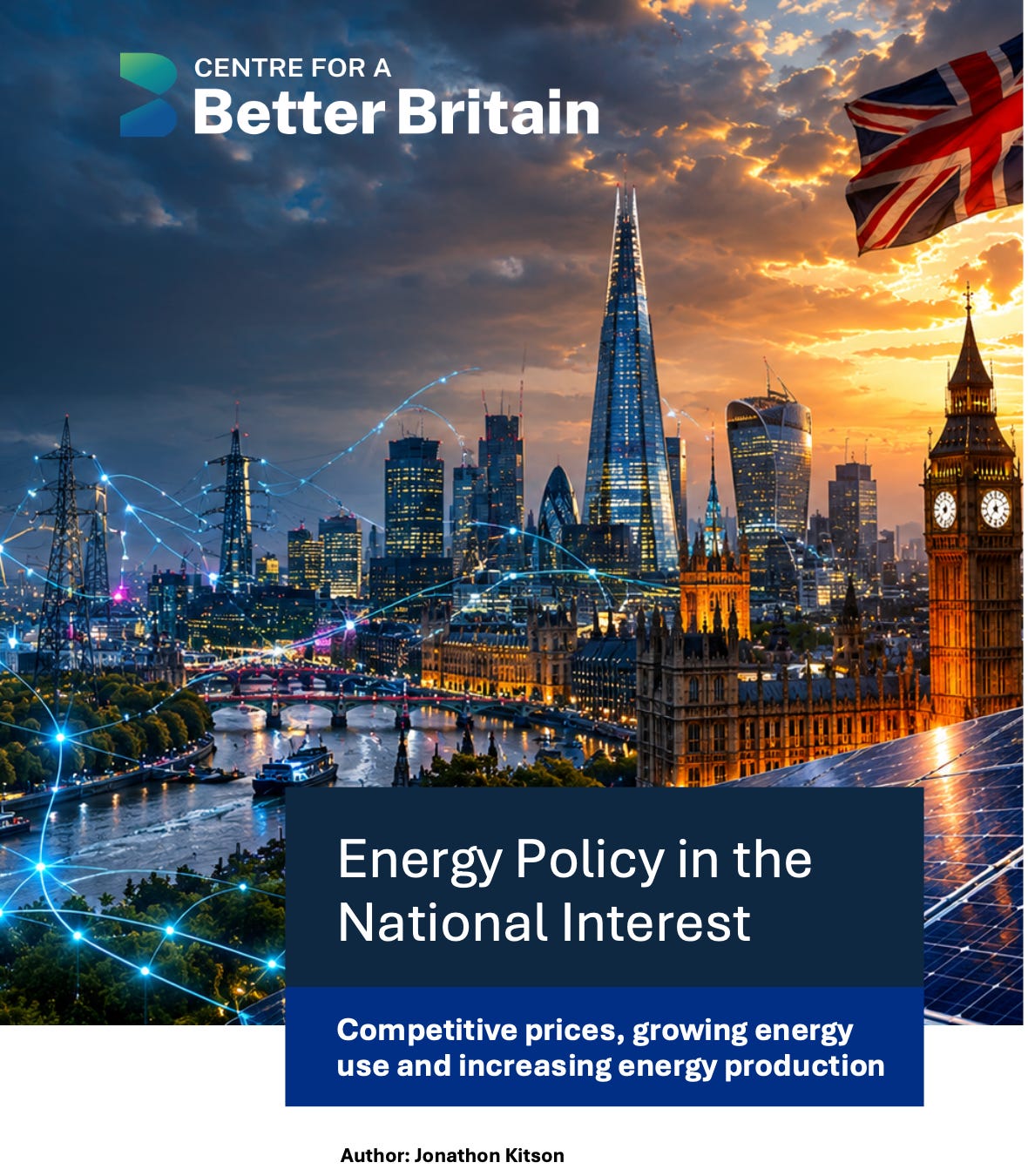
Britain has spent two decades building a smaller, more expensive, and more import-dependent energy system. Energy Policy in the National Interest argues that this is the direct consequence of a policy framework built around a single objective, reducing domestic carbon emissions. Britain now has the most expensive industrial electricity in the developed world, total energy production is at a record low, electricity generation is 22% below its 2005 peak despite doubling installed capacity, and net electricity imports are at a record high.
Energy spending now accounts for 5.8% of GDP, up from 3-4% in the 1990s, while industrial energy consumption is at its lowest level in over 50 years. Restoring competitive energy prices, growing consumption, and productive domestic production will require a fundamental reorientation of energy policy. The paper can be downloaded from our website.
Britain is consuming less energy than at any point since the 1980s. From electricity bills to industrial competitiveness, and from energy security to declining living standards, the consequences of two decades of poorly designed policy are now visible across the economy.
Historically, a productive energy system has rested on four foundations: competitive prices, growing consumption as a measure of prosperity, strong domestic production, and an institutional framework capable of delivering at scale. These reinforced one another. Affordable energy enabled industrial growth, domestic production underpinned security, investment flowed to where it was needed, and the system broadly delivered. Today, each of these foundations is under strain. UK per-capita energy production has fallen 71% since 2000. Industry now pays 108% more for electricity in real terms than it did in 2008. Britain has the most expensive industrial electricity in the developed world, and households face the second-highest electricity prices in the IEA.
Meanwhile, other nations are demonstrating what an energy policy built around abundance can achieve. The United States has increased energy production by 43% since 2000 and broadly maintained per-capita consumption while continuing to grow. South Korea has increased per-capita energy use while achieving faster gains in living standards. Britain, by contrast, has seen consumption fall not only in per-capita terms but in total terms — a trajectory that has coincided with stagnant productivity, flat real wages, and GDP per capita growing at just 0.6% a year since 2007. Had Britain maintained its pre-2006 trend, it would now be roughly 34% richer per capita.
This raises uncomfortable questions. Can an economy committed to electrification remain credible if it cannot bring electricity costs down? Can a state spending more than £200 billion to reach its 2030 power targets justify a system in which the direct costs of subsidies and levies have already reached £22.7 billion a year? Can institutional frameworks designed around a single objective (reducing domestic carbon emissions) self-correct when the consequences for competitiveness, security, and living standards are becoming undeniable?
Rebuilding a system that serves the national interest will require action across all three fronts: restoring competitive prices through reform of the cost and subsidy regime, reversing the decline in productive energy consumption, and maximising indigenous production. CFABB is now conducting working groups to provide options for a future government to help achieve these goals.
The paper was launched at a roundtable with key figures from across the energy industry and attended by Reform UK’s Deputy Leader and Business, Trade and Energy spokesman, Richard Tice. CFABB’s energy policy lead, Jonathon Kitson, appeared on GB News to discuss the paper’s findings.
Comments
Nothing yet. Say the first thing.
Sign in to join the conversation.