
There is as close to a Westminster consensus as you are ever likely to get that the funding and provision of the UK social care sector needs radical reform. However, every attempt to reform social care has failed - it is firmly in the ‘too hard to do’ box. It is this box that our new Prime Minister has opened with the intention of solving. An entangled knot of a policy that would have challenged Alexander, so why the priority now?
The most obvious reason is that there is little scope to ‘kick the can’ down the road any longer – the social care budget is expanding and out of control. Importantly, the budget lands on narrow shoulders - local government - threatening administrations with bankruptcy. Andy Burnham is a politician whose recent past was in local government; he should know the problem. If he is to have a chance at making headway, he will have to do it while he still has political capital.
The benefits to a Prime Minister who cracks the social care problem are many. It would allow local government to concentrate on voters’ broader priorities, rather than be weighed down to little more than a social care provider. This fits with the PM’s devolution agenda, even if it requires centralisation of social care first! Reforming the system also means you get the chance to design what comes next – for the Labour Party that would mean replicating the NHS, rather than leaving it to a market-led solution, be it an insurance model in the private sector. Burnham has indeed spoken of a ‘National Care Service’.
Social care is expensive and getting ever more so. It comes with a yearly cost of £34bn, large but as the state now spends £1.36 trillion (£1,360 bn), this accounts for a surprisingly modest 2.5% of total expenditure.
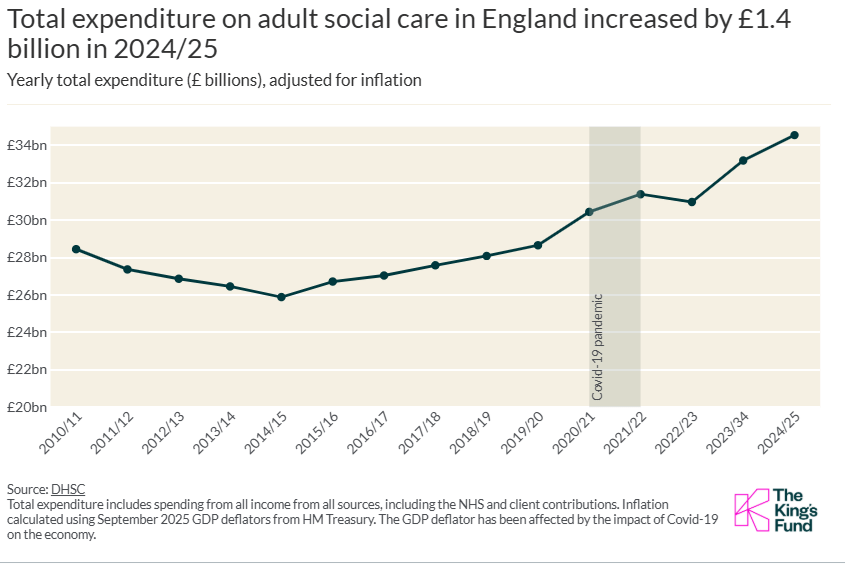
While the increase in costs are real and would put a strain on the national budget it is the fact it lands on the narrow shoulders of local government where it accounts for some 19% of their spending that makes it politically unavoidable. There is clearly a need to change the way its funded.
The funding of local government is already politically dangerous, falling as it does on people’s homes, a topic liable to engender strong feelings in the electorate and again a topic that has the potential to end political careers.
To add to the political toxicity of social care for pensioners - where huge costs can often lead to huge bills landing on those who have saved all their lives while those who have little or no savings can rely on the state. The need for social care and the liability to pay for it are both unpredictable.
If social care is not to be paid for out of more local taxes should it be paid for? For a Labour politician, one answer appears to be widening the net of Inheritance Tax. Currently there is an inheritance tax fee band of £325,000, and many of the largest estates pay little tax due to careful planning. IHT has ended up being a tax on the middle classes and in particular house price inflation in the Southeast of England. Removing the nil rate band and reducing the overall rate would disincentivise tax planning and widen the scope of the tax – could that be a solution?
Well, a new tax is unlikely to be popular but a flat tax on inheritances may possibly avoid the unpopularity of individuals paying for their own treatment out of the sale of their properties – the 2017 proposal by the Conservatives to link the sale of homes to care treatment, which quickly became named ‘the dementia tax’ with devastating political ramifications. The perceived unfairness where some illnesses would be paid for by the NHS (say cancer) and others would have to be paid via the sale of assets – i.e Altheimer’s decease is also a factor.
So is a ‘National Care Service’ (NCS) the answer? Well, replicating the NHS model also means replicating its flaws. Demand for social care is rising and held back to some extent by peoples desires to pay for it. Making it free and accessible to everyone will undoubtedly increase demand enormously leading to a need to ration the care.
It also raises many other questions:
Would a vast NCS covering the who UK be the most efficient way to provide a service?
Can an NCS be genuinely ‘National’ and work with the NHS and its devolved bodies in the devolved nations? Who will decide what is a matter for the NCS or the NHS? Who will employ and train the over 1.5 million people working in the sector?
Can a tax in inheritances, drawn predominantly from the middle classes in the South East command national support? Can this tax be hypothecated to social care or will it just end up being another central government revenue stream? Is centralised tax and spend really the best way to deal with the problem?
To cope with the problems of exponential demand placed on a ‘free’ service might a better system involve an insurance-based model where the service providers for the care and the insurance are not the state but private companies competing for business? This would involve all those able to pay for insurance to pay for care paying for it with a basic safety net for those who cannot. This would be the free market approach. If people wished to opt out an rely on their families that would also be an option.
Would anyone on the Centre Right dare to put forward an alternative to an NCS? So far, the Conservatives and the Liberal Democrats have said they are prepared to work with the Government on reforms, with the Conservatives adding the proviso that the cost of Social Care must come out of existing spending – given that it currently accounts for 2.5% of spending, it must be possible to find savings in the 97.5% of government spending to reduce the burden on the local taxpayer?
But so far nobody has questioned the underlying assumption that the NHS model is the one to replicate – this is unsurprising as the second most urgent discussion that has never had in British politics is reforming the NHS itself!
Comments
Nothing yet. Say the first thing.
Sign in to join the conversation.