
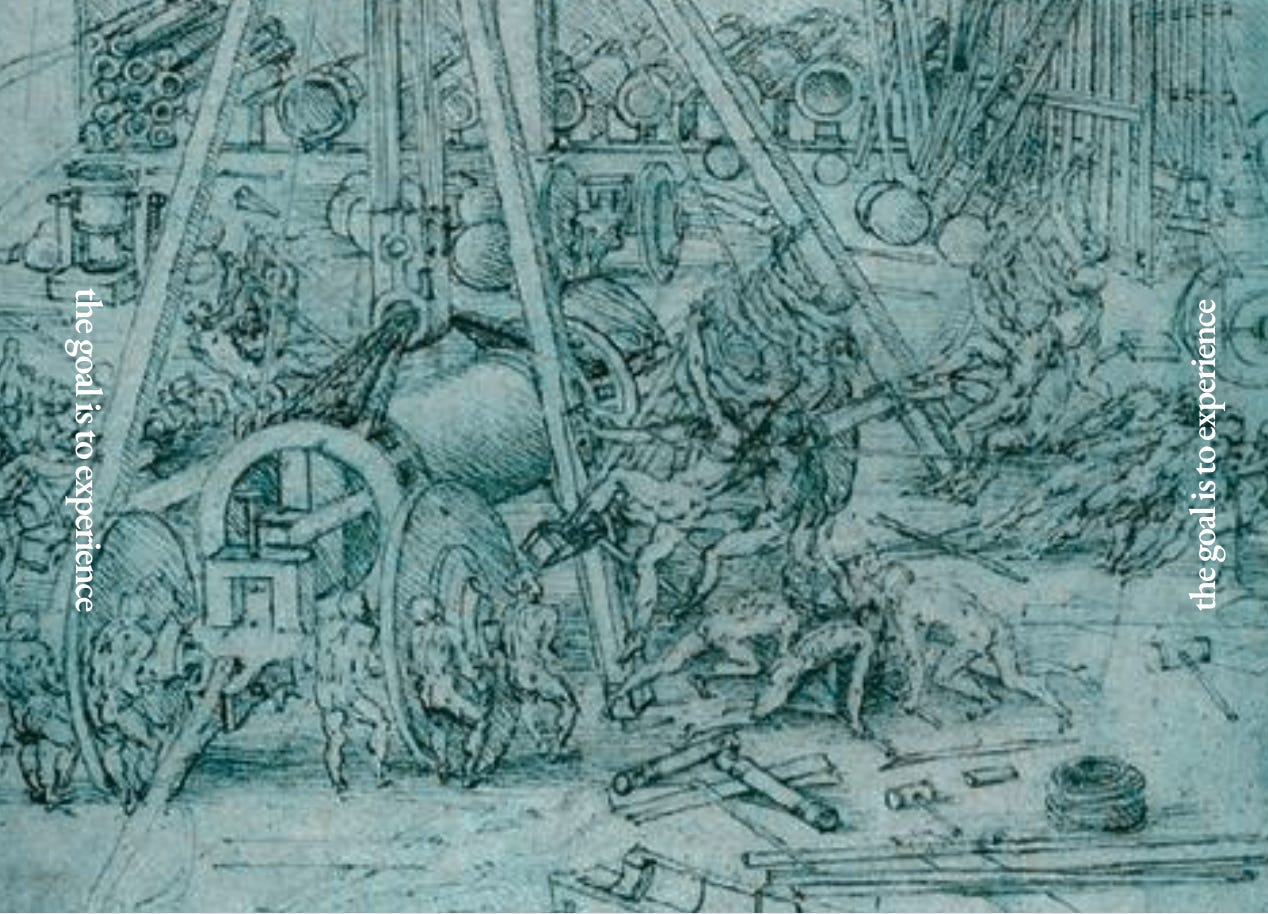
In one of his notebooks, Leonardo da Vinci described a concept that is difficult to fully translate into English: saper vedere, knowing how to see. Not just looking, not observing in the passive sense we tend to mean when we use the word, but training the eye to read the world the way a craftsman reads the grain of wood before putting the chisel to it. He was obsessive about this, and about everything he wanted to learn. He would follow interesting men through the streets of Florence just to study their faces when they laughed, or go to the baths to watch how their muscles would change when walking, cleaning, chatting. He dissected more than thirty human corpses to understand the precise mechanism of a shoulder rotating in its socket. He did not consult a theory first and then verify it against reality (also because knowledge wasn’t as accessible, despite him being in the most important cultural cauldron of that time).
Counterintuitively, he went the other direction entirely.
We tend to imagine Leonardo as highly educated, but in reality he received what we would now consider a limited education, roughly the equivalent of elementary school, because he was born out of wedlock and showed no interest in becoming a notary, so his father did not see him as the kind of heir worth investing in academically. So Leonardo was almost entirely self taught.1
We have largely reversed this. The first instinct now, when we want to learn something, is to find a course, a roadmap, a framework, a tutorial, someone who has already done the work of encountering the world and is now willing to hand us a cleaned-up version of what they found. This isn’t laziness, exactly, you feel responsible of the perfected path you’ll build for your future self. You’re not wasting time reinventing wheels: you are preparing. And preparation feels like progress because it comes packaged in the same containers as knowledge - books, videos, structured curricula - and sits in the mind with a similar texture.
But there is something it cannot give you, and Leonardo, who had no formal schooling to speak of, talked about this more than anyone else: sperienza, he called it, experience not as a supplement to knowledge but as its origin, the encounter with material that surprises you before you have the vocabulary to explain the surprise away. You touch the thing first and you let it confuse you. You stay in the confusion long enough to actually learn something, rather than retreating to the map the moment the territory gets strange.
The reason we don’t do this anymore is partly anxiety. When you approach a skill without preparation, you are placing yourself in the position of not knowing, and not knowing feels, in the moment, almost indistinguishable from being incompetent. The fear of failing - of producing something crude, of being visibly a beginner - presses so hard against the actual act of beginning that most people delay it indefinitely through “preparation”. The tutorials become a kind of security blanket that you can always be wrapping yourself in, always be one course away from readiness. What you sacrifice in that exchange is exactly what Leonardo refused to sacrifice: the encounter with the material on its own terms, the genuine confusion that forces you to build your own structures for understanding rather than inhabiting someone else’s. A crude map you made yourself teaches you more about the territory than a sophisticated one you borrowed, because you know where you got lost drawing it.
There is a version of this argument that sounds like the tired “just do it/you can just build things” culture of productivity influencers, and it isn’t that. The point is not to begin without thinking, or to romanticize incompetence, or to pretend that accumulated and structured wisdom has no value. The point is about sequence and about who builds the conceptual framework. When you encounter the material first and theory second, the theory arrives as an explanation of something you have already partially mapped through direct contact, so it illuminates rather than substitutes. When the sequence runs the other way, you are building on someone else’s conceptual foundation in a way that feels solid but makes it very difficult to notice when the foundation doesn’t actually fit your particular problem. You have inherited not just their insights but their blind spots, their dead ends, their categories, all of it embedded so deeply in how you understand the domain that you can no longer clearly see which parts of your thinking are your own.
The Renaissance had a different relationship to this. Not because people were smarter or more devoted, but because the model of knowledge transmission was fundamentally different: apprenticeship placed you in direct contact with material from the beginning, and the theory, when it came, arrived in the context of problems you had already been wrestling with physically. You encountered the question first, and your personal need to answer it would guide you through the learning process. What is interesting is that even within this culture of direct encounter, the people we now group together as “Renaissance polymaths” were not doing the same thing. We tend to invoke the figure of the Renaissance man as if there were a single type, a kind of template for polymathic learning, and that flattening obscures something important about what we are actually celebrating.
Leon Battista Alberti absorbed the ancient world the way a scholar does - reading, synthesizing, rebuilding in his mind - and then made architecture out of pure reasoning, drawing on a vast internal library of other people’s ideas that he had so thoroughly metabolized they had become his own. He was a synthesizer first; the material came second, as the medium through which mental constructions became physical. Brunelleschi worked in almost the opposite direction. Largely self-taught, he solved the engineering problem of the Florence dome through a decade of obsessive practical experimentation, inventing machines that had no precedent, failing repeatedly in ways that refined his understanding rather than derailing it. He had no inherited framework for what he was trying to build because no inherited framework existed for it yet, which meant that every problem he solved was genuinely discovered rather than retrieved. And then there is Lorenzo de’ Medici, who built nothing and painted nothing and yet created the conditions in which Botticelli, Ficino, and Michelangelo could do the work they did. His learning was curatorial and social, aiming for community impact. He understood enough of each discipline to recognize genius operating within it, which is itself a profound and underrated cognitive achievement: to be able to see the exceptional from a position of genuine comprehension rather than mere enthusiasm.
Three men, three entirely different relationships to knowledge, all three called Renaissance, all three genuinely excellent across multiple domains. What that means is that the question has never been whether learning broadly is legitimate.
The question is which of these modes of engagement actually corresponds to how your mind works, which you have probably been actively suppressing in favor of whichever mode the educational system you grew up in rewarded.
The person who learns by synthesizing texts will fail if they force themselves into Brunelleschi’s mode of building and breaking. The person who learns by assembling and curating will feel hollow if they try to force themselves into the role of original creator, not because they lack ability, but because they are using the wrong instrument. Recognizing this is not lowering your expectations of yourself, it’s validating the beauty of difference.
This is what might be called a personal cosmology of learning: not a fixed type, but an understanding of your own relationship to knowledge that you carry forward and refine over a lifetime, a kind of orientation toward inquiry that you can apply across any domain you enter. The disciplines you accumulate over a life are not separate folders in a cabinet. They are lenses, and each new one changes the focal length of all the others in ways that are difficult to predict in advance and essentially impossible to engineer deliberately. You cannot know, when you spend a year learning to draw from observation, that what you are actually developing is a different relationship to negative space that will later show up in how you structure arguments in writing, or how you listen to people in conversation, or how you design a room. The transfer happens below the threshold of intention. This is the compounding that actually matters: the slow multiplication of perception, each domain altering how you see every other domain you carry with you.
What makes this compounding visible, and therefore actionable, is working through small experiments rather than open-ended exploration. The small experiment has a specific architecture: one question, one variable, a short window of time, and an honest assessment of the result. Not “can I learn to draw” but “if I sketch from observation for fifteen minutes every morning for two weeks, does my ability to see the proportional relationship between elements in front of me actually change.” The precision matters because without it, you are consuming experiences the way you consume content. Writing the hypothesis before you begin is what creates the conditions for genuine surprise. Surprise is where the mechanism becomes visible, and the mechanism/pattern is what transfers across domains. Without seeing the mechanism, you have a skill you cannot explain and therefore cannot deliberately apply anywhere else.2
The fear of the small experiment, for most people, is the same fear that drives the tutorial loop: what if the result is that nothing shifts, that you tried the thing and it didn’t work, and now you have evidence of failure rather than just uncertainty. But this is exactly backwards, null results are results, or as someone might like to say: the goal is to experience. The experiment that teaches you that sketching every morning produces no measurable change in your perception after two weeks has told you something true about your relationship to that particular approach, and that information is worth more than six months of unfocused dabbling that you could interpret as either success or failure depending on your mood when you assess it. The constraint is not the enemy of discovery, it’s what makes discovery legible.
Start somewhere specific: pick a skill adjacent to your work but not inside it. Interact with the material for a week before reading anything written by someone who has systematized it. Write down every moment of confusion you encounter, not to resolve it immediately, but to map the actual shape of your ignorance rather than the imagined shape that your preparation would have given you. Identify your natural mode (synthesis, building, curation) not the one you have been told is most legitimate, but the one that has actually produced the moments of genuine understanding you can remember.
Design one small experiment.
Write the hypothesis.
Change only one thing and watch what surprises you.
Then find, in whatever domain you consider your main work, the place where the same mechanism appears.
Leonardo’s notebooks were not a collection of achievements, quite the opposite! They were a record of a mind in the process of learning to see, endless to do lists of things he would have loved to see (e.g. learning how the tongue of a particular animal was anatomically structured), experiments after experiments. The disciplines bled into each other constantly, not because he planned for them to, but because he couldn’t see the world in a different way.
When thinking about the Renaissance, we mistakenly imagine these absurd geniuses that have an almost incomprehensible way of learning. In reality, their learning system was as messy, if not messier, as ours. Leonardo had tons of notebooks filled with tasks and projects that he never acted upon, because he was easily bored (can you relate?), however, his way of doing things was his competitive advantage: he didn’t really care about how he looked like. He asked questions to any master, he would try relentlessly, no matter how bad a sketch looked like, and he learnt however he wanted to. Even his way of writing, mistakenly attributed to him as a new “invention” is simply a better way for left-handers to write without smudging the page with ink, called mirror writing!
In the end, he simply knew himself enough to create systems and environments that would allow him to learn and create as much as possible, without fearing failure but embracing the sperienza.
Isaacson, Walter. Leonardo da Vinci. New York: Simon & Schuster, 2017
Le Cunff, Anne-Laure. Tiny Experiments: How to Live Freely in a Goal-Obsessed World. London: Profile Books, 2025.
No posts
Comments
Nothing yet. Say the first thing.
Sign in to join the conversation.