
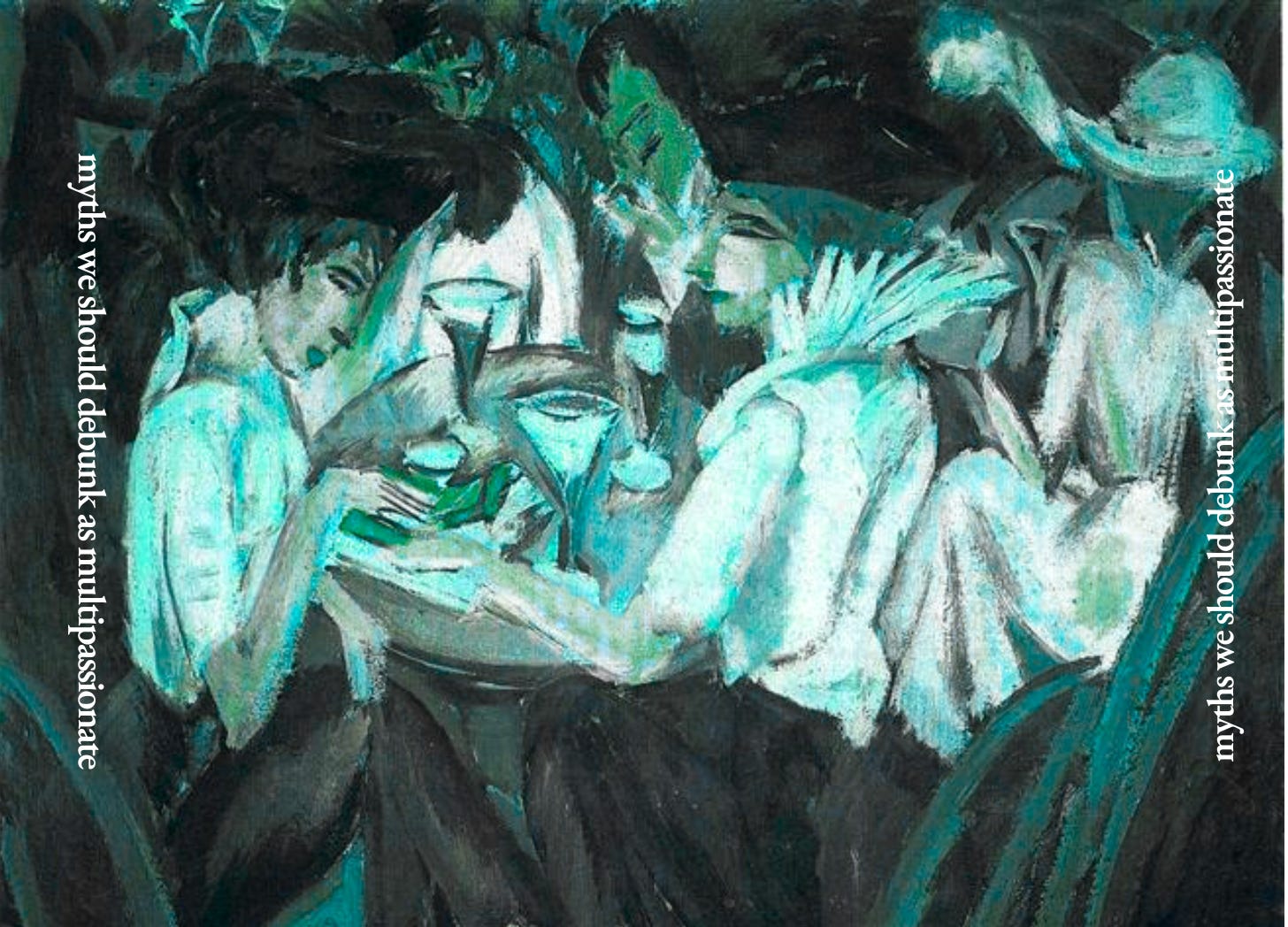
This essay has been inspired by a webinar on creative living we hosted in The Modern Renaissance, and our guest was Marq Mervin. And the picture is The Garden Cafe, Ernst Ludwig Kirchner.
“The limits of my language means the limits of my world”
- Wittgenstein
Most multipassionate people feel a lingering type of frustration from living inside a story they didn’t write, as the world they navigate is largely created by the words used by others to describe them.
You’ll be told a lot of things about yourself. Some will resonate, some will feel inherently discordant, others will look like parts of you that you hoped were not visible anymore. This happens not only during childhood and adolescence, where your identity is barely maintaining a fragile structure, but also in adulthood, as you’re still growing and you’ll never repeat the same birthday twice.
It can take a long time to understand that the words we inherit are not real and set-in-stone descriptions, but they’re prescriptions, or someone else’s blueprint, handed to us before we were old enough to notice we’d been given directions to a place we never chose to go.
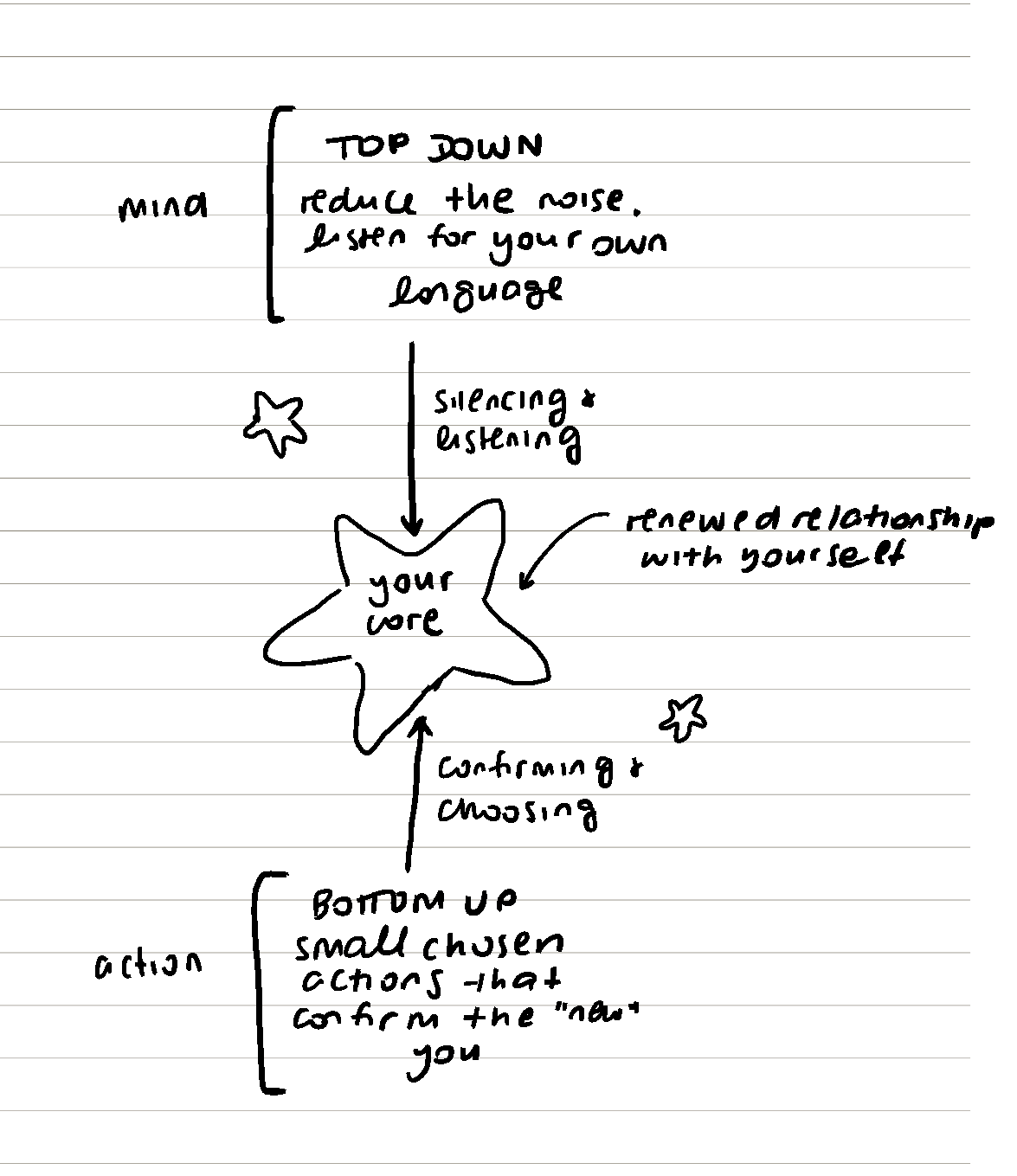
But this blueprint/language/however-you-want-to-call-it doesn’t have to be your native one, as your will can determine what to do with what you inherited. Most of our identity and values unfold in everyday choices, and you can have both a top-down or/and bottom-up approach. The top-down approach signifies reducing unnecessary noise and opinions to listen to your personal core and truth, and initiate an authentic conversation with yourself (your language). The bottom-up approach is choosing small actions that will inevitably confirm your renovated relationship with yourself (aka choosing to dedicate time to things you love, learning to say no to what “you’re supposed to” and choosing what to keep of what you were given)
For those multi-passionate people that have already found a renovated and authentic path, it’s easier to focus on the creative/learning part, and highlight the giftedness of their peculiar identities. But for those that are just starting out, the most difficult trial is reducing the weight of the inherited language, of the myths we perform so consistently that start to feel like facts, and I’d like to debunk the most important ones together.
Feeling like an imposter can be both a feeling and a state of being. You can feel anxious, nervous, hesitant, underprepared; and you can also lean into the delusion that you’re actually an imposter there.
But to be an imposter, you’d have to be deliberately deceiving someone. You’d have to know the truth and actively perform a lie. Is that what’s happening? For most of us, no. What’s actually happening is simpler and harder to romanticize: we don’t know enough yet, we’re perfectionists and would love to be experts, but we haven’t done enough in that space yet. We’re inexperienced; and inexperience, unlike imposture, has a completely ordinary solution: spend some time in the space. You don’t have to perform like an expert, you have to be there as yourself, meet that version of you that is just starting out and be honest about it.
The language matters because one of these things feels like a verdict, and the other is just a starting point.
Perfection is inherently subjective, and somewhat temporary, as it changes and adjusts according to your taste, your experience, your growth. What was perfect yesterday is already not quite it today (not quite my tempo!). The moment we associate our work with a permanent, objective standard of perfect, we’ve attached ourselves to something that never existed and never will.
We don’t need to be perfect and our work doesn’t need to be perfect. We just need to be, as our art, work, or anything else won’t be the final verdict of who we are as people.
The idea that there is a finite thing — resources, recognition, audience, success, call it what you want — and that what someone else takes reduces what’s available to you will inevitably make you feel miserable. We unfortunately inherited this language too!
You can hand someone your entire way of doing something — your process, your words, your framework — and they cannot replicate what you do with it. Because they don’t have your life, your particular arrangement of experiences and losses and joys and obsessions, your specific way of moving through people. These things aren’t transferable, which means by definition you don’t have competition, you have context. Yours is different from everyone else’s, which means what you make is different, which means there’s no contest.
Collaboration is rooted in abundance, while competition is rooted in the fear that abundance isn’t real.
“By a certain age, I should have. By now, I should have”
The language of timelines is so embedded in how we measure ourselves that we’ve taking it for granted, but I’d like for you to notice that nature never does this, and there’s something almost offensive about how clearly it demonstrates it, and how we ignore it when applied to ourselves.
You have your own life and your own timeline. It’s not a lesser version of the one you were supposed to have: it’s the actual and factual one, the only one that exists, the one built specifically from who you are and where you’ve been, and it’s yours.
I come back to Wittgenstein because I think most of the authentic work is linguistic, it’s about learning which words you were handed and which ones you actually chose. Some of those manifesting and mirror work that you might have seen online is actually rooted in a bigger context: what words do you use when talking to yourself. It’s about noticing the difference between what feels like yours and what feels like given for granted. The language you inherited shaped the world you live in, but you can change the language, and when you do, the world changes with it.
It’s just a matter of practice, a way of continually refusing to let inherited limits become your permanent ones, and constantly rebuilding your inner conversation.
In the end, most of what we’re told says more about the speaker than it does about us. When an identity or story no longer matches how we see ourselves, we can choose to let it go. Some parts of us will not change: our past, our family, our early experiences. But everything that is still within our reach is ours to shape, and we can make the best of what we have.
The Modern Renaissance is a community for multipassionate people and generalists who want to broaden their horizons and keep discovering across multiple disciplines. It’s a place to create, discover, meet like-minded people, and see what happens when you bring them all together.
you can find more about it here: https://readymag.website/u3615395533/5964648/
and join the discord community here: https://discord.gg/TwatnEQd
No posts
Comments
Nothing yet. Say the first thing.
Sign in to join the conversation.