
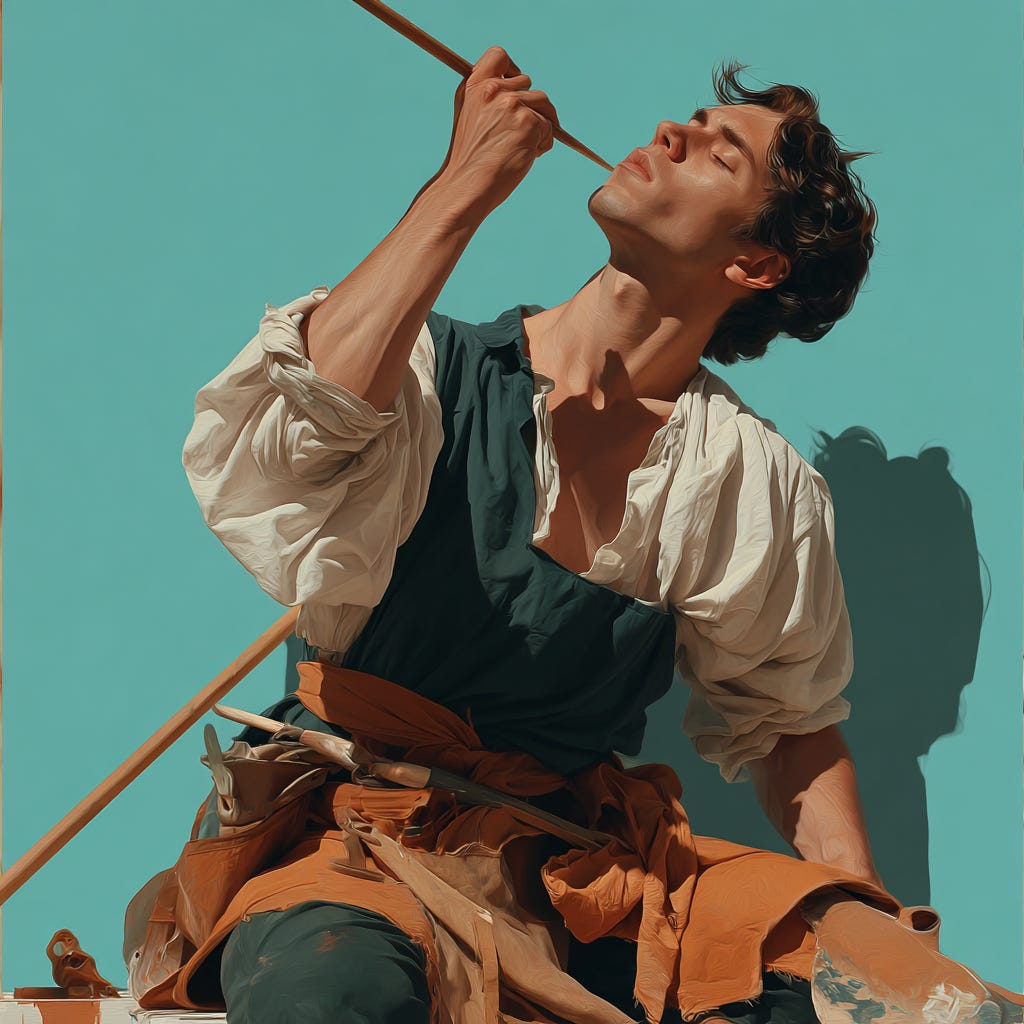
when what you love becomes what you sell, something starts to blur.
this episode is about that, and about what happens when you decide to protect your way of seeing before optimizing your output.
listen here:
Leonardo Cametti is a Rome-born creator, educated at H-Farm, now growing between content, strategy, and community. He’s within the creator economy, produces short-form content for brands and startups, and co-founded A Good Eye, a community born from this question: where do creatives go when the camera turns off?
how do you handle both creating for someone else and creating for yourself?
indeed, when you work full-time inside someone else’s vision, your own ideas slowly stop knocking. They’re not gone, but because your mind commits completely to the project in front of you, it’s hard to come up with new ideas for yourself. There might not be an answer to this problem yet, but it’s always fundamental to keep some time for your own creations and experimenting, without using your creative skills solely for others’ output.
your passions should never eat your work, and viceversa, and when you turn your hobbies into your main source of income, the blurred line between passion and profession cuts through everything else.
especially in today’s world, most of creativity comes from words: blog posts, scripts, carousels, linkedin posts, messages; but that is not the case for everyone. Leonardo’s creative process is reluctant to strategy or scripts: instead, it begins with images. His mind start to fill with voids, lights, hands appearing from nowhere, scenes with no immediate meaning and so on.
only after a bit, here they come the words! Either to anchor intuition (personal projects) or to translate intent into visuals (client work). When working with scripts, he describes a slow, precise method: reading line by line, attaching a precise image to every sentence, like playing the video in slow motion inside your head, and finally creating a storyboard
that said, patience becomes a creative advantage.
not realizing your full potential, especially as a creative, can be the most daunting fear.
however, here’s the paradox: thinking too much about potential often prevents action. Realizing it requires forgetting about it, and we could mention so many great speeches (some of them also quite recent).
just a quote here from Martin Supreme:
and we also recommend watching Steve Jobs’ speech:
then we come to Leonardo’s project, A Good Eye.
A Good Eye is an attempt to reconstruct something history always had: the rooms every creator needed to…create and connect with like-minded people.
in the Renaissance we had courts, during enlightenment there were the cafés, or in Germany we had the Bauhaus etc.
but what about today? Today many creatives close their laptops at night and find… silence, also because usually they lives very far from each other.
A Good Eye then tries to organize events and meetings for creatives - ultimately, places - when and where creatives can meet together, like “salotto creativo” evenings, curated dinners, retreats where creatives teach creatives and so on.
it’s important to recognise those people who refuse to collapse their work into a single axis, those that move in the space where attention to craft coexists with responsibility toward others, where having a vision does not cancel out a sense of service, and where building projects is inseparable from cultivating the people around them.
Leonardo’s work is less about producing outputs and more about shaping the conditions that allow creativity to stay alive over time - socially, emotionally, and structurally - so that it can keep emerging without being prematurely exhausted.
your potential isn’t something you arrive at by refining the plan again and again. It tends to surface while you’re already moving, when attention shifts from controlling direction to inhabiting the terrain you’re crossing. Walking changes perception: details appear, instincts recalibrate, curiosity replaces optimization. In that state, ability grows sideways rather than forward, shaped by encounters rather than forecasts. Sometimes the most generative choice a creator can make is to safeguard their way of seeing, treating it as a living faculty, long before it solidifies into a concrete outcome.
Comments
Nothing yet. Say the first thing.
Sign in to join the conversation.