
0:00
-7:36
Barry Rellaford, guest author
I was 20 years old, living in Brittany, France—co-leading a team of about a dozen people for a nonprofit, and honestly, I was learning leadership on the job.
During a training session in Paris, our regional president, Dean Robinson, asked to talk with my co-leader and me privately. He looked at us and said: “If you need something, it will take us four hours from Paris to get to you.” He paused. “I just want you to know — I trust you.”
That was it. Nothing more.
That moment is etched in my heart. It wasn’t a speech. He didn’t list our qualifications or walk through a plan. He just named something — a choice he was making about us — and returned to the training.
And I stood there feeling the incomparable power of being trusted.
Over the years since, I’ve reflected regularly on that ten-second exchange. Being trusted as a young leader by someone I respected—and loved—so much gave me a new way of seeing myself. Eventually I met David Emerald Womeldorff and discovered The Empowerment Dynamic (TED*), and also worked with Stephen M.R. Covey to create The Speed of Trust, both of which gave me the lenses and language for something I’d already experienced in a meeting room in Paris.
I’ve come to understand that a lot of TED*’s power comes from exactly what Dean Robinson did for me: trusting others, even before they’ve fully proven themselves or “earned” it. Trusting ourselves and our intentions. Choosing to forgive, and to ask for forgiveness. These aren’t soft, abstract ideas. They’re the connective tissue of great relationships and teams.
The two triangles, and where trust lives
The TED* work describes two orientations to life. The upper triangle — Creator, Challenger, Coach — is future-focused. It’s built on what you want to create, the possibilities before you. The lower triangle — the Drama Triangle of Victim, Persecutor, and Rescuer — is often stuck in the past, pointed toward problems, and fixated on fears of what might happen.
Trust abounds in the upper triangle.
When Dean Robinson extended trust to me before I’d earned it, he wasn’t being naive. He was making the choice to see my colleague and me as Creators by being one himself. And in so doing, he invited us into the upper triangle with him. That’s what trust does when it’s offered generously and wisely—it creates the conditions for all of us to rise.
Trust is a choice before it’s a result
Some of us treat trust like a scarce resource. We look for evidence that people can be trusted. We wait. We watch. We stand guard.
And that’s understandable. Distrust is learned through real experience. Kids trust naturally — we have to teach them “stranger danger.” Yet we all get disappointed by people we should be able to trust, and some get deeply hurt. The fact that adults trust anyone at all is, when you think about it, something of a miracle.
Remember this: trust is also a verb. It’s a choice. And a series of wise choices can become a habit. We are not creatures of habit—we are creators of habit.
One of the most powerful things you can do for a relationship is to choose to trust someone when they don’t yet have the track record to fully justify it. To say, in effect: I’m going to move forward with belief in you. That’s a leap of faith. It’s also how trust gets built, rather than just waited or hoped for.
We don’t create alone
Another lesson I’m learning is that we rarely create by ourselves. The most meaningful things I’ve been part of — the relationships, the teams, the work that actually lasted — are built together. We’re designed for relationship. We’re co-creating.
And someone has to go first.
When you’re willing to extend trust before it’s been fully earned, you’re not being reckless. You’re being a Creator. You’re taking responsibility to bring about the relationship you want to have, rather than waiting for the other person to prove they deserve it. That’s leadership.
Empowerment and trust are the same flywheel
If you want to empower someone, trust them. If you want to build trust with someone, empower them — give them room to grow, to stretch, to make mistakes, and learn from them.
These aren’t two separate movements. They’re the same motion.
Empowerment isn’t something we do to people — it’s something we do with them. We use our network, our experience, our authority to create conditions where others can do more than they thought they could. That’s different from controlling, from rescuing, from “motivating.”
Contrast that with the spinning wheel of the Drama Triangle — a lot of motion, no forward progress. Fear-based. Exhausting. We tell ourselves we’re being protective or responsible, but a lot of the time we’re just afraid — afraid of being taken advantage of, of being hurt, of losing control.
TED* is a flywheel. Momentum that builds on itself. Trust enables empowerment. Empowerment deepens trust. And that cycle — when you get it going — is extraordinarily creative.
A final thought about trust
You cannot challenge someone, coach someone, or really be in a meaningful relationship with someone without a foundation of trust. Without it, even well-intended feedback lands as criticism. Even honest questions feel like personal attacks.
The subtitle of The Speed of Trust is “the one thing that changes everything.” I still believe that — not because trust is magic, but because its absence costs so much. It slows progress. It multiplies cost. And more than that, it drains energy and eliminates joy.
I’m still learning about trust because I’m still learning about myself. Learning to trust wisely. Learning when to extend it, when to rebuild it, and how to hold it when it’s been strained.
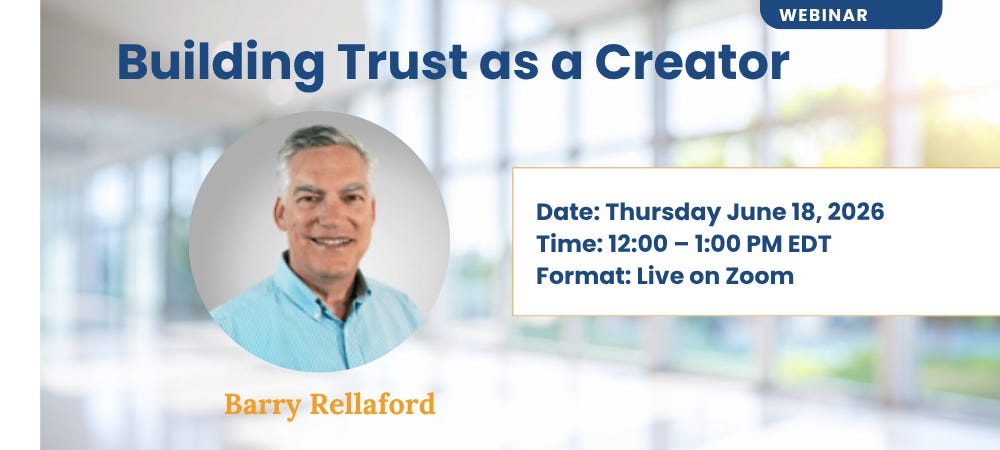
If any of this resonates — if you’re curious what it looks like to generate more trust in your relationships, your team, your life — I’d love for you to join us on June 18th as we go deeper into these ideas together.
To the Creator in You,
Barry
Barry Rellaford is a globally sought-after leadership development expert with more than 30 years of experience as a coach, facilitator, and organizational leader. Barry is on the board of directors and ownership group of the Center for The Empowerment Dynamic.
Click the image below to register!
Comments
Nothing yet. Say the first thing.
Sign in to join the conversation.