
Hello Shining Ones,
It’s been a time since I shared a new oracle card from Celtic Dream Oracle: Ancient Symbols to Guide Your Modern Life. This card took from February to now, July, to come through. That’s how this oracle emerges: some cards arrive in one fell swoop; others shapeshift and gestate for months.
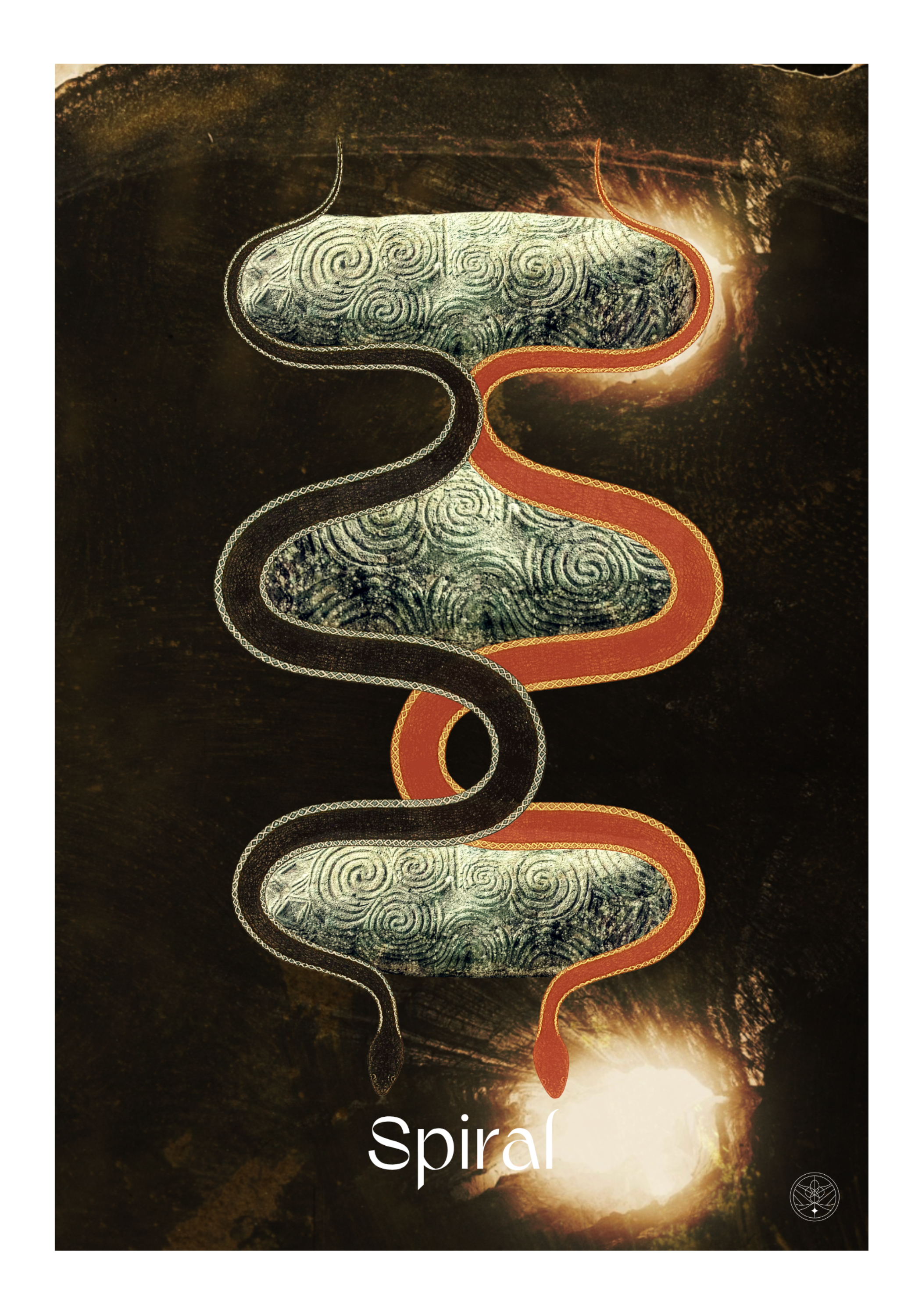
Unconscious, Widdershins, Inner Power
The Gifts
Two serpents entwine over three spiralling stones. The one who slithers left travels towards the dark, deep into the realm of the unconscious, the Otherworld and soul. The one who slithers right travels towards the light, bringing the depths up into consciousness, the waking world and ego.
When our eyes fall upon a spiral, we are met with something we know, or conscious, and something mysterious, or unconscious. There’s nowhere I sense this more than when I’m at Newgrange (Sí an Bhrú), the 5,000-year-old Neolithic temple on the River Boyne. The entrance stone to Newgrange, pictured three times in this oracle card, is adorned with marvellous spirals. These spirals are separated by a line thought to represent the temple’s 19-metre passageway, aligned to the sunrise after the longest night of the year. If you follow the energy from the centre of the double spiral to the right, you move sunwise. If you follow the energy of the tri-spiral to the left, you move widdershins.
There is a long-held ritual in Ireland of walking deiseal, ‘sunwise’, and tuathal, ‘widdershins’, to activate different energies. We see this with the goddess Bóinn, who in her creation myth walks three times widdershins around a secret well to become the River Boyne. One of the words for a sorceress in Old Irish is bantúathaid, a woman who moves to the left. There is much superstition in Irish folklore about moving tuathal, as it is believed to be a form of cursing. But what if, as the spiral at Newgrange indicates, it symbolises a movement down into the unconscious? The islands of the Celtic Otherworld are said to lie in the widdershins direction, to the left, the west, the setting of the sun. This is the hidden realm of the divine, of the ancestors, of soul magic. A place deep within us that we desperately long for and are afraid of because it exists beyond what we’ve been taught is rational, and no one wants to be perceived as mad.
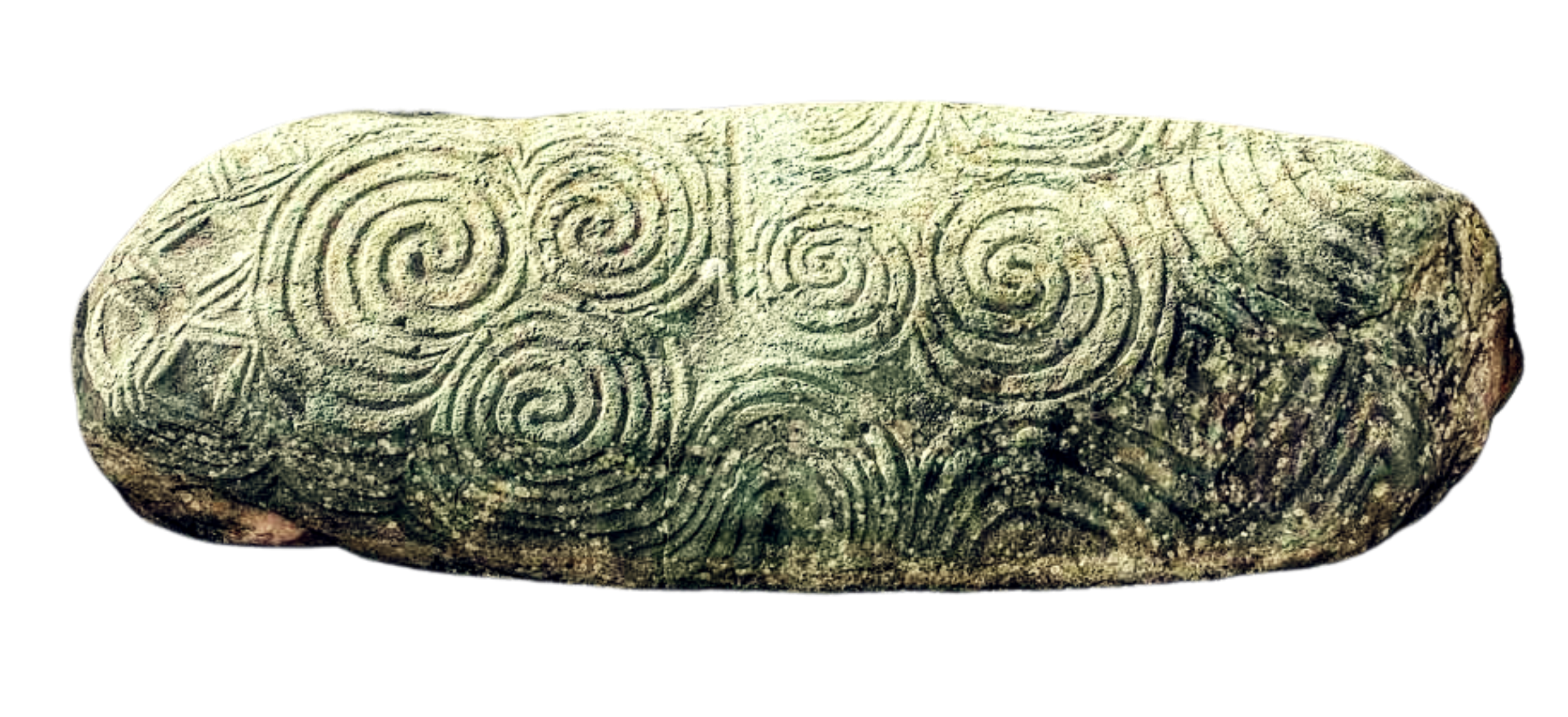
Carved into the back recess of Newgrange’s womb is another triple spiral. If you were to follow this spiral with your gaze, you would enter a unicursal maze, like a labyrinth, where there is one pathway and no dead ends. To complete it, you must travel deiseal and tuathal, cycling with what is conscious and known, and what is unconscious and a mystery. This is in essence the way of the spiral.
In the oracle, you see the serpent wrapped around the stone, another form of coiling spiral, a symbol Ireland has become synonymous with, even though the snake likely never made its home here. We all know the story of St Patrick banishing the snakes of Ireland, often seen as a deliberate rejection of the Old Ways, of the goddess of birth, life, death, and rebirth, and of feminine spiritual authority. A rejection, in other words, of spiral consciousness. Still, because the spiral and the serpent are archetypal images that live deep in the patterns of the human psyche, we see these motifs seep into the illuminated manuscripts of Celtic Christianity, with its intricate spirals, triskeles, and knotwork. The spiral within never stops spinning.
There is a curious tale in the Dindshenchas, the ‘Lore of Places’, that tells us that the Mórrígan had a son called Méiche, who beat with not one, but three hearts in his chest, each coiled with a serpent. Fearing these snakes would grow in power and lay waste to Ireland, the king-warrior Mac Cécht, ‘Son of the Ploughshare’, ploughed out the hearts and burned them. He threw their ashes into the River Barrow (An Bhearú in Irish, meaning ‘boiling’), and all river life boiled and perished.
Mac Cécht, who is himself a triple king, is married to Fódhla, a triple goddess with her sisters Banba and Ériu, from whom Ireland, Éire, gets its name. These goddesses embody the fertility and abundance of the land. Their mother is Ernmas, who is also mother to another triple goddess, the Mórrígan, Méiche’s own mother and her sisters, who evoke the chthonic and destructive aspects of the feminine principle. The Mórrígan herself can shapeshift into an eel, which, although biologically different to a snake, overlaps mythologically.
Both the trinity of Ériu and the trinity of the Mórrígan are necessary; heart and serpent must co-exist. If we can transmute the shadowy aspects of the self that the chthonic serpent represents, we strengthen our hearts as the compass of soul. In doing so, we fiercen our capacity for love, and for a more resilient, abundant life. Our shadow contains the unconscious aspects of ourselves that we deem ‘good’ or ‘bad’, which the ego has rejected, repressed, or never recognised. This includes hidden talents the ego has exiled for fear of living more fully. Like Méiche’s snakes, it feels dangerous to grow, but not living is also a form of destruction. We see this in the myth: Mac Cécht, the fearful ego voice of ‘What if it all goes wrong?’, destroys the serpent hearts, robbing Méiche of his triple heart’s potential, and killing the waters of life.
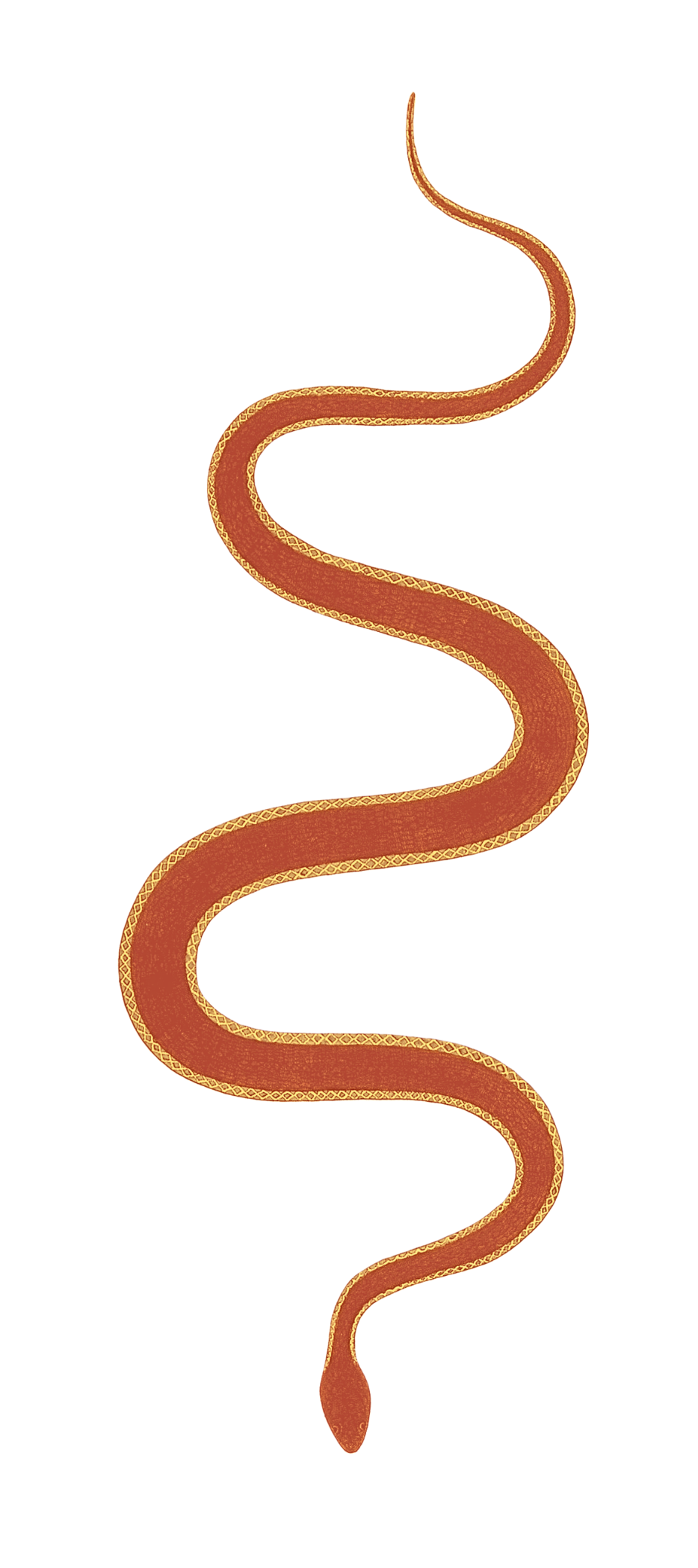
We all have serpents around our hearts, which contain both medicine and poison. If we have the courage to work with them as the unconscious, to spiral tuathal into the unknown places within us and undertake the task of shedding the old worn-out skins that keep us stuck, poisoned and unliving, then walk deiseal to bring this soul wisdom out into life, our hearts beat stronger, pulsing with lifeforce, kundalini, and our inner power.
One of the earliest known symbols of medicine is the Rod of Asclepius, the Greek god of healing, depicting a serpent spiralling around a wooden staff. People worked with the unknown in the Asclepion temples by asking for a dream to guide their healing, entering a state of dream incubation. Perhaps Newgrange was also once a dreaming temple.
The spiral is here to guide you, both in your dreaming and your waking life, to reveal what is hidden within you that wants to be lived. The spiral is spinning, the serpent has stirred, it’s time to acknowledge your inner power.
Place a stone on the ground in front of you.
Stand with your feet almost touching the stone. Take a breath. Invoke:
‘I am a Daughter (or Son, Child, etc.) of the Spiral, reveal to me that which is unknown.’
Begin to walk tuathal, widdershins, in a spiral formation, away from the stone, which forms the centre. Take a soft, meditative gaze as you walk.
Go slow. Trust that revelation will come. If not today, then when you are ready.
Once you have a sense of completion walking tuathal, offer your gratitude to the Spiral.
Commit to taking whatever is revealed (even if it’s nothing, i.e. patience) with you into your conscious life.
Turn to the right and begin walking deiseal, sunwise, until you reach the centre stone.
Pick up your centre stone, holding it against your heart. Breathe. Then, when you are ready, close down the ritual space.
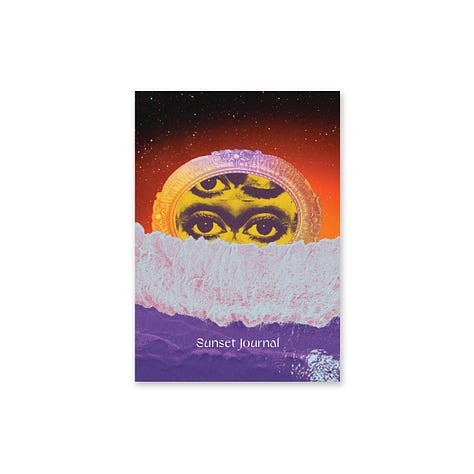
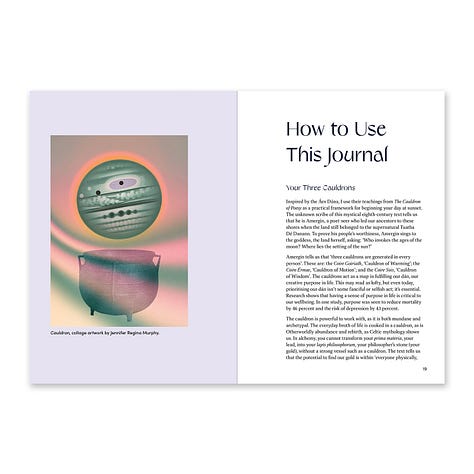
I am buzzing to share that pre-orders for my limited edition Sunset Journal will open by Lughnasa. The journal will be in your hands in September, a perfect autumn companion. Sign up for the waitlist and you’ll be first to hear when pre-orders open:
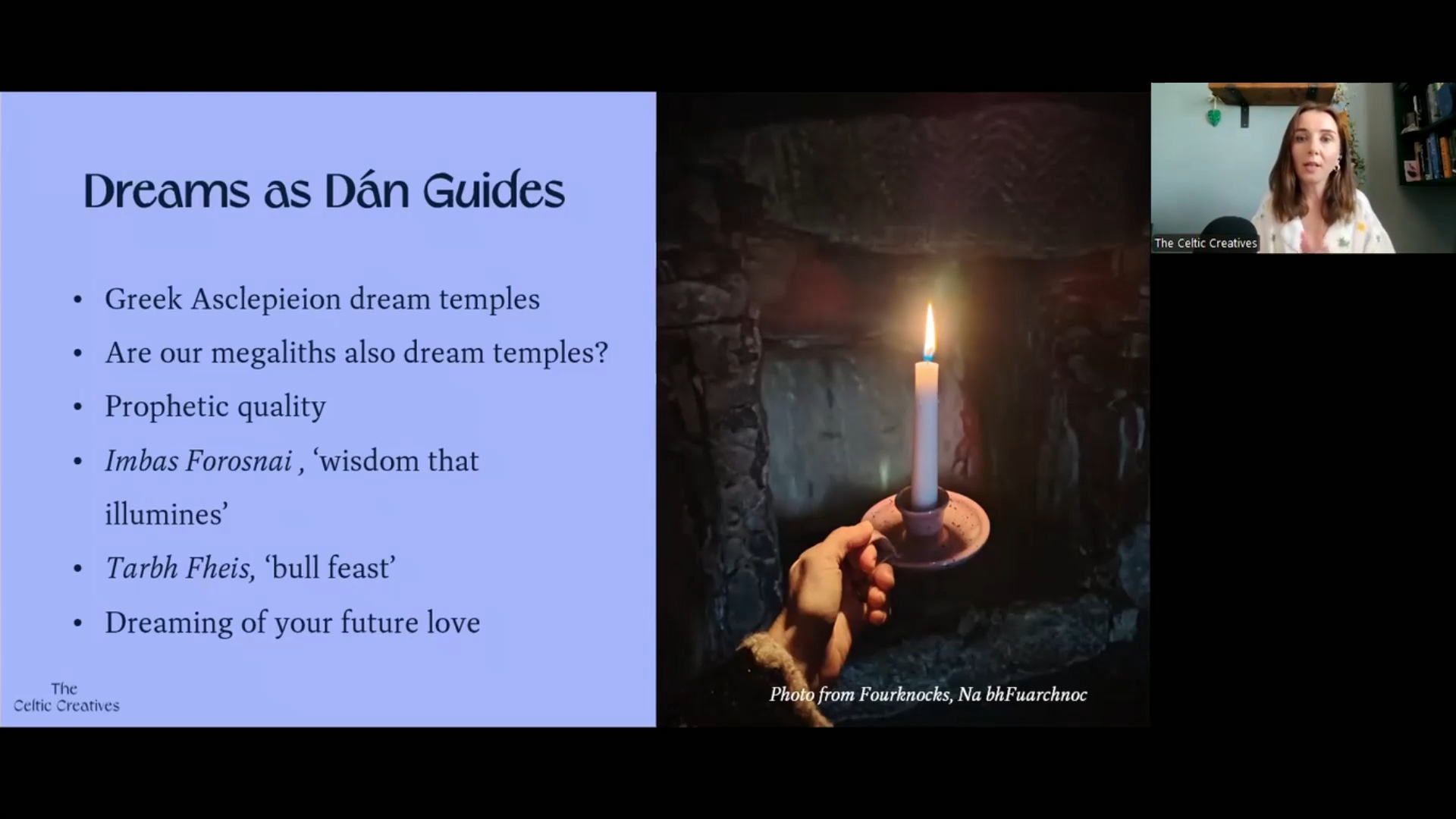
Before July leaves us, I will also open enrolment for a new self-paced workshop for anyone who is curious about the dreaming traditions of our ancestors, and how this wisdom can enhance your own night dreams as a form of spiritual practice and Otherworldly co-creation. Stay close for details, more coming soon…
Croí isteach,
Jen x
Aidan Meehan, Celtic Design: Spiral Patterns
Mary Condren, The Serpent and the Goddess: Women, Religion, and Power in Celtic Ireland
Whitley Stokes, ‘The Prose Tales in the Rennes Dindshenchas’ Revue Celtique 15 (1894): 272–336, 418–484
No posts
Comments
Nothing yet. Say the first thing.
Sign in to join the conversation.