
Thirteen years separate the deaths of Jason Arday and Aaron Dugmore. An unbridgeable gulf separates the meanings Britain’s legacy media and institutional class were prepared to attach to them.
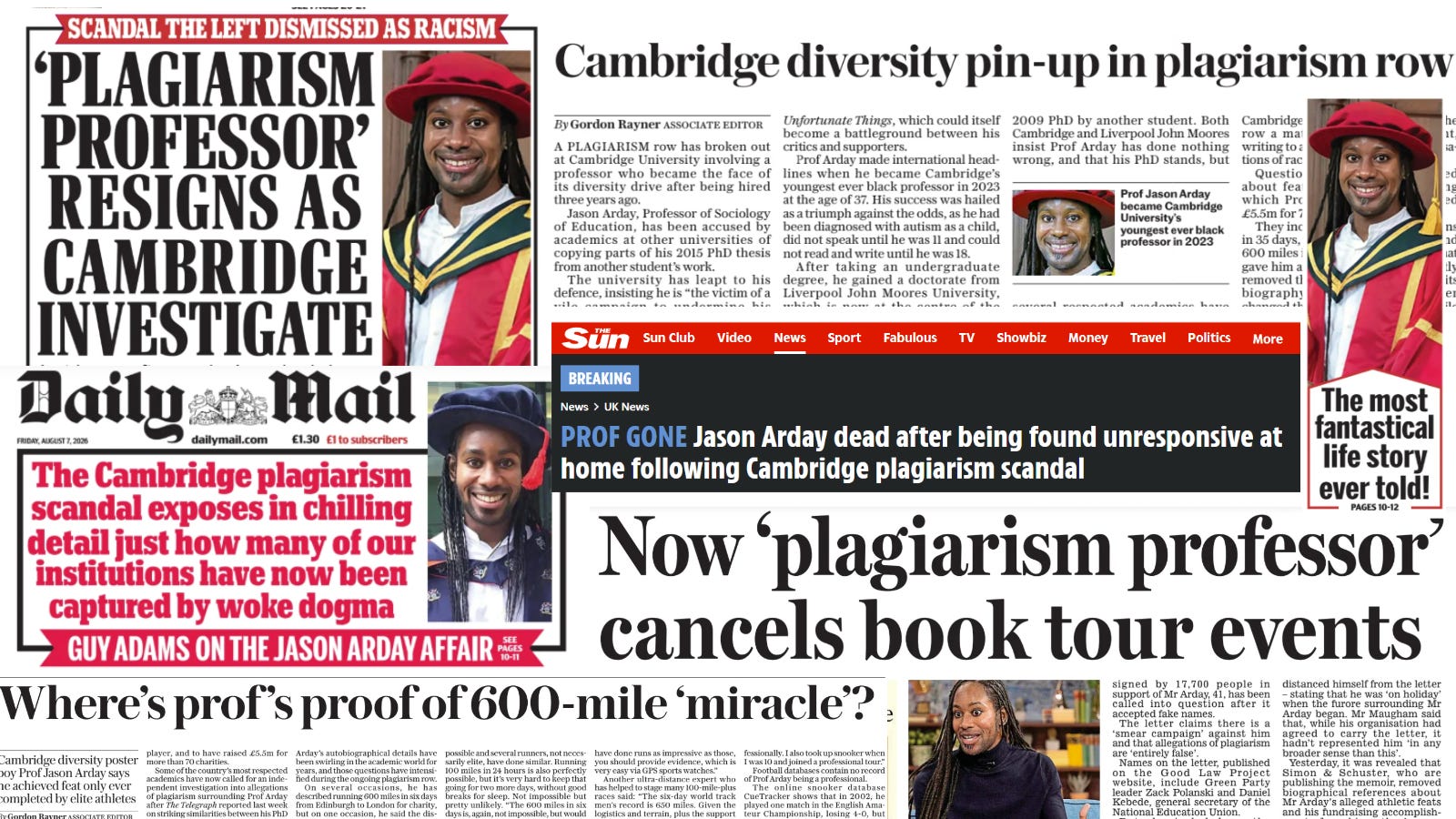
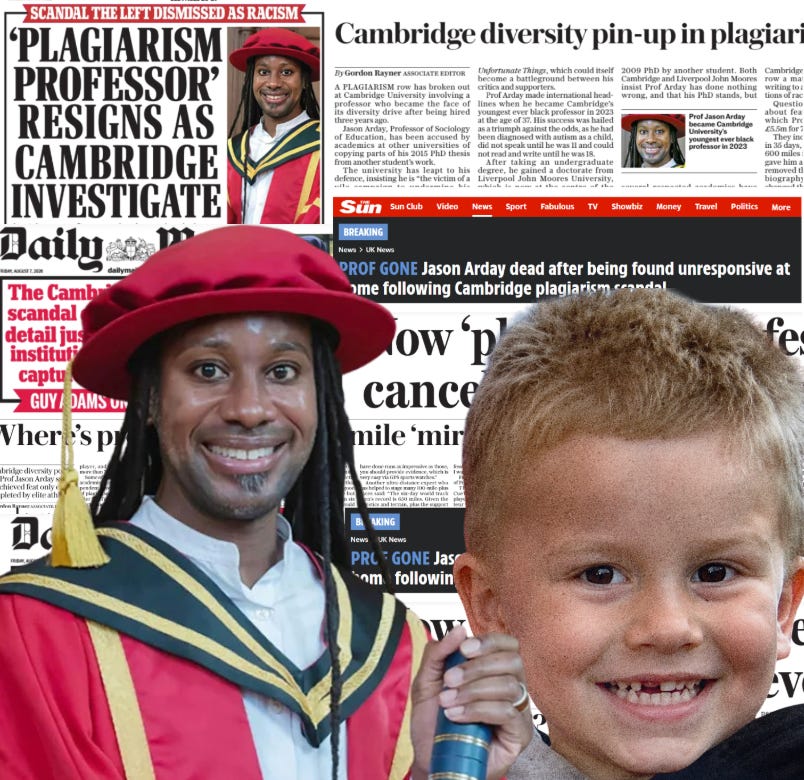
Jason Arday died on 14 August 2026, aged forty-one. Police found him unresponsive at an address in Battersea and are treating the death as unexpected but not suspicious. Nine days earlier, he had resigned as Cambridge’s youngest Black professor after The Times documented extensive passages in his doctoral thesis that were identical or near-identical to earlier work, alongside serious questions about his qualifications and biography. He denied plagiarism. Cambridge, after initially circling the wagons, opened an investigation.
What happened next is the reason his death opens this article, though the actual article is not about him. Within a day, a complete interpretive apparatus had assembled itself. His family’s statement, issued through his publisher, described a three-year campaign of sustained racial abuse. The Mayor of London called it a “pernicious public shaming.”1 Simon Baron-Cohen, who spoke to Arday hours before his death, relayed Arday’s belief that plagiarism allegations function as a racist playbook for bringing down Black academics, invoking Claudine Gay.2 Hacked Off demanded an inquiry into press culture.3 It seems as if Britain possesses a fully developed vocabulary for recognising that a black person’s suffering may have a racial dimension.
The question is whether that reflex survives when the races are reversed. The answer, written in blood and institutional silence, is no.
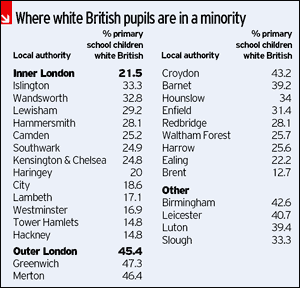
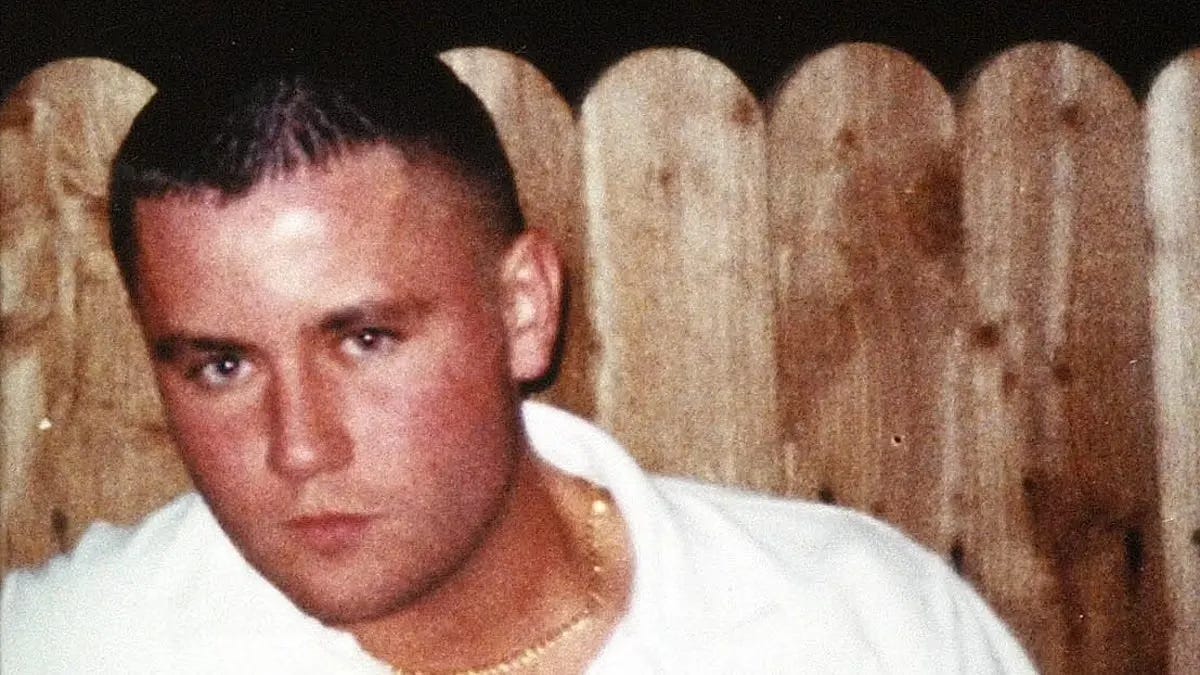
Aaron Dugmore was nine years old when he was found at his home in Erdington on 12 February 2013 with an electrical extension lead around his neck. He died the next day at Birmingham Children’s Hospital. He had only recently started at Erdington Hall Primary School, where White pupils were already a small minority, under 25 percent.4
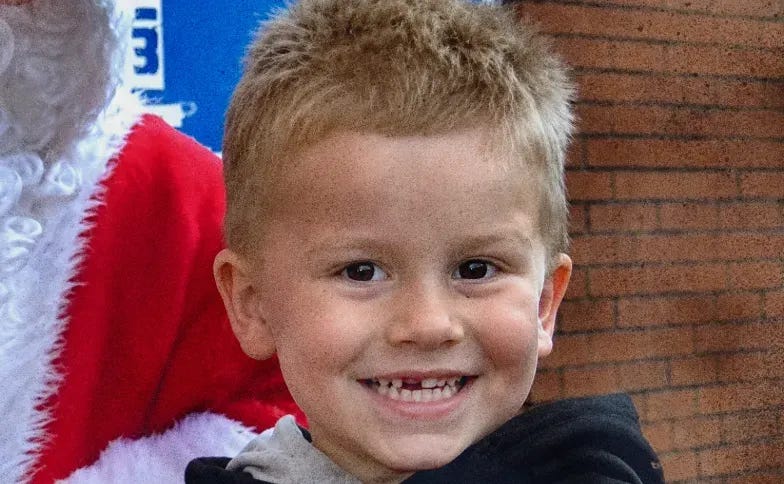
In the days after his death, his mother, Kelly-Marie Dugmore, and stepfather, Paul Jones, described how Aaron had changed from his first days at the school. A group of Asian classmates taunted him for being White. One child told him, “All the white people should be dead.” He was threatened with a plastic knife and warned that next time it would be real. He hid from other children in the playground at lunchtime. When he or his parents raised the bullying with the school, they were not taken seriously.
At the inquest in July 2014, Birmingham coroner Louise Hunt heard that a police investigation found “no evidence of systematic bullying” and that incidents had been dealt with “appropriately and proportionately.” On the night Aaron was found, he had argued with his younger brother and been sent to his room. The coroner, unable to accept that a nine-year-old could form a settled intention to die, recorded a verdict of accidental death and called it “an absolute tragedy.”
Notice what Britain’s institutions did with a clear allegation of racial torment directed at a White child in a majority-minority English school: nothing. No education select committee took evidence on the bullying of minority-White pupils. No charity commissioned research. No university department turned it into a field of study. There is a vast academic literature on the racist bullying of ethnic-minority children. There is virtually none on the reverse, even though the demographic conditions that make the reverse possible now exist in hundreds of English schools. When a minority child’s suffering is alleged to be racial, the allegation itself is treated as national data about Britain. Aaron’s was treated as one family’s private tragedy and then forgotten.
Ross Parker. In the early hours of 21 September 2001, ten days after the attacks on New York, a seventeen-year-old cellarman was walking home from his pub shift in Peterborough with his girlfriend when a group of men blocked the cycle path along Bourges Boulevard. He was sprayed with CS gas, beaten with a hammer and stabbed with a hunting knife. He bled to death on the path. In December 2002, Shaied Nazir, Ahmed Ali Awan and Sarfraz Ali were convicted of his murder. Sentencing them, Mr Justice Jowitt told the court they had armed themselves to attack an innocent man they might find by chance, “simply because he was of a different race to yourselves.” That is a High Court judge, at the Old Bailey standard of proof, describing a racially motivated hunting of a White boy.
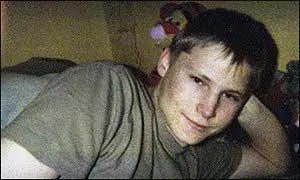
Now the afterlife. In the days after the murder, police initially stated there was no reason to believe the attack was racially motivated. The national press, saturated with post-9/11 coverage gave the case a fraction of the attention its mirror image would have commanded. Parliament noticed it once, in 2003, Peterborough’s MP offered condolences in the Commons. There has been no inquiry, no documentary of consequence, no anniversary journalism beyond the local paper. His memorial is a plaque in Netherton and an annual football match played by the people who actually knew him.
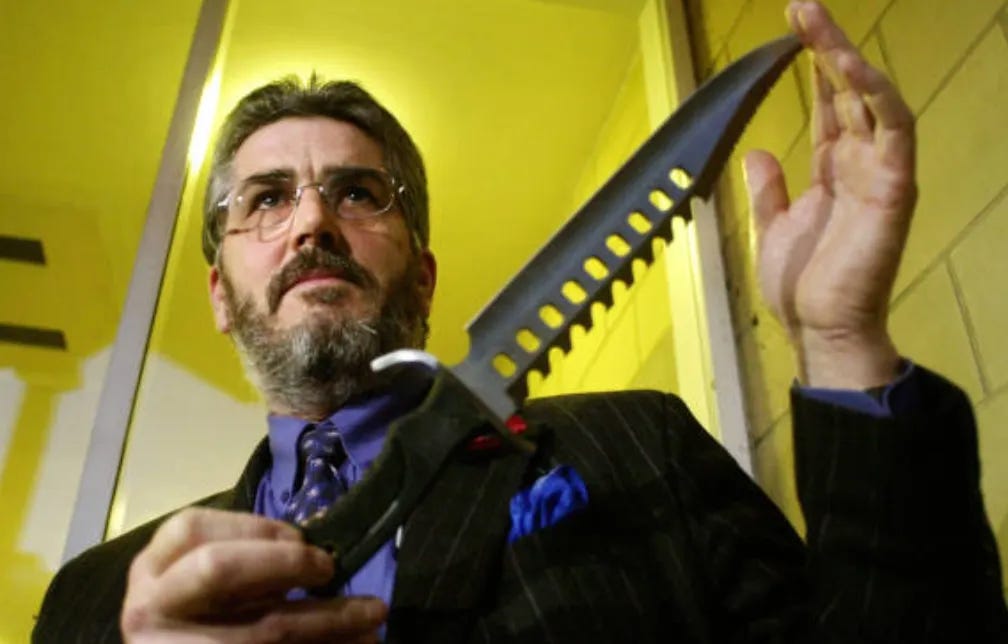
Richard Everitt. Seven years earlier, in Somers Town, the wedge of council estates between Euston and St Pancras, a fifteen-year-old came back from buying food with two friends on an August evening in 1994 and met a gang of Bangladeshi youths, perhaps fifteen or twenty strong, who were roaming the estate seeking revenge for a mugging committed by a different white boy the previous day. Richard Everitt was stabbed in the back with a kitchen knife and died. At the Old Bailey, Badrul Miah was convicted over the killing and jailed for life; the trial judge described it as an unprovoked racial attack. Most of the gang were never convicted of anything.
The Everitt case is instructive because an anthropologist happened to be standing next to it. Rosemary Harris of UCL had been studying ethnic conflict in Somers Town before the murder, and had personally observed Richard’s parents complaining to his school, weeks earlier, after he was set upon by a crowd of Bangladeshi boys. Her account, published in Prospect, recorded two findings that institutions did not want: that the estate’s violence ran in both directions rather than flowing solely from white racism, and that teachers feared disciplining Bangladeshi pupils lest they be accused of racism. She reported that the local council lost interest in her research when its conclusions took this shape. The local MP reportedly believed that acknowledging a racist motive would only inflame tensions, an anxiety about community relations that has a way of appearing precisely when the victim is white. Richard’s family campaigned for three decades for a permanent memorial, at one point his memorial stone was removed from the estate. A bench and plaque were finally unveiled in 2024, thirty years on, after what the local paper called a long battle for recognition. Stephen Lawrence, a black man, murdered eight months earlier a few miles south-east, has a national day, a research centre, a Westminster Abbey memorial and a place in the citizenship curriculum. So why did the Everitt family had to fight thirty years for a bench?
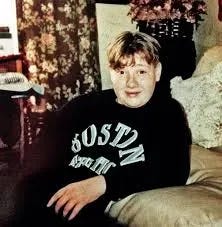
Kriss Donald. I have written about Kriss Donald at length elsewhere, so here the facts can be brief, which is itself a mercy. In March 2004, a fifteen-year-old Glasgow schoolboy with no gang involvement was abducted from Kenmure Street in Pollokshields by five men seeking revenge for an attack on their leader by white men the night before. Unable to find the men responsible, they took the first white boy they encountered. He was driven two hundred miles across Scotland while his captors telephoned around for premises, then brought back to the Clyde Walkway, held down, stabbed thirteen times, doused in petrol and set alight. The convictions that followed, Daanish Zahid in 2004, then Imran Shahid, Zeeshan Shahid and Faisal Mushtaq in 2006, included the first convictions for racially motivated murder in Scottish legal history. The victim of Scotland’s first legally recognised racist murder was a white child. Almost nobody knows this.
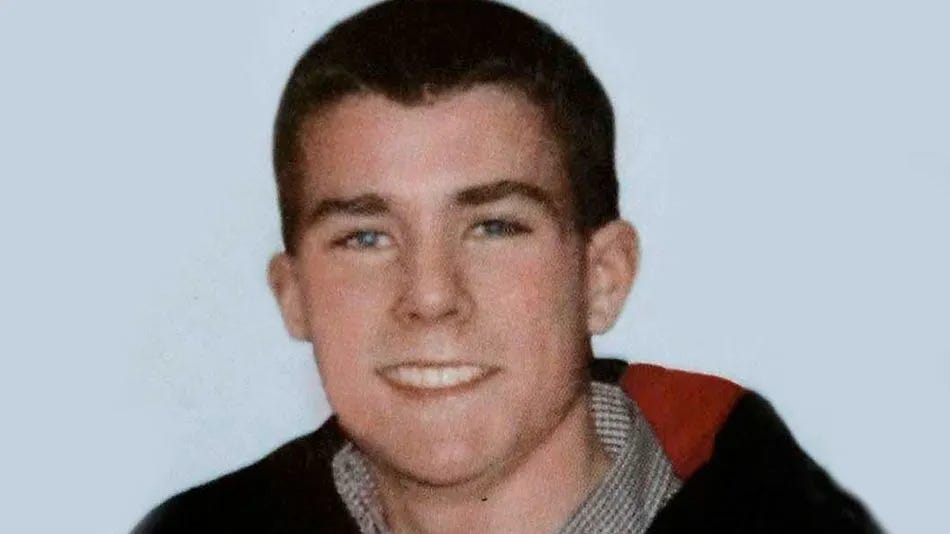
And here, unusually, the institution confessed. The BBC carried the case on UK-wide bulletins only a handful of times, coverage of the first trial was largely confined to Scottish output, and the corporation did not mention the second trial on its main national bulletins until its eighteenth day. After complaints, the BBC’s head of television news, Peter Horrocks, apologised and admitted the corporation had got it wrong. Peter Fahy, then the Association of Chief Police Officers’ spokesman on race, observed around the same period that many police officers and professionals preferred to avoid discussing attacks on white victims for fear of being criticised, and called that instinct unhealthy.
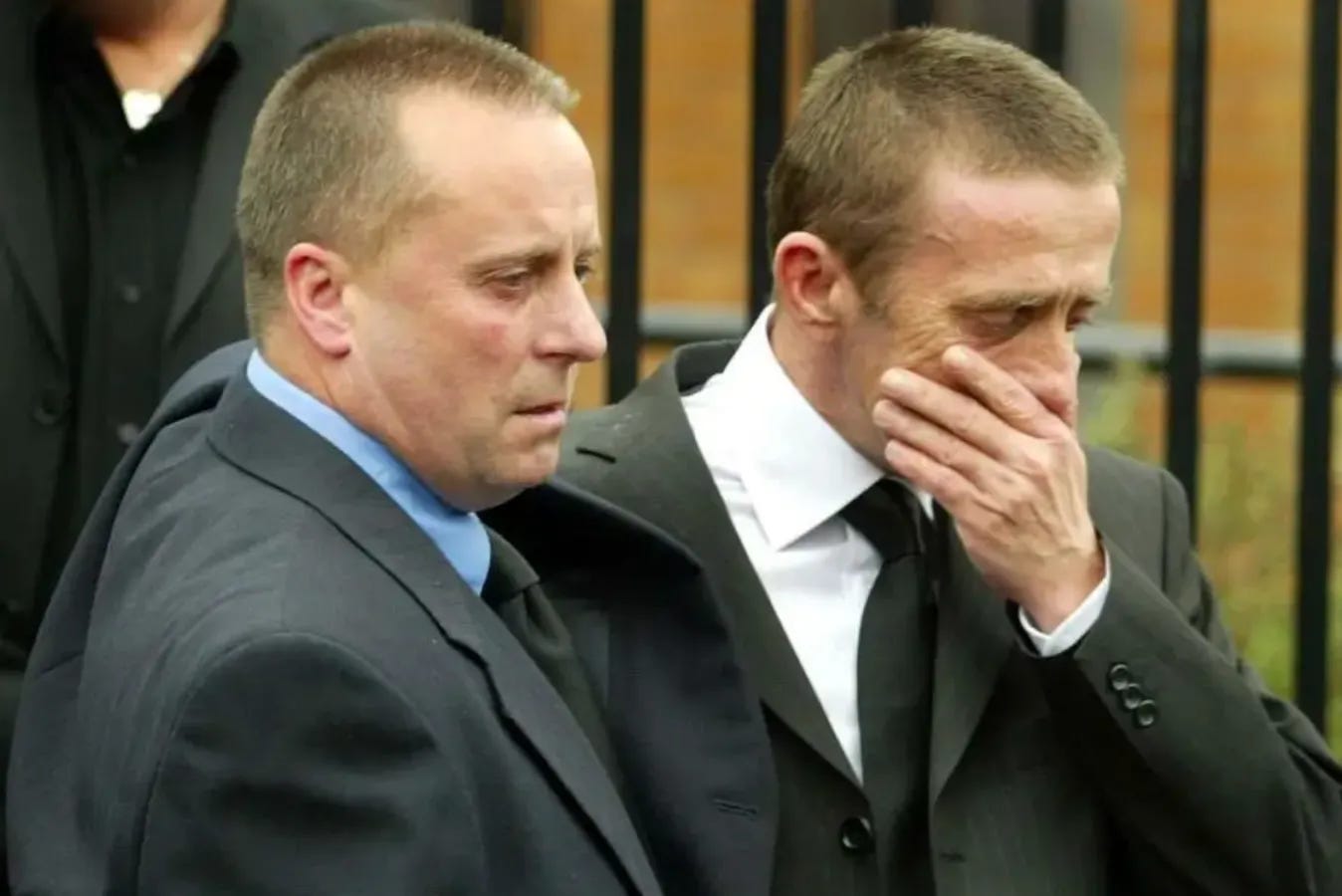
One could extend the list, Michael Collins, writing in The Critic, notes the 2005 killing of Christopher Yates in east London by an Asian gang as another case where the racial motive struggled for official recognition, and the death of Gavin Hopley in Oldham in 2002, for which no one was ever convicted of homicide, is often cited in the same breath, though the evidential record there is thinner.
Because He Was White
·
Feb 8
There are murders that galvanise a nation, like that of the criminal thug George Floyd, and there are murders that pass almost unnoticed, absorbed into the background noise of urban violence. This article is about the second kind. About boys whose suffering and death was not elevated into British national reckoning, and whose killers’ motives were ackno…
Stephen Lawrence was murdered at a bus stop in Eltham in April 1993 by a gang of Whites. Look at everything that followed. The Macpherson Inquiry of 1999 gave the country the doctrine of institutional racism and seventy recommendations that reshaped policing. The campaign led by Doreen and Neville Lawrence changed the law of double jeopardy, enabling the 2012 convictions. Landmark documentaries, award-winning dramas, an architecture centre bearing his name, an annual Stephen Lawrence Day in schools.
The Lawrence case shows what British institutions can do when they decide a racial murder is nationally significant: the inquiry, the legislation, the curriculum, the anniversary, the name every citizen knows. The test it poses is simple. Take the same institutions, the same decade, a victim of the same age, a motive proven to the same standard and reverse the races. Kriss Donald is the reversal. The Lawrence machinery did not only run slower for him; most of it never started. No inquiry examined whether any institution had failed him. No legislation bears his memory. No school teaches his name.
The silence around these White children is the logical endpoint of a deliberate demographic and ideological project. Mass immigration since the 1990s, accelerated under successive governments of both major parties has transformed large swathes of England into majority-minority zones where the native population is already a despised out-group. White British children are now minorities in hundreds of schools, in cities such as London, Birmingham and Leicester they are heading toward permanent minority status within a generation. Official projections, when they are not suppressed, show the indigenous people of Britain becoming a minority in their own country by the middle of this century.
Anti-White racism is the enforcement mechanism of that replacement. It is taught in schools, enforced by the police, amplified by the BBC, and funded by the taxpayer through endless “anti-racism” bureaucracies that exist solely to pathologise the native majority. When Asian or Black gangs hunt White boys for sport, the state looks away. When a White child is driven to despair by racial taunts in a school that no longer feels like home, the coroner records an accident and the story vanishes. The same institutions that built a national religion around Stephen Lawrence treat the racially motivated torture and murder of Kriss Donald as a local Scottish inconvenience.
The future under these conditions is the steady erosion of the historic British nation into a low-trust, high-crime archipelago of competing ethnic blocs, with the original people reduced to a residual, guilt-tripped minority in the land their ancestors built. History offers no examples of a people that voluntarily became a minority in its own homeland and retained its culture, its safety, or its sovereignty. Britain is conducting that experiment in real time, and the results are already written in the blood of Aaron, Richard, Ross, Kriss and many, many more.
There is only one hard truth left. A nation that cannot protect its own children from racial predation, that cannot even name the predation when the victims are White, and that continues to import the demographic conditions that make such predation inevitable, has chosen dissolution. Either the British people reassert demographic control through an immediate halt to mass immigration and remigration, the restoration of borders that actually function, and the open rejection of the anti-White ideology that now saturates every institution or they accept the fate already mapped out for them: minority status, cultural erasure, and the permanent normalisation of their own children’s disposability.
https://abcnews.com/International/wireStory/uks-leader-calls-reflection-after-death-former-cambridge-135673948
https://www.nbcnews.com/world/united-kingdom/jason-arday-ex-cambridge-professor-accused-plagiarism-found-dead-week-rcna592616
https://hackedoff.org/campaign-actions/demand-an-inquiry-into-the-culture-of-the-press
https://www.dailytelegraph.com.au/bullied-to-death-because-he-was-white/news-story/d551e9f430df58d25c42e31a12efc012
No posts
Comments
Nothing yet. Say the first thing.
Sign in to join the conversation.