
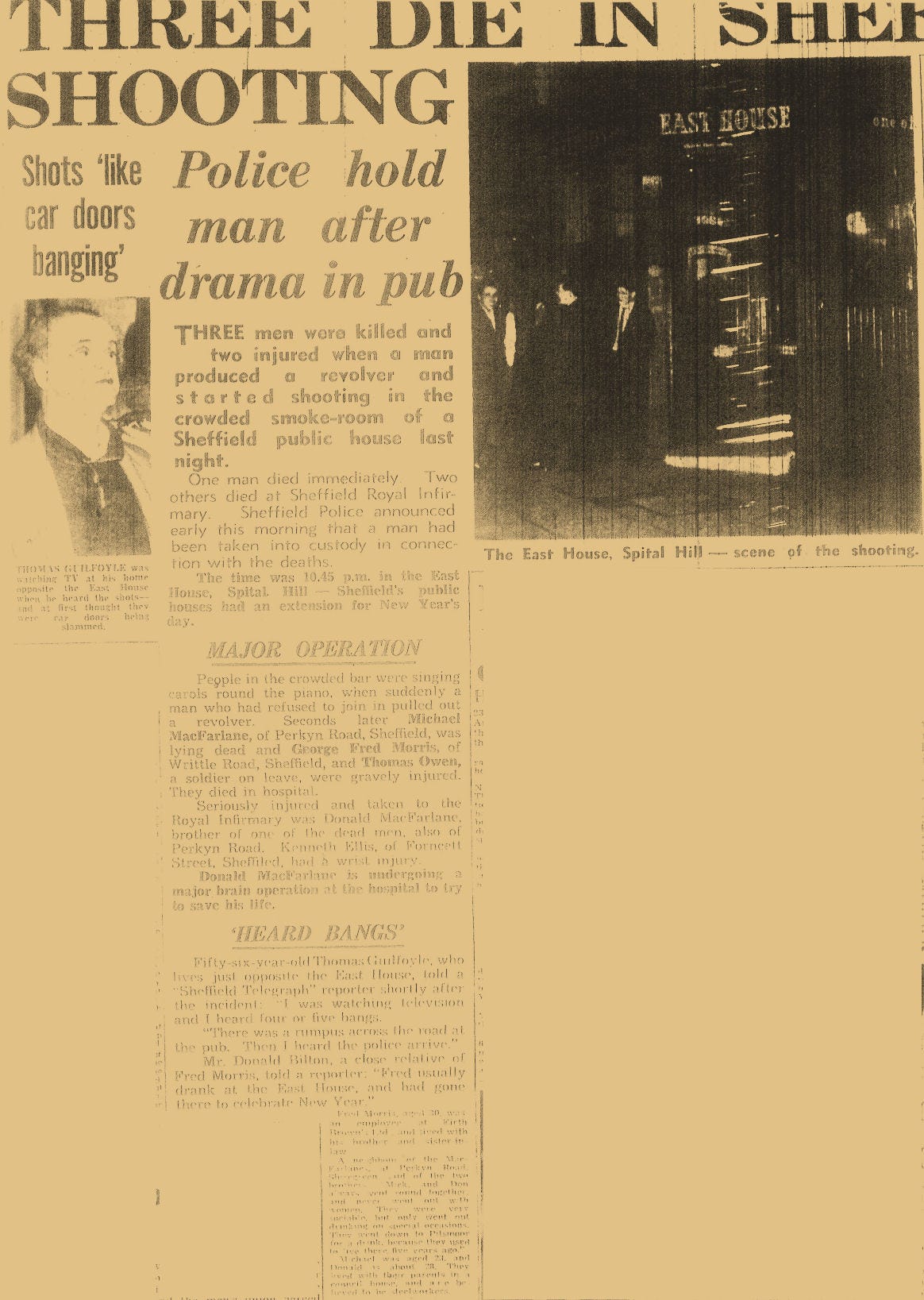
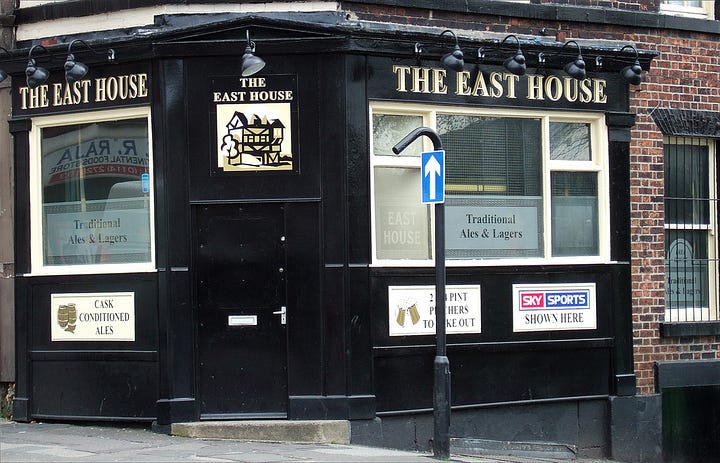
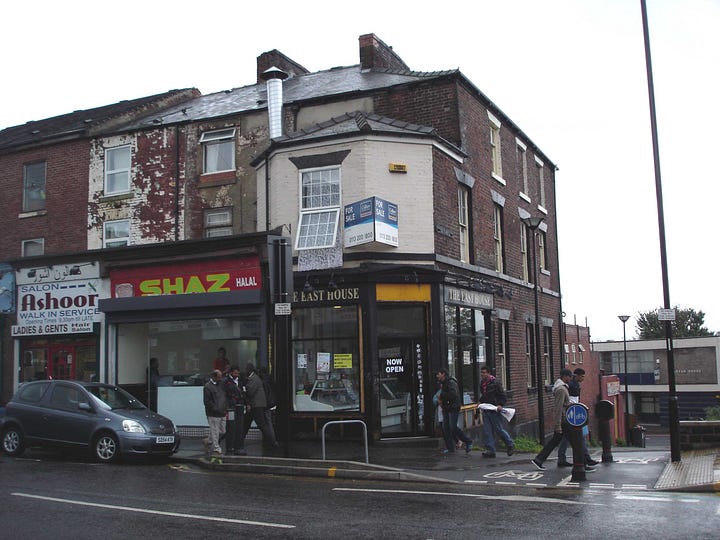
Since it was New Year’s Day in 1960 a small pub in Sheffield, England had been granted an extended license to remain open past 10:30 p.m. Seven or so young men were gathered around a piano, jolly and singing carols.1 Across the road from the pub a 56 year old man named Thomas Gulfoyle was watching television in his home. He told the Sheffield telegraph that he heard five or six loud bangs, then a commotion at the pub and then the police arriving.2
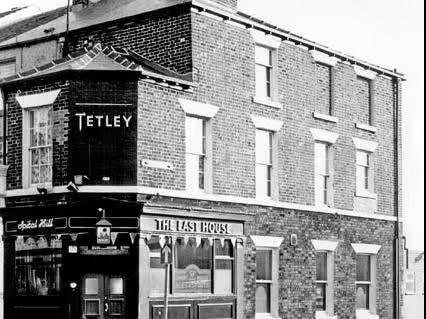
A man had come into the pub, and declined to join in with the jolly carol singing. Kenneth Ellis, who was a 21-year-old railway apprentice standing nearby, saw a revolver in the man's hand and assumed at first that it was a toy. Ellis then raised his hand towards the man's shoulder, and that, he recalled decades after, was when the first shot was fired. 3
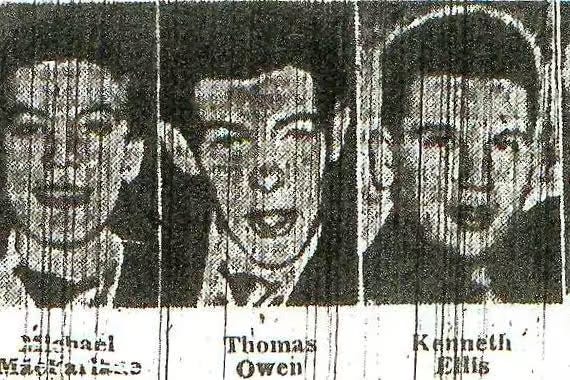
Michael MacFarlane, died where he stood. George Frederick Morris and Thomas Owen were carried out gravely wounded and died at the Sheffield Royal Infirmary. Ellis was shot through his wrist, with the bullet then passing through the wall. Donald MacFarlane, Michael’s older brother, was taken to the Infirmary for emergency brain surgery to save his life.4
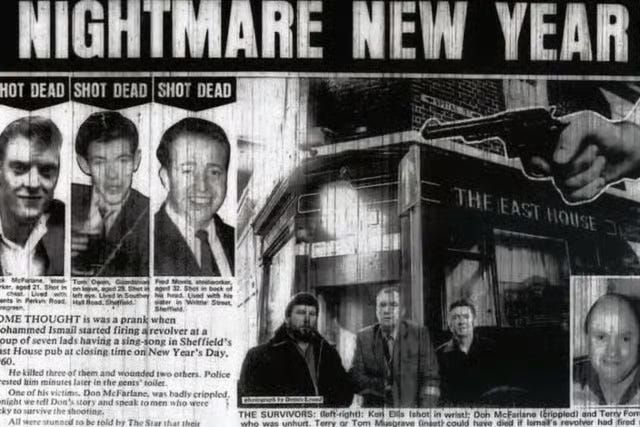
The gun man did not run far, he walked out to the gentleman’s lavatory in the yard and barricaded himself in.
Mohammed Ismail, an unemployed 30 year old labourer, a native of the British Somaliland Protectorate, made little to no effort to deny what he had done. When Detective Chief Superintendent G. A. Carnill showed him the revolver recovered from him and asked whether he had shot the men, Ismail replied: “Yes, sir.” Asked in court whether he wanted a solicitor, he said he did not mind. Ismail was granted legal aid, and he was remanded in custody on three charges of capital murder.5
One of the most horrific facts of this case is that Mohammed Ismail wanted to die but he believed that his religion forbid it. So he instead arranged for the British state to do so by intentionally murdering three innocent British men, as murder by shooting in 1960 was a hanging offence. So he thought that he could provide the crime, so the crown would provide the rope. Almost everything after the fact defeated his plan and worked out in absolutely no ones favour.
In late February of the same year, a Jury was brought forth to consider whether Ismail was fit to sit trial, not yet to consider whether he was guilty or not. And it took, according to one account, only 15 minutes to find him unfit to plead, and he was ordered to be detained until Her Majesty's pleasure should be known.6
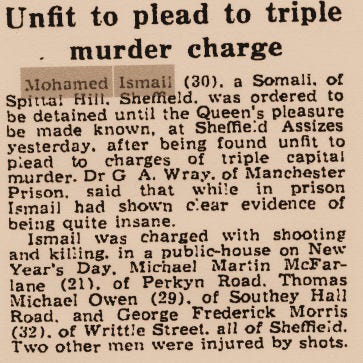
To be clear this was not an insanity verdict, as Ismail was never actually tried, convicted or acquitted. In 1960, the governing provision was Section 2 of the Criminal Lunatics Act 1800, under which the question of an accused's fitness to stand trial went to a jury at the outset. And a finding of unfitness carried a mandatory order for detention during Her Majesty's pleasure.7 Thus the British courts role ended there. The Home Secretary was then able to specify the institution in which Ismail would be sent to, in this case Broadmoor in Berkshire, England. Importantly, when the Mental Health Act 1959 came into force on the 1st of November 1960, patients held during Her Majesty's pleasure were carried across into the new scheme and treated as though detained under a direction, with restrictions on discharge; the Home Secretary's control was preserved.8 In more simple words, this was in principle the most secure form of detention English law then possessed, indefinite and reviewable only by ministerial decision, with no fixed term and no release date. Yet, Ismail was out of Broadmoor in April 1962.
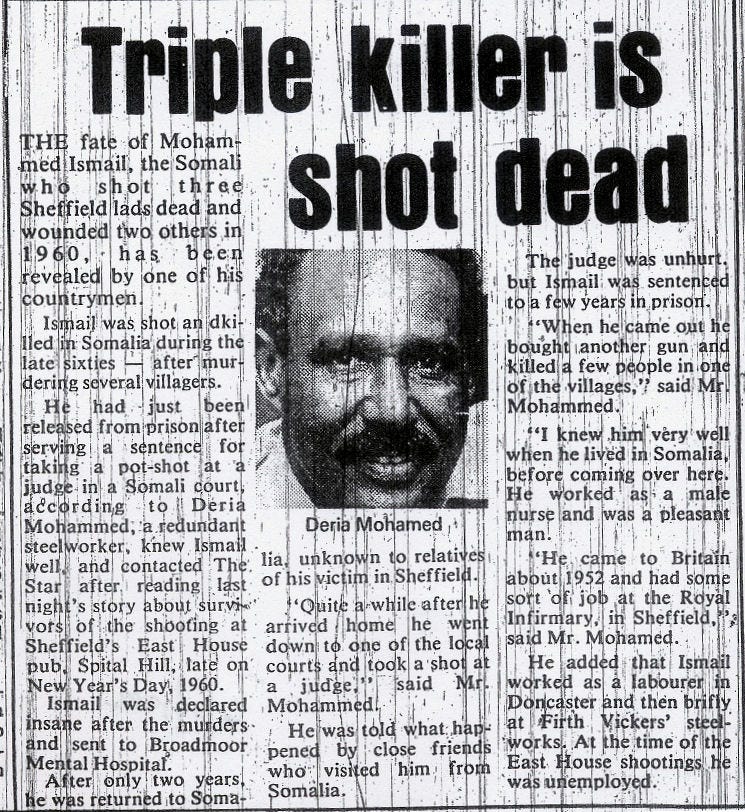
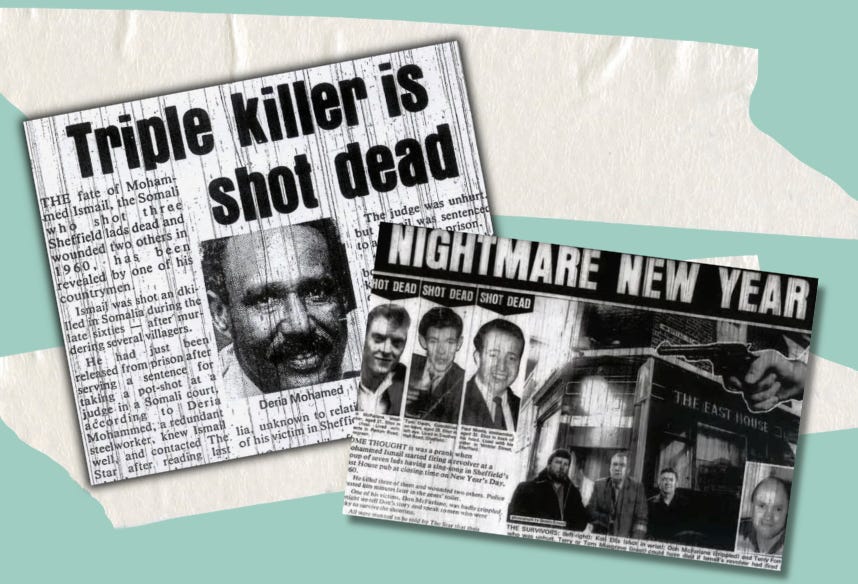
As reported by Ian McGill in the Sheffield Star on 3rd of January 1984, Ismail had been released after 22 months and then deported to Somalia, and apparently the survivors of the shooting were not informed about it. A man who had shot five people in a crowded room, killing three, ceased to be detained or held properly responsible.
It is difficult to understand the Home Secretary's reasoning for allowing Ismail to only carry out two years in a mental institution and then be deported back to Somalia. I believe the most plausible reason for his swift release is perhaps naive clinical optimism. Ismail's presentation on remand was truly psychotic, the medical officer recorded that he believed evil voices reached him through the prison's electrical system, and that he smashed light bulbs to stop them.9 Acute psychosis of that kind can remit substantially, and in 1962 remission would have been documented as recovery.
Ismail's plan was probably doomed on its own terms. He appears to at least understood the English law of 1957, kill by shooting, and you will be hanged. But he was missing everything the same statute had done to introduce psychiatry into the courtroom. He was, in a sense, three years out of date to get the sentence he truly deserved.
It was reported that Ismail, after being deported back to Somalia killed again and then again. But I want to caution that this is the least verifiable part of the story and it should be handled at arm's length.
The day after McGill's feature appeared in February of 1984, The Star was contacted by a man who said he had known Ismail both in Somalia and in Sheffield. It was he who reported that Ismail had in the late 1960s run amok in a Somali village and killed several people, and then had been killed himself.10 He also apparently first shot at a judge in his own courtroom, then he was imprisoned, and after that he went on to commit a second massacre after his release.11
Michael MacFarlane was only 21 when he was murdered in cold blood. He and his brother Donald went everywhere together, including drinking on special occasions and and they had gone down to a Sheffield pub that night because they had lived around the corner from there five years beforehand.12 George Frederick Morris was 30 years old when he was murdered, he had worked until 6pm that evening and had arranged to meet his friends for a drink at a pub. His funeral at Burngreave was one of the largest the district had seen in years. Thomas Owen was 27 and on work leave, The Times called him a Royal Navy man and the Sheffield Telegraph called him a soldier.
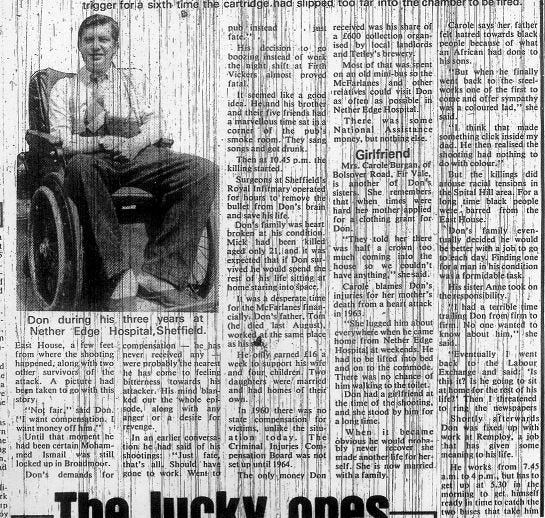
As mentioned earlier, Kenneth Ellis was shot through the hand but recovered in hospital. He died shortly before Christmas in 2007. Donald Macfarlane, (Michael's brother) required emergency brain surgery on the night and he spent three long years in hospital trying to recover. Donald was sadly never able to walk again and since the shooting occurred before the Criminal Injuries Compensation Scheme was established, he received nothing, not even a penny for his horrible injuries. He died in 1990 at the age of 56 of a brain hemorrhage that his family believed traced back to the original incident. His ashes were poured out over where his brothers were at Shiregreen.
The British state should always protect its own people first, but on New Years Day in 1960, like so many times after the fact, it failed in every conceivable way.
The lesson here is simple and harsh. When a foreigner deliberately murders British people in the hope of state execution, the correct response is still execution. Anything less is a betrayal of the dead, of the maimed, and of the principle that the state’s first duty is to its own people.
As mentioned, this is only one of many cases in which the British state has failed to protect its own people. If you would like to read more about these cases and help preserve the memory of their victims, you can find them collected on the Remigration Now In Memoriam website at the link below:
https://www.chrishobbs.com/sheffield/easthousemurders1960.htm
Sheffield Telegraph, 2 January 1960 (Hobbs, as above).
Correspondence from a former railway colleague of Ellis, January 2007, published at Hobbs, as above.
The Times, 2 January 1960, and Sheffield Telegraph, 2 January 1960, both reproduced at Hobbs. The Times names Kenneth Ellis, aged 21, as the fifth man. The distribution of wounds (torso, head, eye, back of head, wrist) is given in later retrospectives: see "East House mass shooting," Wikipedia, https://en.wikipedia.org/wiki/East_House_mass_shooting.
The Times, 4 January 1960, and The Observer, 3 January 1960, both reproduced at Hobbs.
The Times, 26 February 1960, reproduced at Hobbs ("ordered to be detained until the Queen's pleasure be made known"); the fifteen-minute figure and the express finding of unfitness to plead come from Lamb, A Pub On Every Corner, summarised at the same source.
J. P. Bean, Crime in Sheffield, cited at Hobbs; the detail is repeated in The Star, 11 June 2020.
Hobbs, summarising the Sheffield Star's follow-up to the Macgill article: a former acquaintance who had known Ismail in Somalia and in Sheffield contacted the paper the day after publication.
Wikipedia, as above, citing The Star (2016 and 2020) and the Yorkshire Post (2023).
https://www.thestar.co.uk/news/flashback-the-night-three-people-were-shot-dead-in-gun-attack-on-sheffield-pub-460729
No posts
Comments
Nothing yet. Say the first thing.
Sign in to join the conversation.