
Survey Findings: Education of Boys and Young Men in Australia
Unlike longevity and men’s health, there was no overwhelming single signal in education. From 244 respondents:
29% (70) – Lift the number of boys completing year 12 or an equivalent pathway, to match girls
23% (56) – Achieve better gender balance in higher education (students and staff)
19% (47) – Close the literacy gap, which massively favours girls
29% (69) – Other (with wide-ranging concerns)
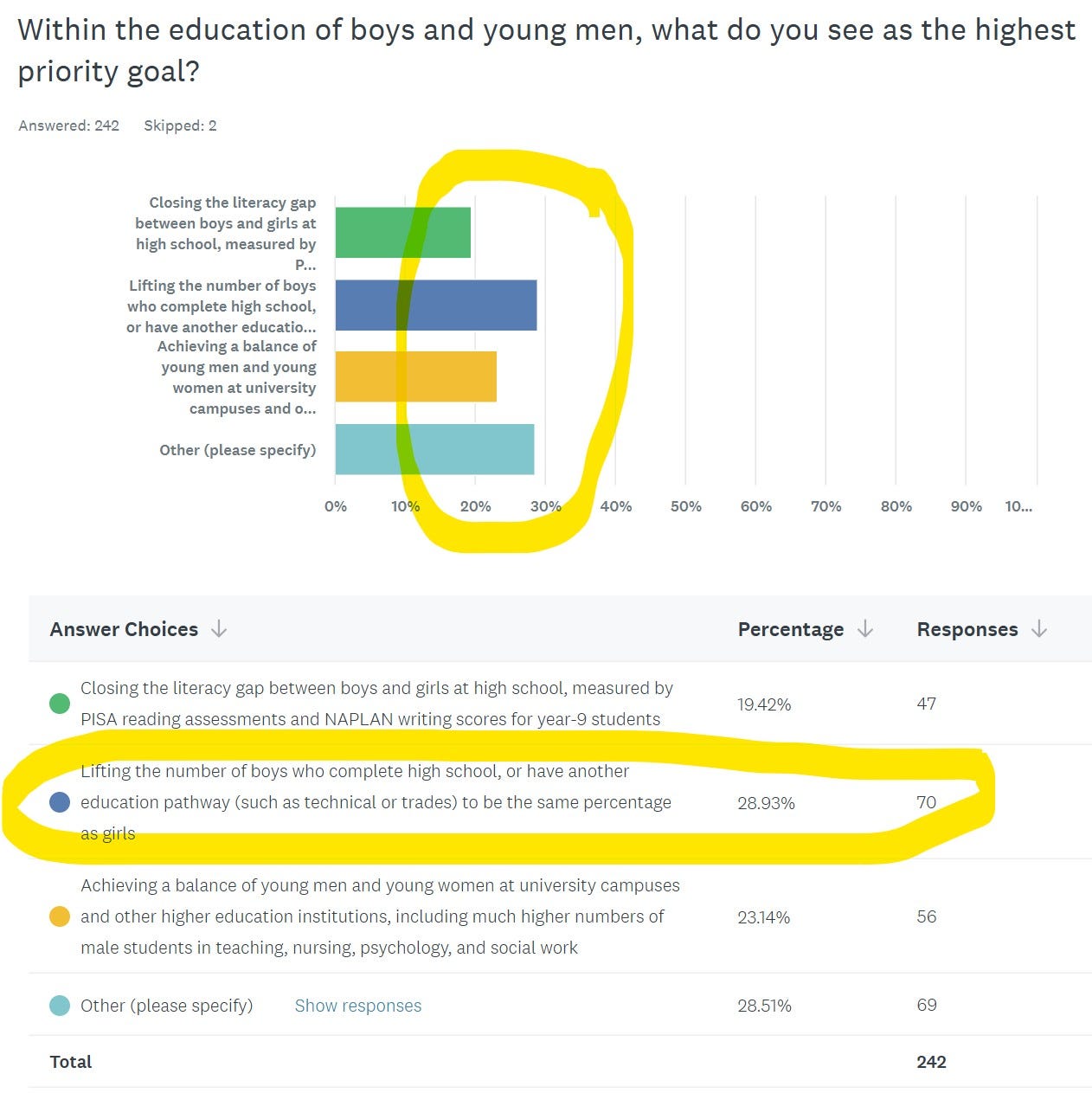
This fragmentation tells us something important: education challenges are multi-layered, and they are complex…
Keep these disparities in mind: the gaps increase with age, so that by year 9 boys are one-and-a-half years behind girls in literacy; there are 12,000 more boys failing to complete high school than girls, each and every year; there are 64% more young women graduating from university than young men, each year…
Three themes stood out across both the data and comments: male disengagement from education; lack of positive messaging and role models; large gaps (in literacy and other areas) that aren’t being addressed.
Completion of Education and Alternative Pathways
Many respondents emphasised practical outcomes over ideology.
“Academic achievement no longer equates to a successful life. Building alternative pathways… are key.”
“Bring back tech schools. Teach real skills.”
A Lot More Male Role Models in Schools
A recurring theme was the importance of male teachers.
“Encouraging more male teachers — especially in primary years — creates role models boys often lack.”
Incremental reforms here include scholarships or fee reductions, in order to increase male enrolments in primary teaching degrees.
Literacy and Accommodating Male Traits
Many people highlighted learning styles and engagement.
“Start with what you can measure and demonstrate like the gaps in education outcomes.”
Targeted literacy interventions for Year 7–9 boys and younger, measured by NAPLAN improvement. These are achievable and politically defensible.
SMART goals for the next two years:
=> Close the gap in high school completion and literacy, between boys and girls
=> Add technical and trades pathways to high schools (available for boys and girls), bridging together education and workplaces, to keep young people motivated… this could start with pilots in public schools across the country
=> Boost the proportion of male primary school teachers from 18% to 30%
These are measurable, bipartisan, and pro-workforce.
The education findings suggest something different from health and suicide: there isn’t one silver bullet.
But there is consensus around this principle: boys need pathways, purpose, and positive role models.
Practical reform is possible; if we focus on what we can measure and improve now…
No posts
Comments
Nothing yet. Say the first thing.
Sign in to join the conversation.