
Survey Conclusions: From Insight to Action… what 244 Australians told us
This week I shared results from the survey on practical, achievable advocacy for men and boys in Australia (575 comments, December 2025–February 2026). Across five posts, one message kept resurfacing: Australians want calm, evidence-based reform that improves outcomes (without turning gender into a zero-sum war).
The strongest signals across the whole survey
1) Save lives: targeted suicide prevention for men and boys was the clearest “north star”.
2) Fairness in health: a strong push to rebalance public spending and redesign services so men actually use them…
3) Keep boys engaged: lift education completion and pathways (school-to-trades-to-work), strengthen literacy, and increase positive male role models.
What the final open-ended question revealed
When people were invited to comment freely on disparities, advocacy, The Relentless War on Masculinity, and Celebrating Masculinity, the patterns were strikingly consistent:
A) “Fair go” and respect for males in public narratives
Many feel boys and men are routinely framed as problems to be fixed, not as people to be understood and cared for… Deep bias and discrimination, which harms boys/young men in particular.
B) Fatherhood and families matter deeply
There is a large cluster of issues linked to male wellbeing, father involvement, separation, plus bias and unfairness in family law.
C) The coalition path is the only way
Some respondents want a tougher, more confrontational stance. But many urged a broad, constructive approach that brings women along and stays focused on measurable outcomes. The former hardens division, while the latter opens opportunities to move forwards.
D) Community, belonging, purpose
Loneliness, social isolation, and the need for male-positive spaces and mentoring came up repeatedly: as prevention, not just treatment.
A flavour of the voices
“A fantastic book, thankyou David. Males and masculinity need to be celebrated not ridiculed.”
“Seen some good stuff from Celebrating Masculinity, but sometimes it comes on a bit strong… may scare people (especially women) off.”
“Supporting men doesn’t mean stealing from women, it’s about acknowledging both genders face struggles and have specific needs.”
“50/50 custody in divorce courts would resolve a lot of inequality.”
“Loneliness in middle-aged and especially older men is significant.”
“We need honest and good faith discussions… to respectfully support males in achieving a good life.”
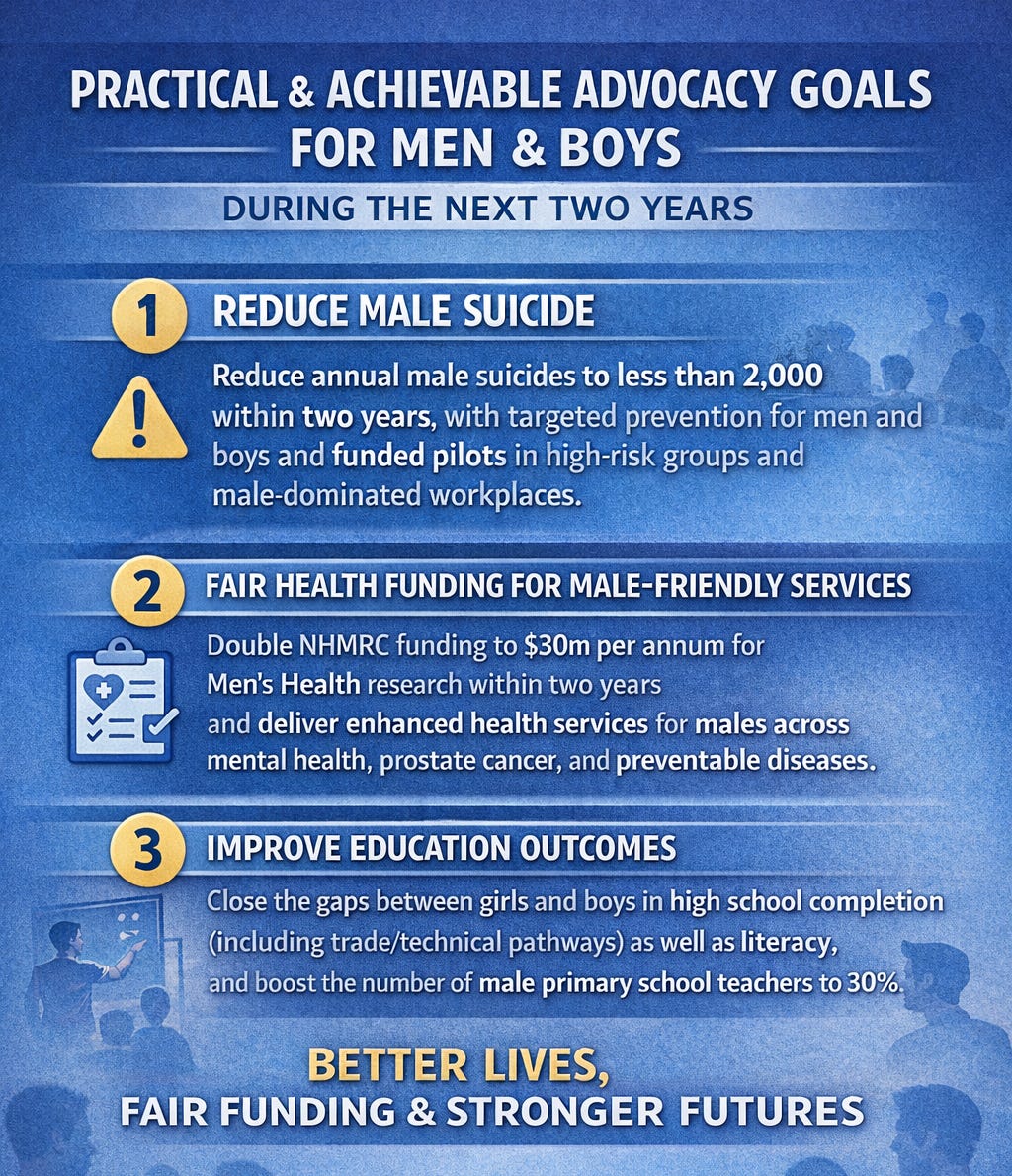
The call to action: three SMART objectives for the next two years (before the next federal election)
If you’ve followed this series and want to help, here’s where to focus: goals that are pragmatic, centrist, measurable, and friendly to a broad coalition of supporters:
Reduce male suicide: commit to a measurable reduction below 2,000 men and boys lost each year (suicide prevention initiatives that target high-risk men and male-dominated workplaces).
Fair health funding plus male-friendly services: double funding for research on men’s health, a transparent audit of spending across males and females, and tailor the service delivery of men’s health based on the needs and preferences of males.
Education pathways for boys: boost high school completion, add trades and technical pathways, close the literacy gap between boys and girls, and lift male primary school teachers from 18% to 30% of the workforce.
If you want balanced outcomes for women and men, girls and boys, then this is the work we need to focus on… Lives, families, and futures literally depend on it.
Let’s make progress on these practical steps forwards (across families, government, schools, workplaces, and communities), by working together.
No posts
Comments
Nothing yet. Say the first thing.
Sign in to join the conversation.