
The judicial system should be above the fray of party politics, acting as a referee that upholds the rules without favouring any side. In practice, the courts are not always seen as politically neutral – especially in the United States, where the selection of judges is more clearly shaped by party politics. Most notably, American Supreme Court justices are chosen by the party that controls the White House and the Senate, based on their political views, leaving the Court with a recognizable liberal or conservative tilt. Donald Trump’s selection of three conservative-leaning members of the Supreme Court during his first term as president famously set the stage for a ruling in 2022 that opened the door to new restrictions on access to abortion.
The appointment of senior judges in Canada is not as politicized as in the United States. Yet, the courts in Canada have been criticized by politicians and commentators on the right, particularly since the Charter of Rights and Freedoms came into force, for being too “activist” – that is, for being too keen to impose their own views in their rulings rather than deferring to the intentions of elected legislatures. A recent example is the Supreme Court’s ruling striking down mandatory minimum sentences, which prompted the leader of the Conservative Party to promise, if elected, to use the Charter’s override clause to overturn the decision.1
How does this encroachment of partisan politics affect public trust in the highest court? We can explore this question using data from the AmericasBarometer. The survey allows us to compare trust in the courts to trust in politicians, to check whether trust has been eroding over time, to compare levels of trust in Canada and the United States, and to examine the relationship between trust and partisanship in both countries.
Here’s the full wording of the survey question:
Please answer the following questions using a number on a scale ranging from 1 to 7, where 1 means NOT AT ALL and 7 means A LOT. If your opinion is between not at all and a lot, you would choose an intermediate score. To what extent do you trust the Supreme Court?
The answers on the scale can be combined in different ways. I tend to work with the following combinations:
A lot of trust or high trust (6 or 7 on the scale)
Some trust (3 to 5 on the scale)
Not a lot of trust or low trust (1 or 2 on the scale)
To start, let’s compare trust in the Supreme Court in Canada to trust in other actors and institutions that are part of our democracy.
Canadians are more likely to say they have a lot of trust in the Supreme Court than in political institutions such as Parliament or political parties (see the full report on trust in institutions here).
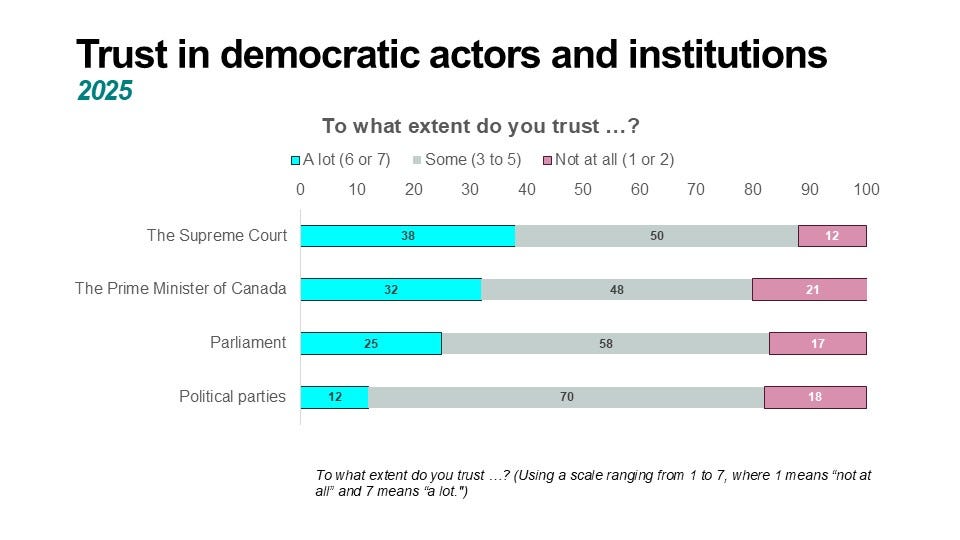
About two in five say they have a lot of trust in the Supreme Court (38%), compared to only 12 percent for political parties. Conversely, fewer have some trust in the Supreme Court (50%) than in political parties (70%). The difference, in more detail, is that there are more “6” or “7” responses (at the top end of the scale) when it comes to trust in the Supreme Court, and fewer “3” and “4” responses (at or just below the midpoint of the scale).
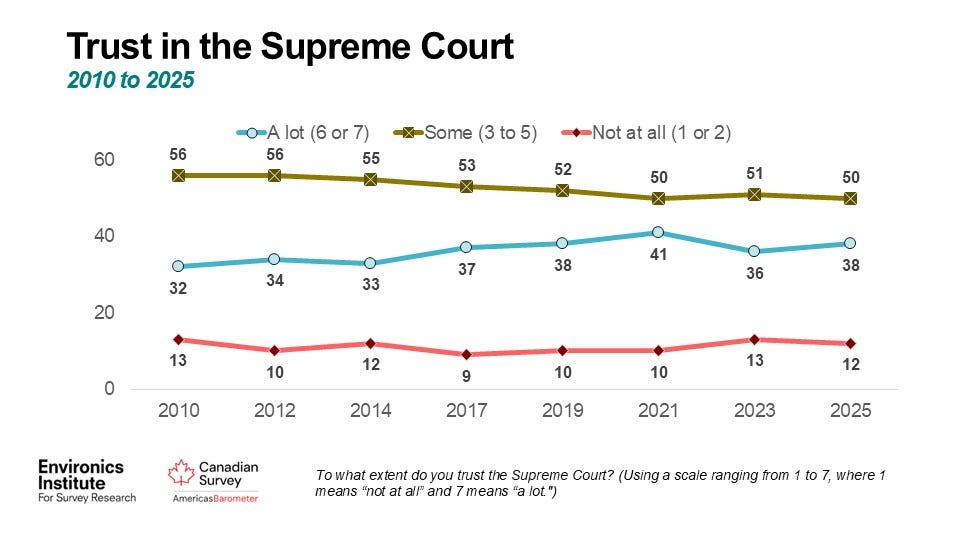
A second finding is that the level of public trust in the Supreme Court is holding steady. If anything, the proportion with a lot of trust is slightly higher today than at the start of the 2010s.
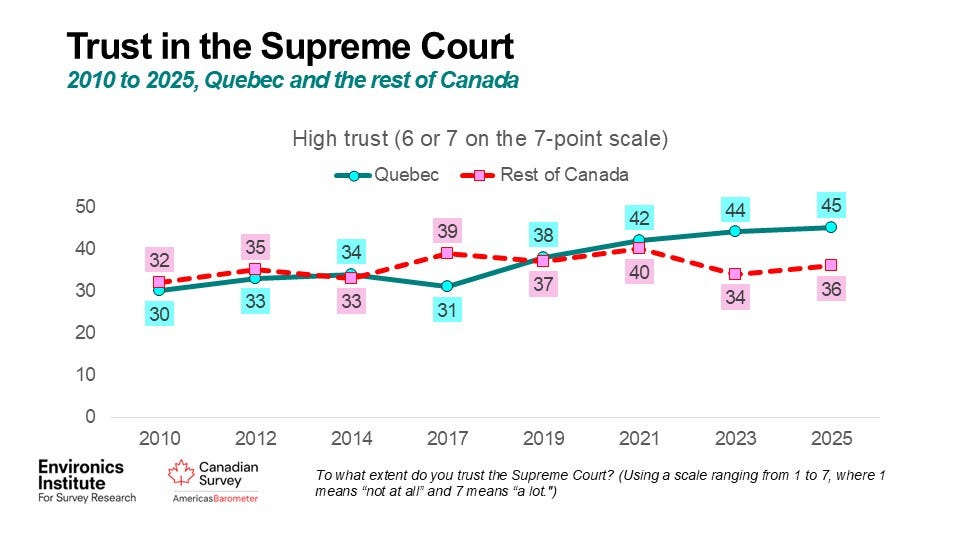
The regional trends within Canada continue to be noteworthy: while the level of high trust in the Supreme Court has held steady overall, it has been gradually increasing in Quebec (by 14 percentage points, from 31% to 45%, since 2017). The end result is that trust is now higher in Quebec than in the rest of Canada – part of a more general pattern that I’ve written about before (see here and here and here). It’ll be interesting to see whether this pattern is affected by an eventual ruling of the Court on the province’s law on “laïcité.”
Let’s leave regional differences in Canada aside – our main purpose is to compare opinions in Canada to those in the United States.
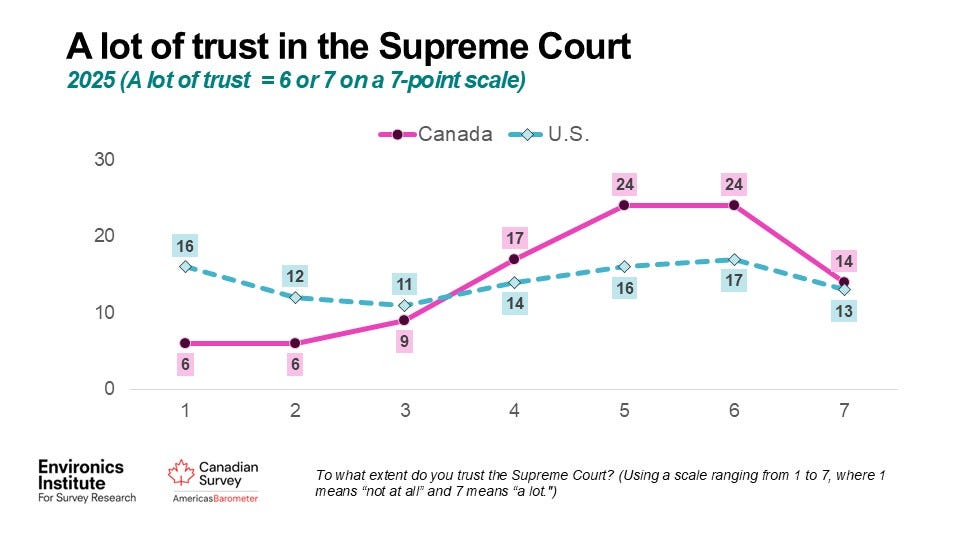
Trust in the Supreme Court is lower in the U.S. than in Canada. Specifically, Americans are less likely than Canadians to say they have a lot of trust in the Court (30%, compared to 38%), as well as some trust (41%, compared to 50%), and more than twice as likely to say they do not trust the Court at all (29%, compared to 12%).
This is one instance where it’s worth showing the distributions of results across the full range of the 7-point scale.2 Americans are much more likely to give their Supreme Court the lowest possible ratings on the trust scale (1 or 2) and much less likely to give it a rating above the midpoint (particularly a 5 or 6).
Over time, trust in the U.S. Supreme Court has not declined, but it has polarized: compared to the early 2010s, Americas are more likely today to express both high and low trust (an increase of about 10 percentage points in each case), and less likely to express some trust (a drop of about 20 points).3
In Canada, the proportion expressing high trust in the Supreme Court increases with age. But younger Canadians are more likely than their older counterparts to express some trust, rather than no trust at all. There is no similar pattern in the U.S. Older Americans are not more likely than their younger counterparts to say they have a lot of trust in their Supreme Court.
The overall eight-point difference in the proportions of Canadians and Americans with a lot of trust in their country’s Supreme Court is explained almost entirely by the larger 13-point gap between Canadian and American women.
The two countries also differ in terms of gender gaps. In this case, there is no real gap in opinions between men and women in Canada. But in the U.S., women are 15 percentage points less likely than men to say they have a lot of trust in their Supreme Court (23%, compared to 38%). One implication of this is that the overall eight-point difference in the proportions of Canadians and Americans with a lot of trust in their country’s Supreme Court is explained almost entirely by the larger 13-point gap between Canadian and American women.
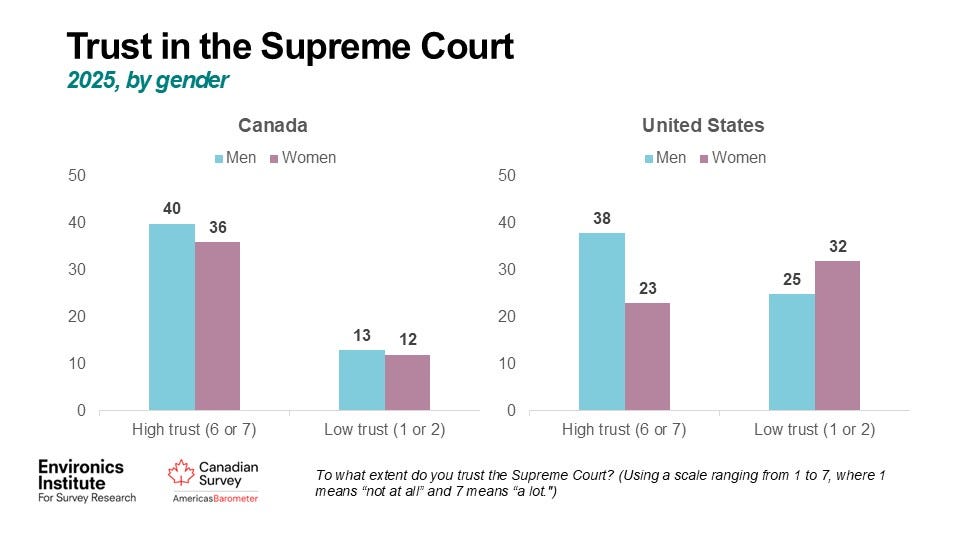
The gender gap in the U.S. is larger than in the past. In 2012, for instance, American men (21%) and women (20%) were more or less equally likely to say they had a lot of trust in the Supreme Court. The gender gap has opened up because men have grown more trusting of the Court over time.
The more striking contrast between the two countries comes into focus when we bring politics into the picture – starting with political ideology.
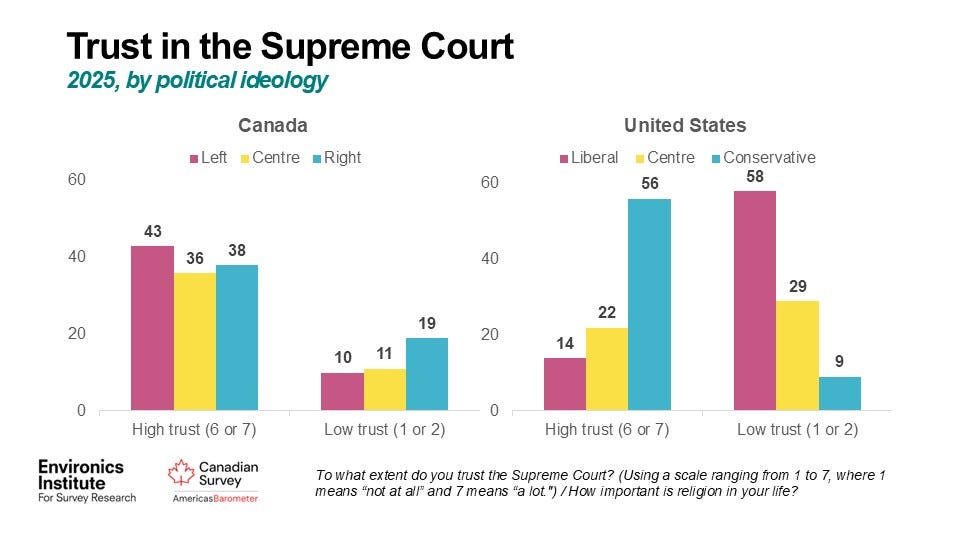
Canadians who place themselves on the left, in the centre or on the right of the political spectrum are all more likely to have a lot of trust, rather than not a lot of trust, in the Supreme Court. And, despite criticisms of judicial activism or overreach from those on the right, right-leaning Canadians (19%) are only nine percentage points more likely than their left-leaning counterparts (10%) to say they don’t have a lot of trust.
This nine-point gap in Canada compares to a 49-point gap in the U.S. – though in the other direction, with those on the left having far less trust in the Court.
This nine-point gap in Canada compares to a 49-point gap in the U.S. – though in the other direction, with those on the left having far less trust in the Court.4 In fact, the opinions of liberals and conservatives in the United States are more or less mirror images of each other: a majority of conservatives (56%) have a lot of trust in the Court and only nine percent have low trust; among liberals, the figures are almost exactly reversed, with 14 percent having high trust and 58 percent having low trust.
In Canada, the differences in opinion between supporters of the main federal political parties are larger than those between those on the left and right. There is a significant gap between the proportion supporters of the Liberal Party (57%) and the Conservative Party (24%) who say they have a lot of trust in the Supreme Court of Canada.
This resembles the large gap between supporters of the Republican (52%) and Democratic (15%) parties in the U.S. – but with the important difference that, in this case, trust is higher among supporters of the right-of-centre party.
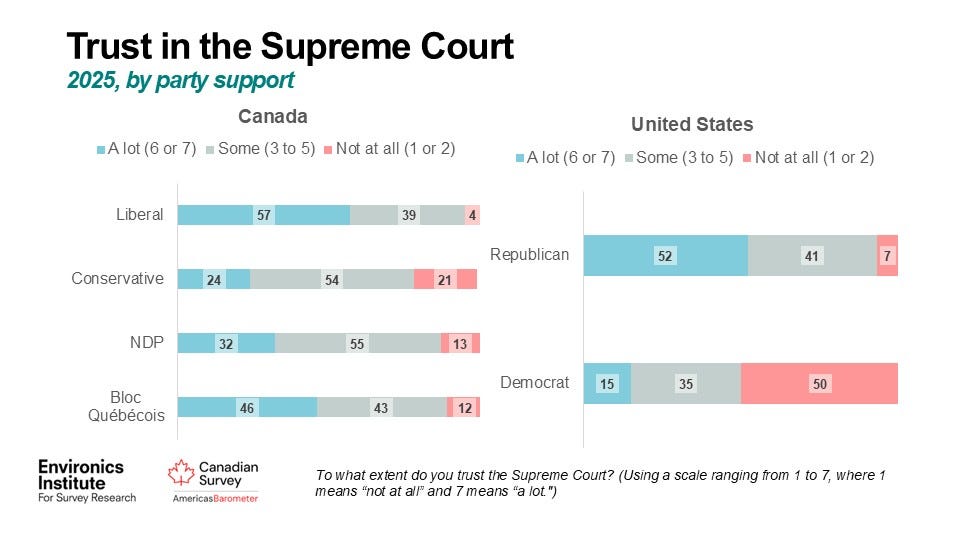
Opinions in Canada are nevertheless less polarized than in the U.S. While Conservative Party supporters are a lot less likely to have a lot of trust in the Court (-33 points), they are only somewhat more likely to have low trust (+17 points) – because they are also more likely to have some trust (+15 points). This contrasts with the situation in the U.S., where a higher proportion of Democratic Party supporters land at the very low end of the trust scale. Whereas 50 percent of Democratic Party supporters have low trust in their country’s Supreme Court, the figure among Conservative Party supporters in Canada is only 21 percent.
That said, the gap between Liberal and Conservative party supporters in Canada has been widening over time.5 Since 2012, the proportion of Conservative Party supporters with a lot of trust in the Supreme Court has fallen, and the proportion with not a lot of trust has increased. What was a 17-percentage point gap in levels of high trust expressed by the two groups of partisans is now a 33-point gap. Opinions in Canada, therefore, have become somewhat more polarized along party lines.
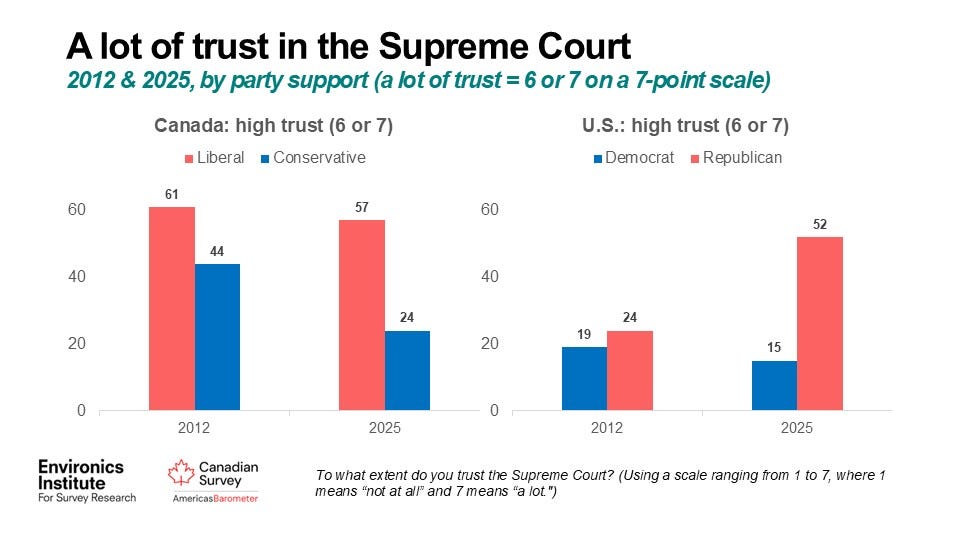
Supporters of the two main political parties in the U.S. have also moved further apart in their opinions about their Supreme Court – and to a greater degree than in Canada. Between 2012 and 2025, the proportion of Republican Party supporters with a lot of trust in the Court doubled, from 24 to 52 percent. Over the same period, the proportion of Democratic Party supporters with not a lot of trust more than doubled, from 21 to 50 percent. What was only a five-point gap in levels of high trust expressed by the two groups of partisans is now a 37-point gap.
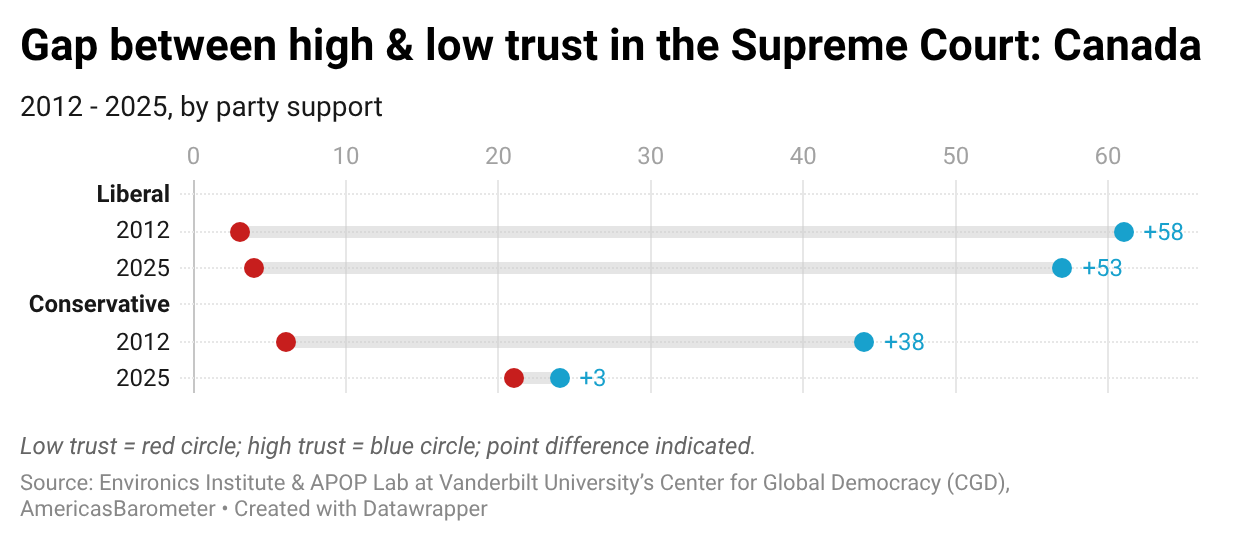
These shifts in opinion can also be illustrated by noting the difference (in percentage points) between the proportions of each group of supporters with a lot a trust and not a lot of trust in the Supreme Court. There has been little change among supporters of the Liberal Party in Canada – the difference was plus 58 points in 2012 and plus 53 points in 2025. But the difference dropped significantly among Conservative Party supporters, from plus 38 points to only plus three points.
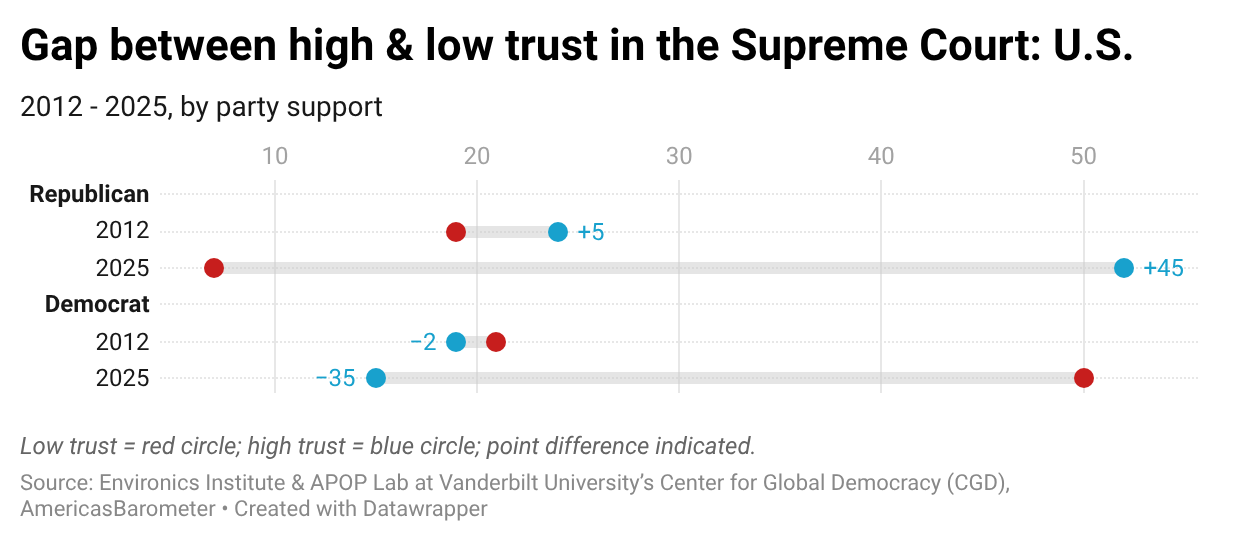
But, in the United States, the changes have been greater. The difference in the proportion of Republican Party supporters with a lot, and not a lot, of trust grew from plus five points in 2012 to plus 45 points in 2025. This was mirrored by a change among Democratic Party supporters from minus two points to minus 35 points (note that the order of the dots for high and low trust is reversed in the case of U.S. Democrats).
Underlying these different patterns by vote intention in the two countries are important differences in the role of religion in politics, and the salience of opinions on the issue of abortion.
Supreme Courts in both Canada and the United States have ruled on the legality of laws restricting access to abortion. The U.S. Court was the first to strike down restrictions – famously in 1973 in the case of Roe v. Wade. The Canadian Court’s ruling came in 1988; the Court struck down laws restricting abortion on the grounds that they infringed on the Charter-guaranteed right to “life, liberty and the security of the person.”
Things then unfolded differently in the two countries. In Canada, the Court left the door open to Parliament to pass a new law, but this never happened. Efforts by those opposed to abortion are therefore mostly directed at convincing members of Parliament and party leaders to revisit the issue. In the United States, campaigners against abortion focused more attention on the Court itself, and particularly on the selection of Supreme Court justices. Once the Court was composed of a solid majority of conservatives, it was asked to revisit the issue – which it did in 2022, overturning the earlier Roe v. Wade decision.
We can explore how this relates to public trust in the Supreme Court by bringing into the discussion two additional questions: one about the importance of religion and one about agreement on access to abortion.
The first question asks how important religion is in a person’s life. Americans (41%) are twice as likely as Canadians (20%) to say it’s very important. Conversely, Canadians (53%) are much more likely than Americans (31%) to say it’s not very or not at all important.
The second question asks people to agree or disagree that “every woman who wants an abortion should be able to have one.” In Canada, 82 percent agree, including 53 percent who agree strongly. In the U.S., the majority that agrees is somewhat smaller (69%). Three in ten (31%) in the U.S. disagree, compared to 18 percent in Canada.
The difference between Canada and the United States goes beyond the proportions in each country that considers religion to be very important, or that opposes abortion. The difference also lies in the way these opinions make themselves felt in day-to-day politics. This is evident when it comes to trust in each country’s Supreme Court.
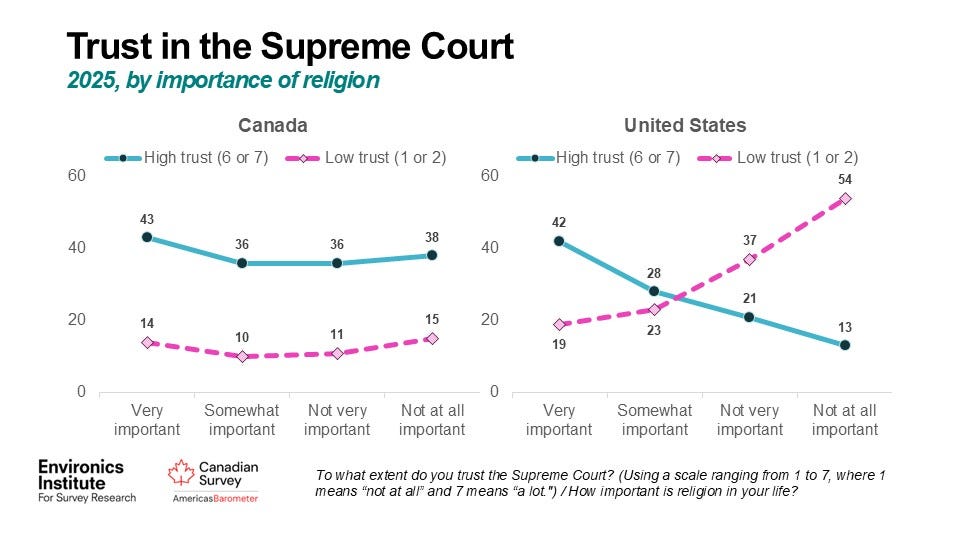
In Canada, trust in the Supreme Court doesn’t appear to be strongly related to the importance of religion. The situation could not be more different in the U.S.
In Canada, trust in the Supreme Court doesn’t appear to be strongly related to the importance of religion. If anything, trust is actually a little higher among Canadians who say religion is very important in their lives – despite the role the Court has played in “liberalizing” Canadian law (through rulings on such issues as abortion, same-sex marriage and assisted death). This is part of a larger pattern: in Canada, more religious people tend to have higher levels of trust in a range of institutions as well as in other people – with the Supreme Court being no exception.
The situation could not be more different in the U.S.: among Americans, the importance of religion is strongly related to trust in the Supreme Court. The proportion with a lot of trust ranges from 42 percent among those for whom religion is very important, to 13 percent among those for religion is not at all important – a 29-percentage point difference (compared to only 5 points in Canada).
The situation is not quite the same when it comes to opinions about abortion, as these do appear to matter in both countries. In Canada, the proportion with a lot of trust in the Supreme Court declines steadily as opposition to abortion grows. And the proportion that doesn’t have a lot of trust in the Court is more than twice a high among those who strongly disagree (29%), compared to those who strongly agree (12%), that “every woman who wants an abortion should be able to have one.”
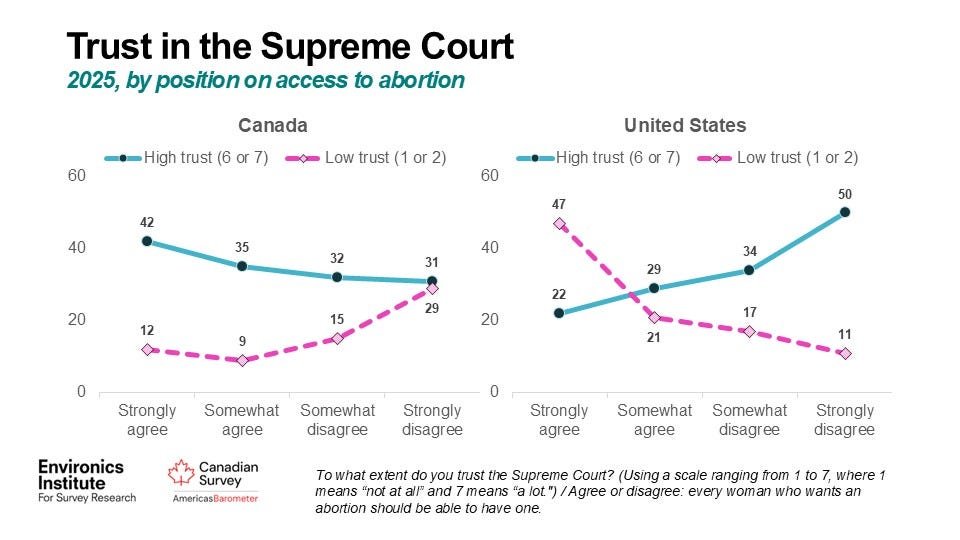
That said, the relationship between attitudes toward abortion and trust in the Supreme Court is much stronger in the United States. The positions of those who strongly agree and strongly disagree with the statement about access to abortion are polar opposites. Among those who strongly agree, the proportion with high trust in the Court (22%) is heavily outweighed by the proportion with low trust (47%). Among those who strongly disagree, the proportions are flipped, with 50 percent having high trust and only 11 percent having low trust.
The extent to which trust in the Supreme Court in the United States is wrapped up in partisan politics and in the issue of abortion is no surprise. Liberals and conservatives in that country have sharply contrasting views on the Court, which undermines any claim that the institution might make to being a neutral arbiter.
The comparison with Canada is more instructive. Compared to Americans, Canadians are more likely to have a lot of trust in their country’s Supreme Court – even more so in the case of women. While Supreme Court rulings in Canada are often widely discussed and sometimes hotly contested, the level of trust has held steady, at least over the past 15 years covered by this series of surveys. Only about one in ten Canadians say they don’t have a lot of trust in this key institution.
More specifically, despite the critique of the Supreme Court of Canada (and Canadian judges in general) from the political right, opinions in Canada are not nearly as polarized along party lines as those in the United States. The proportions with low trust in the Court stands at 19 percent among Canadians on the right, and 21 percent among supporters of the Conservative Party – well below the levels in the U.S. of those on the left (58%) and Democrats (50%). Religion is not really a factor shaping opinions of the Court in Canada. Views on abortion matter a little, but are not as decisive as in the U.S.
Nonetheless, opinions in Canada, while less polarized than in the U.S., have become more polarized over time, as the proportion of Conservative Party supporters with a lot of trust in the Supreme Court has declined. This may simply reflect the mounting frustrations that Conservative Party supporters feel about the political system as whole, in the wake of four successive elections defeats (see the separate report on trust in elections for more evidence on this). But it could also reflect a growing politicization of the role of the courts in Canada – and therefore a trend that should be carefully watched.
There will be no shortage of high-profile cases for the Court to rule on, shaping the law as it relates to federalism, reconciliation, criminal justice, moral issues and personal freedoms. No doubt, some will react by questioning the Court’s impartiality, either because it’s a federal institution, or because members are appointment by the government of the day – with the pending review of Quebec’s law on “laïcité” being only one example. The Court’s ability to explain its decisions in reasonable and accessible terms will continue to matter.
This post features data from the AmericasBarometer 2025 Canadian and American surveys. Additional results from this survey are posted on our website.
The AmericasBarometer is a regular comparative survey of democratic values and behaviours that covers countries in North, Central and South America, as well as a significant number of countries in the Caribbean (the 2025-26 study will cover 20 countries). The project is led by the LAPOP Lab at Vanderbilt University’s Center for Global Democracy (CGD). The Canadian and American surveys were conducted by the Environics Institute for Survey Research, in partnership with CGD’s LAPOP Lab at Vanderbilt University and with the support of the Max Bell Foundation. The author is solely responsible for any errors in presentation or interpretation.
The Canadian survey was conducted online with a sample of 3,550 Canadians (aged 18 and over) between July 30 and August 7, 2025. The results are weighted by region, age, gender, education and language so as to be fully representative of the Canadian population. The U.S. survey was conducted online with 1,600 Americans (18 years of age and older) between October 3 and 16, 2025. The results are weighted by region, age, gender, education and ethnicity so as to be fully representative of the American population.
What is the Environics Institute for Survey Research? Find out by clicking here.
Follow us on other platforms:
Bluesky: @parkinac.bsky.social
Twitter: @Environics_Inst or @parkinac
Instagram and Threads: environics.institute
Photo credit: Pgiam
Note that the survey results presented in this article were collected prior to this Supreme Court decision.
Some commentators have tried to convince me that charts like this one are against the rules, because the x-axis marks the distribution across a numbered scale and not points in time. All I can say is that this is not an actual rule, and the line graph in this case is much more illustrative than a bar graph would be of the difference in the distribution of opinions in the two countries. At least I didn’t use a pie chart.
This survey question was asked in the U.S. in 2010 and 2012, but then not again until 2023 and 2025, leaving a gap in the middle of the time series.
In the U.S., the terms used to mark the two ends of the political ideology scale are “liberal” and “conservative,” rather than “left” and “right”.
Comparisons with earlier surveys based on vote intention are complicated by the fact that, in both countries, the survey question was different. Surveys from 2014 onwards use a vote intention question (about which party someone intends to vote for in the next election). Surveys prior to 2014 used a question about which party someone voted for in the previous election.
Comments
Nothing yet. Say the first thing.
Sign in to join the conversation.