

If you’ve ever tried to write a letter to the editor to advocate for a cause, but hesitated to submit it, this post is for you!
Every advocate I’ve ever coached on writing letters to the editor has been anxious about clicking the submit button the first time. I’ve had well over 100 of my own letters published, but I was also very nervous to send them in when I started. It’s a big deal to go from complaining with your friends about the government to subjecting yourself to the judgement of an editor and newspaper readers! Most of us want to be worthy of taking up the space. And when I write it like that, it’s clear to see the hesitation is really a form of imposter syndrome. (See my thoughts about imposter syndrome here)
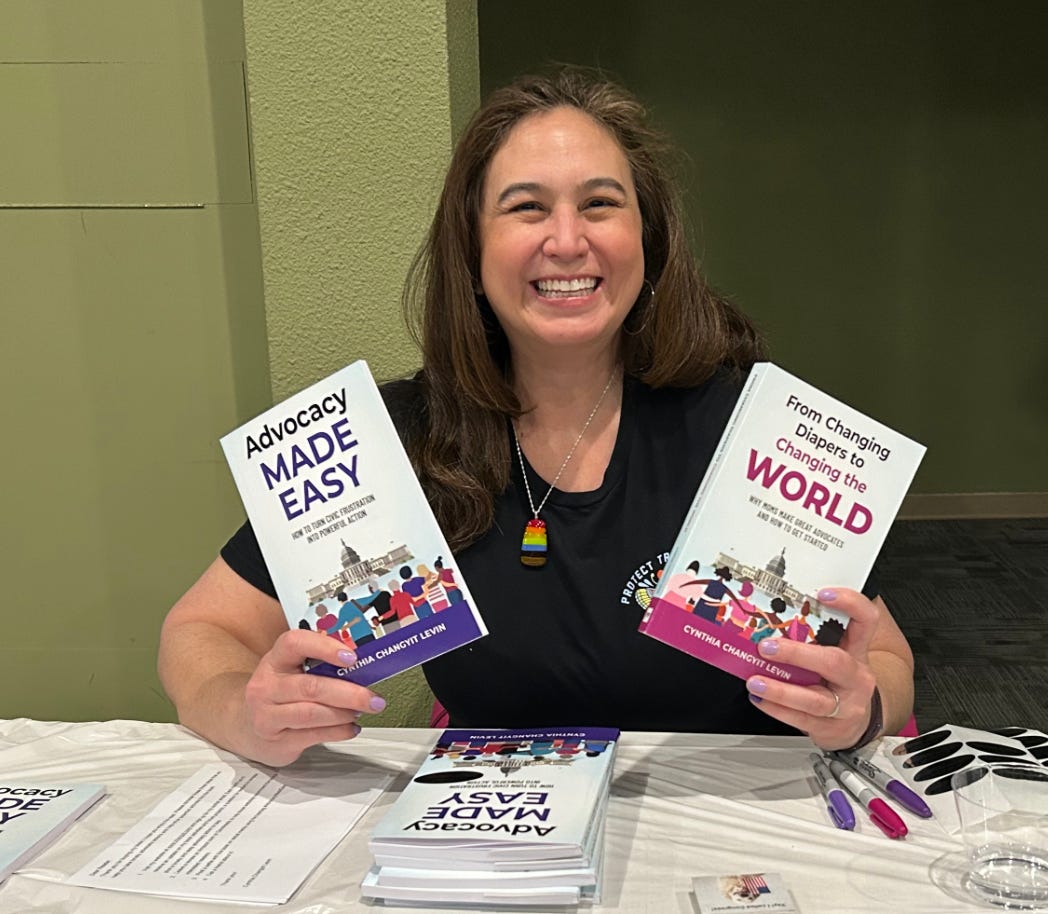
In my book, “From Changing Diapers to Changing the World: Why Moms Make Great Advocates and How to Get Started,” I described how newspaper media advoacy played a role in overcoming negative self-talk and ultimately helped me believe in myself.
“Formerly a technical writer, I was comfortable reporting facts
but not used to writing anything unless I was a subject matter
expert. It was a daunting task to write a 150-word opinion piece,
and I had a hard time imagining why a newspaper would print the
words of an unemployed housewife, which is how I viewed myself
back then. I must have fiddled with my letter for hours before
I got up the courage to push send.
To my utter shock, it was published that week in my tiny local
paper! That validation felt fantastic. Maybe I had something to say
after all. Timidly, I submitted another letter the next month to the
same newspaper and saw my name in print a second time.
Swelling with confidence from my early success, I started
responding to any newspaper article I could find that was remotely
related to poverty. My next forty-two letters went unpublished,
but the forty-third was printed in The New York Times right under
one written by Speaker of the House Nancy Pelosi! My headline
read, “Children in Poverty: There Is No Excuse.” It was an
enormous boost to my self-confidence. If those prestigious editors
believed my words had merit, then I figured I should believe in
myself as well.”
An opinion section of a local town newspaper is not a highly refined public forum. The smaller the town, the more likely you might even see petty grievances aired publicly! Honestly, editors might be relieved to find a thoughtful letter from you with a suggestion for government policy to solve a problem. (Reminder: here’s my guide for how to write a thoughtful letter to the editor)
Every year, I invest hours poring over opinion sections, either looking for my own letters or seeking ones that could use a reply. I occasionally come across published letters that make me think, “My goodness. If this one got in, then I certainly have a chance!” Letters which contain nothing but complaints, have no suggestions for community improvement, or are super vague always get an eyeroll from me. Obviously, editors have different criteria for evaluating letters than I do.
I want to share three examples of local letters to help bolster confidence in your writing. I submit these exhibits as evidence to you that your letters about life-saving or community-transforming policies are worth publishing. If these letters got in, then YOUR ideas about how to improve the world deserve readers, too!
Jan 9, 2023
At Christmas time we recently celebrated the birth of the child who brought compassion, empathy, brotherhood, love, decency, hope, no racism, wisdom and no hate!
We should all listen to and act on His great message! I would like to dedicate this great message to my dear father and mother, Ray and Frances Reeves (both sadly long deceased), who were both born in Kirkwood in 1912, and were married at the old Grace Episcopal Church in Kirkwood in 1933. They had three children and were the couple that everyone totally loved to be around!
Dick Reeves
Kirkwood, MO
My analysis: Editors look for letters that are timely and related to the local community. Even though Dick’s letter is mostly a promotion piece for Christianity and his own deceased parents, this letter is definitely local and timely. How can you incorporate those two qualities in your letter? He’s also lives in the city where the newspaper is published, so that’s a huge plus for an editor.
Jan 23, 2023
Regarding St. Louis’ bagel history (“A brief history of bagels in St. Louis,” published on stljewishlight.org). Growing up in University City, the New York Bagelry came to St. Louis in the ’60s, located in Jeffrey Plaza in U. City. I worked there. It was opened by three brothers (possibly a brother-in-law) who came from New York. Two of the brothers went back to New York, one stayed.
Not mentioned was Lichalters bakery located in downtown St. Louis, where my grandfather, Jake Pretsky and my great uncle, Max Feldman, worked for 40 years. Those bagels were thick and doughy, not like the ones we are now accustomed to.
Donna Weissberg
Roslyn Heights, N.Y.
My analysis: I live in St. Louis and can attest that Jewish folks here have strong preferences about local bagel production! It makes sense that a Jewish newspaper would give space to a letter about this topic. Since editors want their readers to relate to content, this homage to a local controversy fits the bill. How can your writing meet the interests of a paper’s readership?
April 10, 2025
Regarding the “facelift” to the 72 Centre, all I can say is, “how tacky!”
That sign will be an eyesore for years to come.
I’d rather the owner name it after himself than a tacky billboard for the pregnancy center.
Esther Ewell
Rolla, MO
My analysis: I’ve never been to the 72 Centre, but I’m going to assume this also falls into the category of local controversy. It’s hard to tell, though, because local writer Esther assumes everyone already knows what’s on the billboard and doesn’t tell us! But, editors also look for brevity, so they can fit more content in a page. She certainly is brief! When you proofread your letter, can you cut 10-20 more words without changing the meaning?
These letters all seem rather trivial to me, personally, but they meant a lot to the people who wrote them. For each one, I gave you my analysis for why I believe they appealed to editors. What they all have in common is a tie to the local community. How will you give your letter a local connection? Can you keep your letter short? Give it a try!
Lastly, I’ll share a reminder that just because they don’t choose to print your letter doesn’t mean that your opinion doesn’t matter or is not important! Persistence is often the key to getting published. These days, I usually need to submit 5 or more letters for every one that gets printed, but re-read my story above to see that part where I submitted 42 before I felt my validation. Let me be provide your validation right now.
As my friend and experienced media advocate Willie Dickerson says, “100% of the letters you don’t submit will not be published.” So, go ahead and smash that submit button!
My first book, “From Changing Diapers to Changing the World: Why Moms Make Great Advocates and How to Get Started,” is a warm and witty guidebook helping moms to make a better world for all of us. It provides inspirational stories and “how-to” instructions for new and experienced activists to get more involved in advocacy.
My second book, “Advocacy Made Easy: How to Turn Civic Frustration Into Powerful Action,” is a practical handbook designed to demystify the advocacy process for everyone. It offers a convenient, step-by-step guide to making your voice heard in the halls of power—no political experience required.
Buy an autographed copy from my website at www.changyit.com/books.
Order online at bookshop.org or Barnes & Noble.
Order from any independent bookstore near you!
Comments
Nothing yet. Say the first thing.
Sign in to join the conversation.