
If you asked me what matters most when it comes to parenting, I could name any number of things, some of them more difficult to define than others. But the center of gravity for effective parenting is self-understanding, the ability to look beyond ourselves, and the discernment to move between the two, which is really the practice of critical thinking.
Ideally we develop these things in ourselves as we live, and we pass it along to our kids as we parent. These are not things easily taught through a lecture, and nobody wants a lecture anyway, so we have to begin by modeling these behaviors and letting our kids see us regulate our emotions and examine our own behavior. We show them how to process difficult experiences and practice compassion toward others, especially those whose lives are different from our own.
Another way to do this is to make the humanities a meaningful part of our lives and our children’s lives, discovering more ways to see and relate to human behavior through art, music, literature, and philosophy. These things not only expand how we understand ourselves and others, but they also bring joy and meaning to our lives.
And I don’t mean the humanities in an exclusive, highbrow, only-the-classics-count kind of way. I am just as thrilled to take my daughters to see Lady Gaga, the Backstreet Boys, or Taylor Swift as I am to take them to the Art Institute, the Lyric Opera House or a play at Steppenwolf.
The same is true of books. I remember when my girls were young and there were rumblings of concern over graphic novels and whether kids were really “reading.” But to me a book is a book, and my daughters loved the graphic novel storytelling of books like Smile, Drama, Amulet, and so many others. What matters most is that they got to enter someone else’s world and experience life from a different perspective, establishing themselves as readers and social observers in a way that eventually grew into a wider relationship with books and ideas.
Then there were all the movies and television shows we watched together, from serious dramas to comedies, where we discussed and recognized recognize tone and rhythm, character arcs and development like in 30 Rock, Parks and Recreation, Arrested Development, Friends, and The Office. To watch the characters we love make missteps and strides, to go on the ride with them and process why things worked and didn’t. Now my daughters recommend shows and books to me, which has become its own kind of shared language.
Whether we’re watching Hamnet or Dumb and Dumber, we’re stepping into other people’s life experiences, sometimes laughing with them and sometimes crying. We notice what they understand and what they miss, how they navigate emotions and relationships and how it all connects to our own experiences and choices.
One of my favorite categories in our Zen Pop podcast is “Reel Therapy” (reel, as in film 🎞️, get it?) where I talk about what we can learn from the movies we discuss. Whether it’s Gladiator, Cocktail, or Rocky III, there is always something to notice about the cultural moment in which a movie was made, why the characters mattered to us then and what it might still have to teach us now. Like for those who saw The Odyssey, Christopher Nolan didn’t remain completely faithful to Homer’s original, he focused more on the parts of the story that speak to who we are today so we could see ourselves in a work of art that has resonated for nearly 2,700 years. That’s what the humanities have to offer. And while this has always mattered, it matters even more today.
I just read an article in Futurism magazine titled, Bosses Horrified as “AI Native” College Graduates Hit the Workplace: Massive numbers of students are going to emerge from university with degrees and into the workforce who are essentially illiterate. And they don’t mean they can’t read, they mean they can’t think and discern, that young employees considered “AI natives” are showing up to work with “alarmingly shallow ideas”. The problem had become significant enough that hiring managers were avoiding AI-literate STEM graduates and looking to humanities graduates instead. The direct quote was, “We want critical thinking, not just AI.”
The World Economic Forum’s Future Jobs Report recently listed analytical thinking, communication, problem-solving, creativity, collaboration, and judgment as the abilities they need most in the workplace. The National Association of Colleges and Employers found that the vast majority of employers look for problem-solving ability, teamwork skills, and work ethic above everything else, and an American Association of Colleges and Universities survey found critical thinking, applying knowledge to real-world situations, and the ability to communicate effectively as most as the most important skills needed in the workplace. These are precisely the skills that we develop through literature, philosophy, history, and the study of human behavior and social/emotional life.
In high school and college, these skills are typically dismissed as “soft,” but the ability to communicate a cohesive idea or manage healthy conflict is in no way soft or simple. These are skills that take practice, especially when it comes to navigating relationships and ethical concerns in a workplace filled with different personalities and perspectives.
As a social worker, none of this surprises me. So much of the deep work we do as therapists involves helping people understand themselves as individuals while also recognizing how they connect with and relate to others. But it does run counter to what high school and college students are usually told: study AI, become fluent in the technology, and choose a practical major that will prepare you for the jobs of the future! The problem is we become so focused on preparing them for a particular job that we dismiss the arts and humanities as “extras,” even though they develop the essential skills employers are looking for today.
Knowing how to use AI is not the same as knowing how to form an idea, and it’s definitely not the same as recognizing bias, appreciating nuance, or communicating needs or opinions effectively. Of course students should still study STEM and learn how to use the latest technology, but technical fluency without human understanding is not enough, especially in an ever-changing workplace that requires them to pivot, adapt, and think outside the box.
The humanities do not automatically make someone kind or ethical, we all know intelligent, well-read people who are neither. But they give us opportunities to practice and think through hard choices, recognize our shared humanity, and see what happens when people lose their way. Read almost any Shakespeare play, listen to the Hamilton soundtrack, watch Star Wars, or pick up a history book. As Brandi Carlile sings in The Joke, “I have been to the movies, I’ve seen how it ends…” Yet some people have very little exposure to what makes life rich and meaningful, instead, they learn that their value comes from money, power, or staying on top no matter the cost.
And when your sense of self depends on those things, insecurity and shame make other people feel like threats which leaves little room for meaningful relationships or the ability to live in peace and integrity. We also need leaders who value relationships and a life beyond achievement rather than treating everything like a game of king of the hill. We need leaders who care, consider who might be harmed or overlooked, and ask whether something that can be built should be built.
And to end with the humanities themselves, I’ll do what I do best and pull a quote from one of my favorite movies, spoken by one of my favorite characters, a teacher who has been a role model for me:
“We don’t read and write poetry because it’s cute. We read and write poetry because we are members of the human race. And the human race is filled with passion. And medicine, law, business, engineering, these are noble pursuits and necessary to sustain life. But poetry, beauty, romance, love, these are what we stay alive for. To quote from Whitman, “O me! O life!... of the questions of these recurring; of the endless trains of the faithless... of cities filled with the foolish; what good amid these, O me, O life?” Answer. That you are here - that life exists, and identity; that the powerful play goes on and you may contribute a verse. That the powerful play goes on, and you may contribute a verse. What will your verse be?”―John Keating, Dead Poets Society
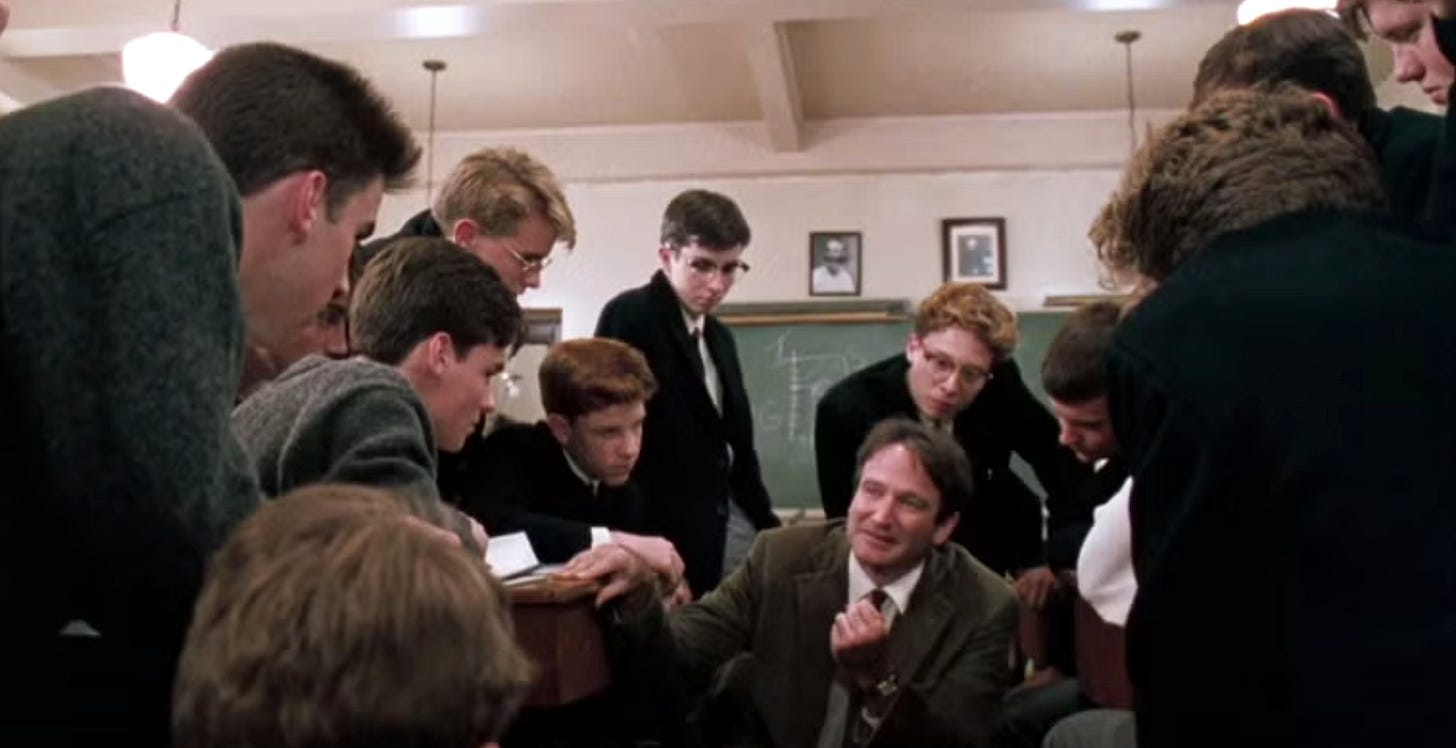

p.s. Paid subscribers will receive this week’s Zen Moment podcast in their inbox. If you’re considering upgrading, below is a preview from this week’s show.
0:00
-5:18

Comments
Nothing yet. Say the first thing.
Sign in to join the conversation.