
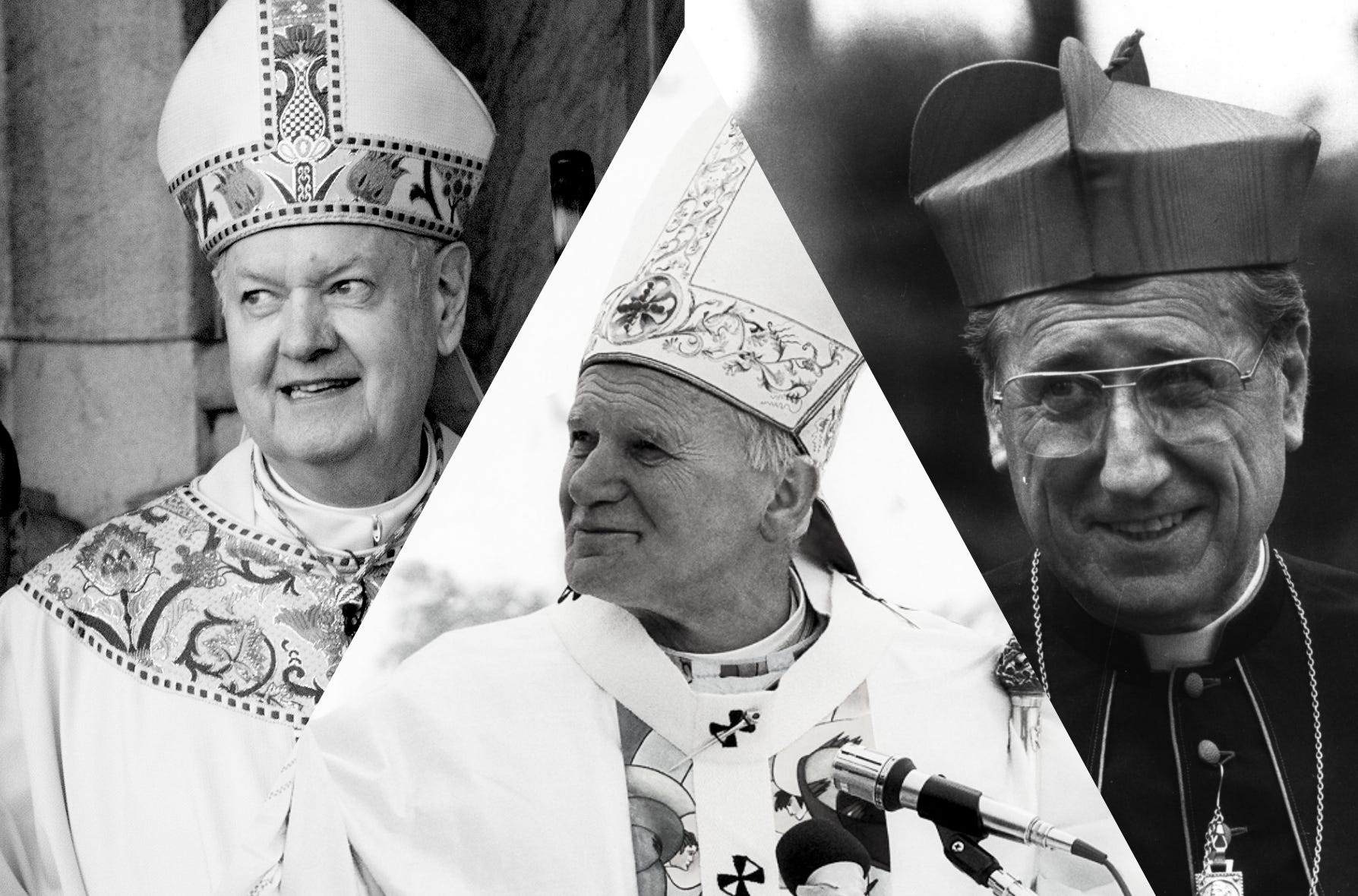
John Cardinal O’Connor rose from his deathbed and donned his clerics. The brain cancer had progressed, and he did not have long to live; it was time to say goodbye. This would be his last meeting with Pope John Paul II.
Publicly, the reason for his February 2000 papal visit was sentimental. But there was more to it—two final requests. The cardinal had already torpedoed Theodore McCarrick’s candidacy to succeed him as Archbishop of New York with a six-page letter to Pope John Paul II detailing allegations of sexual misconduct. But he found the latest rumor regarding the appointment of his ecclesial heir equally unacceptable.
Edward Egan? While essential to the Pope’s 1980’s revision of the Code of Canon Law and a proven fundraiser and administrator, Egan lacked the pastoral touch. This opera-loving loner would never become pastor to millions of ordinary New Yorkers, O’Connor believed. In a few hours, he would fly to Rome to ask Pope John Paul II to appoint Henry Mansell, the Bishop of Buffalo, instead.
But the cardinal had a second dying wish. O’Connor had completed the paperwork to launch Dorothy Day’s sainthood cause more than two years earlier. The requisite documents had been sent to the Holy See but now sat in bureaucratic limbo. Only a direct intervention from Pope John Paul II himself could move Dorothy’s cause forward, particularly if Bishop Egan became New York’s next archbishop.
On the eight-hour flight to Rome, did Cardinal O’Connor consider Dorothy Day’s influence on his own priesthood? In some ways, he was an unlikely advocate, a former Archbishop of the Military Services. Yet he frequently spoke of the impact of Dorothy’s advocacy for workers and service to people living in poverty as an inspiration to priests of his generation.
When he first considered the canonization of Dorothy Day, the cardinal felt positively disposed, but he was unsure. A friend had told him it would be “the worst mistake he would ever make” if he did so. In the interest of broader consultation, he convened a 1997 meeting of prominent Catholics who had lived and worked with Dorothy—around the time of her 100th birthday
The attendees at this and two follow-up meetings included many Catholic social ministry legends: Ade Bethune, Tom Cornell, Eileen Egan, Pat Jordan, Robert Ellsberg, Jane Sammon, and Frank Donovan. Cardinal O’Connor asked what they thought of the possibility of the Church recognizing Dorothy as a saint. The ensuing conversation addressed the danger of smoothing out the rough edges of Dorothy’s story and putting her on a pedestal (nobody forgot her “Don’t call me a saint…” zinger). Ultimately, however, most of the group encouraged Cardinal O’Connor to move forward.
Almost three years later, shortly after O’Connor’s final visit, Pope John Paul II granted his second wish. About a month before the cardinal’s death on May 3, 2000, the Congregation for the Causes of Saints issued a nihil obstat (a “no objection” ruling) permitting Dorothy’s Cause for Beatification and Canonization to move forward. This was the one dying request the pope fulfilled for his friend and longtime supporter.
Ten days after the cardinal’s death, Pope John Paul II appointed Edward Egan as archbishop of New York. That same year, he selected Theodore McCarrick for the prestigious post of Archbishop of Washington. Shortly thereafter named he named McCarrick cardinal, ignoring O’Connor’s warnings after three of the four New Jersey bishops consulted vouched for McCarrick.
Presumably traumatized and distracted by his death, O’Connor’s archdiocesan staff never filed the canonical paperwork necessary to open Dorothy Day’s cause for canonization (a libellus, a formal petition to a canonical tribunal). Nor did his successor, Cardinal Egan. As astute a jurist as he was, Egan never completed this essential legal step. It was not until 2016, when New York’s judicial vicar, Redemptorist Fr. Richard Welch, discovered the omission and insisted on a canonical fix, that Cardinal Dolan stepped in to make the necessary proclamations and file the libellus.
So, did Dorothy’s Cause for Canonization begin in 2016, 2000, or 1997?
In the broadest sense, it began in 1997, when Cardinal O’Connor convened that first meeting of Dorothy’s comrades. Legally, it commenced in 2016—thanks to Fr. Welch. But perhaps the most important and dramatic moment of all came on February 10, 2000, when Cardinal O’Connor summoned his last moments of strength to express his dying wishes to Pope St. John Paul II.
That action, amplified by energy of Cardinal Dolan, set in motion a succession of efforts beginning in 2014 that culminated in a send-off Mass at St. Patrick’s Cathedral on the Feast of the Immaculate Conception, 2021. In all, two-thirds of a ton of evidence was blessed, sealed in red tape, and shipped to the Dicastery for the Causes of Saints in Rome. Dicastery staff is now reviewing this evidence and is expected to make a recommendation on whether to declare Dorothy Venerable in the next one to three years.

Writer and comics creator Jeffry Odell Korgen coordinated the local phase of the canonization process for Dorothy Day, Servant of God for the Archdiocese of New York.
He is the author of Dorothy Day: Radical Devotion (Paulist Press, 2024), a graphic biography for adults illustrated by Christopher Cardinale.
Comments
Nothing yet. Say the first thing.
Sign in to join the conversation.