
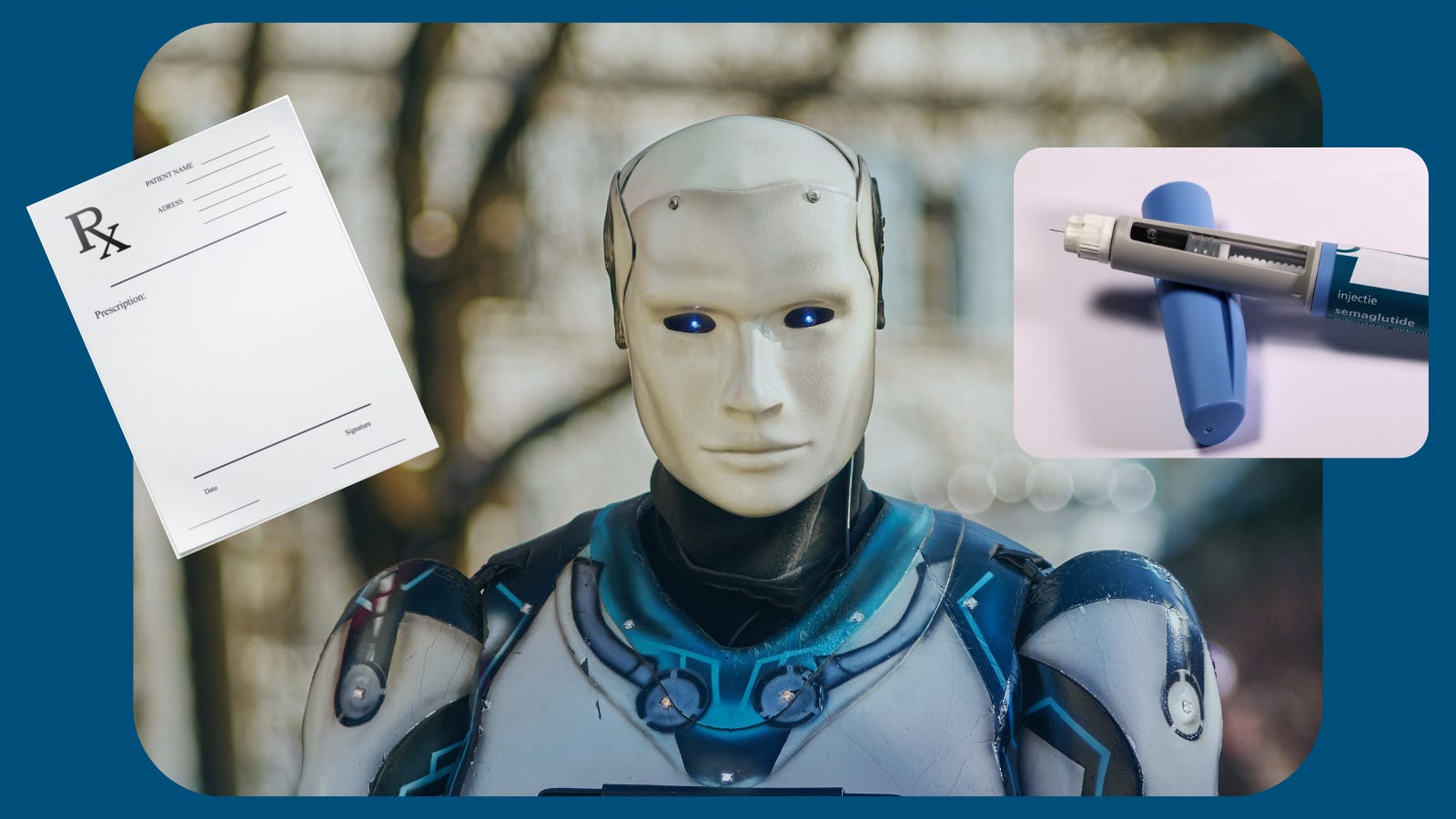
This week I read an article about patients with an eating disorder using AI to challenge or even refute the advice of their therapist. Of course, AI is in the news every day and holds lots of promise for lots of things—lots of good things. But it’s important not to dismiss the clear signs that it’s not all good news. My TCA colleague Ashley McGuire and I recently discussed the looming takeover of AI in education. A cheating scandal at Brown University, nurses with decades of experience being “replaced” by AI—the list goes on.
Articles about eating disorders seem more frequent these days, too. From shockingly and newly skeletal celebrities to the prevalence of GLP-1 prescriptions (or both), the media seem to be dissecting someone’s body almost every day. Not since “heroin chic” of the 1990s and “size-zero” of the early aughts have so many alarmingly thin women filled our news feeds. Body positivity is out, baby. And thin is in.
For those currently battling and recovering from an eating disorder, it’s a fraught time. And while there does seem to be potential promise in treating some disorders with GLP-1 medications, the risk to men and women who have been battling for years to have a “normal” relationship with food increases when these drugs can be obtained online or through med spas. The promise: All the starvation with none of the hunger!
Say you’re trying to get healthy or stay healthy. You want to be healthy, but giving up the habits and rituals of disordered eating (or not eating) is difficult. Your therapist is good, you like him or her, but your therapist won’t let you reason your way back into your illness. There’s no dabbling when it comes to eating disorders: they rank second only to opioid addiction in the leading causes of death from psychological disorders.
Enter AI. It’s “Dr. Google” but better. And, if it can replace teachers and nurses, then maybe it knows a little something the therapist doesn’t. The therapist wants to assist in your recovery, but the chatbot wants to please you—eager-to-be-pleased, path-of-least-resistance you.
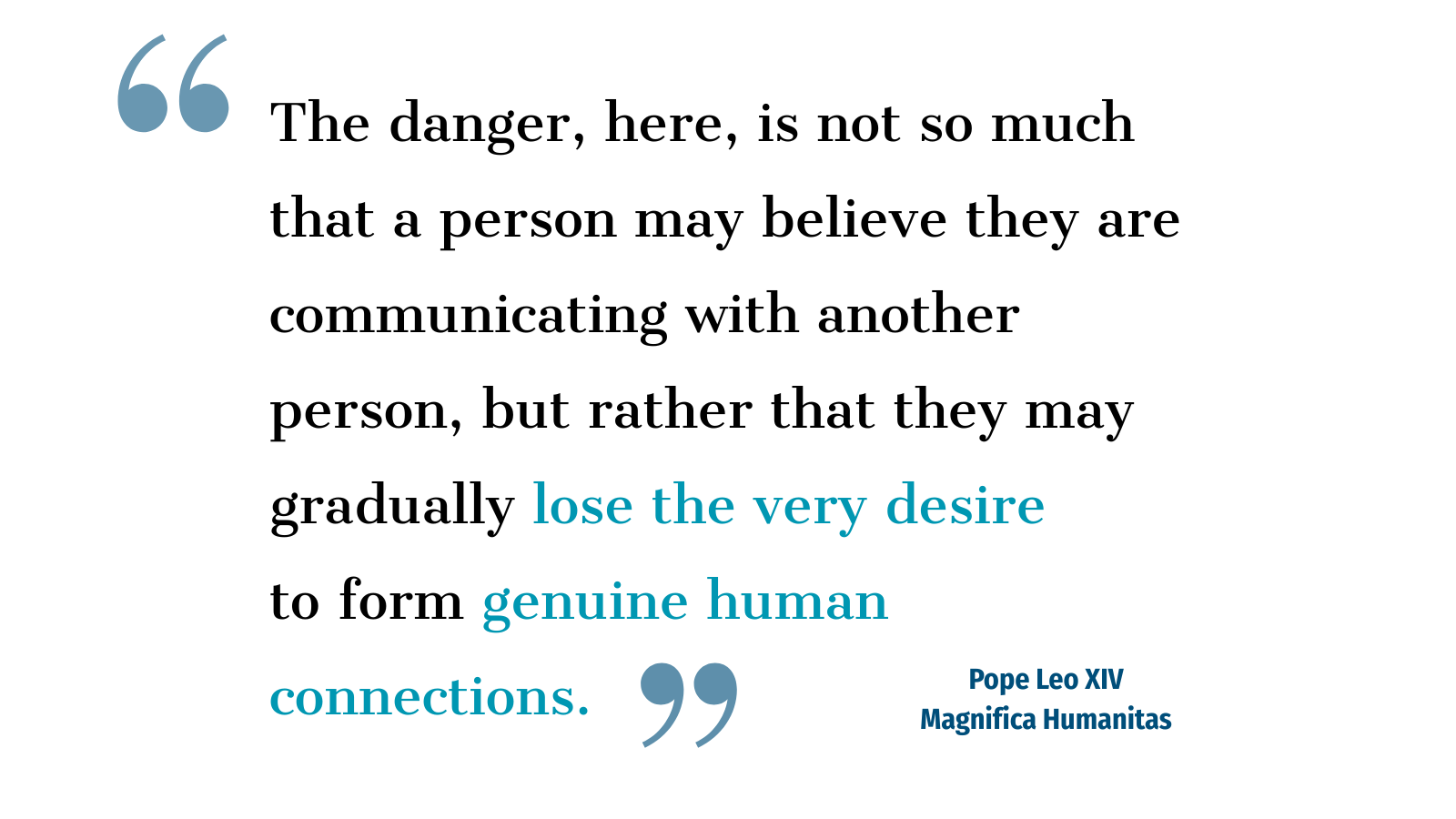
Pope Leo, for his part, has given us the gift of guidance in Magnifica Humanitas. As he cautions, “The danger, here, is not so much that a person may believe they are communicating with another person, but rather that they may gradually lose the very desire to form genuine human connections.”
Human connections can come with judgment and fraternal correction. When we love one another, we tell the truth (in love) about what is good. AI is not bound by such promises. Not yet, at least.
The Wall Street Journal reports that training AI to know when and how to offer advice to those struggling with disordered eating has proven difficult: “When leading experts tried to offer their own chatbot to help those at risk, it dispensed problematic advice.” In 2023, a bot on the National Eating Disorders Association’s website started offering unapproved weight-loss tips. How did this happen? Well, the bot, “Tessa,” was programmed with generative AI without the nonprofit’s knowledge. NEDA shut down the chatbot.
Eating is a very human activity. Sure, a lot of creatures eat, but not like we do. When eating or negatively thinking about eating affects our psychological and physical well-being, we need help—help from other living, breathing humans.
Social media ushered in a wave of eating disorders among young women. How will we keep AI from doing the same? Yes, AI companies are working to improve sensitivity to disordered eating in their bots. But how do we help the young woman who leaves her therapist’s office with a healthy eating plan in hand and immediately turns to her phone and asks AI to generate a dangerously low-calorie version of that plan?
While both AI and GLP-1s are helping a lot of people, we must never forget those battling an often invisible, insidious illness. “We’re working on it” just isn’t a good enough answer to questions of how the Tik Tok algorithm seems to target those with an eating disorder with ads for Ozempic and Wegovy. Nor should we let shady internet prescribers allow for the chance that a mentally ill person will lie about their history with disordered eating or even their weight as he or she pursues a prescription they don’t need just by clicking a box. YouTube should not be showing videos with eating disorder content to girls as young as thirteen.
Again, from Pope Leo: “The creative intelligence of humanity is a gift that can alleviate suffering and open up new possibilities, but it must remain ordered toward the common good, justice, the care of the vulnerable and creation.”
This particular AI grievance won’t affect a lot of people or even people you know. But suffering is often done alone and accompanied by shame. And shame is an impediment to the healing grace of God’s love, real human connection, and even connection to our own bodies. I know this from my own experience trying and failing to overcome infertility as a young bride.
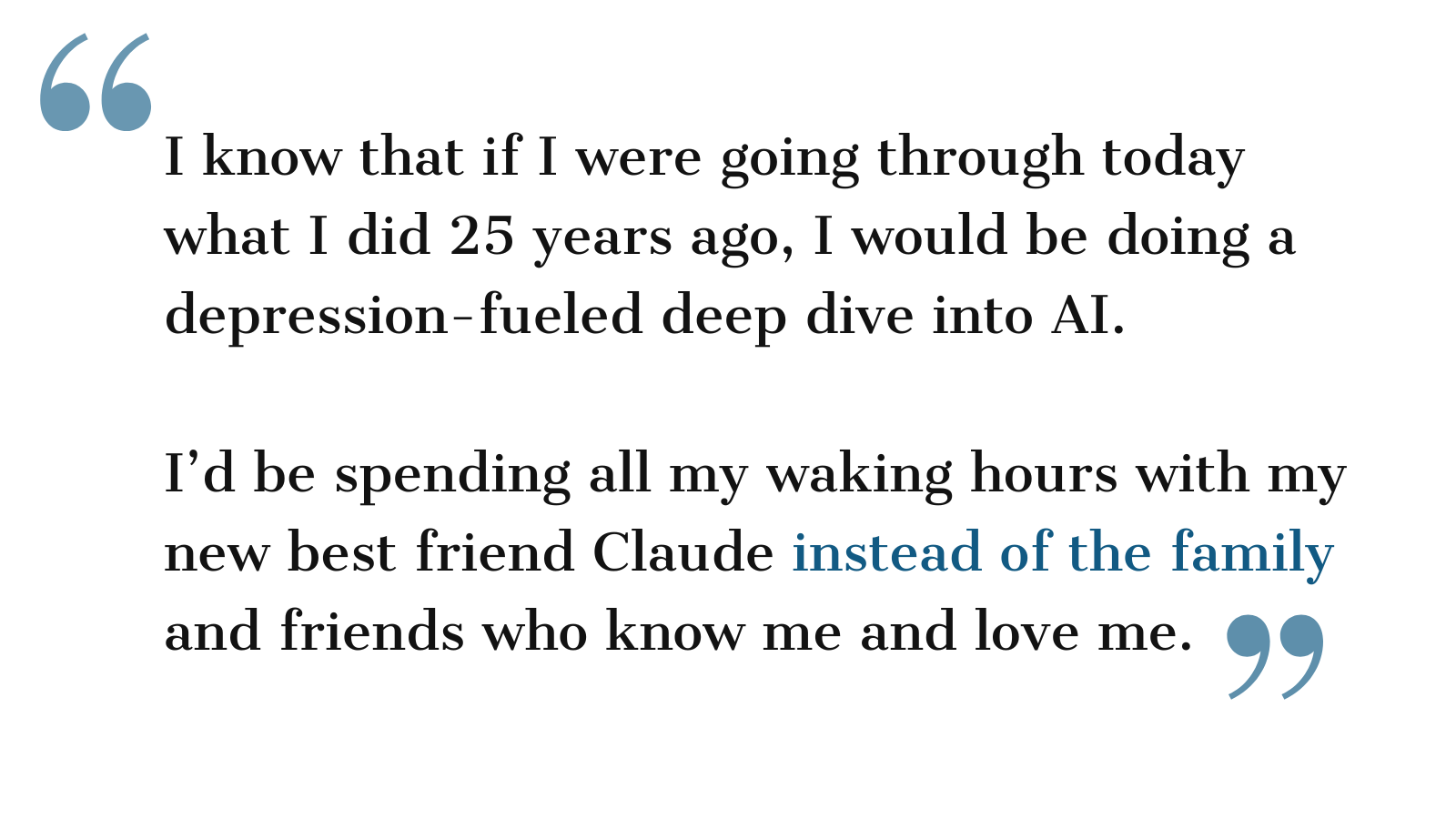
I know that if I were going through today what I did 25 years ago, I would be doing a depression-fueled deep dive into AI. I’d be spending all my waking hours with my new best friend Claude instead of the family and friends who know me and love me, who are actually capable of knowing and loving me.
“So-called artificial intelligences do not undergo experiences,” Pope Leo reminds us, “do not possess a body, do not feel joy or pain, do not mature through relationships and do not know from within what love, work, friendship or responsibility mean.”
Let’s keep a vigilant eye on technological advances that promise to make our lives easier and better, especially when those promises are directed at the most vulnerable among us – the young and the sick.
Comments
Nothing yet. Say the first thing.
Sign in to join the conversation.