
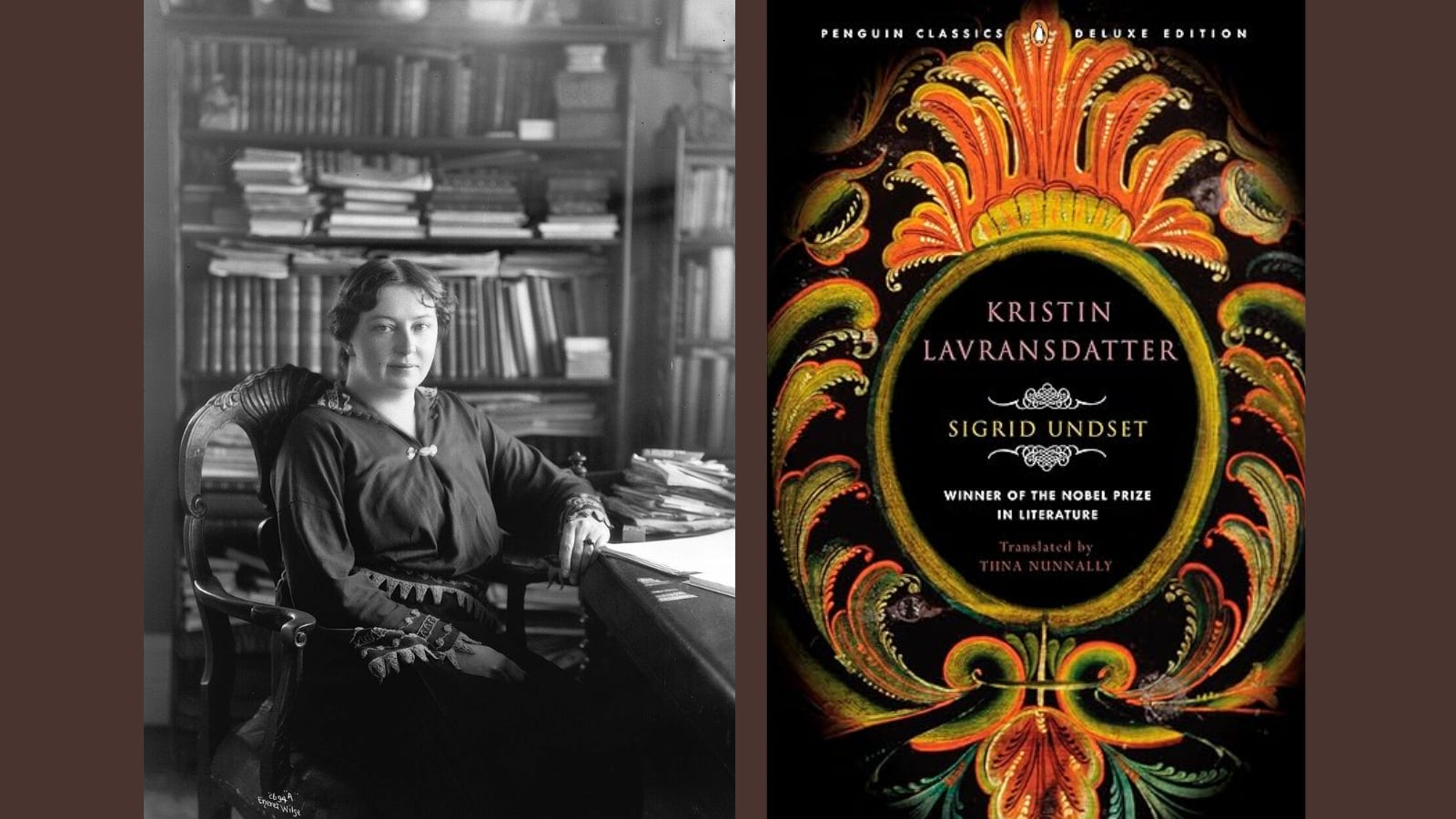
If you haven’t read Kristin Lavransdatter, now is the perfect time to pick it up. Its author, Sigrid Undset, may very well be a saint.
Earlier this month, the Diocese of Oslo announced that it intends to open the cause for her canonization this fall. This lit an instant spark of excitement across the globe, as her novel is routinely hailed as one of the best of the 20th century.
I think, too, it excited Catholics to think that the path to sainthood can be forged at the tip of a pen. Or in her case, with the tap of a finger on a key. We often think of saints as martyrs, but her cause moving forward is a reminder that drawing the eyes of the faithful heavenward through beauty and art is also a way to live a life of heroic virtue. And goodness, does the world need beauty—and in the case of Kristin Lavransdatter—beautiful stories of sanctification, even imaginary ones.
So it was a treat to have Michael O’Neill, known as the “Miracle Hunter,” on Conversations with Consequences this week to talk about this momentous news and to explain its significance. Michael investigates miracles and Marian apparitions for authenticity and works with dioceses the world over when sainthood causes are underway.
“This is a big deal for Norway,” he pointed out, because “it’s been a very long time since we’ve seen a Norwegian saint.” He pointed to Saint Magnus Erlendsson, who died in 1117, and Saint Olaf Haraldson, who was canonized in 1164, as the last saints from that region.
To have your cause put forward, he explained, the Church must have enough evidence to show that that person lived a life of sanctity.
“Fame of sanctity, fama sanctitatis in Latin, is what really impels a cause to get started. So, when it is believed by the faithful, usually over the course of years, decades, centuries, that someone truly lived a holy life and that there are miracles and intercessions related to them, that’s what starts a cause.”
“In the case of a very modern saint,” he continued, “you’ll see them doing interviews with family members, with friends, with co-workers. In the case of a historic cause like this one, they’ll be examining her writings. And, of course, she’s well known for her writings, so that will be a big part of it—to look at how she lived through the reports and through her own writings.”
How beautiful to think that Norway’s first potential saint in a millennium was a writer who wrote a story with some of the most beautiful and vivid imagery of her native land and told a story of sanctification that, in a sense, mirrors her own.
You’ll start hearing a lot more about Sigrid Undset in the months and years to come. Here are five interesting things you may not know (I didn’t):
She was a fierce Nazi resister. She called anti-Semitism “racial insanity” and was such an outspoken opponent of Nazism that the regime burned her books. After her oldest son was killed by the Germans, she fled occupied Norway through Sweden to the United States, where she spoke out and wrote against fascism.
She was a sinner. (Who isn’t?) But her path to virtue was not a straight one, much like the heroine of her novel, Kristin Lavransdatter. A convert, she was first a homewrecker who had an affair with a married man, causing the marriage to collapse. Her own subsequent marriage to him also collapsed (it was later annulled). No doubt Undset’s own painful experience defying the sexual and marital mores of her day inspired the events in Kristin’s life, as Kristin has sex out of wedlock with the town’s resident bad boy. Her marriage to him is fraught, including his infidelity.
The book is very much about sin. But as one writer put it in a piece for The National Catholic Register, “For many of her readers, what makes Undset’s writing so compelling is how effectively she portrays the confrontation of sin as a possible channel for God’s mercy.” The author quotes Michael Foley, a professor of patristics at Baylor University, who said, “Undset’s depictions of the interplay between fallen nature and grace are among the finest ever put to paper.”
Indeed, they may get her canonized.
As Bishop Frederik Hansen of Oslo said upon the announcement of the intention to open her cause, “Through her many books she has shaped countless believers, inspired them to live in Christ, and borne witness to our medieval saints.”
She was an avowed defender of the sanctity of human life. Her defense of all vulnerable lives conformed with what the Church calls a “consistent ethic of life.” She was outspoken against abortion, but also against other crimes against the sanctity of life including eugenics, Nazism, mistreatment of the disabled and the poor. “She showed a constant and practical concern for the poor,” Bishop Hansen said of her. “She gave of herself in caring for her daughters, and in her commitment to life and to the sanctity of life.” She cared for her ex-husband’s children after they divorced, one of whom was disabled. And she donated much of the proceeds of her Nobel Prize in Literature to charities and families caring for children with disabilities.
She became a lay Dominican. She joined what is known as the Third Order of St. Dominic, a pathway for the laity to join the Dominican Order, after her conversion to Catholicism in 1924, drawn to and influenced by the Order’s commitment to the truth and intellectual engagement with the faith and culture.
She started her writing career by moonlighting. For years she worked in a mundane role as a desk clerk, pursuing her writing after hours. Much of her initial writing was rejected, but she persisted and kept a regular habit of writing when she was off the clock at her desk job. Just like her path to sainthood, her journey as a writer began in a much different place from where it ended.
And the ending of her story is not yet written. Rather, the impact of her novels, her advocacy, and her public witness has yet to be fully understood, by the Church and by the world.
Comments
Nothing yet. Say the first thing.
Sign in to join the conversation.