
Observe the progressive movements towards the Incarnation. The Eternal Spirit, the Most Holy Trinity, God was always showing his desire to tabernacle amongst us and develop a union between heaven and earth. At Mount Sinai, God came veiled in a “thick cloud.” Next, with the tent of meeting, he tabernacled, veiled in garments of skins and curtains embroidered with cherubim. Filling the tent of meeting with His glory was like taking on the sinful flesh of man. Under Solomon, he solidified his presence in stone and filled hardened clay with glory. Images of Adam are hard to miss, both with the tent of meeting and Solomon’s Temple. Finally, God permanently became flesh, even redeeming it from death. The “living stone” (1 Peter 2:4) showed forth his glory at the Transfiguration. All the prior temples were prefigurements and announcements of the coming Incarnation of the Christ.
Introduction
Apocalypse does not mean the end of human life on earth. It means unveiling. To unveil something is to reveal that which is under a cover by removing the cover. To unveil means to show what is hidden and unseen. For this reason, apocalypse is synonymous with revelation. The Book of the Apocalypse is the Book of Revelation. The book is a glimpse beyond the cover of the material world into the unseen and invisible world by means of understanding signs and symbols through the light of faith and a canonical reading of Scripture. One sees with his intelligence and faith rather than merely light stimulating nerves through the retinas.
That which covers the unseen world from human eyes is materiality. Christ came veiled in flesh, but now we know that his flesh covered or hid his divine nature. He wasn’t trying to hide from us; he was simply making himself approachable. Through his resurrection from the dead and all the evidence, miracles and witnesses, faith helps us to see what was hidden all along: “the Word became flesh and dwelt amongst us” (John 1:14). Christ kept trying to tell us his identity and so explain his miracles, but even that was too scary for people who needed God to hide and remain behind written laws. Christ told us, “Before Abraham was, I AM,” and men took up rocks to stone him.
It is for this reason that Saint Augustine reminded us: “believing is seeing.” The Book of Revelation is trying to teach us how to see the world and its sacramentality through faith. The Book of the Apocalypse is not trying to fill us with fear of the end of this realm. The Book of Revelation is not supposed to be used for false prophecies justifying or excusing unlawful violence. Christians are warned not to use God’s name falsely, nor justify messianic extremists. Christians must love our enemies and do good to those who hate us.
The sacramentality of the world and God’s on-going communication with humanity was always seen in God’s merciful condescension and striving to tabernacle amongst us. To tabernacle was to establish some kind of physical presence in our midst. “Behold, I am coming to you in a thick cloud, that the people may hear when I speak with you, and may also believe you forever” (Ex 19:9 RSV).
Similarly, Saint Gregory Nazianzen spoke of the Incarnation as the “the Logos became thick” (cf. Saint Maximus, Ambigua 33). According to Saint Maximus the Confessor’s interpretation of Gregory, the Logos is in the creation he sustains. The Logos is in the words [logoi] of Scripture that precede his coming and he “ ‘becomes thick’ in the sense that, for the sake of our thick minds, he consented to be both embodied and expressed through letters, syllables, and sounds, so that from all these He might gradually gather those who follow Him to Himself…”[1]
Christ was always coming into this world in thickness. “He was in the world, and the world was made through him, yet the world knew him not” (John 1:10). This world was made through him and for him. Saint Paul’s Letter to the Ephesians is clear that all things were only made in view of his coming into this world and as a preparation for his coming. He would come from invisibility into material substantiality and thickness, from zoe [life of the Spirit] to bios [biological life]: God “chose us in Christ before the foundation of the world…He destined us in love to be his sons through Jesus Christ” (Ephesians 1:4-5).
It was for this reason that Saint Thomas Aquinas taught: “before the state of sin, man believed, explicitly in Christ's Incarnation, in so far as it was intended for the consummation of glory…” [STh II-II, 2.7]. Aquinas is in accord with the movement of Scripture in the Tradition and even appealed to Saint Paul’s Letter to the Ephesians for support. Man’s contemplation of the Garden before sin was designed to lead man to understand God’s plan through the lex orandi, lex credendi. [“Man” was the proper name of Adam before sin.]
Man perceived Eden as a pattern of the true Temple from heaven and pattern of things to come [cf. Gregory Nazianzen, Oration 45.8; Hebrews 8:5]. God wanted the Tree of Life established permanently amongst humans. The Tree of Life was to be the nexus between heaven and earth. In Eden, it was the joining of heaven and earth [a temple] which was not yet permanent since access could be lost. It was not yet made “thick” or permanent and so remained ephemeral, a sign of the coming of the Christ, the true Temple and Tree of Life.
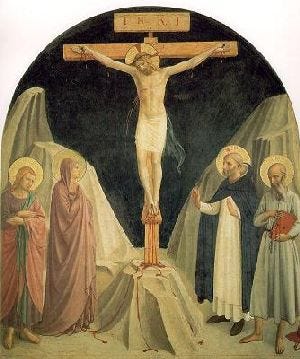
[Fra Angelico’s “Crucifixion with the Virgin Mary and Sts. John the Evangelist, Domenico, & Jerome,” Public Domain, Via Wikimedia Commons.] Christ is the Tree of Life.
God’s Gradual Efforts to Permanently Dwell Amongst Men
Saint Irenaeus taught that God was always trying to accustom humanity to himself gradually, moving from the ephemeral to the substantial, image to reality, and type to anti-type. The Catechism of the Catholic Church #53 discusses this:
The divine plan of Revelation is realized simultaneously "by deeds and words which are intrinsically bound up with each other" and shed light on each other. It involves a specific divine pedagogy: God communicates himself to man gradually. He prepares him to welcome by stages the supernatural Revelation that is to culminate in the person and mission of the incarnate Word, Jesus Christ.
St. Irenaeus of Lyons repeatedly speaks of this divine pedagogy using the image of God and man becoming accustomed to one another: The Word of God dwelt in man and became the Son of man in order to accustom man to perceive God and to accustom God to dwell in man, according to the Father's pleasure.
In God’s pedagogy of humanity, he called Israel-according-to-the-flesh out of Egypt and formed them into an assembly, the “ecclesian Kuriou,” (Deut 23:1 LXX), “church of the LORD.” It was not yet God’s full assembly which would invite all humanity, and so the tabernacling presence in the Exodus would not be the final or permanent “thickness” that God wished to communicate and establish. The permanent presence would await the “time of reformation” (Hebrews 9:10) with God’s final temple, Christ.
The Prefigurement of the Incarnation in a “Thick Cloud” & Garments of Skins
Nevertheless, a “thickness” and substantial presence of the invisible was made visible at the first assembly of the LORD: “On the morning of the third day there was thunder and lightning, and a thick cloud upon the mountain…” (Ex 19:16). God’s presence became substantial this side of eternity so that his voice could be known to all and eternity could be visible inside the created order.
Despite the sin of the people at the golden calf, God wished to come amongst them still and keep a created presence in the midst of his assembly. Such a paradox, eternity inside a created presence. Divinity was “contained” in time and space without change to the divinity. A tent of meeting [a kind of tent temple] was established based on the meeting design of Mount Sinai. The supernatural and ephemeral cloud of Exodus 19-24 eventually became a transitory tent for approximately the next 500 years: “Then the cloud covered the tent of meeting, and the glory of the LORD filled the tabernacle…the cloud abode upon it” (Ex 40:34-35).
Careful attention to the design of the tent of meeting reveals the mystery of man. Its exterior covering of goats’ skins is like the exterior of man (cf. Gen 3:21; Gen 27:16; Ex 26:7), beastly, like when Jacob was covered to receive Isaac’s blessing. However, underneath the skins were embroidered curtains and veils with images of the angels (Ex 26:1), just as man’s soul is spiritual beneath his beastly exterior, but the spiritual is veiled in thickness (cf. Ex 19:16). Man was made in the image of God. Beneath the angelic coverings of the tent of meeting was the divine presence of God, as had always been intended to dwell inside men’s souls. Man (male and female) was also made in the likeness of God.
After about 500 years of the tent of meeting, that tabernacling presence of the Tree of Life [the union between heaven and earth] finally arrived in Jerusalem and was transferred to the middle of God’s settled people, Jerusalem. Now that it arrived and the covenant and promises met their resting place, the promise of God sharing his “name” was realized (cf. Gen 12:2; 2 Sam 7:9,14): the yes of Virgin Israel in David’s faithfulness, renewed by God, saw a further “thickening” of God’s presence. The rock of God’s promise to David of a forever heir was symbolically put into stone and memorialized as a Temple under young Solomon’s leadership.
The Prefigurement of the Incarnation with Solomon’s Temple
Stone was stacked upon stone and was an initial realization and pledge of things to come. The clay of the earth (cf. Gen 2:7) had formed stones, and stones took the place of the tent of meeting with the advent of Solomon’s Temple. The ephemeral tent of Moses took on stone and greater thickness under Solomon. Metaphorically, God breathed into it and so His Spirit manifested: “And when the priests came out of the holy place, a cloud filled the house of the LORD…for the glory of the LORD filled the house of the LORD” (1 Kings 8:10-11). Solomon’s Temple “contained” or “housed” the Lord. Heaven and earth were joined.
The Tree of Life was symbolically in the stone Temple of Solomon as the Ark of the Covenant was transferred from the tent of meeting to the stone temple. Heaven and earth were joined again [Tree of Life] visibly at the advent of the overshadowing and resting cloud of presence from Sinai, now inside Solomon’s Temple. The temple had the living presence of God as at Eden. For this reason, all around the Ark of the Covenant the walls were decorated with angels and images of the Garden of Eden: “[Solomon] carved all the walls of the house round about with carved figures of cherubim and palm trees and open flowers, in the inner and outer rooms” (1 Kings 6:29). Spirits were thus veiled beneath stone and clay as embroidered curtains with cherubim were once veiled in the tent of meeting.
Nevertheless, God’s true temple is not made by human hands as Eden was not made by human hands. Solomon’s Temple was only an image and promise of what was to ultimately come, what Man had always known even in Eden: that God’s Word and Logos would become man. God always wanted to establish his living presence amongst us permanently. God always wanted to feed us a share in his very own life from the Tree of Life, the place of the joining of heaven and earth. God wanted to give us himself and make us sons in the Son. A stone temple is still not God in the flesh and living or dwelling permanence. Nothing less would suffice in God’s love for mankind. The flesh that would become the mystical body of his Son was too dear to Him for God to not take flesh upon himself.
Even though signs were given of what God wanted to ultimately accomplish, to live amongst us, only a “living temple” could accomplish such a promise. A tent covered in goat hair (cf. Gen 27:16; Ex 26:7), was still not a living man; and clay which had been breathed into and filled with the glory of God was still not a living man if the Temple of Solomon remained only cold stone and not a heart of flesh. God was still coming to us in true thickness and would form a living temple from a new and blessed earth; a new creation (cf. Jer 31:22) from the old creation.
Within 500 years, Solomon’s Temple was destroyed and replaced with something more modest as a reminder that humanity awaited the true Temple which only comes down out of heaven. With the promised coming Son of David (Isaiah 7, 9, 11), all of God’s promises would be realized. About 500 years after the Second Temple which Zerubbabel initiated, the ultimate Temple, the one not made by human hands arrived.
The Incarnation Is the Final Temple
The Son and Word of God came as the Son of David. Image became reality and so God built a house for David in the Incarnation of the Son of God. Hope and promise became permanent and “thick cloud” (cf. Ex 19:16) through flesh and blood. Eternity came clothed in time and space to bring time and space into eternity. The divine became man so that man might become divine. God espoused us (cf. Hosea 2:19).
As the cloud rested upon the tent of meeting and filled it, and as the cloud transferred to Solomon’s Temple, resting upon it and filling it, so the glory cloud was present to the Virgin Mary and actually formed God’s ultimate and final Temple. The cloud rested upon virgin daughter Israel: “The Holy Spirit [the cloud] will come upon you, and the power of the Most High will overshadow you; therefore the child to be born will be called holy, the Son of God” (Luke 1:35).
Sonship and Temple became one in Mary’s pure womb. Instead of dead clay or mud [limo in the Vulgate], God assumed living clay from the pure and blessed earth of Mary’s womb. Instead of dead stone, God assumed flesh & “living stone”. Zoe became bios, Word became flesh. The stone not cut by human hand became a kingdom: “and the Lord God will give to him the throne of his father, David” (Luke 1:32).
The times of the Son of Man (Dan 7:13-14) arrived. The “stone not cut by human hand” (cf. Daniel 2:34a) brought an end to images, both the false ones of the pagans and the preparatory ones of the Old Law. The stone “struck the image and became a great mountain and filled the whole earth” (Dan 2:34b). Jesus became the mountain of the LORD. Jesus became the true Temple. “I tell you, something greater than the temple [of Solomon] is here” (Mt 12:6). The original image [cf. Ephesians 1:4] was re-established.
Saint Peter spoke of this: “Come to him, to that living stone, rejected by men but in God’s sight chosen and precious; and like living stones be yourselves built into a spiritual house, to be a holy priesthood, to offer spiritual sacrifices acceptable to God through Jesus Christ” (1 Pet 2:4-5).
The Tree of Life Planted in the Church
With the True Temple, Jesus Christ, the Tree of Life has been permanently re-established on earth again, but it is guarded by new ministering angels who open and close the gates [bishops]. God has restored and recapitulated complete access to sharing in his life, eternal life through Jesus Christ. The Tree is planted inside his Church, the new assembly of the LORD, with real ministers with real authority to bind heaven and earth (Mt 16:19, 18:18). They do so through the institution of the Lamb of God under the appearance of bread and wine and only by participation in Christ the High Priest.
Jesus Christ is the nexus between heaven and earth and by his resurrection from the dead has become the gateway and source of eternal life. Jesus grants real, true, and substantial participation in himself through the mysteries he established to join the earthly to himself in heaven. He is completely accessible through faith and substantially present as the Lamb of God and Tree of Life, in Holy Communion. He “has become a life-giving spirit” (1 Cor 15:45) through his glorified body in heaven which comes down to earth in mysteries.
The New Jerusalem, the heavenly temple, comes down out of heaven whenever the apostles make present the Lamb of God (Rev 21:14,21) under the veil of bread and wine. Access to the Tree of Life is given to the final assembly of God, the Church of Jesus Christ: “Behold, the dwelling of God is with men” (cf. Rev 21:2-3); “share in the tree of life and in the holy city” (Rev 22:19). The “fruit” of the Tree of Life comes substantially and in “thickness” in the Sacrament of Holy Communion which is only unveiled for those with living faith in Christ. This “thickness” is experienced in the assembly of God, the true Israel.
“Israel according to the flesh, which wandered as an exile in the desert, was already called the Church of God. So likewise the new Israel which while living in this present age goes in search of a future and abiding city is called the Church of Christ. For He has bought it for Himself with His blood, has filled it with His Spirit and provided it with those means which befit it as a visible and social union” [Dogmatic Constitution on the Church, Lumen Gentium #9.3].
The visible and social union has no problem with God still coming to us in a “thick cloud.” However, we have not come to “darkness, and gloom, and a tempest…but the heavenly Jerusalem” (Heb 12:18-22) through the real, true and substantial presence of Christ in the Eucharistic Liturgy.
For more reading on Saint Gregory Nazianzen’s views of Eden and the Trees in the Garden, see this article in the Adoremus Bulletin.
See also my book at Amazon, A Catechesis on Deification, Transfiguration & the Luminous Mysteries.
[1] Maximos the Confessor, The Ambigua, vol. II, ed. & trans. by Nicholas Constas (Harvard University Press, 2014), 63. Some of my summary comes from reading his introduction to Ad Thalassios published with CUA.
Comments
Nothing yet. Say the first thing.
Sign in to join the conversation.