
Introduction
In one of the most authoritative commentaries on Vatican II, John Oesterreicher, a peritus and ghostwriter of Vatican II’s declaration Nostra Aetate, summarized a petition from Rome’s Biblicum which was made in view of the coming Council. The petition was signed by Rector Ernest Vogt, SJ, on behalf of 18 other Jesuit professors on 24 April 1960. The petition helped to organize what eventually became the declaration Nostra Aetate, a magisterial document which gave pastoral direction for the Church’s relation with non-Christian religions. The declaration is known for emphasizing the pastoral importance of preventing antisemitism as seen in Nazi Germany. The interpretation of all declarations are subject to the magisterial documents known as dogmatic constitutions.
In advance of Vatican II’s deliberations, the Biblicum professors from around the world petitioned for the Council to make a statement highlighting the Church’s rejection of antisemitism. For the professors at that time, antisemitism was defined as hatred towards Jews as an ethnos [a race or cultural identity]. The professors were rejecting slanderous use of the New Testament which falsely claimed Jews as an ethnos were rejected by God or accursed. They wanted to see the idea of collective guilt rejected so horrors of the Nazi holocaust would not be repeated. The Biblicum professors of 1960 would have never accepted the idea that official Catholic doctrines about the Church as the “new Israel” or “Israel of God” stemmed from antisemitism or caused it. These were theological and specifically religious matters recorded in what became dogmatic constitutions, like Lumen Gentium #9.3.
Unique to the Biblicum’s 1960 petition to condemn antisemitism was how the Church’s liturgies were tied to the identity of the Church as the “new Israel” (and as repeated in Lumen Gentium #9.3 a few years later in 1964). In the authoritative commentary which was written immediately after Vatican II’s closing, Oesterreicher summarized the Biblicum petition in a positive light: “Christians are without doubt the true successors of the spiritual Israel, the authentic heirs of the faith of Abraham ‘our Patriarch’ … and of the blessing of Jacob, ‘the Israel of God’, as the Apostle says (Galatians 6:16). And therefore the Christian profession of faith can fittingly and rightly be called the ‘dignity of Israel’, as in the liturgy of Holy Saturday.”[1] Implicit to the petition was a matter of Catholic faith that the “authentic heirs of the faith of Abraham” and “the blessing of Jacob,” was Christ’s Church [ekklesian in Greek or assembly]. It became the “new Israel,” the “Israel of God” at “the time of reformation” (Hebrews 9:10) through the New Covenant established in the Messiah of God.
The Church’s center for advanced biblical studies in Rome unhesitatingly affirmed the Church is “the Israel of God” per Galatians 6:16 according to the ghost writer of Nostra Aetate. Months after the Biblicum petition, Oesterreicher himself, then a professor at Seton Hall University in the United States, signed a petition supporting that the Church is the “Israel of God” in accord with Galatians 6:16 and called it “the Church’s understanding of herself.”[2] These are terms found in the unanimity of the Church Fathers which the Church would repeat in calling itself “the new Israel” in the 1964 Dogmatic Constitution on the Church, Lumen Gentium #9.3 and again the “new people of God,” in the 1965 declaration Nostra Aetate #4.6. Clearly, the Church never associated antisemitism with the doctrinal truth that the Church is the “new Israel.”
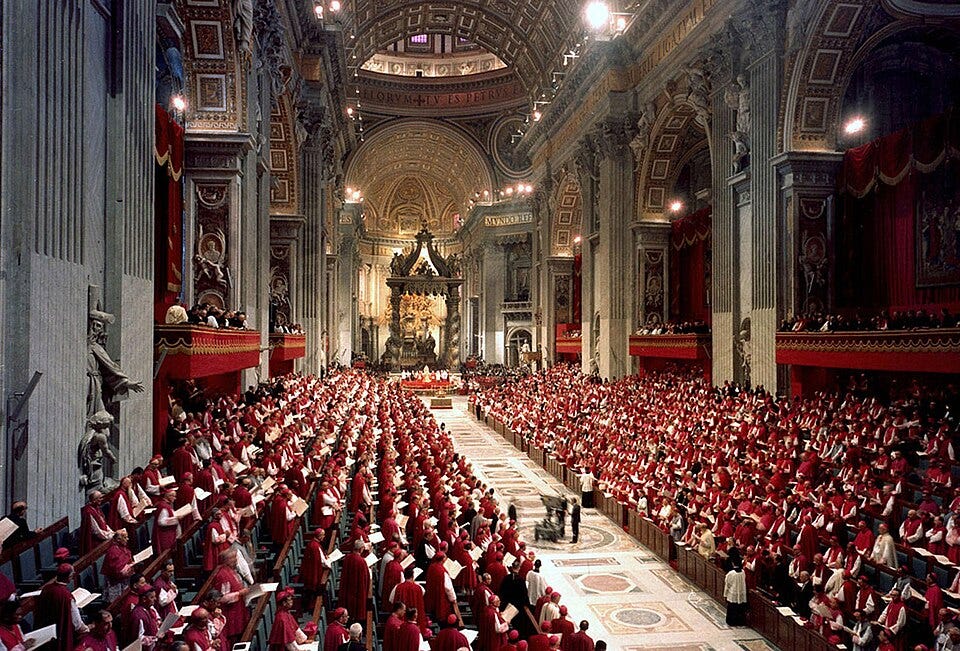
It is disappointing that Catholics are misrepresenting the teachings of Nostra Aetate 60 years later. Catholic theologians are cooperating with Protestant professors, Jewish rabbis and Israeli lobbies to get the Church to change its doctrines and stop calling itself the “new Israel” or “Israel of God.” It is a denial of Jesus as Messiah and his perfect sacrifice to deny these titles or water them down. It is false ecumenism which has given in to a false theological Zionism. It is no wonder that Benedict XVI in his last published academic essay concluded:
The formula of the “never-revoked covenant” may have been helpful in a first phase of the new dialogue between Jews and Christians. But it is not suited in the long run to express in an adequate way the magnitude of reality. If brief formulas are considered necessary, I would refer above all to two words of Holy Scripture in which the essentials find valid expression. With regard to the Jews, Paul says: “the gifts and the calling of God are irrevocable” (Rom 11:29). To all, Scripture says, “if we endure, we shall also reign with him; if we deny him, he also will deny us. If we are faithless, he remains faithful—for he cannot deny himself” (2 Tm 2:12f).[3]
Thesis Concerning “Recapitulation”
It is time to explore Benedict XVI’s meaning of the “magnitude of reality” because he was pointing to the meaning of Ephesians 1:10 which the RSV translates as: “a plan for the fulness of time, to unite [ἀνακεφαλαιώσασθαι] all things in him, things in heaven and things on earth.” From that verse, Benedict will take the Greek word ἀνακεφαλαιώσασθαι and render it more etymologically as “recapitulate” or “re-head-up” all things. [4] This understating of recapitulation is inseparable from Hebrews 9:10 when it speaks of the “time of reformation” which is when the Messiah recapitulated Israelite worship in and through himself as the union between heaven and earth.
By following the works of Pope Benedict XVI, this presentation seeks to re-establish that the prudential way to speak about the Church as the “Israel of God” (Gal 6:16) is through the term “recapitulation,” i.e. the Church of Christ recapitulates Israel. Since we must ultimately acknowledge that the New Covenant “supersedes” [cf. Ratzinger] the Mount Sinai covenant, and since some theologians falsely attach the terms “replacement” and “rejection” as static cognates of “supersedes,” a language of “recapitulation” is needed to rightly avoid misrepresentations of the Church’s teachings. The concept of recapitulation, as found in Ephesians 1:10, captures the dynamic meaning of replace or substitution intended in Catholic thought regarding the Church as the “new Israel.” Catholics should not repeat false Protestant and Jewish usage of the term “supersessionism” as though the term captures Patristic exegesis. The Church Fathers always understood “replace” and “substitution” as recapitulation.
“Recapitulation” rightly explains how the fire that once came down on Mount Sinai is now recapitulated in the liturgies established by Christ at “the time of reformation” (Heb 9:10). Christ’s liturgies communicate the indwelling fire of the Holy Spirit [cf. Acts 2:3; Heb 6:4-5] and not merely foreshadows of it as once shown by angels in the giving of what became the Torah under Moses. At his Transfiguration (cf. Mt 17), Christ is the sign and reality of the holy fire in which we are immersed in Holy Communion and where the “dignity of Israel” is realized in God’s holy temple. It is in Holy Communion “that what is mortal may be swallowed up by life” (cf. 2 Cor 5:4,17) in Christ, God’s re-established temple which comes down from heaven (Rev 21:10, 22-23).
The Letter to the Hebrews and God’s Israel
In the New Testament Letter to the Hebrews, we find a Pauline treatise on the relation of the Old Covenant to the New Covenant. In describing the ceremonial laws of the Torah giving way to the new and “better sacrifices” (Heb 9:23) or rites of Christ, Paul calls what was central to the rites of Second Temple Judaism “obsolete.” He then states, “And what is becoming obsolete and growing old is ready to vanish away” (Hebrews 8:13). The rites of Second Temple Judaism were meant to vanish away so the Judaism of the Messiah could establish a renewed Israel via “the time of reformation” (Heb 9:10) and reign of the Messiah from heaven (cf. Rev 20:6) as God’s temple.
Second Temple Judaism was not simply extinguished or meant to be extinguished. It was destined for realization in the Messiah, to be taken up into him by means of recapitulation. The choice is between the Judaism of the Messiah or the Judaism according to the flesh (cf. Romans 9:8). The choice is between the old and vanishing or the true Israel of God which was the “telos of the law” (cf. Rom 10:4). Christianity did not simply replace Judaism. Faith in the Messiah was always true Judaism and so Christians are true Jews as the Church Fathers have always said in accord with Saint Paul: “It is not the children of the flesh who are the children of God, but the children of the promise” (Rom 9:8).
Judaism didn’t end with Christ, it was transformed by Christ. Paul never said the Old Covenant was irreformable in Romans 11:29. Instead, he said “the gifts and calling of God are irrevocable.” The calling of God is the gift, it includes the covenants, but the covenants are “reformable” (cf. Hebrews 9:10) and had a “telos” (Rom 9:8; 10:4). Nations that cannot reform and better themselves always become obsolete; only the kingdom of the Messiah is forever and blessed.
Paul explains how the ceremonial aspects of the Old Covenant were “imposed until the time of reformation” (Heb 9:10), making clear that the liturgies of Israel are reformable and can find even higher dignities. He immediately explained that Jesus reformed all cult practices of Israel through the new covenant because he is the authoritative Messiah: Christ “is the mediator of a new covenant, so that those who are called may receive the promised eternal inheritance” (Heb 9:15). By chapters 10:19-22 and 12:18-24 of Hebrews, Paul reveals that Jesus now operates as the true plan of Mount Sinai. Christianity is what true temple worship has become through the eucharistic institution of Christ’s Body and Blood (cf. John 6). The mystery of Christ became mystical and sacramental in the new temple worship and “better sacrifices” (Heb 9:23; cf. 1 Cor 5:7-8):
For you have not come to what may be touched, a blazing fire, and darkness, and gloom, and a tempest, and the sound of a trumpet, and a voice whose words made the hearers entreat that no further messages be spoken to them…But you have come to Mount Zion and to the city of the living God, the heavenly Jerusalem, and to innumerable angels in festal gathering…and to Jesus, the mediator of a new covenant… (Hebrews 12:18-24)
God’s Israel went with Jesus the Messiah from Judah. Since the prudential decisions of the Second Vatican Council have requested that we should not speak of old Israel as being rejected or accursed (“Although the Church is the new people of God, the Jews should not be presented as rejected or accursed by God” Nostra Aetate #4.6), then how do we explain the “new Jerusalem” (Revelation 21:2) that comes down out of heaven at our eucharistic liturgies? After all, old Israel, Second Temple Israel became obsolete in 70 A.D as Paul had foretold. The “new Jerusalem” does not exist apart from the “new Israel.” How do we discuss something new without speaking of the Old as simply, and inaccurately, just replaced?
The correct word to use is actually “recapitulated,” and not “replaced.” Israel was recapitulated in the Messiah. The term best holds the meaning of something new, but not a strict replacement or substitution. “Recapitulation” speaks of change and continuity through authentic “reformation” (Heb 9:10), fulfillment and superior development as the Letter to the Hebrews does.
The language of Vatican II’s Dogmatic Constitution on the Church captures this language of “reformation” when it announces: “Israel according to the flesh, which wandered as an exile in the desert, was already called the Church of God [ἐκκλησίαν κυρίου in the Septuagint Dt 23:1]. So likewise the new Israel which while living in this present age goes in search of a future and abiding city is called the Church of Christ” (Lumen Gentium #9.3). Israel according to the flesh is presented by the Dogmatic Constitution as an early version of the ekklesian Christou [assembly of Christ] to come. Recapitulation is implicit and Israel was always inseparable from becoming the ekklesian Christou.
Notice the Catechism of the Catholic Church #877 captures this language when it cuts to the heart of explaining the reformation of Israel in order to expand communio with Christ which forms the new Israel, the true Greater Israel:
Likewise, it belongs to the sacramental nature of ecclesial ministry that it have a collegial character. In fact, from the beginning of his ministry, the Lord Jesus instituted the Twelve as “the seeds of the new Israel and the beginning of the sacred hierarchy.” Chosen together, they were also sent out together, and their fraternal unity would be at the service of the fraternal communion of all the faithful…
Jesus’ sacrifice supersedes the manifestations of Mount Sinai, it remains its continuation in a higher reformation and development, something we call “fulfillment.” A higher and superior reformation as described in Hebrews 9-10 & 12, can only be defined as a recapitulation. In his earlier work, Many Religions, One Covenant, Joseph Ratzinger writes: “…the Sinai covenant is indeed superseded.”[5] So too, since the Twelve are taken from the original Twelve of ancient Israel, then the New Israel is the continuation of Israel per CCC #877. It is the “fraternal communion of all the faithful” as the covenantal assembly of God.
Ancient Israel is recapitulated by the Church of Christ in God’s new and everlasting covenant. It was not simply replaced. Rather, it was realized and so what was only temporary or preparations for the Messiah became obsolete or realized in a higher way via a “time of reformation” (cf. Heb 9:10). The earlier assembly of God during the time of Moses is finalized in the awaited Messiah and becomes the assembly of Christ in the new Exodus “which Jesus was to accomplish at Jerusalem” (Luke 9:31). It is exactly as Vatican II’s Dogmatic Constitution Lumen Gentium #9.3 described. No one denies that Israel-according-to-the-flesh exists in some fashion, but as Saint Paul teaches: “neither circumcision counts for anything nor uncircumcision, but a new creation [in Christ]” (Gal 6:15). Jesus took the ancient temple into himself when the veil of the Second Temple tore at the time of his death (cf. Mt 27:51). In his resurrection, Jesus made the temple into something mystical (cf. Jn 2:19-21) as described in Revelation 21.
The kingdom and kingship goes with the “Lion of the tribe of Judah” (Rev 5:5) since the “time of reformation” (Hebrews 9:10). The Church is the new Israel, the “Israel of God.” The 1948 state of Israel cannot claim to be God’s true Israel or the biblical Israel since the Second Temple was made obsolete for 2,000 years while God’s true Temple was found in the ekklesian Christou [assembly of Christ] and her liturgies. Any attempt to displace God’s true Israel under God’s Messiah is by definition antichrist: “Who is the liar but he who denies that Jesus is the Christ? This is the antichrist, he who denies the Father and the Son” (1 Jn 2:22).
The Church of Christ was founded by Jews for Jews to be fulfilled in the Judaism of the Messiah. No one is trying to erase Judaism. It is those clinging to Judaism without the temple of the Messiah who are erasing Judaism. It is those who don’t want gentiles to belong to Judaism who are erasing what Judaism hoped for: gentiles subject to God and his Messiah. In the Judaism of the Messiah, divisions according to the flesh have been brought to an end. Those who seek to re-establish them are ignoring Paul as did the Judaizers (cf. Gal 5:12).
Benedict XVI and his emphasis on recapitulation
For similar reasons of correcting those who misapply the word “supersessionism,” Pope Emeritus Benedict XVI sought to give clarity to the 2015 “reflection” document from the Commission for Religious Relations with the Jews. Already, that commission “reflection” of 2015 entitled, “ ‘The Gifts and Calling of God are Irrevocable’ (Rom 11:29): A Reflection…on the Occasion of the 50th Anniversary of ‘Nostra Aetate’ (No. 4),” opened with a clarification: “The text is not a magisterial document or doctrinal teaching of the Catholic Church, but is a reflection prepared by the Commission for Religious Relations with the Jews…” Many such documents have led to misappropriations or misreadings of Nostra Aetate by overzealous ecumenists. Clearly, the opening clarification was not enough. Misappropriations of the document and Nostra Aetate led to Benedict XVI as Pope Emeritus in 2018 to write a response to points concerning a proper understanding of the term substitution in Catholic tradition. The pejorative use of the term supersessionism seems to reject the Church’s traditional doctrinal position.
In Benedict’s 2018 Communio essay, Grace and Vocation Without Remorse: Comments On the Treatise De Iudaeis, he describes the relation between Sinai and the Divine Liturgy in the following terms:
For Christians, it is clear that all previous cult finds its meaning and its fulfillment only insofar as it moves toward the sacrifice of Jesus Christ. In him, to which it constantly refers, the whole makes sense. In fact, there is really no “substitution,” but a journey that eventually becomes one reality. And yet this entails the necessary disappearance of animal sacrifices, in place of which (“substitution”) the Eucharist occurs.[6]
In Christian tradition, the sacrifices in the Torah were proto-Christian, & revealed their value as types of Christ’s sacrifice at the “time of reformation” (Heb 9:10). Benedict’s climactic summary of how we might avoid unnecessary alienation of Jews from Catholics when we use language that touches upon “replacement” or “substitution,” is through the Ephesians 1:1-10 concept of “recapitulation.” Benedict XVI stated, “Instead of a static view of substitution or nonsubstitution, there is a dynamic consideration of the whole of salvation history, which finds its ἀνακεφαλαιώσις [recapitulation] in Christ (see Eph 1:10).”[7]
There is a kind of substitution and replacement of Second Temple Israel and its Judaism that must be explained dynamically, and the proper term is recapitulation in Christ (per Ephesians 1:10) so as to avoid a static interpretation of “substitution” or the false pejorative of “supersessionism” when if fact “recapitulation” was intended. Blanket condemnations of “supersessionism” are false and misrepresentative of the Catholic faith if they ignore or reject what Ephesians 1:10 teaches clearly [recapitulation] in union with Hebrews 9:10 [“at the time of reformation”].
The term supersessionism has been absorbed by Catholics without discernment of its anti-Catholic origins and misrepresentations. Israel was not replaced by the Church in a static understanding or replacement theology as many Protestants misrepresent Catholic teaching. Lumen Gentium #9.3 is very clear that Israel was the Church awaiting the Messiah and Israel remains now with the Messiah, the Church of the Messiah. It is not surprising that modern religious Zionists want physical promises of land to be irrevocable and non-reformable since they reject God’s Messiah, Jesus Christ.
Notice that those who accept Jesus the Messiah and understand the new temple worship (Catholics and Orthodox) see that the physical land is obsolete since Christ is the central place of worship for God’s Israel and he reigns from heaven until his mystical body is complete. Since the categories of Jew and Greek no longer matter in Christ, do Jewish and Christian Zionists really think God wants to segregate us again by geography? It is an odd eschatology to say the least. It would be comical if not for all the senseless death such theologies are causing in today’s Middle East.
Benedict XVI repeatedly spoke against the non-sense of separating Jews and Christians geographically:
A suitable interpretation of the promise of land, in the context of the formation of the state of Israel, is of vital importance to all sides today. Without repeating all that I say in my text [2018 essay], I would like to reiterate my thesis, which is important not only for Christians, that the state of Israel as such cannot be regarded theologically as the fulfillment of God’s promise of land.[8]
From Slavery to Sonship: Getting from Sinai to Zion and the Israel of God
At Mount Sinai and the tabernacle of the tent of meeting, the true presence of the Lord was manifested by the “elemental spirits” (Gal 4:3) and so gave the Torah, the law: “we were slaves to the elemental spirits of the universe.” In his De Trinitate, Saint Augustine reminds us and teaches what was meant by the phrase elemental spirits in Galatians 4:3: “It has been established by all rational probability … and by firm authority as far as the divine words of scripture have declared it, that whenever God was said to appear to our ancestors before our savior’s incarnation, the voices heard and the physical manifestation seen were the work of angels.” [Book III, Chapter 4][9]
Since the holy angels then and forevermore behold the face of God in beatific vision, then at the cloud and fire that came down on Mount Sinai, a manifestation wrought at God’s command by the angels, the angels brought the true presence of God which they always behold. Manifesting in the temporal world, they produced a voice from behind them and the thick cloud. Hebrews 2:2 thus confirms this role of the angels with the statement that the “message declared by angels was valid.” Since these were ministering spirits, and Leviticus made the receivers in no better a position than servants, Paul called the Torah a pedagogue (cf. Gal 3:24). Sinai was an inferior participation in God’s presence than that which came in the flesh by God’s Son, the Logos in flesh.
In other words, there was a presence and law brought by angels whose covenant permanence was inferior insofar as it was preparatory in comparison to the one that would be delivered by God’s natural Son, the Logos. Thus Galatians 4:4 speaks of the fullness of time being the coming of the Son & Hebrews 9:10 speaks of the coming of the Son as the time of reformation of that which was not meant to be permanent. Chapter One of Hebrews presents the Son as superior to the angels and so we must see the covenant the Messiah brought at “the time of reformation” as superior as that delivered by angels at Sinai and the tabernacle of the tent of meeting (cf. Hebrews 2:2-3).
At the Transfiguration, at Tabor, the true presence of the Lord was revealed by the Word made flesh, the Son of God and not merely angels. It was a light coming from Christ’s face which was more glorious than what came from Moses at Mount Sinai because Christ caused the glory cloud to appear. Christ brings the glory cloud, he doesn’t only enter it. This is why the new Jerusalem comes down out of heaven whenever his body and blood are made present through the apostolic words of consecration (cf. Rev 21:2-3, 14). Along with his Resurrection and Ascension, the revelation at the Transfiguration inaugurated the “time of reformation” (Heb 9:10) and “better sacrifices” (Heb 9:23).
Since his Resurrection and Ascension, the Son of God now makes present in the Eucharistic liturgy God’s real, true and substantial presence (Mount Zion). Jesus has recapitulated the tabernacle of the tent of meeting in himself. The true presence of the Lord was begun at Mount Sinai by angels (adopted sons) and now continues in the Divine Liturgy with real continuity, but in a much greater way through God’s natural Son, the Logos who tabernacled amongst us (John 1:14). Herein we have recapitulation and not simple replacement. Only a people without liturgical comprehension would say Catholics teach replacement of Israel or substitution of something foreign to the promises. Ancient Israel was the Church awaiting the Messiah, so the Messiah finishes giving us “the Israel of God” (Gal 6:16)
The fire of Mount Sinai came down as a consuming fire, but in reality, it was the beginning of the restoration by angels of God’s dwelling amongst humans who had not yet become accustomed to the LORD, God the Eternal (cf. Gen 21:33). As man became accustomed to God’s law and love through the divine pedagogy (cf. CCC #53), the Lord comes to us meek and humble of heart. He comes as the Lamb. In the reception of the Lamb in Holy Communion we pray with Saint John Damascene:
God, my God, unextinguishable and invisible fire, You make Your angels flaming fire. Out of Your inexpressible love You have given me Your divine Flesh as food, and through this communion of Your immaculate Body and precious Blood You receive me as a partaker of Your divinity. Permeate all my body and soul, all my bones and sinews. Consume my sins in fire. Enlighten my soul and illumine my mind. Sanctify my body and make Your abode in me together with Your blessed Father and all-holy Spirit, that I may always abide in You, through the intercession of Your immaculate Mother and all Your saints. Amen.[10]
This brings us to John Oesterreicher’s point at the beginning of this essay. The Christian profession is rightly called the dignity of Israel. After the third reading of the current Easter Vigil readings is the prayer: “…through the waters of rebirth, grant, we pray, that the whole world may become children of Abraham and inherit the dignity of Israel’s birthright. Through Christ our Lord. Amen.”[11]
We are washed now, not to approach a “blazing fire, and darkness, and gloom, and a tempest” (Heb 12:18) as produced by ministering spirits (Heb 1:14; Gal 4:3), but Christian baptism exists so as to enter the “heavenly Jerusalem” (Heb 12:22), the true “sanctuary by the blood of Jesus, by the new and living way which he opened for us through the curtain, that is through his flesh…” (Heb 10:19-20). In the words of Benedict XVI, Sinai is superseded by the Eucharist through recapitulation; that is, the inferior and preparatory of the angelic is taken up into the superior and substantial of the Word made flesh.
It was at the Transfiguration of Our Lord that the joining of Heaven and Earth at the Incarnation of God was revealed to Peter, James, and John and so to all of us. Mount Sinai revealed the transfiguration of Moses, a transfiguration which revealed a lesser and momentary participation of the divine nature by a mortal as ministered by angels. It was at the superior transfiguration of Jesus [cf. Hebrews 1] that we met the God who is the source of human transfiguration. Jesus, the natural Son of God and Word made flesh, brings the glory cloud. The fire that was behind the power of the angels and which flashed out from behind their manifestation and through their beatific vision now comes to us in peace through God’s Son. To an assembly alienated from God, the Lord came in storm. To an assembly reconciled with God, the Lord comes as the Lamb (Rev 21:22; 1 Cor 5:7-8) and in peace and says, “Fear not” (Rev 1:17).
In the Transfiguration was made comprehensible Jesus’s words that “something greater than the Temple is here” (Mt 12:6). It is God in human flesh. Jesus showed us that he was the Son of Man in steams of flaming fire in Daniel 7. He showed us that he is the new Jerusalem that comes down out of heaven. In him and through Holy Communion we are immersed in the redemptive fire of God’s love which transfigures us into sons in the Son as we are “swallowed up by life” (2 Cor 5:4).
“COME, Holy Spirit, fill the hearts of Thy faithful and kindle in them the fire of Thy love.” Come, Lord Jesus!
Consider learning more about becoming a “partaker of the divine nature” (2 Peter 1:4). The book, “A Catechesis on Deification, Transfiguration & the Luminous Mysteries,” is available at this Amazon link: A Catechesis on Deification
[1] John Oesterreicher, “Declaration on the Relationship of the Church to Non-Christian Religions,” in Commentary on the Documents of Vatican II, Vol. 3, edited by Herbert Vorgrimler (New York: Crossroad Publishing Co. 1989 [reprint]), 8-9; see: Matthew Tsakanikas, “True ‘Israel of God’: Saint Paul, Saint Augustine, & Vatican II,” June 23, 2025: https://catholic460.substack.com/p/true-israel-of-god-saint-paul-saint
[2] Oesterreicher, 11.
[3] Benedict XVI, “Grace and Vocation Without Remorse: Comments on the Treatise De Iudaeis,” trans. Nick Healy, Jr., in Communio: International Catholic Review, Vol. 45 (Spring 2018), 163-184, at 184. Digital PDF. https://www.communio-icr.com/files/45.1_Benedict_XVI.pdf.
[4] cf. Ibid, 171.
[5] Joseph Cardinal Ratzinger, Many Religions—One Covenant, trans. Graham Harrison (San Francisco: Ignatius Press, 1999), 70. Bold mine.
[6] Benedict XVI, “Grace and Vocation Without Remorse,” 171.
[7] Ibid.
[8] Benedict XVI, “Letter from Benedict XVI to Rabbi Arie Folger,” in What is Christianity? The Last Writings, trans. by Michael J. Miller (San Francisco: Ignatius Press, 2023), Kindle format, p.92.
[9] Saint Augustine, The Trinity (second edition), trans. Edmund Hill (New York: New City Press, 2012), 146.
[10] As prayed after Communion by Greek Catholics and Orthodox Churches. See: https://icshrine.org/communion-prayers/ for more prayers.
[11] See the Easter Vigil readings and prayers in the Roman Rite at: https://www.liturgies.net/Liturgies/Catholic/roman_missal/eastervigil.htm
Comments
Nothing yet. Say the first thing.
Sign in to join the conversation.