
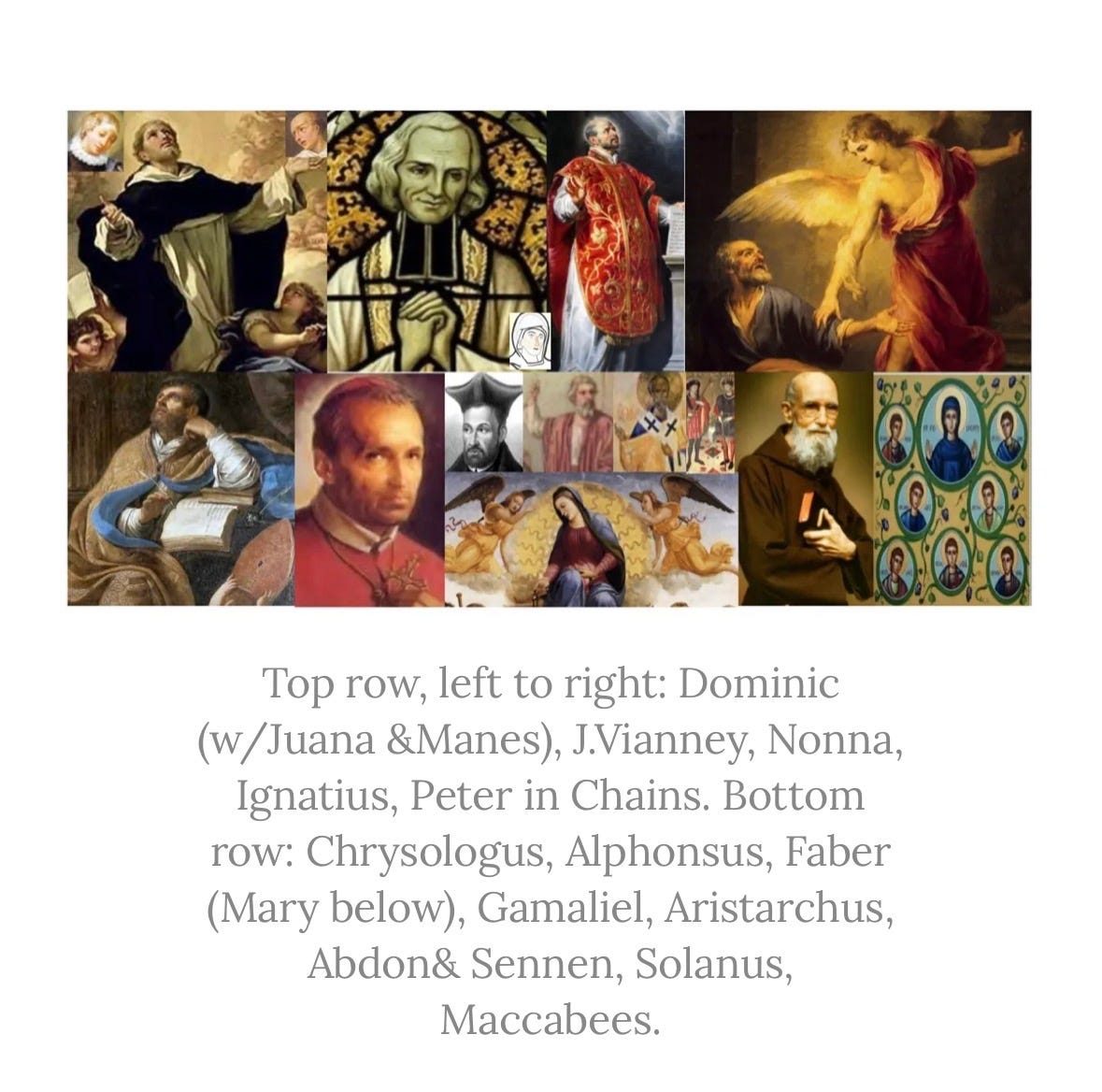
This upcoming week we celebrate the Transfiguration, when Jesus revealed Himself to three of His Apostles in the glory of His Divinity. Like the Apostles and saints, we must preach Christ’s divinity to the world.
St. Dominic (August 4, Latin Mass), preacher and miracle-worker, founded one of the greatest religious orders and conquered heretical errors. “Dominic Guzman, born in Spain, opposed the disorders of the Albigenses. He founded the Order of the Friars Preachers, propagated devotion to the Rosary [after a vision], and saved the Western Church from heresy and anarchy. He died in 1221.”1Dominic’s mother Bl. Juana de Aza(August 2), a Spanish noble who raised three saints and had a vision of Dominic’s future greatness, and Dominic’s brother Bl. Manés de Guzman (July 30), a priest who dedicated himself to spreading the Dominicans, are also honored this week.
St. Jean-Marie Vianney (August 4): “The Cure d’Ars was born at Dardilly, near Lyons, in 1786. The sanctity of St. [Jean] Vianney gives to the obscure village of Ars a universal fame. As parish priest he converted sinners and directed souls, not only those of his own flock, but people of all nations and conditions who came to [confession and to] consult this spiritual director. [Fought with demons.] He died on August 4, 1859, and was canonized in 1925.” St. Peter in Chains (August 1) commemorates the miraculous rescue of St. Peter the Apostle from prison by an angel, just before he was to be executed (see Acts 12). The chains Peter wore are still preserved in Rome.
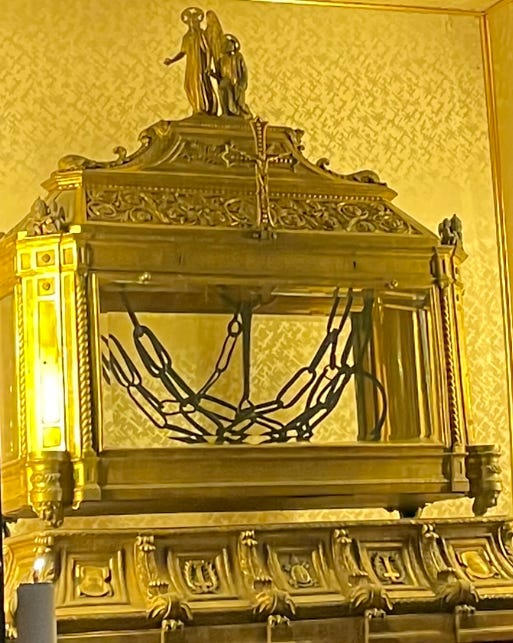
St. Peter’s chains, as preserved in Rome. Photo taken by me.
The Holy Maccabees refers specifically to “seven holy brothers [and their mother who] suffered martyrdom under Antiochus in the second century before Christ.” More generally, it refers to all those holy warriors and Jewish priests of the Maccabees dynasty who freed Israel from Greek rule and paganism, especially Judas, Eleazar, Mathathias, Jonathan, and Simon. Our Lady of Copacabana (Aug.5), patroness of Bolivia, is venerated at a spot that was once a hotspot of Incan pagan worship; later, a native Christian boy wanted to create a statue of Jesus’s mother. Miracles were reported through prayer before the statue.
St. Ignatius of Loyola (July 31), Spanish “courtier and knight, was wounded at the siege of Pampeluna. During his long convalescence the reading of the lives of the Saints revealed to him that the Church militant needed an army of glorious soldiers to fight the forces of Satan: Pagans, Mohammedans [Muslims], Protestants, etc. He founded the Society of Jesus and as first General of this new spiritual chivalry he moved to the attack under the motto: ‘Ad majorem Dei gloriam—To the greater glory of God!’ He died with the Holy Name of Jesus on his lips in 1556.” Ignatius was the companion and mentor of St. Peter Faber (August 1), who became a Jesuit priest and was sent to Germany to renew the faith there. He also worked in Portugal and Spain, and died in Rome in Ignatius’s arms in 1546.
St. Peter Chrysologus (July 30), bishop of 5th century imperial Rome’s Ravenna, stamped out paganism, opposed heresy, and enacted reforms. Most famous for his sermons, hence his title “Chrysologus” (golden-worded). Bl. Solanus Casey (July 30) was an Irish-American Capuchin. “He had faithfully served the people of Detroit, Huntington, Indiana, New York City and Yonkers, New York by providing soup for the hungry, kind words for the troubled, and a healing touch for the ill. Wherever he served, people would line up for blocks for a moment with Blessed Solanus [d.1957].”
St. Alphonsus Liguori (August 2), Doctor of the Church: “This Neapolitan nobleman renounced all earthly things. He established the Congregation of the Most Holy Redeemer (Redemptorists) to preach the Gospel to the poor. Illustrious by his preaching and writings, he was made to accept the bishopric of St. Agatha, in Southern Italy. He returned to his Congregation and died in 1787.” Pope St. Stephen I (August 2) “was beheaded by the persecutors towards the end of the Mass he was celebrating, while seated in the Episcopal chair in the Catacombs in 257.” St. Nonna (Aug.5) converted her pagan husband, St. Gregory; mother of and praised by St. Gregory the Theologian, and St. Caesarius. Miraculously healed after a vision (d.374).
The Finding of the Relics of St. Stephen (August 3) commemorates the finding of the body of the first martyr St. Stephen (see Acts of the Apostles), who appeared in a vision to a priest. The priest found the body under the ruins of an old tomb outside Jerusalem in 415, and Stephen’s relics gave off a sweet scent and caused the cure of more than 70 ill people on the spot. St. Gamaliel (August 3) was a Jewish scholar and teacher of the Mosaic Law who defended Sts. Peter and John (see Acts 5). He converted to Christianity, and both he and his son St. Abibas are honored for their piety. Our Lady of the Angels (August 2) honors Mary as queen of the angelic hosts, and under this title Christopher Columbus dedicated his famous voyage to Mary.
Sts. Abdon and Sennen (July 30), “natives of Persia, were arrested and brought to Rome. They suffered martyrdom under Decius in 254.” St. Aristarchus of Thessalonica (August 4) was a convert, the spiritual student of St. Paul, who in the Epistle to the Colossians calls Aristarchus “my fellow prisoner.” Aristarchus evangelized with Paul, became a bishop, and was martyred. St. Addai (Aug.5), one of Jesus’s disciples, healed and converted King Abgar the Black and preached in Syria and Persia; one of his converts was St. Aggai in Edessa.
St. Eusebius of Vercelli (August 2), a 4th century Sardinian appointed bishop of Vercelli, was exiled but always fought the Arian heresy, in spoken word and in writing. St. Oswald of Northumbria (Aug. 5) returned from exile to unify Northumbria and spread Christianity. Charitable and pious, he founded monasteries and was killed in battle with pagans in 642.
St. Peter Julian Eymard (August 2) was a French priest who overcame illness and other obstacles to found the Congregation of the Blessed Sacrament in 1856 and spread devotion to the Eucharist. St. Germanus of Auxerre (July 31) “was a [5th century] Gallic prelate who was twice sent on crucial missions to England that helped effect the consolidation of the British church.” Bl. John Colombini (July 31) was a sinful, married Sienese businessman who reformed and became very charitable. He founded a religious institute.
St. Waltheof of Melrose (August 3) was an English noble and stepson of Scottish King David I, who became an Augustinian abbot and archbishop. He later joined the Cistercians, helped King David found monasteries, and avoided another archbishopric. Known for his charity, his visions, and his miracles (d.1160). The Seven Holy Sleepers of Ephesus (August 4, Byzantine) were walled up in a cave to die but woke up a century later! The Nowogrodek Martyrs (August 1) were 11 nuns who were brutally interrogated and martyred by Nazis.
St. Rioch (August 1), son of St. Darerca and nephew of St. Patrick, was a missionary bishop-abbot in Ireland. St. Plegmund(August 2) was a Benedictine archbishop of Canterbury and the tutor of King Alfred the Great (d.914). St. Perpetua of Rome(August 4), mother of St. Nazarius, was baptized by St. Peter and martyred. Bl. Federico Lopez y Lopez (August 3) was a Spanish Franciscan priest, teacher, novice master (including of Bl. Eugenio Remon Salvador), and martyr in the Spanish Civil War. Bl. Frédéric Janssone (August 4) was a French Franciscan military chaplain, peace-maker, and writer who worked in the Holy Land and Canada (d.1916). Bl. Thomas Abel (July 30), chaplain to Catherine of Aragon, defended her, and was martyred in 1540. Bl. Pierre-MichelNoël (Aug.5) was a priest imprisoned and left to die in a Hulk at Rochefort during the French Revolution.
St. Sithney (August 4), a 6th century British monk, asked God not to make him patron of unmarried girls—he preferred to help mad dogs. St. Almedha (August 1) was a Welsh princess who fled an arranged marriage and was killed by her father; in legends she is called Luned. St. Godelieve(July 30) was a Flemish noblewoman, married to a bad husband, abused by her mother-in-law, and eventually murdered by her in-laws. St. Sophia (August 1) was the mother of the 2nd century Roman virgin martyrs Sts. Faith, Hope and Charity. Bl. CeferinoJimenez Malla(August 2) was a widower, catechist, and 3rd Order Franciscan who was killed during the Spanish Civil War. St. Leopold Mandic (July 30) was a Croat priest who suffered bad health but worked for Christian reunion and cared for the sick (d.1942). Bl. Ioan Bãlan (August 4) was a Romanian bishop martyred by Communists in 1959. St. Margaret the Barefooted (Aug.5) converted her abusive husband and ministered to the needy (d.1395).
Bl. Augustine Gazotich (August 3) was a Dalmatian Dominican missionary and bishop with the gift of healing (d.1323). St. Helen of Skofde (July 31) was a 12th century noble and pious widow killed under a false accusation of murder. St. Trea of Ardtree (August 3) was a 5th century convert of St. Patrick’s who became an anchoress in Derry, Ireland. Bl. Cecilia Schelingová (July 31) was a Slovak nursing nun abused by Communists (d.1955). St. Bernard Võ Van Duê (August 1) was a Vietnamese priest martyred in 1838. Bl. Everard Hanse (July 31) was an English convert and priest martyred in 1581. Bl. Gil Rodicio y Rodicio (August 4) was a teacher, bakery distributor, and Salesian martyred in 1936 during the Spanish Civil War. St. Viator (Aug.5) was a sixth century French Benedictine monk.
You can also read about Natividad of the Blessed Sacrament, Silaus and martyrs, Mother Vicenta, Sebastia Llorens Telarroja, Richard Featherstone, Edward Powell, Terenzio of Imola, and Julitta of Caesarea (July 30); Franciszek Stryjas, Neot, Giustino de Jacobis, Élisabeth Eppinger, Vicenta A.Gogenola, Michal Oziebijowski, Jean-François Jarrige, and Calimerius of Milan (July 31); Ethelwold of Winchester, Emericus of Quart, Aleksy Sobaszek, G.Hirschfelder, VM Millán, G.Bufalari, Ðaminh VH, Orlando, Arcade, and Friard (August 1); Serenus of Marseille, Giustino Russolillo, Felipe M.Azcona, Francisco Calvo Burillo, and Pedro de Osma (August 2); Aspren, Anthony the Roman, Benno of Metz, Senach of Clonard, Euphronius of Autun, Francisco Bandrés Sanchez, Salvador Ferrandis Segui, Godfrey of Le Mans, Dalmatius, and Gregory of Nonantula (August 3); William Horne, Josep Rabasa Betanachs, Eudoxia, Gonzalo Gonzalo y Gonzalo, Eleutherius of Bithynia, Lua of Limerick, and Onofrio (August 4); and Emidius of Ascoli, Mari, Arnaldo Pons, Abel of Rheims, Pierre-Michel Noël, Memmius, Venantius of Viviers, Paris, and Cassian of Autun (Aug. 5).
Have a blessed week!
No posts
Comments
Nothing yet. Say the first thing.
Sign in to join the conversation.