
The long-awaited Curriculum and Assessment Review – ‘Building a world-class curriculum for all’ – has landed. We now know that new national curriculum frameworks will be published in Spring 2027, granting schools approximately four terms to prepare before first teaching begins in September 2028. This long runway could feel deceptively quiet, and for many leaders, the lack of immediate subject-level detail might provoke anxiety. But this lead-in time should not be seen as a void to be filled with guesswork. Instead, it is a gift – a rare opportunity for deep thinking, professional dialogue, and the strategic investment of our most precious commodity: time.
The schools that will be best prepared for the September 2028 implementation will not be those that rush to predict and rewrite specific content. They will be the ones that use this preparatory period to strengthen their internal systems, cultivate a culture of curriculum inquiry, and deepen their collective understanding of what makes learning truly ambitious and coherent.
This post offers a strategic framework for school leaders, curriculum leaders, and teachers, outlining how to use the next two years productively. It is a guide to building the institutional habits that will allow your school to adapt with confidence and purpose when the final blueprints arrive. To begin, I’ll consider the high-level direction the Review has already provided, focusing on broad shifts and curriculum design.
Over the next few weeks I’ll return to elements of this post to dive into what each might look like in more detail.
The strategic challenge for leaders now is not to anticipate the fine print, but to grasp the core principles underpinning the proposed changes - many of which reaffirm well-established foundations of effective curriculum design:
A more coherent curriculum: The Review calls on us to move beyond mere coverage and towards the purposeful sequencing of knowledge that enables genuine progression. It also highlights the importance of coherence across transitions - between primary and secondary, and between key stages within each phase.
Stronger disciplinary thinking: The emphasis here is on understanding how knowledge is formed and contested within a subject, not just memorising what is known. This shift prioritises disciplinary integrity and asks schools to consider how they teach pupils what it means to think like a geographer, a scientist, or a mathematician, embedding disciplinary habits into the curriculum from the ground up.
Renewed focus on inclusion and accessibility: This is framed as a fundamental design principle, not an afterthought or adaptation. Effective curriculum work bakes in accessibility from the start, considering how all pupils, including those with SEND or from disadvantaged backgrounds, will experience the curriculum in terms of both access and a sense of belonging.
Integration of modern literacies and climate education: The inclusion of digital, financial, and media literacy, and climate education, is an acknowledgement that a world-class education must prepare pupils for the complexities of contemporary life. This is not about adding isolated units but weaving these essential skills into the fabric of the existing curriculum in a meaningful, subject-appropriate way.
Understanding these principles is the first step; the real work lies in embedding them as institutional habits that build the capacity for meaningful, sustained change.
The following recommendations should not be treated as a compliance checklist. Rather, they are a set of high-impact, low-cost “habits” designed to build the institutional capacity needed to adapt to any future framework. The best way to invest the gift of time we have been given is to build strong systems and a robust professional culture.
1.) Map the terrain: conduct a strategic curriculum audit
Before you can plan a journey, you must know your starting point. Map what you already teach and how it is sequenced to identify strengths and highlight gaps. This audit doesn’t need to be overly formal; a visual map or a one-page summary for each subject will create a clear picture that facilitates all future planning.
2.) Nurture a culture of curriculum inquiry
Leaders could consider running short, collegial reading sessions using excerpts from the Review. The goal is not compliance but to build a shared language through generative questions: What do we mean by “knowledge-rich”? or What does progression look like in our subject?
3.) Strengthen subject-sensitive leadership
The Review’s emphasis on coherence demands strong subject leadership. Curriculum leaders need protected time not for administration, but for deep, subject-specific dialogue.
4.) Articulate your school’s curriculum story
Revisit your school’s curriculum statement as a reflective process to clarify your “why”. A clear, authentic internal narrative makes aligning with external mandates a simpler and more meaningful process. When you are certain about what you value most, you can connect new requirements to your existing vision rather than feeling driven by them.
5.) Embed inclusive design principles
Use this period to run a small-scale review. Ask how pupils with SEND or those from disadvantaged backgrounds truly experience your curriculum – not just in terms of attainment, but access and belonging. Start small by piloting adaptations to a single unit, perhaps by introducing more flexible entry points or assessment formats, to learn what works in your context before scaling up.
6.) Focus on systems, not predictions
Resist the temptation to rewrite schemes of work prematurely. Instead, focus your energy on strengthening the underlying systems that support great teaching and learning: collaborative planning routines, high-quality internal CPD, cycles of feedback and coaching, and robust subject leadership. These systems will serve your school, regardless of what the final 2027 frameworks look like.
These ongoing habits provide the cultural engine for change; the following timeline provides a strategic map for the journey ahead.
This timeline is not a rigid schedule but a flexible model to help leaders structure their thinking, allocate resources, and manage the preparation process over the next three years.
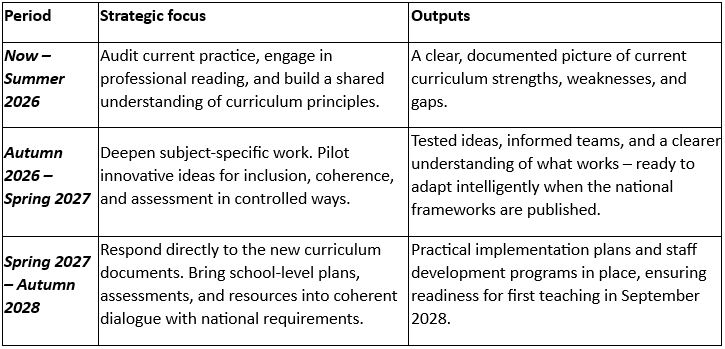
Shaping the change, not chasing it
Curriculum reform often feels like a cliff edge, but this time we have been given a long approach road. The schools that treat the next two years as a space for deep thinking, cultural development, and system-strengthening will enter 2027 confident and ready. They will be in a position to shape the change in their own context, rather than simply chasing compliance.
You do not need every answer yet. You just need a curious staff, a clear map of what you already do, and the collective habit of asking: how can we make learning more coherent, inclusive, and ambitious for every single pupil? That is preparation in its truest form.
Thanks for stopping by. Next time - understanding the Curriculum and Assessment Review: from signposts to principles.
No posts
Comments
Nothing yet. Say the first thing.
Sign in to join the conversation.