
I like having a tidy home. Neutral walls, clean surfaces and simplicity makes me feel calm. It stresses me out when everything is messy and all over the place. It’s like there’s a correlation between the state of my home and the state of my mind.
I would love my home to be tidy all the time, but alas, I have a five year old… It’s near on impossible for it to be minimal every day. And what you see on Instagram is only really the best bits. So while I have good intentions, I’ve learnt that sometimes I just have to let it go. And you know what, isn’t that the real lesson of parenting? A slow process of letting go – letting go of control as they grow up and become their own person.
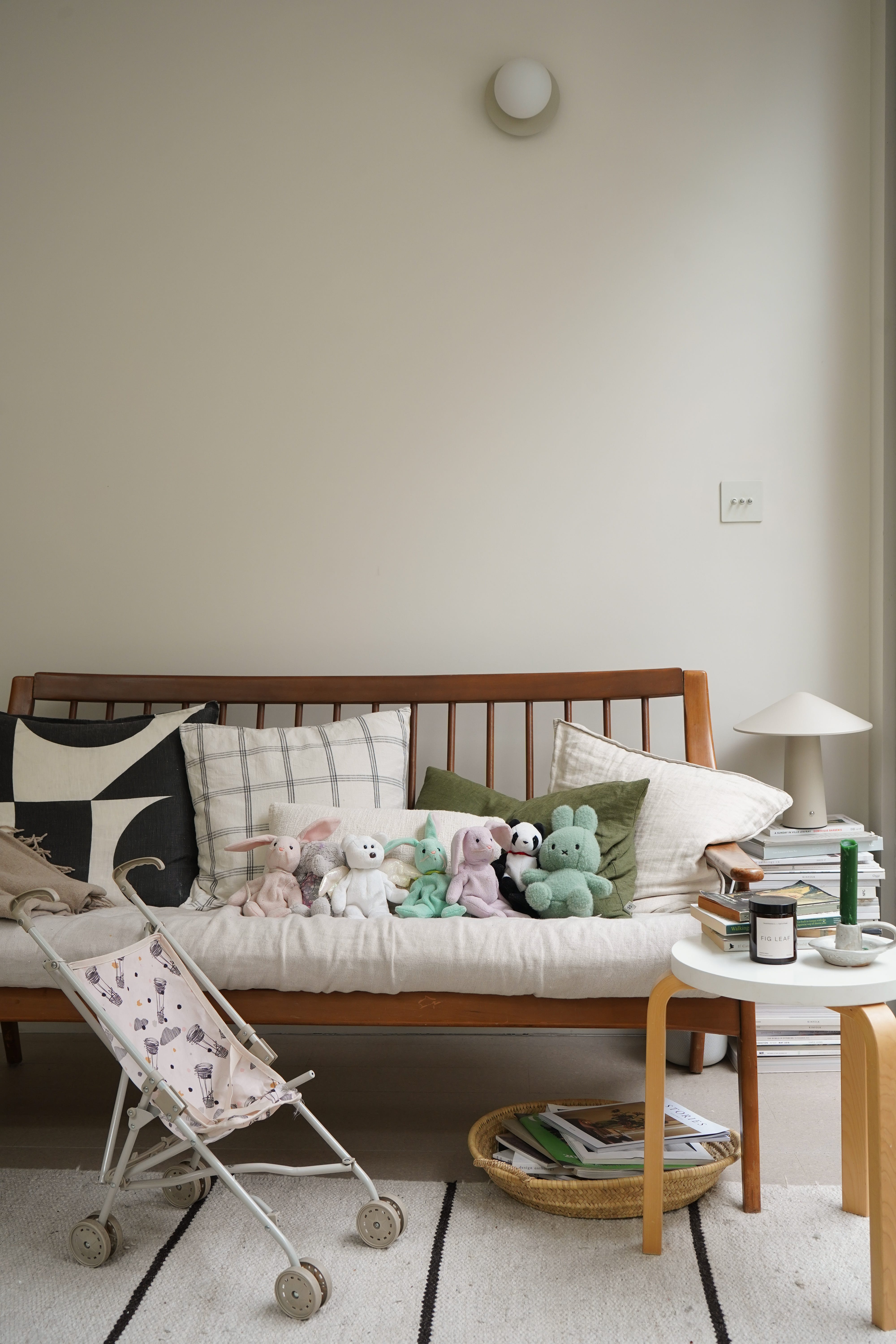
My daughter is pretty much the opposite of me. As much as I have tried to make everything gender neutral – in my clothing choices, toy choices, the way I speak about different roles or jobs – she is drawn like a magnet to colour, rainbows, unicorns, and really, anything girly. She recently said to me, ‘Maman, there’s too much green in this house!’, and if she had her way she would paint every door a different colour and the walls bright pink.
I’ve had to find a compromise between the interior I would like and the interior that best supports her and makes her feel happy and at home. I don’t want her to grow up in an environment that feels so controlled and restrictive that she ends up having to have therapy! She also lives here, so my home, and my style, has had to adapt and evolve.
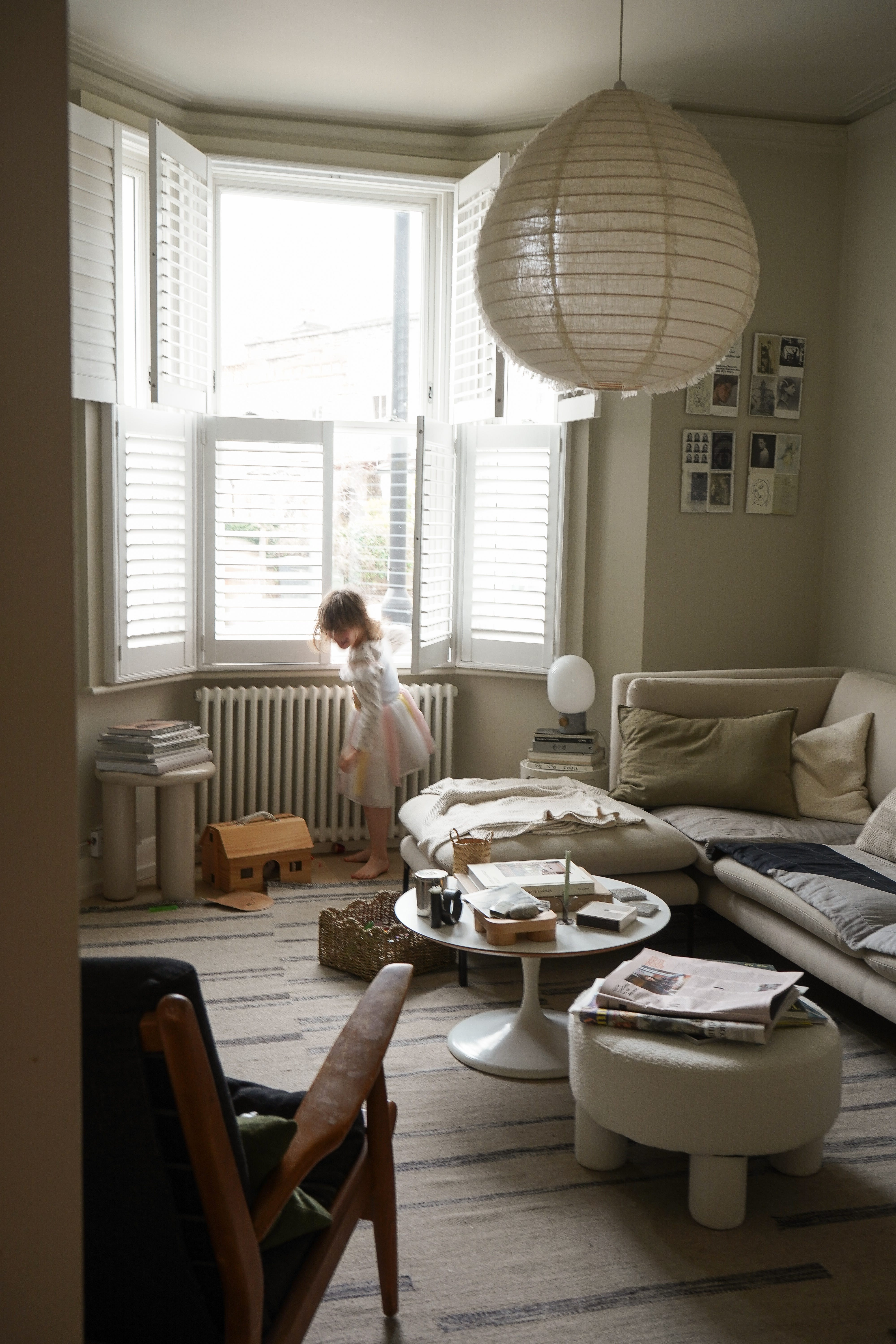
That said, I have found that there are a few simple ways to integrate the ‘stuff’ of children more seamlessly into a space. In today’s post, I’m sharing the strategies that have helped me retain a sense of calm, while not allowing toys to overrun the place.
I’ve learnt that, in reality, children don’t actually need much stuff. My daughter is always deepest in play when it’s imaginative play and she’s making something up; perhaps it’s a pretend school or a pretend journey or pretend cafe. An open book will become a laptop or a cushion will become a boat. When she has lots of toys out she gets a bit more overwhelmed and I get a cry of, ‘I’ve got nothing to do! I don’t know what to do!’. I think creativity and imagination thrive off less; in the moments when we’re bored or when we have to think outside the box. When they’re younger I think it’s a great idea to have a toy rotation, which you swap every week, to help keep a sense of novelty.
I think children lead by example; they’re always watching what you’re doing and picking up cues. The phrase ‘monkey see, monkey do’ really does ring true. I have always had nice things out right from the start, even when she was tiny. I’m talking candles on the coffee table, vases of flowers on the dining table, nice design books, pebbles I’ve found on beaches arranged on a book, slightly fragile lamps on a side table. I think because she’s grown up with these things around here, they don’t seem like a novelty to her, they have just become part of her environment. When she was a toddler she just didn’t seem to have the curiosity (or perhaps cheek) to knock things off surfaces or destroy things. Obviously every child is different but I think if something is out of bounds, a child just wants it more, and I’ve just tried to normalise having lovely things.
In that process, I have also subtly tried to teach her to respect her belongings and the things we have in our home. For example, if she bent the page of a book, I’d gently say ‘No, we don’t do that to our books’. Or if she picked an object up, I might say, ‘We can have a look at it, but that’s not a toy’, then redirect her to one of her toys, ‘Here, you can play with this if you want’. My child isn’t perfect and we call her a bit of a drama queen (!), but I found this approach helped.
Comments
Nothing yet. Say the first thing.
Sign in to join the conversation.