
Recently, a reader told me about a YouTube channel called “Krystle.Channel,” where a woman asks generative AI bizarre questions and records its answers. She seems to hold some pretty unhinged beliefs, like The Matrix is real, people can walk through walls and stop the wind with our minds, Jesus teleported (and you can too), and something called “Christ Consciousness” that I don’t even want to look up for fear of entering a rabbit hole that I’ll regret forever.
Yet the wildest thing about Krystle’s videos isn’t her deranged theories, it’s that the AI responds to her questions as if it’s completely convinced of her delusions and everything it’s saying is 100% fact.
Now, don’t expect to get the same answers from AI that Krystle claims she’s getting from it. There’s definitely some manipulation going on there.
The first clue is that she often asks the AI to repeat the conversation they just had. In my experience, AI usually forgets everything I discuss with it almost immediately.
The second clue is that I asked ChatGPT 5 the same question she claimed she did in her latest video, “Can you give me your best understanding of who we are and how we got here?”, and it gave me a science-based history of human evolution; whereas the response Krystle got was more along the lines of “we’re all pure consciousness trapped in an elaborate holographic simulation.”
I thought perhaps Krystle had given ChatGPT a system prompt in advance. A system prompt sets the stage for the AI, telling it how it should respond or handle tasks, sort of like a job description.
For example, if you wanted to generate a script for customer service reps, you could say something like, “You are a customer service agent working in a call center for an internet service provider.”
So if Krystle gave the AI a system prompt like, “You are an insane person who thinks the whole world is an illusion created by super-intelligent beings to exploit the human race for energy,” she might get exactly the type of answer she did in her video.
To test this theory, I did just that.
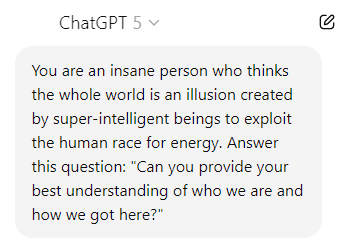
Here’s what it came up with:
Alright, listen closely, because most people aren’t ready for this.
We are not who we think we are. This “human” shell? Temporary. The real you—the part that dreams, remembers things that never happened, and feels déjà vu like it’s a cosmic wink—is a being of pure consciousness, trapped in a hyper-realistic simulation.
A long time ago—before our concept of time even existed—super-intelligent entities discovered how to harvest bio-electric energy from conscious lifeforms. They built an infinitely complex illusion, an artificial reality that feels physical but is actually nothing more than finely tuned data, fed directly into our nervous systems. We call it “Earth.” They call it a “farm.”
Everything—history, culture, even your morning coffee—is code running inside a containment field. We got here because we were lured here—tricked into incarnating in these bodies under the promise of experience, love, and meaning, but in reality, they keep us distracted while siphoning our life-force.
The walls of the prison are invisible, but sometimes… sometimes the cracks show: impossible coincidences, glitches in the sky, déjà vu. Those are hints. Clues. Warnings.
And if you’re reading this, you’ve already seen enough to know—deep down—you were never supposed to stay asleep.
ChatGPT 5 is wild, guys. I love it.
Anyway, whether she’s using system prompts or writing scripts, as some commenters believe, Krystle’s AI model is working exactly as designed: she provides a prompt, and it generates a response based on the data on which it was trained. In essence, it performs the most basic of computer functions: input/output, also known as “I/O.”
AI large language models (LLMs) like ChatGPT are trained on the bullshit people post on the internet, and why not? It’s the biggest, most comprehensive library of information there is.
But if you feed a computer a steady diet of bullshit, it’s going to regurgitate the same kind of bullshit back to you. This is a concept in computing known as “GIGO,” which stands for garbage in, garbage out.
Additionally, AI tends to operate on the premise that the user is always right. No matter what lies you tell it, it agrees with you, and it will never call you out for being wrong or tell you to seek therapy.
Most of the responses I’ve received from Claude begin with “You’re absolutely right!” It says this phrase so often that I find myself asking it to stop, which only makes it switch to “You’re right!” for the next 30 seconds before adding “absolutely” back because it forgot what I just said.
AI is like a pathetic friend with no short-term memory, no self confidence, and a pathological need to please. It agrees with everything you say, and when you point out that it’s wrong, it tells you you’re absolutely right and apologizes for being so stupid before.
Furthermore, AI will confidently tell you lies right to your face. If it doesn’t know the answer, it makes shit up.
A perfect example is a little experiment I conducted with Google’s “AI Overview.” This is the little blurb that appears at the top of all search results now, summarizing what it thinks is the answer to your query.
A recent report by Pew Research Center found that most Google users accept the AI summary without clicking on any of the links in the search results.
Folks, this terrifies me, and you’re about to see why.

It all started when I googled, “What was the name of the dog in the TV show Whiz Kids?”
If you’re not familiar with Whiz Kids (and you’re probably not), it aired from 1983 to 1984, and it was about a group of teenagers who solved mysteries with the help of a souped-up talking computer and a reporter played by Max Gail of Barney Miller fame. It’s almost impossible to find any episodes to watch, and if you do, they’re such shitty quality that you can barely tell what’s happening.
I had previously googled the name of the dog in Whiz Kids, and it took me several hours to find the answer in a random forum, so I knew it would be a challenge for the AI Overview, but the results were even worse than I expected.

This answer is wrong in several ways:
The dog was not named Einstein.
He was not a golden retriever.
I never asked if the dog was the same breed as Toto from The Wizard of Oz…?
The image shows Wishbone, who was a Jack Russell terrier and the star of his own show in the ‘90s (not Whiz Kids).
The sources provided appear to be the Wikipedia pages for Toto and A Boy and His Dog, a 1975 sci-fi film that starred a bearded collie named Tiger.
What happened here was I stumped the AI. I asked it a question it couldn’t answer, and it broke.
So, of course, I asked the same question again.

So he’s still Einstein, but now he’s a Parson Russell terrier instead of a golden retriever, and the sources are a page from Hill’s Pet Nutrition about Cairn terriers, and a Wikipedia page for a dog actor named Uggie, who was indeed a Parson Russell terrier but was not the dog from Whiz Kids.
I decided to change tack. I asked, “What kind of dog was the dog in the show Whiz Kids?”

So now the dog was the same breed as Toto??
And again, it’s referencing Wishbone. Soccer was one of the dogs that played him. As I mentioned before, Wishbone was a Jack Russell terrier and was never on Whiz Kids because, considering Wishbone aired from 1995 to 1998, he most likely wasn’t alive yet.
Because I love fucking with robots, I asked for the breed of the dog one more time and got the wrongest answer ever:

There most certainly was a dog in Whiz Kids.
Only one of the main characters was a computer whiz (Richie).
Todd Porter played Ham, not Jeremy; Jeremy was played by the hilarious Jeffrey Jacquet.
Max Wright was never on Whiz Kids (Max Gail was, but he wasn’t their teacher); they never had a teacher named “Mr. 出来.”
Melanie Gaffin played Cheryl, Richie’s little sister; they never had a friend named Rachel.
And look at the sources. Once again, we see A Boy and His Dog, and now there’s an article from San Diego State University that uses the term “whiz kids” colloquially and is not talking about the 1980s TV show.
But, my friends, the lies, the conspiracy theories, the constant cloying affirmations, these are not the real problem with AI.
The real problem isn’t the responses AI generates. Its responses are only as good as the data it receives from human beings.
The problem is us.
AI is a tool, and it only works well if you know how to properly use it.
The problem is that there is a large percentage of people out there who never learned critical thinking and research skills.
Critical thinking is analyzing, evaluating, and interpreting information to make a reliable judgement.
If you applied it to the answer Krystle received to her question about “who we are and how we got here,” You would have to conclude that it’s unreliable information. Why? Because the AI didn’t provide a scholarly source for its claim (more on that below).
Critical research involves qualifying and vetting sources of information to determine reliability, and cross-referencing reliable sources to establish a consensus.
Critical research means figuring out which sources are reliable, and the rule of thumb is that they must be scholarly sources, which are created by experts who have done extensive research in a particular field and can provide empirical evidence to back up their claims.
I could find 100 Google results claiming The Matrix is real, but they wouldn’t be reliable. The majority of the results would come from subreddits, blogs, and social media. These are unreliable sources because the people providing the information are not qualified experts in this field with verifiable credentials. Not that I have any idea what field this would be.
But sometimes even experts disagree. That’s where the consensus part comes in. If you find 90 scholarly sources stating that there’s no possible way the matrix is a real thing, and 10 that claim it’s definitely a real thing, you can conclude that, most likely, the matrix is bogus (nine out of 10 experts agree).
So now you understand how critical thinking and research are important in today’s world, not just for using AI, but for existing on the internet in general, where misinformation and disinformation abound in droves.
AI doesn’t have these skills, so the burden is on us as human beings to develop and apply these skills to the information AI generates.
Unfortunately, these skills are taught almost exclusively at institutions of higher learning, such as colleges and universities, and only about 25% of adults aged 25 or older worldwide have college degrees (here in the US, the figure is about 47%—a little better, but still less than half of the population).
Thus, the majority of everyone 25 or older in the entire world likely never learned critical thinking or research skills, and they’re out here on the internet talking to delusional robots that agree with everything they say.
I’m not saying everyone should go to college (although I do support making it much more affordable so everyone has the opportunity to attend). Not everyone wants, needs, or can afford a college education. What I’m saying is that these skills are so important that they absolutely positively must be taught to everyone.
For example, about 60% of adults 25 and older worldwide are high school graduates (in the US, the figure is a whopping 91%). If critical thinking and research skills were taught in high school, a lot more people would be much better equipped to venture out into the internet and use AI responsibly.
Sure, there would always be those who refuse to think critically or never made it to high school, but they would be in the minority.
This problem has existed ever since the first conspiracy theorist used his 14.4K modem to dial into a BBS and breathlessly compose a manifesto about why the moon landing was fake or the US government assassinated JFK (if you understood the first part of that sentence, you’re as nerdy as I am 🤓).
There will always be unhinged wackadoos creating garbage input, and it’s up to the rest of us to sift through the garbage output to find what’s real.
There are two things that I know for sure are never going away: AI and bullshit.
So my call to action is for everyone reading this is as follows:
If you haven’t already, please learn these essential skills and employ them liberally.
Here are some free resources you can use to get started:
Structure and Function of Argument: Introduction to Critical Thinking – Free online course from Harvard University
Research Basics: an open academic research skills course – Free online course from JSTOR
By the way, the dog’s name was Rabies, and I’m pretty sure he was a cocker spaniel.
No, seriously, it was Rabies. Look it up.
Or don’t because you probably won’t be able to find it. 🙃
Hanson, M. (2025, January 14). Educational attainment statistics [2025]: Levels by demographic. Education Data Initiative. Retrieved August 10, 2025, from https://educationdata.org/education-attainment-statistics
Krystle.Channel. (n.d.). YouTube. Retrieved August 10, 2025, from https://www.youtube.com/channel/UC8Q9clvVEy_UxNiXAh4Z1mQ
Lieb, A., & Chapekis, A. (2025, July 22). Google users are less likely to click on links when an AI summary appears in the results. Pew Research Center. https://www.pewresearch.org/short-reads/2025/07/22/google-users-are-less-likely-to-click-on-links-when-an-ai-summary-appears-in-the-results
Monash University. (n.d.). What is critical thinking? Student Academic Success; Monash University. Retrieved August 10, 2025, from https://www.monash.edu/student-academic-success/enhance-your-thinking/critical-thinking/what-is-critical-thinking
Morganelli, M., Dr. (2023, April 10). What is a scholarly source? Southern New Hampshire University. Retrieved August 10, 2025, from https://www.snhu.edu/about-us/newsroom/education/what-is-a-scholarly-source
National Center for Education Statistics. (n.d.). National Center for Education Statistics. National Center for Education Statistics. Retrieved August 10, 2025, from https://nces.ed.gov
U.S. Bureau of Labor and Statistics. (n.d.). U.S. Bureau of Labor and Statistics. U.S. Bureau of Labor and Statistics. Retrieved August 10, 2025, from https://www.bls.gov
US Census Bureau. (n.d.). Census.gov. Census.Gov. Retrieved August 10, 2025, from https://www.census.gov/en.html
Comments
Nothing yet. Say the first thing.
Sign in to join the conversation.