
The best explanation of TABOR I’ve seen was on Full Frontal with Samantha Bee in 2018; Congress had just passed major tax cuts and people were wondering what that might mean for the future. Enter Colorado.
In 1992, a California Republican and then Colorado State Legislator named Doug Bruce got an initiative on Colorado’s ballot that said, “An amendment to the Colorado Constitution to require voter approval for certain state and local government tax revenue increases and debt; to restrict property, income, and other tares; to limit the rate of increase in state and local government spending; to allow additional initiative and referendum elections; and to provide for the mailing of information to registered voters.” Doug Bruce hates taxes so much he went to jail for 180 days for tax evasion, ironically living off our taxes during that time.
One story about the need for lower taxes comes from the idea that government is corrupt. To republicans, who by definition are part of the government, the people we elect (them?) are all corrupt. This is a favorite story of California Republicans. It could be true everywhere, but in California there are rules that attempt to keep one person or small group of people from ruining it for everyone. Not being free to do whatever one wants (so long as it only applies to them)—or to put it another, having to be considerate to other people—is antithetical to Republican ideals. For proponents of less taxes, it means the wealthy can keep their wealth and do what they want and tell others how to live.
But the idea that the United States was built by people who didn’t want to pay taxes isn’t entirely true. The wealthy have never wanted to pay taxes going back to Europe and possibly before; but since the Magna Carta, at least in England, people realized the benefits of paying taxes when they consented, via representation, and were obliged to pay. In America there has always been a push and pull between those who didn’t mind pooling their resources for the betterment of their communities (and the country) and those who would hoard it all. While the story of the Boston Tea Party is often told as the new Americans not wanting to pay taxes, it was actually a rebellion against a British tea tax that was to used to bail out the “too big to fail” East India Company. Money taken from the poor, without representation or consent, to give to the rich. During the revolutionary war, rural farmers levied £27,000 in taxes on themselves to pay for the war, while, many of the wealthy in Philadelphia “dared not whisper the word ‘independence,’.” “And when it came to land taxes, taxpayers in the western counties were more reliable and timely than their eastern counterparts. It was not uncommon for frontier protestors to carry banners that simply read, ‘Land tax.’”1 After the Revolutionary War the fledging United States government owed money to foreign creditors as well as local farmers, artisans, and merchants who had seen their goods requisitioned. Rich speculators bought the state war debt promissory notes for pennies on the dollar and were eventually paid interest on the face value by the new federal government, thanks to Alexander Hamilton, essentially making an aristocratic class living high off the government teat. Under Hamilton, the United State’s first internal tax, was an excise on whiskey designed intentionally to burden small distillers and farmers and consolidate the whiskey industry and concentrate “wealth in the hands of the few.”2 As Vanessa Williamson wrote in The Price of Democracy, “There is a stereotype that the early American frontier was full of hard-drinking, violent people unwilling to pay taxes. On the contrary, frontiersmen were hard-drinking, violent advocates of more progressive taxation.”3
Hamilton right after the ratification of the Constitution wasn’t for smaller government, but for the government to primarily benefit the rich. It was after the civil war that limiting government by limiting taxes became popular…among rich anti-reconstruction whites. Before the civil war, southerner paid very little in taxes, and what taxes were levied were paid in large part by merchants, who paid five or six times what wealthy plantation owners paid. Reconstructionists (Republicans) tried to level the playing field by placing taxes on wealth across the board. As you can imagine the previously independent fiefdoms of slave owning plantation owners didn’t like this. They immediately started screaming about corruption, which there was in both the north and south at that time by both parties, but the reconstructionists fought against it and the beneficiaries of bribes and resultant legislation were usually white Democrats.4 Of course, to the white supremacists the “corruption” came from black suffrage. How dare the formerly enslaved demand equality from their enslavers. Rich white men in the south started calling themselves “taxpayers,” despite willfully not paying taxes and running a terrorist campaign of violence and murder against tax Republican voters and public officials, including tax assessors, in order to gain support of the poor white farmers (who were also saddled with Hamiltion’s—dare I say corrupt—whiskey tax) and middles class white merchants. “As ‘taxpayers,’ wealthy whites could directly attack the functioning of government, overcome divisions among Southern whites, and make their grievances appear reasonable to Northerners. By asserting that the taxpayers were those with a right to rule, they turned a critique of government corruption into a case for oligarchy.”5 (Sound familiar?) Aligning white voters as “taxpayers” allowed wealthy southerns to claim their taxes (which they did not actually pay) were too high, and government too big; a conniving rhetoric for blocking black voters. Virginia Governor Frederick W. M. Holliday said in an address to the Virginia House of Delegates in 1878, “Public free schools are not a necessity. They are a luxury, adding, when skillfully conducted, it may be, to the beauty and power of a state, but to be paid for, like any other luxury, by the people who wish their benefits.”6
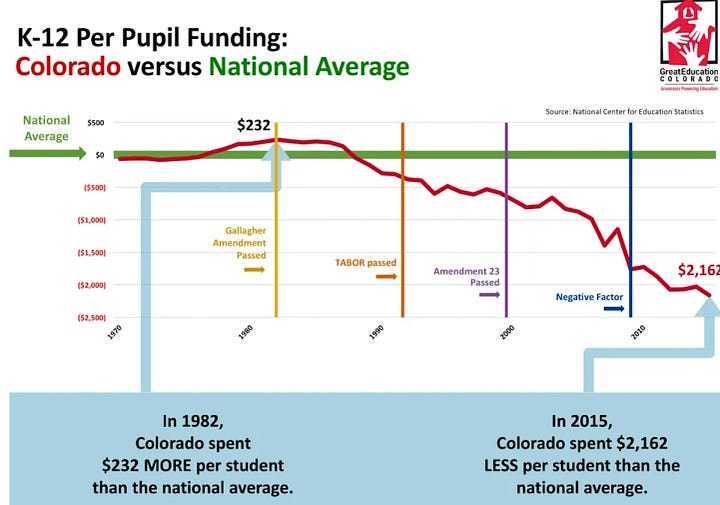
In 2010, Colorado Springs faced a very similar situation where the town government could no longer pay for “luxuries” like street lights, parks, firefighters, police, recreation centers, museums, street paving, and public transportation.7 The wealthy, including Doug Bruce, in gated communities could pay for their own services, so they were largely unaffected by the budget cuts, so it was the working and business classes who felt the pain. The collapse of the subprime mortgage and housing markets in 2008 sent the whole country into a recession. But for Coloradans, the pain was worse. TABOR prevents Colorado from having a “rain day fund,” so when property taxes plummeted, Colorado’s general fund evaporated. In a time, when the people needed more support—especially as two of Colorado’s biggest employers, the construction and financial industries, were hit the hardest—the state had no money to spend on social safety nets, targets fiscal relief, or education. And because of TABOR’s “population-plus-inflation” formula the state couldn’t recover. Colorado Springs in 2010, faced a $22 million shortfall and so street lights became a “luxury.” (While burlgury and theft decreased after the cuts, the homicide rate nearly doubled.8)
Population plus inflation seems like a reasonable formula on the surface. Just as we expect (hope) to get inflation raises each year, so to the government needs to keep up with inflation. However, inflation is based on the price of consumer goods, not the actual cost of living. So just like our family budgets, which seem to always be stretched thinner and thinner, even inflation raises (for those who get them) don’t keep up. For states, as the Center on Budget and Policy Priorities points out, “the cost of health care, education, corrections, and other areas of government generally grows more rapidly than the cost of consumer goods. Moreover, certain segments of the population — such as schoolchildren and the elderly — require more public services than others. When these segments grow more rapidly than the population as a whole, the cost of government grows more rapidly than the TABOR limits allow.”9 Before the FDIC after the depression of the 1930s, the United States used to experince “great” depressions every twenty years or so. Thanks to the FDIC we now only experience “great” recessions. But for Colorado, this means majorly limited services we’ve grown to expect, like good schools with teachers paid at least a cost of living wage, safe paved roads, and healthcare subsidies, not to mention all the other social programs that state pays for. During the early 2000s recession, while men like Karl Rove touted Colorado as having good finances, “Colorado reported the nation’s second-largest budget shortfall relative to its budget. The fiscal problems cost some 15,000 children their state-financed health care coverage and some 100,000 senior citizens their property tax exemptions, and led to reductions in expenditures on everything from health to higher education to highways, among other areas. The legislature [then planned] another $194 million in spending cuts for the 2004 fiscal year.”10 The problem with this cuts, is that they did not stop costing communities. Hospitals can’t turn away patients, so if children or elderly or low income people don’t get to see doctors and get even more sick, they end up costing the rest of us in increased medical costs. When potholes aren’t filled after the snow melts, we pay for in car repairs. When schools are defunded, businesses struggle to find good workers, crime increases, there is less draw for people to move to an area, and we pay for it in high tuition. And lest you think this was just a recession problem, as the Center on Budget and Policy Priorities points out, “even during the boom years of the mid- to late 1990s, Colorado was disinvesting in its public sector. For example, the state failed to set aside money in a reserve fund, it was among a very few states that cut higher education funding, and it reduced public health spending. In 50-state studies in 1999 and 2001, before the fiscal crisis, Governing magazine and Syracuse University ranked Colorado’s finances as among the nation’s worst-managed.” In 2024, Colorado paid out $1.7 billion in TABOR refunds; in the 2025/26 fiscal year they had to cut $1.2 billion from the budget. That is not good financial management.
There are other costs from TABOR. In Rural Colorado, cuts to medicare and medicaid as well as a restrictive state budget can mean hospital closures, or hospitals running a huge losses.11 This mean traveling for hours to get to a hospital in an emergency or for cancer treatments. Budgets deficits are also pitting neighbor against neighbor. In Summit County, the school district pitted Summit Cove community members against Breckenridge Elementary community members combining budget shortfalls and aging building issues. But if our schools were fully funded communities could have their schools, and a maintenance or aging building problem would be a single problem rather than a weight that is sinking a whole school district. A similar budget issue caused by state cuts pitted Summit County Commissioners against the County Sheriff. In a tight budget, communities have to decide between road and safety. One of the issues the sheriff pointed to as a reason for the size of his budget (aside from population and tourism growth) is unfunded mandates like body-cameras (which he supports for the protection of his deputies as well as the public). When the legislature can’t raise taxes, they can only pass unfunded mandates. This passes the costs down to local governments who are partially funded by the state and subject to their own TABOR limits.
TABOR comes from an idea that anti-tax activist Grover Norquist’s put the most psychotically, “I simply want to reduce [government] to the size where I can drag it into the bathroom and drown it in the bathtub.” (I’ve never wanted to drag anything into the bathroom or drown anything in a bathtub.) The thing about a small government is just as the rich white southerners wanted after the civil war it ensures inequality, it maintains a status quo of the haves having and the have-nots never gaining anything. In Colorado, this means in addition to our schools being underfunded, our roads being in terrible shape, childcare is exorbitant and the state, despite their best efforts can’t afford to subsidies it, and it has become nearly impossible to lower the cost of housing,12 ranking Colorado the third highest cost of living.13 Exactly what the republicans wanted.
Williamson, Vanessa S.. The Price of Democracy: The Revolutionary Power of Taxation in American History (p. 61).
Journal of the House of Delegates of the State of Virginia for the Session of 1877–8(Richmond: R. F. Walker 1878), 428.
https://www.denverpost.com/2010/01/30/colorado-springs-cuts-into-services-considered-basic-by-many/
https://coloradosprings.gov/document/2011cspdstatisticalannualreport.pdf
https://www.cbpp.org/research/a-faulty-fix-repairing-the-ratchet-will-not-repair-tabor
https://www.cbpp.org/sites/default/files/archive/3-17-04sfp.htm
https://www.cpr.org/2026/01/23/rural-hospitals-hickenlooper-funding-cuts-hugo/
https://coloradofiscal.org/tabor-the-colorado-con-12/
https://www.fox21news.com/top-stories/colorados-cost-of-living-soars-ranks-third-highest-in-the-us/
Comments
Nothing yet. Say the first thing.
Sign in to join the conversation.