
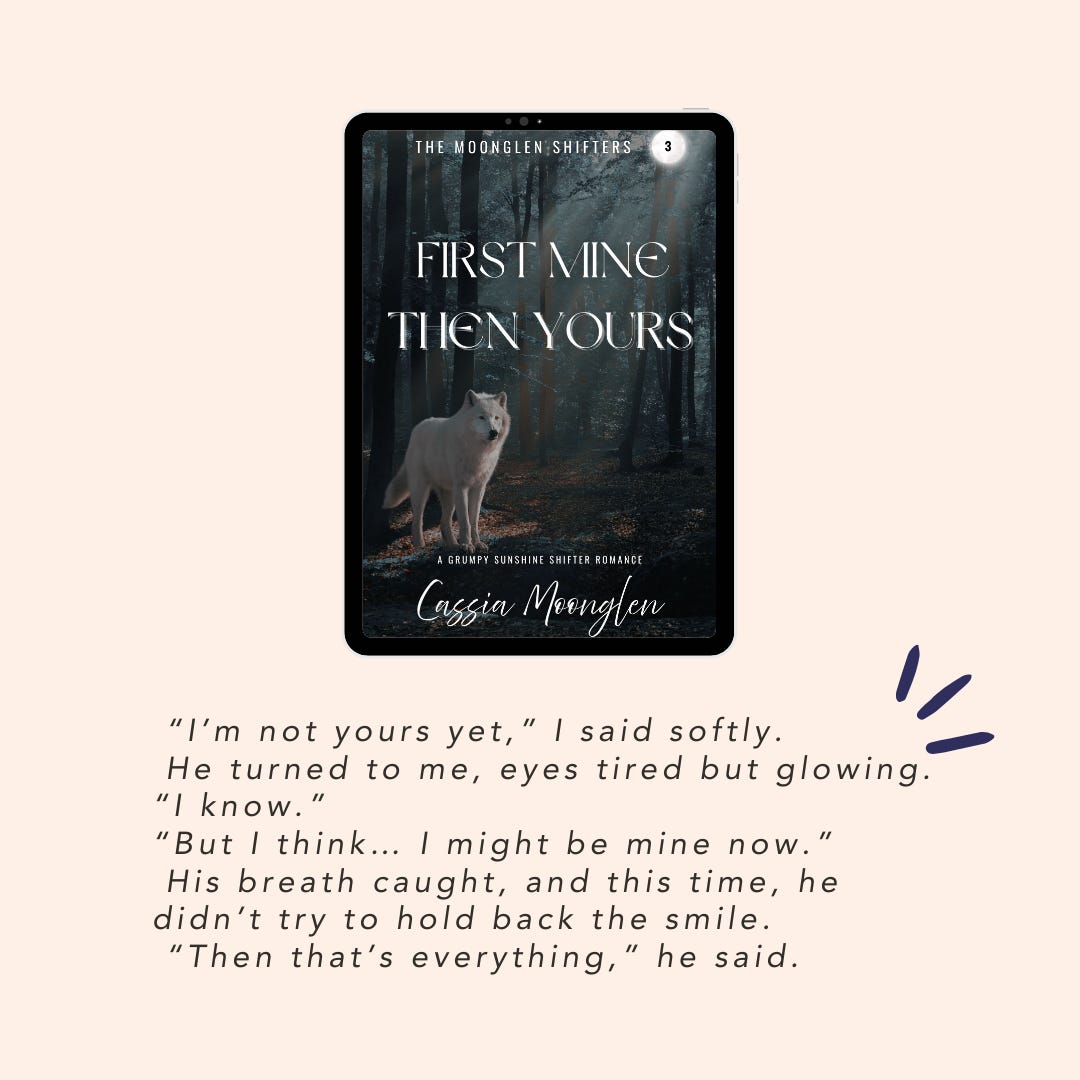
In First Mine, Then Yours, River starts reading a few books Merit recommends to get to know her.
Merit is a scholar studying early feminist writers. Most of these were written in the 19th century, one in the 18th.
Fun fact: I read many of these during my English Literature degree. I wanted to go on to study a Master’s in English Literature, but I got sick in the last year of my degree and was unable to carry the load required for postgraduate study and work enough to survive.
This is the list I imagine Merit would have recommended to River if we’d seen all of them.
Evelina by Fanny Burney (1778)
A witty coming-of-age story that critiques social class and gender expectations; Burney paved the way for Austen.Pride and Prejudice by Jane Austen (1813)
A sharp critique of marriage as a means of economic survival, wrapped in charm and wit; Austen wrote anonymously and upended norms.Jane Eyre by Charlotte Brontë (1847)
A rebellious, independent heroine who insists on emotional and moral autonomy in a patriarchal world.The Tenant of Wildfell Hall by Anne Brontë (1848)
A radical portrayal of a woman who leaves an abusive husband—stunningly progressive for its time.Wuthering Heights by Emily Brontë (1847)
Dark, intense, and psychologically rich; explores feminine rage, trauma, and transgressive desire.Frankenstein by Mary Shelley (1818)
Written at 18, Shelley reshaped science fiction while wrestling with motherhood, ambition, and creation.Incidents in the Life of a Slave Girl by Harriet Jacobs (1861)
A rare firsthand account by a formerly enslaved woman, confronting the intersection of race, gender, and autonomy.Our Nig by Harriet E. Wilson (1859)
The first novel published by an African American woman, revealing the realities of race and servitude in the North.Aurora Leigh by Elizabeth Barrett Browning (1856)
A feminist epic poem that defends the woman writer’s right to independence, intellect, and creative expression.Agnes Grey by Anne Brontë (1847)
Drawn from Brontë’s own life, it subtly criticises class snobbery and the vulnerability of working women.Villette by Charlotte Brontë (1853)
A haunting, introspective novel about repression, loneliness, and a woman’s intellectual awakening.North and South by Elizabeth Gaskell (1854–55)
Explores industrial change, gender roles, and class conflict with a complex, principled heroine.Ruth by Elizabeth Gaskell (1853)
A compassionate, controversial novel about a “fallen woman” that critiques social hypocrisy.The Yellow Wallpaper by Charlotte Perkins Gilman (1892)
A chilling short story on mental health, female confinement, and the cost of silencing women’s voices.Poems by Emily Dickinson (various, primarily posthumously published)
A revolutionary, reclusive voice whose quiet, compressed poems burst with emotion and insight.The Awakening by Kate Chopin (1899)
A lyrical, powerful novel about a woman’s struggle for autonomy, sensuality, and identity.Behind a Mask by Louisa May Alcott (1866)
Published under a pseudonym, this novella features a cunning female protagonist defying gendered expectations.Mary Barton by Elizabeth Gaskell (1848)
Combining the working-class struggle with the story of a young woman caught between duty and desire.Desperate Remedies by Thomas Hardy (1871)
Hardy’s early novel features a bold, determined heroine—a surprising twist from a male author—and hints at how women’s roles in fiction were evolving.The Story of an African Farm by Olive Schreiner (1883)
A South African novel ahead of its time, exploring gender, colonialism, and philosophical freedom through its young female lead.
No posts
Comments
Nothing yet. Say the first thing.
Sign in to join the conversation.