
In recent weeks, I have participated in several panel discussions on UN transitions in which many speakers have delivered talking points about the importance of local (or national) ownership. But the fact that little has changed on the ground in integrated settings in the past decade suggests that the regular invocation by member states of the importance of local ownership is not in itself enough to drive meaningful local ownership. There are more systemic obstacles that need to be overcome.
In September, CIC published a report in which I highlighted four key recommendations highlighted in the 2015 report of the High-level Independent Panel on Peace Operations for which little progress has been made over the past decade. These recommendations related to the primacy of politics, the need to be able to draw upon the full spectrum of peace operations, “Christmas tree” mandates, and accountability for the performance of uniformed peacekeepers. For each, I pointed out that the main obstacles are administrative and budgetary in nature, and that unless these obstacles are addressed, no amount of member state exhortation—whether in the form of statements or in resolutions—will meaningfully move the needle on implementation. The same is true when it comes to local ownership.
The push for local ownership in UN peace operations emerged out of the experience of the 1990s and 2000s, when missions began to take on a broader range of peacebuilding tasks, as a strategy for maintaining legitimacy for intrusive interventions and for mitigating the risk of dependency on international actors.1 Although the concept of local ownership is now ensconced in peacebuilding orthodoxy, there remains a major gap between rhetoric and practice.2 The problem originates in the organizational culture of the UN and other international actors, which privileges the knowledge of international staff over that of local staff,3 despite (or because) the cosmopolitan outlooks and practices of international staff are driven by their being mobile generalists who usually lack detailed knowledge of most of the local contexts, or even local languages, in the contexts where they work.4
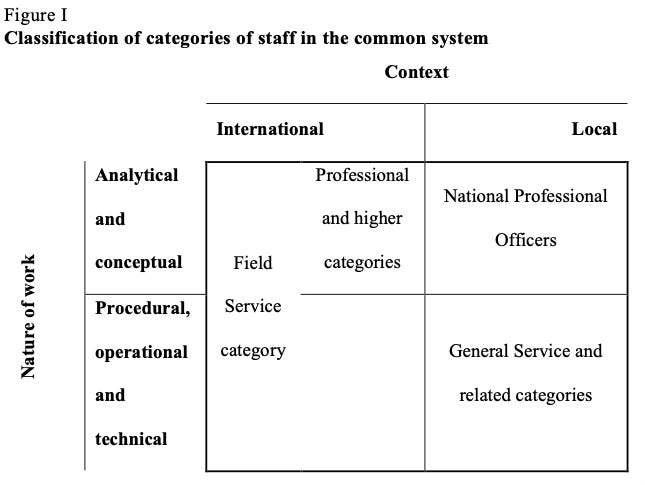
Within peace operations, a clear hierarchy exists in which national staff are subordinated to international staff,5 and the privileging of international perspectives over local expertise permeates the culture, rules, and practices of peace operations.6 This de facto caste system is reinforced in the UN compensation framework, in which separate arrangements are in place for the determination of salaries and benefits for international and local staff,7 and daunting administrative and cultural barriers to moving from the latter to the former. Indeed, there is a stigma in missions against considering national professional officers for international professional positions elsewhere in the system. The stratification is also reinforced in the fact that the Secretariat relies on international staff for analytical and conceptual roles, and local staff for administrative and clerical roles.
Bringing down the structural barriers between international and local staff could be a first step towards addressing the stratification among UN staff members and, in turn, help promote a greater receptivity to local knowledge and expertise in peace operations. Of course, overcoming these administrative and budgetary hurdles is necessary but not sufficient; changes in how programmes are designed and implemented are also necessary, but these are beyond the scope of this commentary.
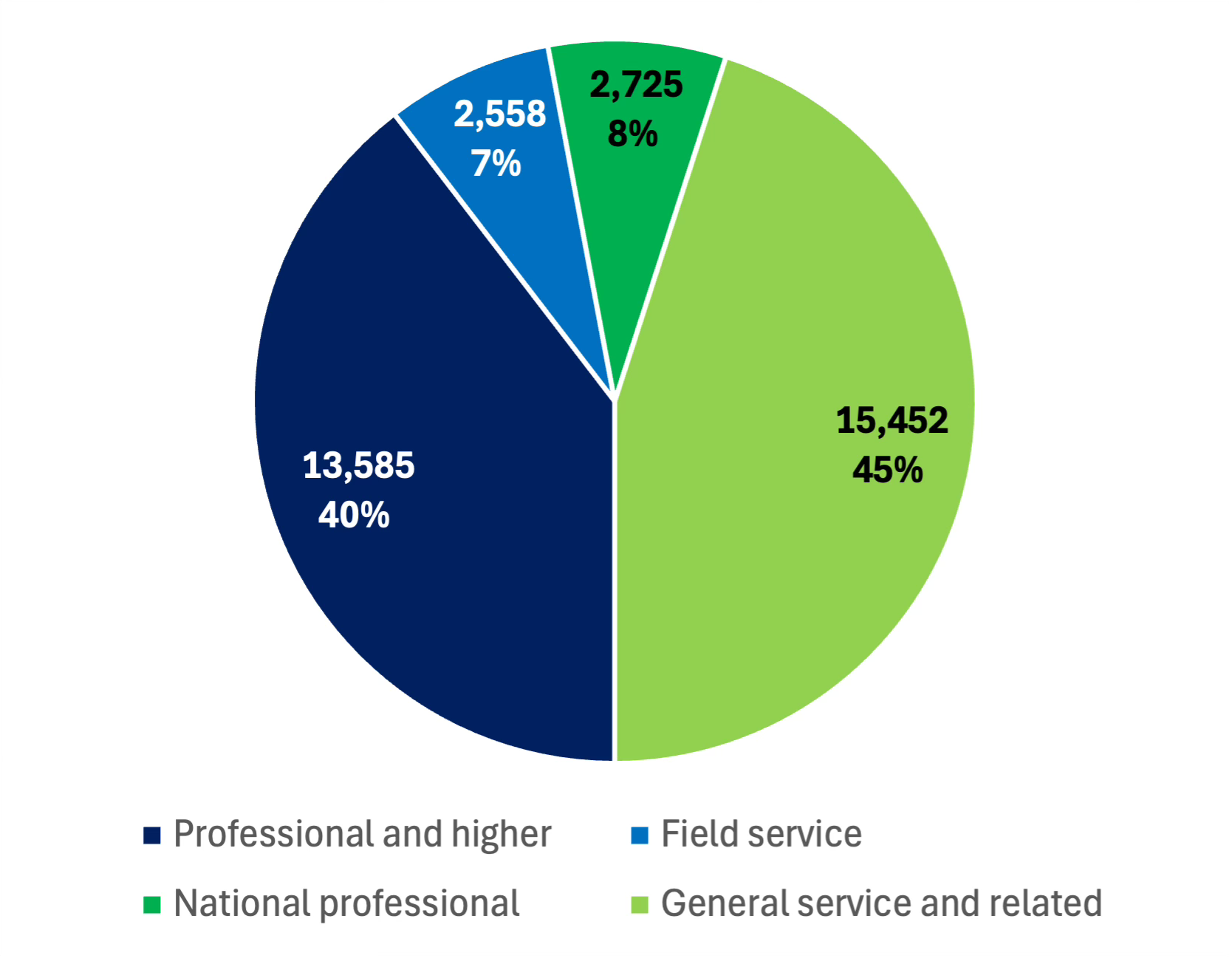
International professional staff and national professional officers are both responsible for “carrying out analytical and conceptual work”. One key difference, however, is that international staff usually work outside of their country of origin and often have an obligation to move geographically over the course of their career, while there is no expectation for national officers to be geographically mobile. The prerequisite educational and professional qualifications are comparable, with the NO-A through NO-E national professional officer grades correlating with the P-1 through P-5 international professional staff grades. The second key difference is that the UN overwhelmingly relies on international staff for analytical and conceptual work. National professional staff represent just 8% of Secretariat staff.
Given the comparability in the functions and minimum qualifications between international professional and national professional grades, one way to address the structural barrier would be to treat them as equivalent. In other words, for any professional vacancy that arises, the most qualified candidate should be selected, and the application of either the international or national salaries and benefits would simply be a function of the nationality of the successful candidate. This would be a major shift from the current approach in which relevant posts in staffing tables are designated either for international professional staff or national professional officers.
Such a shift would have several benefits. It would reduce the administrative obstacles to the selection of national professional staff, and therefore increase the degree to which local knowledge and expertise is utilized in decision-making. It would also enable the nationalization of posts over the lifecycle of a mission without the need for onerous civilian staffing reviews. It would also have the ancillary effect of reducing staff costs in missions given that, in the field, the costs associated with national professional officers are considerably less than those of international professional staff.
To implement such a shift, however, would require a more flexible approach to budgeting for civilian personnel in the Secretariat. At a minimum, the General Assembly would need to approve the ability for missions to approve the engagement of local candidates who meet the minimum qualifications for a P-level post, but as national professional officers.8 Another way would be for staffing requirements in budgets to be presented and approved on the basis of an overall envelope rather than on the basis of a rigid staffing table. This is something I’ve previously suggested as a way to fix other recurring problems in peace operations, including the challenges of prioritization and sequencing of mandates and of being able to pivot to respond to changing circumstances and requirements without the need for a revised budget or supplementary requirements.
But for this change to really have an impact requires that the approach apply globally. Currently, national professional officers (and their salary scales) are only used in developing countries and mission contexts. The national professional officer modality should be extended beyond the field to Headquarters and other duty stations in high-income countries. In other words, a United States national performing a P-4 role would be paid at the P-4 level in Juba but at the NO-D level in New York. Treating the two categories of professional staff as being functionally equivalent would help drive a shift in organizational culture that prioritizes qualifications rather than national origin in selection for professional roles.
This type of shift is what the International Civil Service Commission should be considering and proposing to member states, including in the context of the ongoing comprehensive review of the compensation package. The fundamental setup of the international civil service and the common system reinforce longstanding problems that undermine effective mandate delivery and the legitimacy of programmatic interventions, and does not take into account the profile and expectations of the global talent pool.
I worry, however, that the ambition of the Commission remains limited, including in the context of the ongoing comprehensive review of the compensation package. A recent article published by Geneva Solutions highlights the pitfalls of being fixated on individual elements of the existing compensation package and the vested interests of various stakeholders in the discussion, including current UN staff members who want to avoid a reduction in remuneration. This all points to the need for an objective independent review of the overall UN compensation framework, rather than the internal review currently underway by the International Civil Service Commission.
Ultimately, the purpose of the compensation framework should not be to provide so generous a package as to attract candidates from countries with the highest-paid national civil services, but rather to ensure that compensation levels are not a disincentive for attracting and retaining talent, including qualified local candidates. A comprehensive review should not be limited to a technical exercise to examine the methodology of each element of the compensation package. Instead, it needs to be a broader exercise to make changes and propose recommendations to ensure that the compensation package enables effective mandate delivery, meets the needs of a modern workforce, and is sensitive to the financial and reputational risks facing the organizations of the common system in a time of geopolitical turbulence.
© 2026 Eugene Chen under CC BY-NC-ND 4.0
The views expressed herein are those of the author and do not necessarily reflect the views of the United Nations University..
Ejdus, F. (2021). Revisiting the Local Turn in Peacebuilding. In J. Kustermans, T. Sauer, & B. Segaert (Eds.), A Requiem for Peacebuilding? (pp. 41–58). Springer International Publishing. https://doi.org/10.1007/978-3-030-56477-3_3
Nowicka, M., & Kaweh, R. (2016). Looking at the Practice of UN Professionals: Strategies for Managing Differences and the Emergence of a Cosmopolitan Identity. In M. Nowicka & M. Rovisco (Eds.), Cosmopolitanism in Practice (1st ed., pp. 51–71). Routledge. https://doi.org/10.4324/9781315574424
Salaries for international staff are set in comparison to the highest-paid national civil service under the Noblemaire Principle, while salaries for national staff are set based on the best prevailing local conditions under the Flemming Principle.
This would overturn the new provision included in the 2025 administrative issuance on the staff selection system (ST/AI/2025/5) that states that applicants for positions in the professional or higher categories in the field “cannot be of the nationality of the country where the position is located”.
No posts
Comments
Nothing yet. Say the first thing.
Sign in to join the conversation.