
Subscribe for free to receive new essays.
If my work moves you, please help me gain more traction and support by “liking” (press the little heart icon), adding your comments, and/or sharing it with others. And if you’re able to help by sponsoring my writing, I would be so grateful.
Always, thank you for being here.
A personal prelude: Careful eyes and early readers of this substack may notice this essay’s title plays on an earlier one (“To See the Darkness, To See the Light”). While this is not directly a “Part Two,” these pieces are certainly deeply connected and you may want to read both, as complementary (though it is not necessary). I wrote the first in December 2023, heart shattered in the wake of October 7 and what was unfolding, bearing witness to the collapse of a world and fragile ideals that I knew would not — could not — return.
So it is that change is the only constant, and in many ways, I am relieved for the naked honesty and decay, as painful as it is. Today, while we are weary, we see with more transparency; we recognize the edifices upon which our outdated stories have been constructed. The opportunity is now for more truth, more care, more participation, and for the boundless joyful buoyancy we can unleash when we are able to be vulnerable and generous with our tenderness — our grief, our love, our aliveness.
In my 20s and 30s, I spent an occupational decade idealistically do-gooding in non-profits, between hyper-local community counseling and social services, and international human rights advocacy (specifically genocide and mass atrocity prevention) directed at the United Nations.
I left that world because my way in was never best channeled through policy, but through the heart; I am more often an artist and philosopher than a proceduralist. Too, I am a reluctant activist, with one half of me pushing towards “better answers,” and the other half (the one who laughs at myself), surrendering to the bewildering questions; urgency and patience. I need both. I need spectrums. I always have. So, for the last ten years, a more spiritual approach beckoned. And here is what I learned: I tried the outer work without the inner work, and now I bear close witness to a “healing” industry of inner work that lacks real connection and accountability to the outer world, and both of these things frighten me.
I do believe that peace is as spiritual and as lifelong a discipline as ever there was one. Not just the kind we contemplate from the safety of our meditation cushions. My work now, far from the sterile halls of the UN, is ultimately still forever in service to its ideals; to the belief that we can transform the violence we manufacture within and amongst ourselves; in the affirmation of the dignity, worth, equality, and beauty of every single creature on Earth; in the profound honoring of all that sustains us.
I write to remember.
“A life of learning requires holding courage and humility together — the courage to speak to what we hold dear and the humility to explore what remains uncertain and what is challenged. We should never be fearful to let our understanding deepen when the vastness of the complexity we inhabit confronts our lived experience and cherished truths.”
— John Paul Lederach1
Last month in my small part of the world, warm rain melted patches of snow enough to remind me that spring’s thaw was within reach. At the same time, some 6,200 miles away, rain disrupted an already besieged landscape; I had never heard of “oil rain” until the day it fell from a battered sky over Tehran. Enraged, I remembered Cloudy With a Chance of Meatballs, the children’s tale of a town where the weather happened in food. Drizzles of orange juice, clouds of mashed potatoes, pea soup fog, sandwich hail; no one in Chewandswallow went hungry. I imagined our world with abundant nourishment and safe skies — we’d drop flowers instead of bombs, I determined, as I rearranged the entire cosmic chessboard to advantage the oppressed and vanquish the antagonists — and for a while, I drifted there, high in the immaculate, righteous clouds of every humanitarian “if only,” careening towards a dangerous virtue.
I pulled myself back. Virtue is not my endeavor. Virtue, I think, is a way violence is maintained.
It’s there, justifying the machinery of annihilation; the systems constructed to support the perpetration of weaponized patriarchy; the pathologizing, exploitation, abuse, and discarding of bodies. It’s there, lurking behind every “victory,” every war sponsored by “conscience,” where “heroes” slay “monsters.” Too, it infiltrates spiritual cultures, where “attainment” whispers of impeccability, of purity, and its opposite; and where the innocence of vulnerability — the very vulnerability that is needed for growth and transformation — can fall prey to those with power. Power constructed upon promises of, yes, virtue.
It was declared 232 years ago by the French revolutionary, Maximilien Robespierre (1758-1794): “Terror is nothing more than speedy, severe, and inflexible justice; it is thus an emanation of virtue [...].” Violence in the name of “morality.” Violence that swiftly killed him, too, at the guillotine. Violence so virtuous that it would have exonerated his own executioner.
Because violence is not a thing that lands and stays landed. It ricochets across centuries, across the lines we draw between justice and carnage. It changes hands. And in all that time, it has never stopped. Not because we are so cruel but because we are faithful — to “progress.”
And still, as progress has unfolded throughout the epochs, between a time when we killed only for calories and now, when we kill for triumph, there is something recognizable in our violence, a through line: our drive for survival. What has changed, it seems, is how manipulated we have become as “enemies.” For paralysis is convenient, outrage is profitable, and fear is mobilizing. Our differences and our self-protective instincts are now the most exploited — and lucrative — facets of our being (as private defense contractors, consulting firms, development organizations, and even charities increasingly exploit and foment conflict and war for obscene profits,2 while fossil fuel giants collect record windfalls — to the tune of $30 million per hour in gains in the first month of this farcical US-Israeli war in Iran3).
Today, owing to more progress, our little glowing boxes ferry every injustice into the cradle of our palms with merciless speed and efficiency, and we have never been more furious. In my sensitive heart and disobedient soul, I say: rightfully so.
This holy outrage — born of our heartbreak and care — is sensible and defiantly alive. At its essence, anger is honest and powerful. In Tibetan Buddhist iconography, the wrathful deities are depicted with ferocious, fanged expressions; these are the compassionate protectors of the Dharma, removing obstacles and ignorance through the clarity and wisdom of anger’s straightforward energy. I like what is fierce and wild and what does not conform. Anger is the possibility to awaken and remain uncapturable. Anger is our young people, un-learning the lessons of broken institutions, locking arms in the streets, refusing to be placated, refusing to be gaslit, refusing to ignore the possibility of a generous new world that they can feel beckoning in their souls. Anger disrupts the program; it is a seed of transformation — towards learning, towards justice, towards accountability, and towards repair. It helps us understand what is at stake and how to effect change.
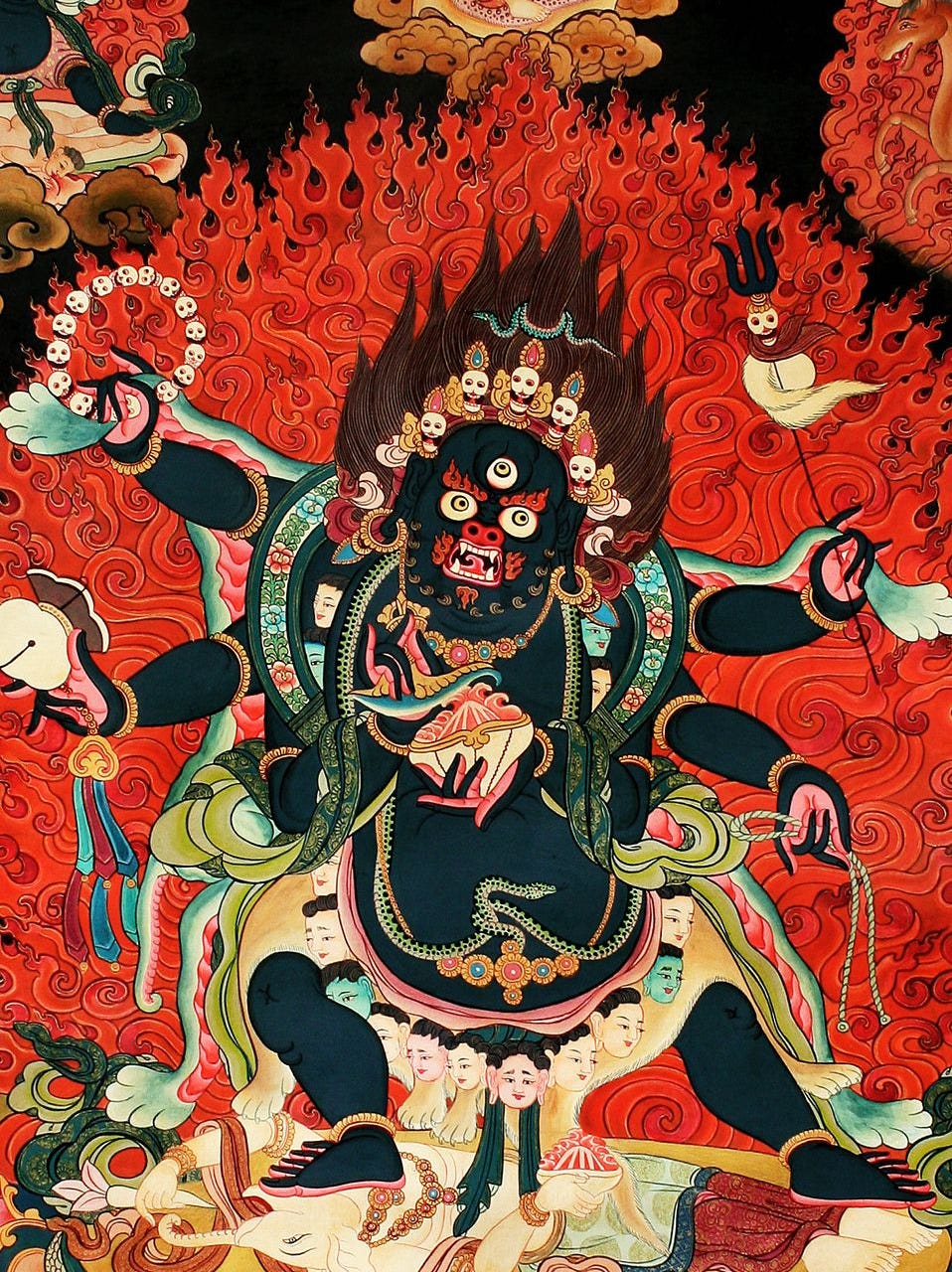
At the same time, something slippery happens when our anger fractures us from the whole, leaving us dependent upon the legibility of a moral high ground. This is the anger of retribution, at a time when what we truly need is rehabilitation.
Because we rarely pause to ask what our virtue is doing. Not whether it is right. Not whether it is justified. But what it is doing. For even in our holiest of aspirations, we humans meet again and again in the realms of our imaginal frailties, our formulaic circularities, and our rationalizations that stay tethered to binaries: good vs evil, light vs dark, friend vs enemy. One necessarily begets the other, and somehow, despite their mutual dependence, it is their incompatibility that gives each its meaning. When left unchecked, our virtue sets us far apart, paving the way for our anger to lead us down a path of dualistic judgments and destructive blame. Something essential to our complex humanity is lost here.
Dehumanization happens like that, in a tricky, sometimes even ambiguous way that hides itself in the folds of our certitudes and victories. We pay little attention to how we may be participating in hostility. Pointing emphatically towards the most extreme and overt displays of hatred and aggression, we lose sight of the subtle ways we negate the humanity of “the other,” especially those with whom we disagree. We call them “evil” and “broken,” as if they are anomalies of the system, as though the same capacity for harm does not live quietly within us all. “I am not that,” we insist, as though we are not woven from the same flawed and wondrous fabric, in denial of our interbeing and interbecoming with each and every mysterious element of life within the boundless cosmos.
Until one day, we realize we have already witnessed the terror in the eyes of the ones who now unleash the terror; that on a vastly larger timescale, perhaps we are merely taking turns as enemies in endless, intergenerational cycles of barbarism, conquest, and resistance. Might we acknowledge by now that this is not a system glitch, rather it is how the system has spoken, throughout time and space, across plural histories and unparsable identities?
No words have captured the paradox of interbeing quite like Thich Nhat Hanh’s extraordinary poem, “Call Me By My True Names.” Thich Nhat Hanh (1926–2022) — also called “Thay” (meaning “master” or “teacher”) by his followers — was a Vietnamese Zen monk and an extraordinary peace activist who guided a Buddhist movement that extended the practice beyond meditation, beyond personal spiritual development, towards a response to wider ecosystems of suffering. “Engaged Buddhism,” he called it, as he led antiwar protests, created peace-oriented institutions, resettled refugees, and rebuilt destroyed Vietnamese villages.
The invitation of “Call Me By My True Names,” written in 1976, is foundational to my own orientation towards the contradictory truths of our lives; our inherent belonging to one another; and the deep, difficult, sometimes inconvenient work — and honor — of love. While I referenced this poem back in my December 2023 essay on Israel and Palestine, I think it deserves more dedicated reflection, and anyway, I cannot stop thinking about its excruciating and exquisite teaching these days, amidst rampant polarization near and far. Please invite your attention:
Don’t say that I will depart tomorrow —
even today I am still arriving.
Look deeply: every second I am arriving
to be a bud on a Spring branch,
to be a tiny bird, with still-fragile wings,
learning to sing in my new nest,
to be a caterpillar in the heart of a flower,
to be a jewel hiding itself in a stone.
I still arrive, in order to laugh and to cry,
to fear and to hope.
The rhythm of my heart is the birth and death
of all that is alive.
I am the mayfly metamorphosing
on the surface of the river.
And I am the bird
that swoops down to swallow the mayfly.
I am the frog swimming happily
in the clear water of a pond.
And I am the grass-snake
that silently feeds itself on the frog.
I am the child in Uganda, all skin and bones,
my legs as thin as bamboo sticks.
And I am the arms merchant,
selling deadly weapons to Uganda.
I am the twelve-year-old girl,
refugee on a small boat,
who throws herself into the ocean
after being raped by a sea pirate.
And I am the pirate,
my heart not yet capable
of seeing and loving.
I am a member of the politburo,
with plenty of power in my hands.
And I am the man who has to pay
his “debt of blood” to my people
dying slowly in a forced-labor camp.
My joy is like Spring, so warm
it makes flowers bloom all over the Earth.
My pain is like a river of tears,
so vast it fills the four oceans.
Please call me by my true names,
so I can hear all my cries and my laughter at once,
so I can see that my joy and pain are one.
Please call me by my true names,
so I can wake up,
and so the door of my heart
can be left open,
the door of compassion.
[While I typed the poem, the tiniest spider jumped onto my hand and I recalled a time, long ago, when I might have violently flicked it away, out of my own fear and ignorance. I suffered from arachnophobia into my early teens, with no rational justification except perhaps some cultural indoctrination. If we’re lucky, as I have been, we’re afforded decades of compassionate and patient un-learning, and we do our best to make amends. Now, Spider has become a benevolent messenger through frequent visitations and admirable analog web design. I placed the creature next to me on the couch, where it kept me company for another 20 minutes before quietly disappearing back into its own realms.]
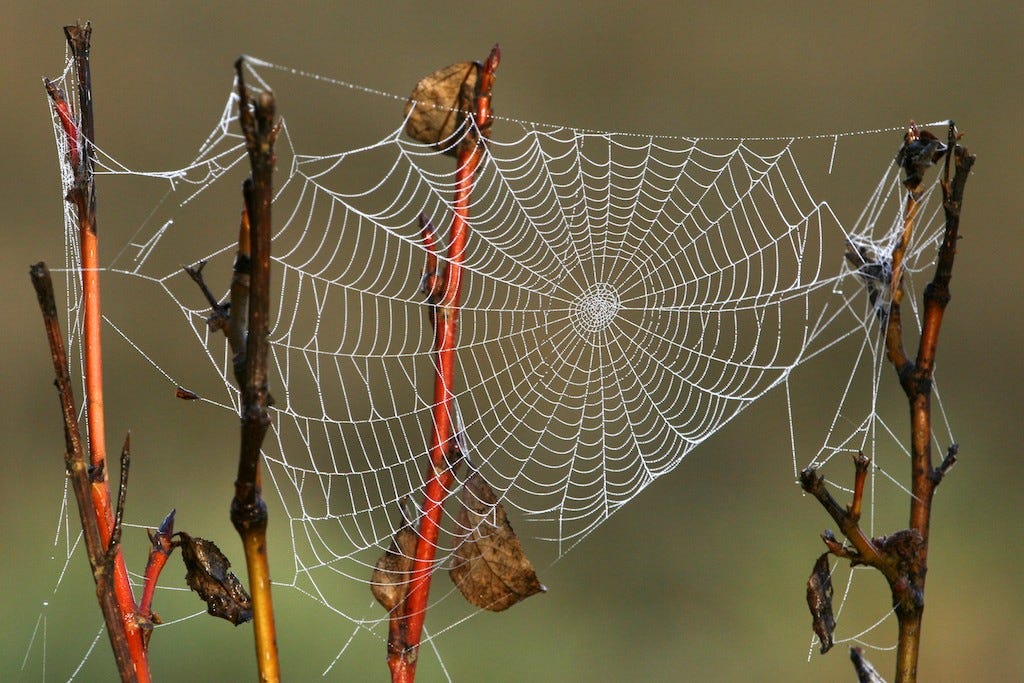
So, we see from the poem’s first insight that identity is always “arriving” — incomplete, partially occluded, and arising of relationality. This calls into question the dominant narrative that we are singular, stable, autonomous agents. Rather, we are dynamic, open-ended processes, and forever in touch. Every interaction is a sophisticated, mysterious equation, with more participants and components than we may be accustomed to acknowledging or even aware of; tangible and intangible, form and idea, internal and external, emergent and long-inherited, all conspiring again and again in each moment to fashion a semblance of “self.” Still, by some miraculous sequence of primordial collisions, we each have some kind of agency to speak of. (And more remarkable, indeed, is that so many of us seem to share a global vision on the horizon, though we may disagree on the pathways towards it.)
Then we can see, too, that our experiences and our fates, while distinct, are also quite literally intertwined. And then, can we call our opponents by our true names? Can we see their own suffering being shaped by conditions we may not understand? We need not bypass accountability nor excuse harm, but we can spare our hearts the poison of hatred...
…and relieve ourselves of the burden of our virtue.
For in the raw truth of things, while we insist upon our goodness, at this point we are all well-aware of our indisputable complicity in harm. At the very least, without ever leaving our comfortable homes, our every convenience draws upon the blood or the hardship of another. Our purchases, our investments, our necessities, our pleasures, and most of the foods we eat rely upon exploitative and extractive modern systems that simply outsource the harm-doing (and drive us towards imminent climate and social collapse). We mean well, we care about our families and communities and the fates of strangers on the other side of the world… and… we are willing to accept a level of suffering on our behalf when that suffering is ungraspable to us, or remote, and especially if we believe that it is essential to our own survival.
I do not mean to equate the vast array of harms perpetrated across our world, while some humans intentionally create unbearable and merciless conditions of suffering unto others. It is necessary to see reality clearly and describe it: genocide, ecocide, colonialism, apartheid, land theft, terrorism, cultural erasure, gender-based violence, wage theft, discrimination, etc. It is necessary to engage the material conditions of our existence and invest our efforts in the changes we desire. It is necessary to allow our anger to help us understand what is at stake and for whom.
Even Thay, one of the most equanimous of beings to ever have caressed our world, was explicit in naming injustice and his refusal to accept the barbarity of war. Twelve years before he wrote “Call Me By My True Names,” he wrote “Condemnation” (1964) as an impassioned cry against the Vietnam War, conveyed from the perspective of a villager whose home is destroyed:
“Here in the presence of the undisturbed stars, / In the invisible presence of all the people still alive on earth, / Let me raise my voice to denounce this filthy war, / This murder of brothers by brothers! / [...] Whoever is listening, be my witness! / I cannot accept this war. / I never could, I never shall.”
The penetrating clarity in his protest. And then he turns:
“I have a question: Who pushed us into this killing of one another? / [...] I feel I am like that bird which dies for the sake of its mate / Dripping blood from its broken beak, and crying out: / Beware! Turn around to face your real enemies – / Ambition, violence, hatred, greed.”
Even in his defiant anguish, his grief and moral outrage, he evades the trap, he does not capitulate to hatred; our enemies are not external. His compassion, his leadership, his willingness to understand that to blindly blame one another is to stay entrenched, immobilized, and attached to the very patterns that fuel our wars. His courage is to condemn the act without dehumanizing the actor. This is how we build bridges, especially for those of us lucky enough not to be gasping for air under the rubble brought by colonial onslaught. This is how we invest in the material and the psychological, emotional, and spiritual changes we desire: we shine a light on the harms and we shine a light on the very way we approach shining a light, until they are mutually reinforcing.
My Zen teacher, Roshi Joan Halifax, who was a student and friend of Thich Nhat Hanh, calls it “strong back, soft front.” This somatic metaphor and philosophy is described beautifully by John Paul Lederach, a man I introduced to you in my last essay; he’s an international peacebuilder, negotiator, conflict mediator, haikuist, teacher, and friend of Joan’s. “A strong back cultivates a strength of courage and conviction. A soft front refuses dehumanization and risks remaining open, vulnerable, and accountable in our relationships. Together these qualities enhance deep care, connection, and transformation.”4
This is why I interrogate the architecture of virtue. We can squabble over words and definitions (“What does ‘virtue’ mean?”), but that is not the point. What I am calling into question are frameworks that shape our understanding, beliefs, and behaviors. Whatever permits us to name another as enemy is what permits us to suspend our empathy is what permits us to meet violence with unexamined fury, until we have become the thing we once denounced and swore to dismantle. How will it end if we do not take responsibility to end it? It is not because we need to perform our “goodness,” it is because we need to be honest.
There are prominent voices and movements throughout history who emphatically reject this idea, who deny empathy for abusers or advocate for violent uprising, and I hear that. It is an honest struggle in my heart sometimes, too, when it feels that the well-being of every Earthling hangs urgently in the balance. It seems impossible — and perverse — to beg for decency from incomprehensibly callous and destructive systems. And I cannot blame people for whom violence is all that is available or all that is left in a world that can reinforce domination, subjugation, violation, humiliation, invisibility, and despair simply based on the color of your skin or your place of birth or the way you inhabit and express your own being; a world that can dull and distract; a world in which many of the institutions from which we’ve been promised protection are now failing, co-opted, and perpetrating violence in many forms. What then, when what oppresses adheres to an entirely different construction of “morality”? Can we expect oppressed, marginalized, occupied, and dispossessed people not to protect and defend themselves? Can we really expect a hunger strike from those who are already hungry, or a protest from those who do not have the world’s eyes upon their cause?
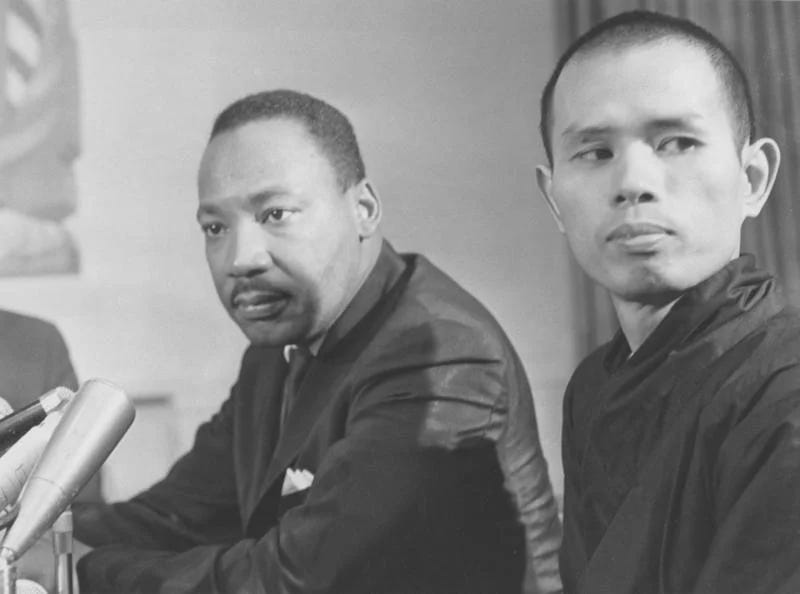
It was the great Bodhisattva and civil rights leader Rev. Martin Luther King Jr. who famously said during his 1964 Nobel Peace Prize acceptance speech, “I refuse to accept the cynical notion that nation after nation must spiral down a militaristic stairway into the hell of thermonuclear destruction. I believe that unarmed truth and unconditional love will have the final word in reality.”5 And yet, even he, in his last years, could not deny that the American justice system was so structurally organized against justice that the “giant triplets” of racism, materialism, and militarism were “incapable of being conquered.”6 King never abandoned nonviolence, but he began communicating more emphatically that only radically disruptive and unrelenting confrontation could move the needle.7 In my sensitive heart and disobedient soul, I say: rightfully so.
Who am I to know anything about these lived experiences and render an opinion? I only have a wish, but alas, no magic wand, and anyway, isn’t that how this essay began, with my own dubious “if only”s? What I do know is that many of us are privileged enough to have myriad choices. Can we do our part to support the causes and conditions that reduce violence and the need for violence across as many systems and power structures with which we are entangled? Can we do our part to support the thriving of all beings, including through our own un-learning and re-education? (Perhaps instead of asking AI first, we can ask the monarch butterflies about metamorphosis, we can ask the wind about change, we can ask the Great Basin bristlecone pine about growth, we can ask the mountains about time and the stories of humanity they have witnessed?) And what of our own forbearance? Can we refuse to see our neighbors as enemies and deny power as much as possible to those who do?
Or, in the magnificent sentiments of John Paul Lederach: “I cannot bring judgment as to why [some] choose violence. But I find it deeply incumbent upon me to do everything I can possibly do to form and fashion the alternatives that make the imagination of something other than violence not only possible, but the only viable and real way we can engage the challenges that face our local communities, wider humanity, and now the entire planet.”8
I am so moved by this.
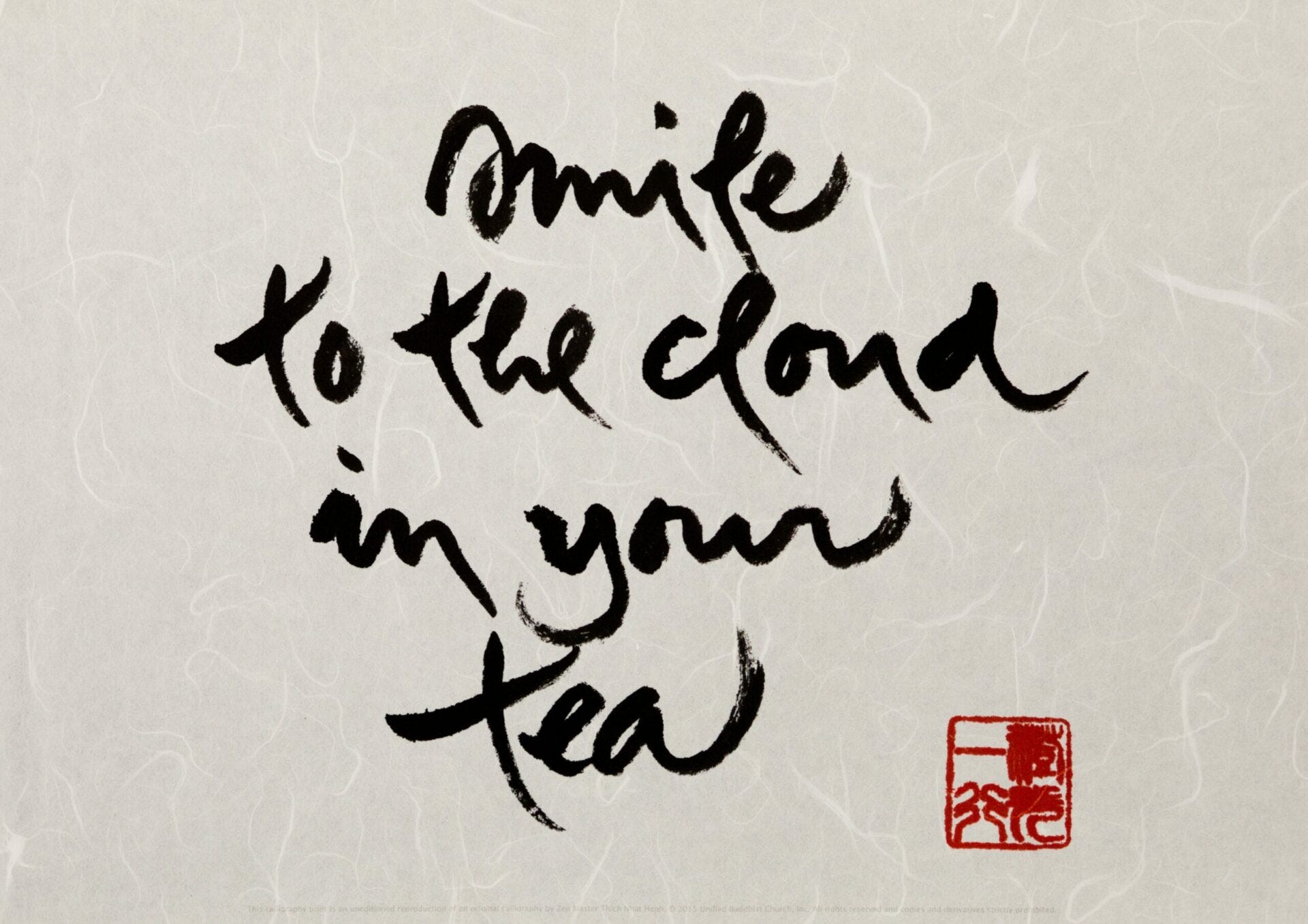
“Purity,” then, cannot be the salvation we have been promised.
Never was I more delighted by this conclusion than when I watched The Good Place, a television comedy series from 2016. The show’s genius further emerged with each season, bringing its audience into exquisite philosophical reckonings with our notions of humanity, ethics, and what it is to love. [Spoiler] To start, the show brilliantly subverted its own title: for the first three seasons, the characters are actually in the “Bad Place,” designed to look like the “Good Place,” as an intentional form of afterlife torture — punishment for their Earthly misdeeds. It is only in the fourth and final season that they enter the gates of the real “Good Place” (I won’t tell how or why), only to discover a different kind of hell: a paradise so pure, so static, that its residents have become bored, catatonic zombies, trapped for eternity in a realm of never-ending ease and comfort — no trouble, no friction, no blessed inconvenience of conflict.
This entertained me spectacularly, while it pointed at something profound: purity is not ascension, it is stagnation. Eternity without struggle is not a utopia, it is a different kind of death. Stasis may successfully advertise itself as harmonious, but it lacks motion. Conflict is our motor, our agent of change, and a way we make meaning. Martin Luther King Jr., who was also a friend of Thich Nhat Hanh, spoke to this in an open letter he penned while imprisoned in a Birmingham city jail in April 1963: “Human progress never rolls in on wheels of inevitability; it comes through the tireless efforts of men willing to be co-workers with God, and without this hard work, time itself becomes an ally of the forces of social stagnation.”9
Understandably, we prefer not to struggle, but our hubris encourages yet more: a win, a victory, if only intellectually (like we writers pursue). This is the cunning of the binary, and it indoctrinates us everywhere, including in our holy places. That is to say, our modern spiritual rhetoric can exacerbate the problem.
When “light” represents God, divine, knowledge, truth, ascension, and salvation, and when “dark” represents sin, corruption, ignorance, and the fallen, we are ill-equipped to face the essential truths of our complex natures. We aspire to “love and light,” and speak about darkness as an absence of light, a privation, and not a real presence. We divide ourselves between “good” and “evil,” those who are virtuous and those who are not. Darkness is our enemy; dehumanization follows closely behind. Perhaps it already seems obvious. However, think about how often we use the word “evil” without considering what we imply, also whether or not we have truly integrated darkness before we disown and disavow it elsewhere.
Further, this kind of language directly enables silence in the face of atrocity. If dehumanizing our aggressors arrives us all at a destructive place, then the opposite error is equally dangerous: refusing to name the aggressor at all. Many prominent spiritual leaders who have said nothing about the genocide in Gaza are not practicing equanimity, they are practicing avoidance masquerading as transcendence. They mistake silence for peace and neutrality for wisdom. But “strong back” means bearing witness and having the courage to name things as they are. A spirituality that cannot acknowledge the true breadth of our suffering — that cannot look at the oil rain over Tehran, the bombs falling on Gaza and Lebanon, the starvation of Cuba and Sudan, the extractivism in Congo, the crisis of homelessness on our own streets — is not “enlightened,” it is anesthetized, decorative, addicted to virtue. It belongs to the same individualistic logic that begets our wars: an industry of self, “purifying” one’s own energy, “raising” one’s own vibration, “protecting” one’s own peace. We cannot truly be surprised when the powerful and influential figures within this industry are outed as pedophiles and sexual predators, can we? As I heard Nigerian philosopher Bayo Akomolafe say recently, our modalities of healing often reinforce the economy of relations that make the harm possible in the first place.
“We want spiritual depth without material sacrifice. We want ancient wisdom without cultural context. We want transformation without discomfort. We want to feel enlightened without actually changing our lives.”
— Liz Bucar, “We Made Deepak Chopra Rich. Then He Befriended a Predator.”
Our anger seems not only justified, but useful here. We might see that the problem is not anger, but our insistence on living inside it, on making a home there, in a stance of injury that reifies our sense of separation and a lack of agency. For anger, while initiatory, is not transformational. When we can move out of personalization in the narrative and use anger well, we can see clearly with the penetrating energy of discernment. What we are left with is determination: “Take the selfishness out of anger and you’re left with determination,” said the late Roshi Bernie Glassman, founder of the Zen Peacemakers and a leading figure of Engaged Buddhism’s emergence in the West. Determination, born of our compassion and love for all who suffer — all, each and every one of us. This heat can generate action and support the work of accountability.
Moreover, we are not benefited by bypassing our anger, for anger can expand us if we are able to stay with it long enough to make contact with what it is safeguarding underneath: our grief. Grief is an immense and essential terrain of the soul to which I have already dedicated many words (in every previous essay, all of which serve as companion pieces to each other), but I must at least repeat this: grief is the raw, uncontainable wail of the heart that can soften its hardest places; it is an essential gateway to compassion. In this way, grief is the opposite of “othering,” rather it is entanglement and intimacy with the world.
Vengeance, they say, is a lazy form of grief. To act from grief rather than vengeance is to hold both things at once: the fierce naming of the injury (strong back), and the open heart that refuses to stop caring (soft front). “All too often, our so-called strength comes from fear, not love; instead of having a strong back, many of us have a defended front shielding a weak spine. In other words, we walk around brittle and defensive, trying to conceal our lack of confidence. If we strengthen our backs, metaphorically speaking, and develop a spine that’s flexible, but sturdy, then we can risk having a front that’s soft and open, representing choiceless compassion. The place in your body where these two meet — strong back and soft front — is the brave, tender ground in which to root our caring deeply,” Joan Halifax teaches.10
True compassion requires intimately knowing our own pain and grief, knowing our anger, touching it, breathing with it, transforming it into understanding, and then acting. To do otherwise is to refuse the generative, transformational nature of grief and darkness, the fertile soil, the womb of becoming. We cannot have warmth without fire, nor can we have resolution without conflict.
Carrying these understandings, let us absorb the origin story behind “Call Me By My True Names,” recounted by Thay:
“[...] One day, we received a letter telling us about a young girl on a small boat who was raped by a Thai pirate. She was only twelve, and she jumped into the ocean and drowned herself. When you first learn of something like that, you get angry at the pirate. You naturally take the side of the girl. As you look more deeply you will see it differently. If you take the side of the little girl, then it is easy. You only have to take a gun and shoot the pirate. But we can’t do that. In my meditation, I saw that if I had been born in the village of the pirate and raised in the same conditions as he was, I would now be the pirate. There is a great likelihood that I would become a pirate. I can’t condemn myself so easily. In my meditation, I saw that many babies are born along the Gulf of Siam, hundreds every day, and if we educators, social workers, politicians, and others do not do something about the situation, in twenty-five years a number of them will become sea pirates. That is certain. If you or I were born today in those fishing villages, we might become sea pirates in twenty-five years. If you take a gun and shoot the pirate, you shoot all of us, because all of us are to some extent responsible for this state of affairs.”11
Breathe.
How do we make our way back to a sense of our shared humanity when it has been so damaged? Where do we turn?
Towards rehabilitation, towards transformation… towards each other.
With my weary, angry, hardened, and war-saturated heart, I have been returning to John Paul Lederach’s teachings again and again, for the poignant artistry and encouragement of his work; for his commitment to care, to understanding, to people, and to sustaining constructive change that reduces violence and increase the practice of justice in relationships. He has done this for over three decades across some 25 countries in Latin America, Africa, Southeast and Central Asia, and Europe. Lederach does not use the term “conflict resolution,” rather “conflict transformation,” as it “brings into focus the horizon toward which we journey, namely the building of healthy relationships and communities, both locally and globally,” as he describes.12 I appreciate this because it inherently honors the reality of change and the work we must be prepared to do with one another, constantly, along the way. This is the long and tireless work of building bridges — of love.
He captures his wisdom in this haiku, honoring what we might learn about tending to conflict in our human relationships by observing Spider’s web:
silk thread stretched from
branch to earth bent by breeze but
grounded on both ends13
[Please visit that footnote.]
Here, he gazes upon an outer thread of the web, appreciating its tender tenacity; enduring ties anchored to the most unlikely, unstable, and marginal of places (branches, leaves, cactus spikes, rocks, windows, furniture…) hold strong the dense center of the web. [You can scroll back to examine it in the photo above — mesmerizing!] The threads bowed in the breeze — moving, yielding, willing — yet steadied by its connections. This is the strong back and soft front of conflict transformation: flexible enough to bend with the elements and rough edges of life, sturdy enough to endure. In this way, Spider asks us to widen our focus, to touch and connect with more aspects of our landscapes, to appreciate and tend the margins and conversations beyond our bubbles, to embrace our uncomfortable edges. And Spider teaches us about courage.
As Lederach has described, peacebuilding is about common purpose: “It’s about rebuilding the quality of relationship that has to develop over time between people who have been divided. And that requires us to develop a quality of presence [...] where we are true to ourselves, but open and less fearful to understanding and seeing the world from the viewpoint of the experience of the other. So there’s a deep humility that accompanies the rebuilding of trust [...] to hold what you have experienced and be honest to it, but also be open to what other people have experienced and how they see the world.”14
Then perhaps we might start to see the inevitability of conflict in human relationships as a starting point, an opportunity to move into our discomforts, to question our narratives, to expand our concepts of time and success, to invite complexity, to deepen our capacity to hold varied identities and relationships. Disagreements as doorways, tended respectfully.
An incredible example of this is the community-based peacebuilding work of women in the arid borderlands of Wajir, Kenya, during the 1990s. In the face of inter-clan conflicts over water, pasture, and resources that escalated into violent cycles that claimed the lives of their husbands and sons while fracturing the local marketplace, six women met to discuss how to calm the crisis. Their efforts grew into the Wajir Women for Peace, which operated through decentralized village networks across clans and leveraged the women’s social and economic influence to resolve disputes and broker local ceasefires. What began as informal dialogues developed into a dedicated Wajir Peace and Development Committee, a body that included clan elders, religious leaders, and youth. Owing to its relative success, the model was later replicated in other parts of Kenya and the Horn of Africa.
An entire peace movement born of first honoring relationships. It was beautifully expressed by one of the founding six women, Dekha Ibrahim Abdi: “Peace is not an event, an end, but [...] peace is the way, though the journey is long and the road winding and difficult.” I encourage you to watch the short documentary of this inspiring movement; their own testimonies are worth hearing.
Another exceptional, more recent endeavor is the Enemies Project, which brings people on either side of various current ideological and political divides (racial justice, guns, Israel/Palestine, abortion, LGBTQ+ discrimination, etc.) into face-to-face facilitated conversation, not to debate but to actively listen. For “understanding yields cooperation,” writes the creator and host, Larry Rosen, who comes with a background in mediation. The conversations are filmed, and are an immensely powerful and informative watch, as each “enemy” moves towards understanding of the other. Find the episodes on the website and read about the project; the psychology behind it, the skills involved, the “why.”
As deeply challenging as it is, I do believe our task lies here, in living this engaged interbeing — Thay’s beautiful word. “Radical intimacy with the world,” Roshi Joan calls it, which is about “the most basic realization that awakening is not an individual experience, rather it is the liberation of intimacy in our relatedness with and through all beings.”
This is the opposite of purity, the opposite of dehumanization. This is the slow, arduous work of repair and transformation — building something new, together, as we transmute both personal and social suffering into compassion and wisdom through a life of learning. With a more vulnerable approach, we free ourselves into something far more useful: courageous presence. Courageous presence does not flee from the darkness, rather it honors its true name. ♥

“Peace is not just about the absence of conflict; it’s also about the presence of justice. Martin Luther King Jr. even distinguished between “the devil’s peace” and God’s true peace. A counterfeit peace exists when people are pacified or distracted or so beat up and tired of fighting that all seems calm. But true peace does not exist until there is justice, restoration, forgiveness. Peacemaking doesn’t mean passivity. It is the act of interrupting injustice without mirroring injustice, the act of disarming evil without destroying the evildoer, the act of finding a third way that is neither fight nor flight but the careful, arduous pursuit of reconciliation and justice. It is about a revolution of love that is big enough to set both the oppressed and the oppressors free.”
― Shane Claiborne, Jonathan Wilson-Hartgrove, and Enuma Okoro; Common Prayer: A Liturgy for Ordinary Radicals (2010)
If my work moves you, please help me gain more traction and support by “liking” (press the little heart icon), adding your comments, and/or sharing it with others.
My enduring gratitude to the wisdom and care of those from whom I drew my inspiration, ideas, and support for this piece: Thich Nhat Hanh, Dr. Martin Luther King Jr., all actors across nonviolent resistance movements, Siddhartha Gautama Buddha, Avalokiteshvara, John Paul Lederach, Joan Halifax, Bernie Glassman, Bayo Akomolafe, the courageous and visionary women of Wajir, Larry Rosen, Michael Schur and the writers of The Good Place, Medea Benjamin, Tara Brach, Hatim Belyamani, Amma Brown, Earth, Sun, Moon, Spider.
From “What might a life of learning require?” February 26, 2025. https://www.johnpaullederach.com/wp-content/uploads/2025/02/What-might-a-life-of-learning-require-1.pdf
https://www.accountabilitycounsel.org/blog/civil-society-organizations-raise-alarm-over-world-banks-role-in-gaza
https://www.theguardian.com/environment/2026/apr/15/big-oil-huge-war-windfall-consumers and https://www.commondreams.org/news/totalenergies-war-profits
From “Alive and Whole in a World of Hurt: the below and beyond of well-being,” a dispatch, August 13, 2025. https://www.johnpaullederach.com/dispatches/alive-and-whole-in-a-world-of-hurt-the-below-and-beyond-of-well-being/
Full text: https://www.nobelprize.org/prizes/peace/1964/king/acceptance-speech/
From “Beyond Vietnam: A Time to Break the Silence,” sermon delivered April 4, 1967, at Riverside Church in NYC. https://www.crmvet.org/info/mlk_viet.pdf
From a fundraising letter to the members of the Southern Christian Leadership Conference, April 1968. https://www.crmvet.org/docs/6804_mlk_ppc-letter.pdf
From a teaching series, “THE MEASURE OF OUR HUMANITY: Actualizing Compassionate Action in These Tangled Times,” this talk is “REHUMANIZATION with John Paul Lederach,” April 12, 2026. To access the talk, register here: https://www.upaya.org/program/the-measure-of-our-humanity-john-paul-lederach-online-april-12-2026
From “Letter from a Birmingham Jail,” April 16, 1963. https://www.crmvet.org/info/bhamjail.htm
From Joan Halifax’s website: https://www.joanhalifax.org/about
Full text: https://plumvillage.org/articles/please-call-me-by-my-true-names-song-poem
From “Conflict Transformation,” excerpted from his book, “The Little Book of Conflict Transformation,” 2003. http://peacebuildingforlanguagelearners.pbworks.com/w/file/fetch/73426925/Lederach%20and%20Maiese_Conflict%20Transformation.pdf
This haiku does not seem to be published anywhere online, or at least I cannot find it. It is certainly his own creation, which he shared during a live training in 2021. I wrote it in my notes, but I am unable to add a proper reference. Please be mindful of this so the words are not shared without crediting him.
From the conversation “Building Peace in Divided Societies” during the 2021 Korea Global Forum for Peace Education.
No posts
Comments
Nothing yet. Say the first thing.
Sign in to join the conversation.