
Instead of Depression
try calling it hibernation.
Imagine the darkness is a cave
in which you will be nurtured
by doing absolutely nothing.
Hibernating animals don’t even dream.
It’s okay if you can’t imagine
Spring. Sleep through the alarm
of the world. Name your hopelessness
a quiet hollow, a place you go
to heal, a den you dug,
Sweetheart, instead
of a grave.
— Andrea Gibson (d. 2025)
We had our work cut out for us since July, with a big move and a taxing construction project. I looked up from the early November snowfall to find no trace left of autumn. One day the neighbors had gone, too, moved on to greener pastures, I suppose. Now we’re back in the darkness, with the promise of light lingering on the horizon. The winter solstice. The time of Capricorn, the mythological sea goat, ruled by the planet Saturn. “Stern” and “austere,” they say about Capricorn. “Disciplined” and “determined” is the goat in its ascent up the mountain from the darkness. Is it counterintuitive that stoic Capricorn is the threshold guardian of the solstice’s joyous and “hopeful” return of the light? Or perhaps Capricorn’s mysteries run deeper. There is something here for us in the darkness.
We can look around and notice the changes, the proof we’ve been at it. There’s a pile of dust where an incense stick once was and I think about becoming. “Become” derives from Middle English “bicomen,” one of its earliest definitions (12th c.) being “to change from one state of existence to another.” I like it as a mantra: becoming, becoming, and all it brings. Seems apropos for Year’s End time, where endings and beginnings meet.
Here we are, always becoming with the world; change is the math of life.
So it was in August that after four years of scattered living between two wildly different places (and paces), I finally permanently traded my home of the last two decades — New York City — for life in the woods, encircled by oak trees. I was prepared for the relief of it all, to gracefully descend into autumn with my usual attentiveness to its undoings. After all, I like to explore beneath the surface of things; my toolbox is calibrated for the depths.
And yet, amidst the loss and change, amidst the overwhelming mess of boxes and dust and deadlines; amidst painful personal challenges; amidst the intimidating task of starting anew; amidst the unfathomable anguish and delusion of the world and every “heart” I have to click, in cruel irony, on an endless stream of videos from every corner of the globe that I cannot even believe I am seeing; but also amidst the ineffable, complex beauty that endures, an undercurrent swept me.
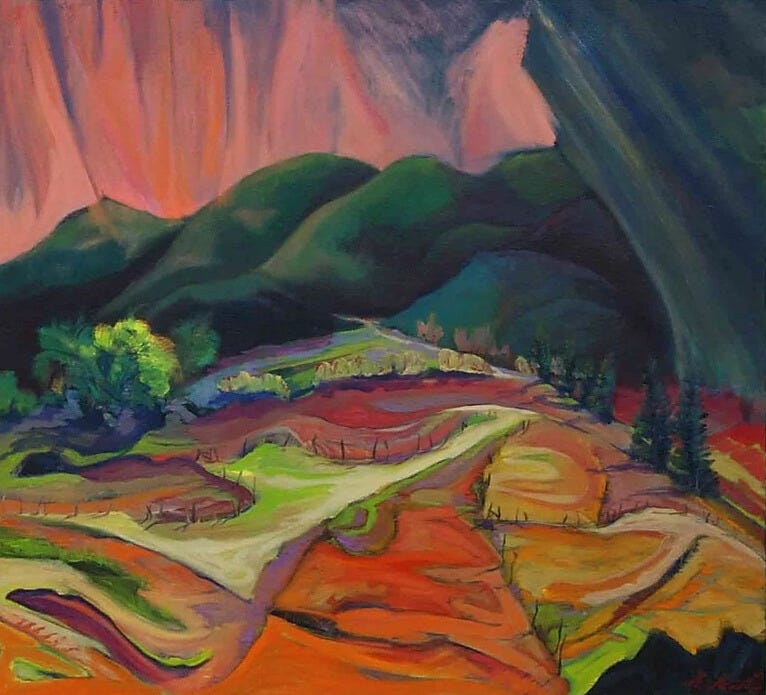
There’s a man called John Paul Lederach. He is a peacebuilder and mediator by trade, calling his process “conflict transformation.” I hardly know a person whose commitment and approach I admire more than his. To me, he is an artist, in touch with and receptive to the world as it is, gently listening for opportunities to bring understanding and impact. This is how he said it: “We inhabit unprecedented complexity. Access to nearly every aspect of our wondrous and suffering world is available at any given moment. The pace and immediacy of their unveiling presses beyond human capacity to perceive, hold, and understand. If honest, I for one feel the constant weight of inadequacy.”
There is what I couldn’t name. I couldn’t even speak about it to anyone. I could only curl inwards to brace myself under the constant weight of my own inadequacy. Isolated, I watched as the towering, deciduous oaks shed their leaves, losing their ability to photosynthesize, knowing that they, too, would slowly stop breathing.
Autumn
Urge me to drop every leaf I don’t need
Every task or habit I repeat past its season
Every sorrow I rehearse
Each unfulfilled hope I recall
Every person or possession
to which I cling-
Until my branches are bare,
until I hold fast
to Nothing…
Two months passed like this. For as much as I was doing and building and striving towards, internally I was stuck; my shame pitted against my productivity, my usefulness, my ability to make, create, perform, and accomplish. I’d think anxiously of the frenzy of the collective human marketplace, where we all dwell to make something of ourselves to the world, to each other; I’d think of everything I owed. For heroic and consumptive cultures have no room for open wounds; we’re doing “the work” of wellness, of personal healing, to deliver, deliver, deliver our “best” selves, always indebted to our endorsement of “stability.”
But I didn’t have “deliverables.”
Blow me about
in your wild iron sky,
crush
all that’s puffed up,
fluff
all that in me needs
to go to seed,
send my shadows to sleep…
These are “strange times of difficult grace,” my teacher, Francis Weller, would say, when our strategies are failing, leaving us forced to confront exactly what these strategies were crafted to keep us from facing. Put another way, I often wonder whether our quest for healing is the very impediment to it.
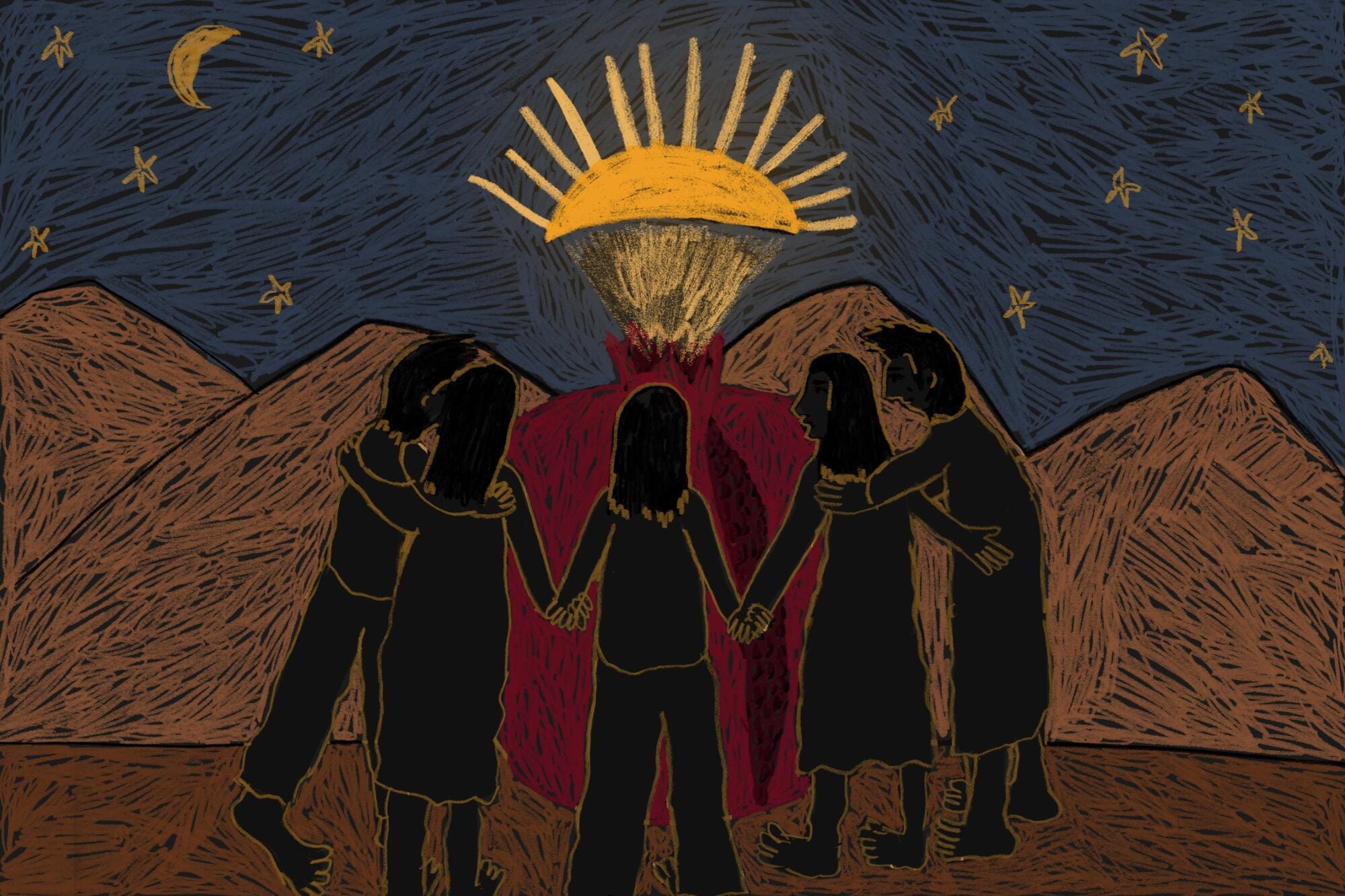
It was in finally returning to the altar within that I could gasp for air. “Wonderful,” I heard Francis say. “You’re stuck? You’re regressing? Wonderful. I wonder where Soul is taking you today.” This is how we are released from the prison of “progress,” from the fixation on forward movement: when Soul brings us to the spot where we must stop and dig. It is not a grave, as our beloved and trustworthy guide Andrea Gibson assured us, it is a den — a den where we can go to do nothing and to name our hopelessness without feeling pressure to “move on.” That is how we find healing, or rather, how healing finds us.
At the grief altar.
We can address it as “stuckness,” but Soul won’t hear us. It doesn’t speak the language of linear progress, rather it dances and meanders like a river bed, carving us over eons of being in relationship with all there is, all there isn’t, all that will be, and all that will be never again.
Grief, too, has a different cadence; it lingers there and interrupts our stories of achievement. We treat it as a pit stop along the race or as a character flaw, something to be overcome. But grief is not an obstacle, rather it is an invitation into becoming, becoming, and all it brings. To become different in ourselves and our senses during this time of the Great Unraveling, the Long Dark. Grief is Soul’s ritual answer to the emptiness of our technocratic solutionism. It is not in the way, it is the way.
Then our wounds can be approached not as a stain on our worthiness, but as a site of revelation. In my grief is also my love and my awe, an eternal connection with the mysteries in which we are held, alongside all other inhabitants of our planet (and beyond). The symphony of beetles and jaguars, ravens and rivers and rocks, the Great Plains and grains of sand, wild strawberries and coral reefs, the dinosaur bones and incalculable stars in the night sky… our companions who show us the ways of undomestication, who don’t abide by our limiting (colonial) models of success and failure. And the bare, bony oak trees before me, who themselves were full of chlorophylled life only months ago. They know the math of life. They’ve listened. And just by staying still, they’ve changed. In the right way, at the right time, in right relationship.
Tutor me
through straining night winds
In the passion of moan and pant
The gift of letting go
At the moment of most abundance
In the way of
falling apples, figs, maple leaves, pecans…
The most poetic notion of grief comes from ecologist Paul Shepard (d. 1996), who said, “The grief and sense of loss that we often attribute to a failure in our personality, is actually a feeling of emptiness where a beautiful and strange otherness should have been encountered.” What “otherness,” you ask? All of it, the symphony of the others, the entire surrounding field we’ve disrupted and eroded and from which we’ve set ourselves apart. And the sobering reality is that this particular grief — Earth grief — is unresolveable because the losses remain too tremendous.
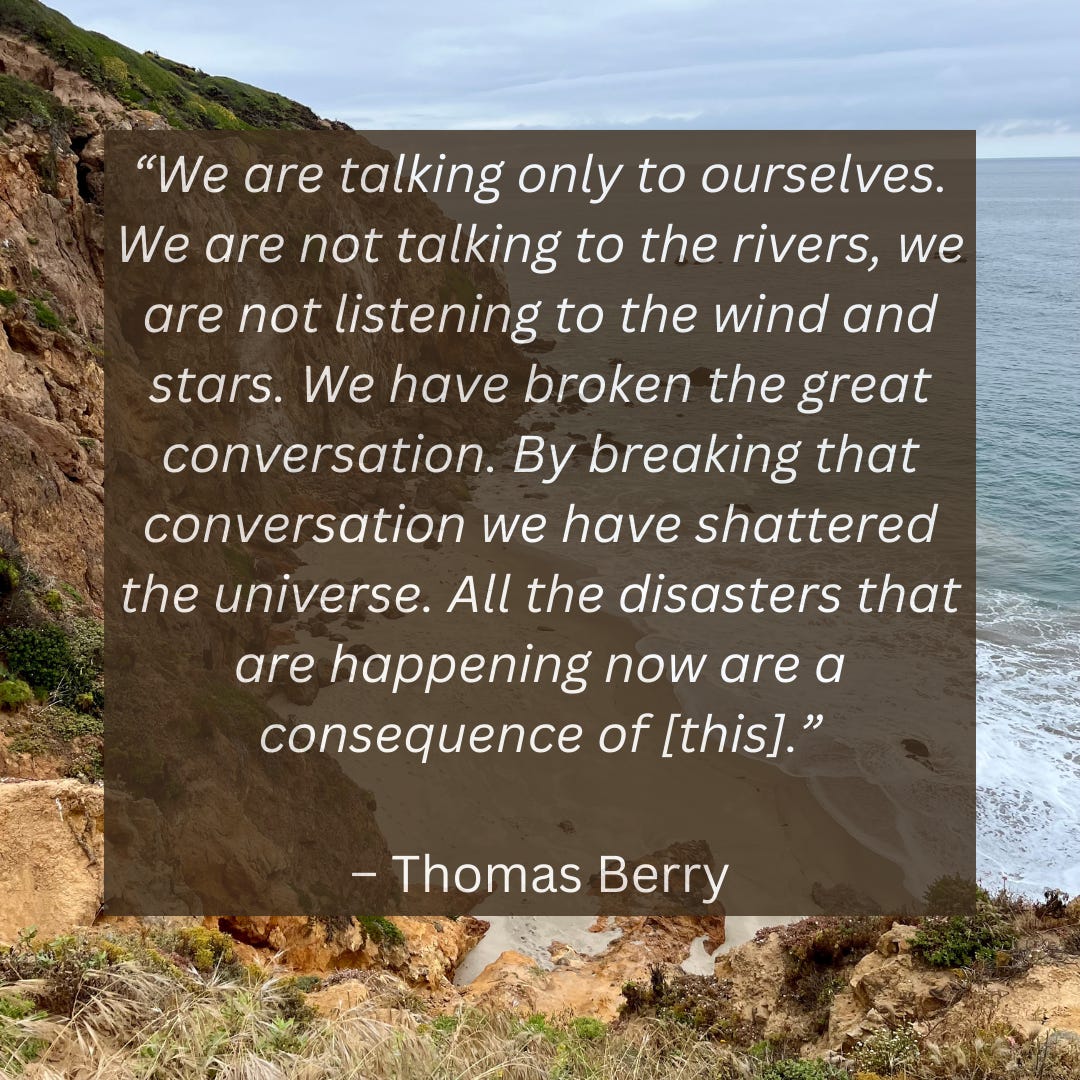
Here is the “difficult grace” in renouncing our strategies of control and becoming more receptive to loss. For the secret life of loss looks something like this: the seed buried in the dark soil underground ceases to exist when it gives way to the flower. It is the same at the winter solstice: the great solar light begins in the pit of darkness. Is loss, then, not also another form of becoming?
There is something Saturnian here. In Hellenistic astrology, Saturn — the farthest planet visible to the human eye — is considered the outermost planet (Uranus, Neptune, and Pluto are not incorporated into ancient techniques), seen as the watcher on the edge of the world, the boundary between the known and unknown. Saturn is the zodiacal elder; its nature is to endure. Cold and dry, it is associated with winter, impermanence, melancholy, longing, and, yes, grief. Saturn evokes a desolate landscape, distant from the loud vibrancy of spring and summer. And yet, it’s here — in the darkness, the quiet place, the monastery — where we can truly contemplate the subtle, the intangible realms, the long arc of time. Saturn signifies not only death, but rebirth, too. Loss is its sacred hymn.
It is no coincidence, then, that melancholy has always been food for the artists, mystics, poets, and imaginative forces of creation. “Melancholy” is defined by sadness or depression but it can also convey a pensiveness, suggesting a contemplative engagement with the feelings. A proximity to pain, to suffering, to sorrow, to grief, has the potential to generate luminous beauty through what we dared to love; art born of devotion. For loss sweetens life. In generous defiance, Saturn makes beauty of bleakness.1 This is the planet that rules Capricorn.
Open my eyes
to your languid light,
let me stare in your face
until I see no difference
between soar and fall,
until I recognize
eternity
in single breaths,
faint whispers of cool air
through lungs…
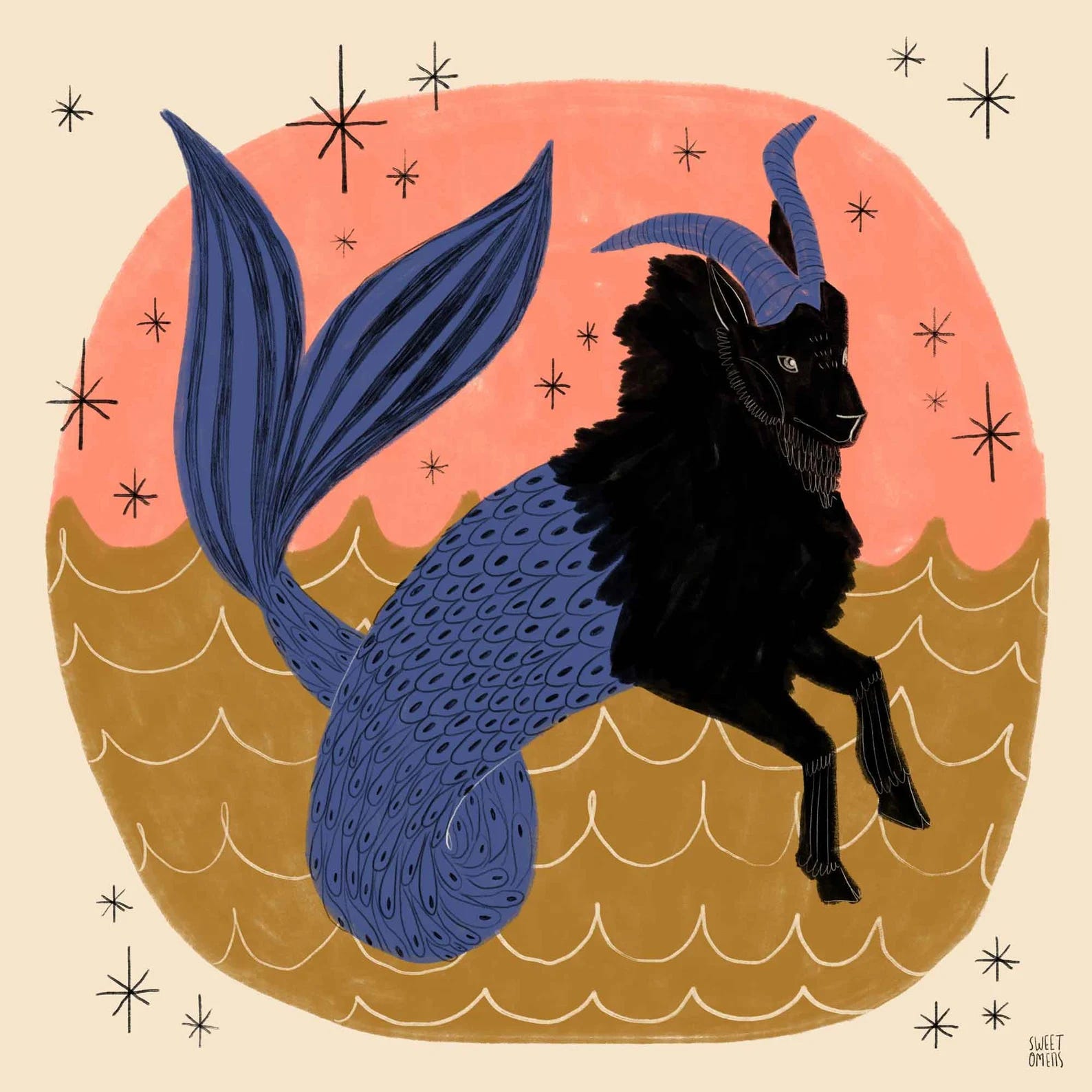
Capricorn, for all its well-earned stereotypes of the no-nonsense, ruthless, earthy mountain goat, is still a deeply imaginative, mythological creature with the tail of a fish, whose watery origins point to the unconscious places that we do not understand, the unknown. The sea goat is fueled by its vision, but the long journey of our lives and how they take shape remains largely an enigma outside of our control; the fish must ultimately surrender to the currents. The wisdom here draws us away from control-based determinism into submission to the mystery. Capricorn’s guardianship at the gates of the winter solstice acknowledges that there is no upwards climb that does not begin as an inexplicable force of fate, no birth into the light that does not first gestate in the bountiful darkness of the womb.
Let us be careful with our intentions as the solar light returns. Our binary systems pit opposites against each other and strive for ascension, efficiency, confidence, victory… “light.” But the darkness is the dwelling place of the sacred, where we come into primal intimacy with the divine. Let us not rush from here, for we need it, not only as a function of survival, but as a site of holiness. Can we reclaim the darkness and become its pilgrims? Speaking about the winter solstice years ago, my astrology teacher, Adam Elenbaas, offered this: “When darkness comes, rather than feeling oppressed, can we see the question mark?”
Show me the way of dying
in glorious boldness
Yellow, gold, orange, rust, red, burgundy.
~~~~~~
Thank you, friends and supporters, for being here and staying here through this long pause while I dug my den and moved in. We’re nearing completion on our construction project (a space for creation, sound, music, ritual, prayer, exchange) and settling into a more sustainable pace, inshallah. I am ecstatic to return here, for, in truth, the words that come through are always the cairns I myself need on the path, reminders to keep going.
Part of this practice, also, involves becoming transparent to each other. Francis Weller speaks about the impossibility of the “I,” the individual, surviving our wounds alone. And yet many of us do, or at least we try to, out of fear of being known or becoming a “burden” in a culture that values hyper-individualization and the privatization of every external and internal resource. I still feel the reverberations of being told I’m too serious, too gloomy, too “negative” for the ways I’ve oriented my whole life — towards the ungraspable, inconvenient, nagging questions, towards the complexities and wounded hearts.
Sometimes, I am indeed too serious and grumpy (Saturn in my first house!). But the sobriety in my work is an act of love, of not turning away, of keeping in focus what the dominating, colonizing forces have marginalized and rendered inappropriate and unworthy of our care. My work is an invitation to bear witness and to feel; to stay awake in a time of incredible numbness, division, and distraction. It asks, “Is it always depression that we feel, or is it also oppression, the weight of a thousand undigested sorrows?” I like “love and light” and active hope, too; I like video games and candy and mascara and pretty dishes and and shopping for Moroccan rugs; I like reality TV cooking shows and dogs in silly outfits; but I don’t like if they drown out the cries of the world, or if they replace an honest assessment of our fears or our relationship to death. I don’t like them at the expense of the dignity and wellness of other humans, animals, and Earth. The “cost” of our choices that I’m interested in understanding is not displayed on the price tag, but silently borne by those we’ve exploited for our comforts. This, too, is an unresolvable grief, for the ways harm is inherent to many systems of our lives.
There’s an immensity being asked of us: how vast can we become in order to respond carefully to what is moving in the field right now? Paradoxically, the invitation I offer here is… nothing. The den. The grief altar. I think of the ever-bewitching words of Nigerian philosopher Báyò Akómoláfé: “These times are urgent, let us slow down.” There is effort, still, to be invested in the deliberate deceleration of our pace through a reverence to our approach. Grief does not ask to be tolerated or take us hostage, it asks us to hold true to it so that we might become ripened and wise. Moreover, as I heard the Guyanese visionary Orland Bishop explain recently, if there is “hope,” it is in our shadow, for nothing external will “save” us. If we can hope to understand our shadow, we might see what is accumulating in our collective and personal unconscious. This, he says, is wisdom.
The scorching doubts and anxieties may linger and each of us will assess our own capabilities and limitations. A compassionate reply is offered again from John Paul Lederach: “Perhaps the only antidote for inadequacy is a grounded humility, this contrarian stillness required to slow to the unfolding of the world through small doses of clarity and essence.”
If there is an intention to be set for the winter solstice, may it be this: to remember that our wounds are the places where Soul beckons, the entryways of our becoming. Seeds of initiation have germinated in this fruitful darkness, and for that, we give thanks. Let us not go alone, for we cannot; we must dare to love — and dare to lose — together. ♥
~~~~~~
The poem I’ve woven throughout is called “Autumn,” by Monza Naff, from her book, Healing the Womanheart (1999). I recommend scrolling through again to re-read the poem in its entirety, start-to-finish.
My enduring gratitude to the wisdom of those from whom I drew my inspiration, ideas, and support for this piece: John Paul Lederach, Francis Weller, Monza Naff, Andrea Gibson, Adam Elebaas, Demetra George, Orland Bishop, Bayo Akomolafe, Joanna Macy, Joan Halifax, Hatim Belyamani, Sun, Moon.
If my work moves you, please help me gain more traction and support by “liking” (press the little heart icon), adding your comments, and/or sharing it with others.
For folks who are interested in the astrology here, I think it’s also worth noting that Saturn is exalted in Libra, the sign of Venus, the planet of beauty.
No posts
Comments
Nothing yet. Say the first thing.
Sign in to join the conversation.