
Originally published by Forbes on April 2, 2026
Thanks for reading Tech and Democracy! This post is public. Feel free to share it.
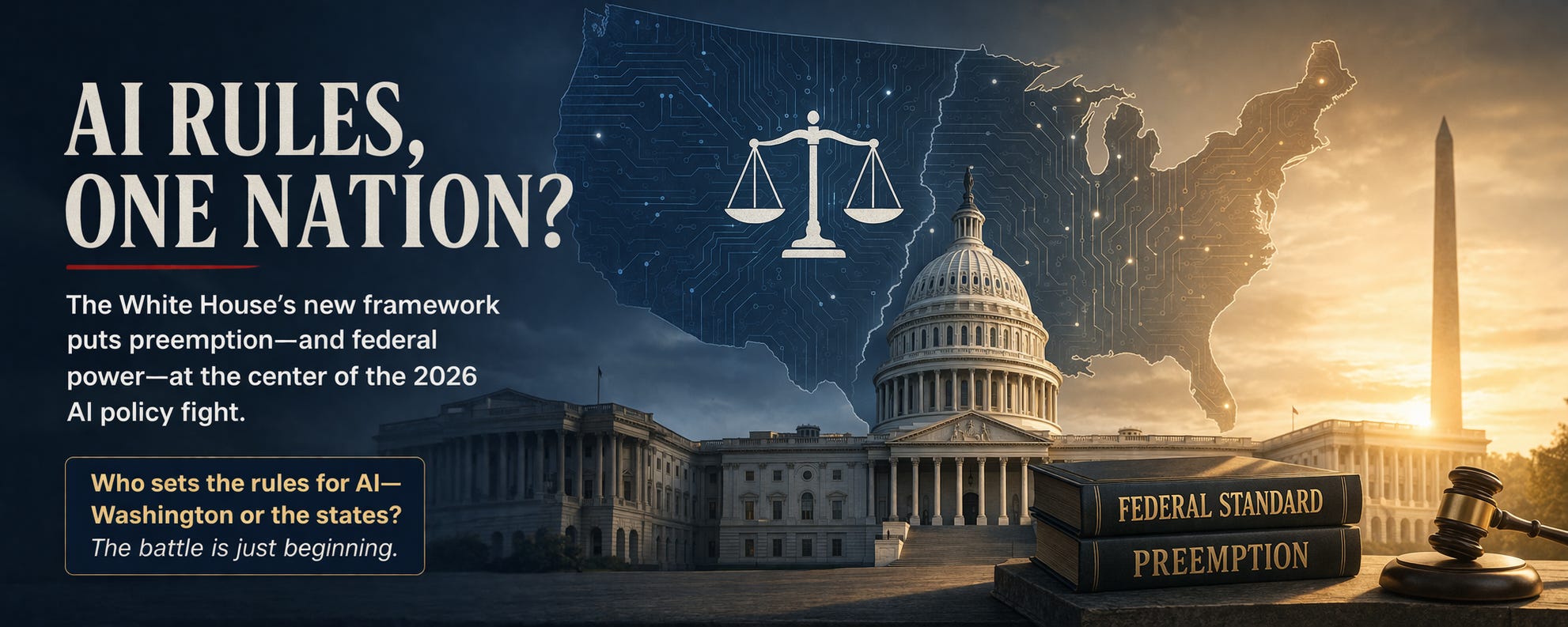
The National Policy Framework is the White House’s clearest signal yet that America’s AI era is entering its political phase. It asks Congress to set one national standard for AI, then preempt the expanding state-by-state patchwork that has grown in the absence of federal law.
Released March 20, 2026, the framework is short by design: four pages, seven priorities and an unmistakable posture. The administration argues that AI development is inherently interstate and tied to national security and competitiveness, so Washington should define the baseline with a federal standard. It also urges Congress to stay short of preempting states from enforcing generally applicable laws, including protections for children and fraud prevention.
For business leaders, the value proposition is clear: uniform rules reduce compliance friction, improve planning confidence and make it easier to invest in model deployment, data centers and workforce change. For the public, the stakes are different. Preemption can either become the on-ramp to durable protections, or it can become a way to thin out accountability at the moment when technology adoption accelerates.
The seven pillars read like a policy outline or statement of intent rather than a draft bill. On children, it calls for age assurance, parental control tools and features that reduce risks of exploitation and self-harm and it warns Congress against “open-ended liability” that could trigger excessive litigation.
On communities, it ties AI scale to energy and infrastructure, calling for ratepayer protection, streamlined permitting and stronger enforcement against AI-enabled scams and fraud. On creators, it takes a careful position on generative AI and copyright, stating the administration’s view that training on copyrighted material does not violate copyright law while leaving the issue to courts because arguments to the contrary exist.
On speech, it centers on First Amendment protections and warns against government coercion of providers to ban, compel or alter content. On innovation, it rejects creating a new AI regulator and leans toward sector-specific oversight, sandboxes and making federal datasets accessible in AI-ready formats. On workforce, it calls for weaving AI training into existing programs and for studying task-level workforce realignment.
The final pillar turns preemption into the framework’s clearest governing tool. It urges Congress to preempt state AI laws deemed unduly burdensome, while preserving state authority over generally applicable laws, zoning and the government’s own use of AI. In doing so, it shifts the center of gravity in AI governance away from the states and toward Washington. States are not waiting. Colorado is reworking its landmark AI law ahead of its delayed 2026 effective date and California has ordered new safeguards for AI vendors seeking state contracts. That puts preemption in direct collision with an active state policy field.
The National Policy Framework does not settle how liability should work, how enforcement should be financed or how federal rules will keep pace with capability jumps as both enterprise adoption and political attention rise. It is an invitation to legislate and a test of whether Congress can transform broad themes into workable rules that hold up in court and markets.
Early reactions suggest that even sympathetic observers see the framework as a starting point rather than a settlement. Supporters praised its pro-innovation posture. Critics on both left and right argued that it is too thin, too ambiguous or too dismissive of state authority and tech accountability. That skepticism is already organizing politically. House Democrats are holding listening sessions with major caucuses, Josh Gottheimer is warning that preemption without a more comprehensive federal standard will face resistance and Senator Maria Cantwell has signaled openness to a federal standard, but only one with enough substance to work.
A more detailed alternative is already circulating: Senator Marsha Blackburn’s TRUMP AMERICA AI Act discussion draft, a 291-page bill that tries to translate themes into enforceable obligations. It pairs preemption with a thick federal standard built from mandates, definitions and enforceable reporting requirements.
The contrast shows up quickly in liability. Title I would impose a duty of care on developers of AI chatbots, requiring “reasonable care” in design, development and operation to prevent and mitigate foreseeable harms, with the Federal Trade Commission empowered to set minimum safeguards and enforce compliance.
The bill also reaches into areas the White House framework leaves deliberately open. It proposes to sunset Section 230, mandates AI-related job effects reporting and lays out multiple frameworks for advanced AI evaluations and creator protections. In effect, it argues that if state laws are going to be displaced, the federal replacement should be concrete.
For executives, the resulting dilemma is practical. A light-touch federal floor might accelerate deployment while pushing disputes into courts. A comprehensive statute might clarify duties faster but raise near-term compliance costs, particularly for firms that deploy third-party models across regulated domains. In both scenarios, the transition period can be the most unstable, because expectations will rise faster than institutions.
It is tempting to frame the National Policy Framework as a narrow federalism fight, but AI governance is increasingly a proxy for older anxieties: trust in institutions, polarization, stalled mobility narratives, loneliness and mental health. In that context, not engaging with the rules of this transition becomes a form of civic recklessness, because the default outcome tends to reflect concentrated power rather than collective consent.
That broader unease is likely to intensify as AI runs into three converging limits: economic, physical and moral. The economic limit emerges as investors and enterprise buyers demand clearer returns. The physical limit appears in the harder constraints of energy, infrastructure and buildout. The moral limit comes into view when questions of judgment, responsibility and human control can no longer be deferred. As AI moves from technical fascination to lived economic and social consequence, those limits will not stay confined to boardrooms or labs. They have migrated into electoral politics, where the fight is less about abstract innovation and more about jobs, prices, community impacts, legitimacy and who gets to decide the boundaries of what we are willing to delegate to machines and to the institutions behind them.
But there is also, as Larry Lessig puts it, an elephant in the room: the corrupting force of money in politics. That matters here because AI preemption will not be decided only in principle. It will be fought through influence, access and organized spending. A $150 million AI lobbying war over preemption indicates that the loudest voices will be the best-funded ones, particularly when statutes are vague and the real contest shifts into implementation and litigation.
A better outcome requires engagement that brings the tradeoffs into the open before they are diluted by election-year bargaining, lobbying pressure and closed-door compromise. Politically, the framework is being cast around four themes: children, creators, censorship and communities, while leaving other issues for later negotiation. That creates a risk that preemption moves first, catalyzed by industry urgency, congressional timing and organized lobbying pressure.
Whether that produces durable governance is another matter. A federal standard still must be strong enough to earn public trust and survive implementation, litigation and electoral turnover. With a compressed legislative calendar, the prospect of attaching any compromise to a must-pass bill and growing AI money already shaping the field, vague statutory language shifts the decisive contest to the period after passage. The National Policy Framework should therefore be treated as the opening salvo in a larger democratic fight over power, accountability and the terms of AI governance, with preemption serving as the beginning of that contest rather than its resolution.
No posts
Comments
Nothing yet. Say the first thing.
Sign in to join the conversation.