
(Note: I read all my pieces out loud for you; I think they’re best that way—but feel free to read instead! And while I do love an em dash, rest assured every post is written by me—a human—not AI.)
Originally published in The Groke Literary Magazine, Issue #1, Winter 2024
“Look, Dan. Our old house is for sale.” My mother tapped her index fingernail on the car window.
In the driver’s seat, my father swiveled his head around. “Well, would you look at that!” he cried.
I wasn’t interested in houses or much of anything really. Draped on the backseat, I had taken off my sandals, stretching the tip of one toe toward my mother in the front seat. The toe barely missed her sleeve. I let my leg thunk to the floor. The long morning with long sermons had made me more sluggish and stupid. Every week was the same; we would drive home and do whatever we usually did on Sunday afternoons. I didn’t care; it was all the same to me.
“The sign says it’s an open house,” my mother said. “Wouldn’t it be fun to go inside and take a peek to see how it’s changed?”
As if in answer, my father pulled the car alongside the curb. No other cars were in sight.
“Hm?” I said, opening one eye. I didn’t know why we had ended up in that part of town; it wasn’t on the way. I let my eyelid fall. “I’ll stay in the car,” I said, a yawn drooping the corners of my mouth. “Riiight here.”
* * *
Standing before the front steps, I didn’t recognize it. And then, like a PR rep rearranging her face before a press conference, my brain slowly assembled the picture—or maybe it was the house itself clicking into place—and there it was.
Our old house.
It looked different though, but I couldn’t tell how, and I didn’t much care. I was cold and tired, and I wanted to lie down again.
“Do you think we should call someone? Let them know we’re coming?” My mother hung her hat on rules.
“I think we’re good,” my father said as my mother’s mauve, kitten-heeled pump clicked on the front step.
At that moment, a steady ticking sound cracked in my brain, as if a clock had invaded the space behind my eyes. Cold panic sank its nails into my skin.
The countdown had started, but I didn’t know to what.
All I knew was that if the timer ran out, something terrible would happen.
I was wide awake now, the tick tick tick pulsing my sternum.
Desperately, I scanned the front yard for movement.
It might come from anywhere…
My attention snapped around the sound, and I felt its birth: the panicked realization that everything before this had been a sleepy lie, and that this crouched, hunted feeling might be the only real thing I’d ever known.
We were too out-in-the-open on the porch.
“I think we should go inside,” I said.
My father pushed on the front door, and it swung open. I shut the door hard behind us and yanked on the deadbolt, the heavy lunk sound of metal hitting wood. Immediately, the ticking stopped, and relief blew through me.
The room was dim and empty except for a few small trinkets on the fireplace mantle, and it smelled faintly of chewing gum and dust. We stood like penitents, paralyzed with holiness. The air felt like both a wedding and a funeral, and it made my bowels tingle. Out of the corner of my eye, I saw my mother finger the silver cross around her neck.
Then, remembering why they had come, my mother’s heels broke the silence as she clicked across the floor to the kitchen.
“They’ve totally redone it!” she gushed, running her hand over the farmhouse sink. “I love it! And this looks like ‘American Beige!’” she said to the cabinets. If my mother knew anything, it was interior paint colors.
“Doesn’t look like an open house to me,” I said.
They swept through the house, clucking over all the improvements: better flooring, top-of-the-line fixtures, and tasteful additions—all in their style.
“I sure do miss this house,” my father said.
“Oh, Dan,” my mother fondled the molding around the door. “Me too.”
This made no sense. My parents had always talked about how moving from this house had been one of the best decisions they’d ever made.
“Dan! Look! It’s your mantle!”
Following the script of manhood, my father had stumbled into woodworking long ago. The result of much grunting and many “dadnabits” was a scrolled, blonde oak mantle he had proudly bolted over the fireplace in the living room.
“It’s a testament to your craftsmanship that it’s still here,” my mother said, her words caressing him.
He gave the mantle a pat as if he were stroking his own leg.
“Beth—this might sound…I don’t know…crazy really,” my father said. “But do you think we should—”
“I know,” she interrupted, once again fingering her cross. “I feel it too. We’ve been faithful to Him, and now, He is giving our house back to us.”
Like an actor in a musical breaking into song, my father raised his hands and proclaimed, “God, we accept this house as a gift of blessing from You. If this is to be, open the door.”
He meant this figuratively of course, but as if in response, the front door swung open. No one was there. Immediately, the ticking began again, each tick a nail in my brain, and I scrambled to close and lock the door.
My parents tittered.
I know I had locked that door.
* * *
It all happened so fast.
He carried her across the threshold, the two of them laughing and bumping around like drunks. I backed into the house behind them, eyes wide and ever shifting across the yard, the ticking pounding through my whole body. I shut and locked the door, and the ticking stopped like a faucet. From then on, I was always checking the outside doors, and more and more, I found them consistently unlocked.
“Folks!” I gesticulated with two fingers toward the doors like a flight attendant. “We really need to be better about making sure the doors around here stay locked!”
And like frequent flyers, they talked on through my speeches.
On top of the improvements, the house was slightly different than I remembered it. For example, I could have sworn my bedroom closet had been closer to the door to the hall instead of to the window. I felt around inside the window wells for the screw holes from my old shutter hinges, but I found nothing. I tried to find any evidence besides the mantle of our having lived in the house before—a curl of old wallpaper, a gouge in the floor, a stick-on earring forgotten in a closet—but I found nothing.
I noticed things starting to creep. I made a list of measurements of where the furniture was in relation to the walls and other furniture. A dresser that might be eight inches from the corner at 10:43 am might be nine and a half inches away by 7:21 pm the next day.
The creeping gave way to seismic shifts. The master bathroom and closet switched places. I discovered an entirely new bedroom in the den closet.
“Can a house do that?” I asked my parents who kept on reading in their newly-discovered sunroom.
One afternoon, while my mother was dusting around the trinkets on the mantel, I asked, “Are you going to take all those strange things down? They’re not ours.” There was a small wooden box, a glass ashtray full of bits of eraser, a snow globe with a blue boy, a brick, a small cushion in the shape of a cloud with pins stuck into it, and a dozen or so brightly-handled children’s scissors stuck in an empty aluminum can.
“You know, I don’t know why but all those things up there give me comfort,” my father said, looking up from his Bible.
“They are funny little things, aren’t they?” My mother rolled her rag around the top of the snow globe. “I don’t have the heart to take them down.”
“Then don’t!” my father laughed. “Let’s just let sleeping dogs lie!” Which I thought was a strange thing to say because I didn’t think it pertained to the situation at all.
Then, we discovered the basement.
“I’ve always wanted a basement!” my mother sang on the stairs.
My father’s voice called from the basement bathroom, “Seek and ye shall find!”
“Don’t you think it’s weird this house never had a basement before, and now, it does?” I asked.
“It’s a kiss from Heaven!” My mother sang as I shadowed her up the stairs.
Gradually, they started spending more and more time at the house, leaving only for provisions and church. I stopped recording the measurements as pieces of furniture shifted all around the house or disappeared entirely. The floor started to feel gummy, and I didn’t like the feeling on my feet, so I floated above it instead. I had been floating for a couple of days before I remembered people don’t usually do that.
I had become even more vigilant about the door locking, but it was getting harder and harder to lock them. My hands were starting to lose their definition, and objects passed through them.
“Bodies are supposed to be solid,” I repeated out loud to myself.
Of course they were—I had nearly forgotten! I had to focus hard on making my hand a hand or else the deadbolt slipped through my fingers. Between all the locking of the doors and the trying to stay solid, I was getting really tired.
At dinner, my parents stood up, holding hands, and leaned their foreheads against the wall next to the dining room table.
“God, this house is our inheritance—our spiritual birthright, and we thank You for it,” my father said, his voice muffled by his mouth’s proximity to the wall.
I wasn’t paying attention to them; I was trying to keep the chair underneath me and the fork in my hand.
My parents stopped leaving the house altogether, and we ran out of food which was a relief to me. I was exhausted by having to stay solid enough to hold food in my mouth and chew. They started spending more time in the basement, curled on the sofas. Eventually, they only came upstairs at “dinnertime” when they would lean their foreheads against the dining room wall, always in the same spots. The parts of the wall with which their foreheads came in contact started to change color, morphing from American Beige to something that looked like a rash. One evening, I noticed several long, straight black hairs growing out of the wall near my mother’s head. Horrified, I studied my parents in profile and noticed their foreheads now stuck into the drywall. They were sinking headfirst into the inside of the inside of the house.
I tried throwing my arms around their waists to pull them back, but I ended up hugging myself as my arms slipped through their bodies.
“No!” I shrieked, but my voice came out high, thin, and whispery like a flute played with too little air. I backed up as far away from them as I could and bumped into the mantel. I turned and raised my hands to touch it—the only thing that had stayed the same—feeling for its realness, but my hands fell through it. Frustrated, I slapped at it, willing myself to become substantial again. Instead, I pushed farther into the fireplace and the wall behind it.
I stopped once I was between the walls.
My parents were lost to me.
I was awake and alone, the realization doubling me over in pain, and that’s when I heard the small clicking of mouth sounds.
I looked up. Between the walls and about ten feet away from me, something glistened.
Relieved not to be alone after all, I instinctively reached out, and my hand rested on the thing instead of falling through it. It was warm and wet, and when I touched it, it gave a great groan as if its heart were breaking.
Its breathing was labored and waterlogged. Its flayed face was turned toward me, crushed into the shape of the space between the walls. Great tears rolled down its twisted cheeks, and I realized the thing was made of meat.
“I sought, and I found,” the thing said.
And then I saw that about a foot away, melted into the wall of flesh so that I couldn’t tell where one started and ended, another face wept.
“It’s our inheritance,” it said through broken teeth.
Then, all their mouths started moving, and they all started to speak at once, and I tore away from them as if I too were drowning.
I watched my parents disappear slowly into the wall.
It could have taken a month or a decade.
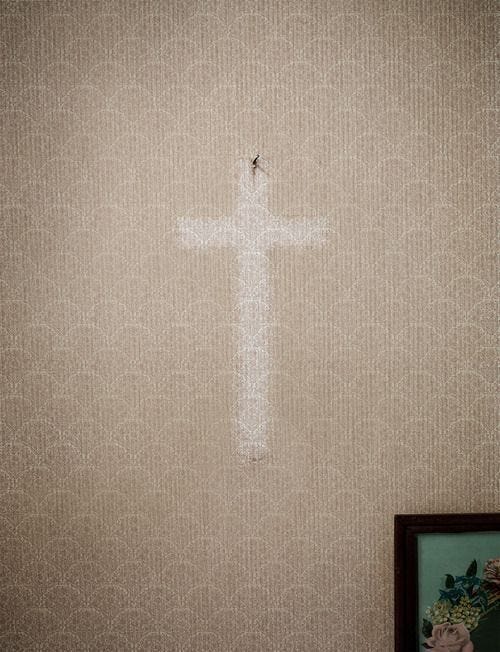
I know where they’ve gone, but I don’t dare go in between the walls near the dining room. I found a silver cross on the mantel next to the snow globe. I never look at it.
I can’t go outside. It might come from anywhere.
I stay away from the doors; my hands can’t lock them anymore.
I hide in the walls near the mantel but as far away from the things as I can get.
But it is starting to be so awfully hard to hold things in my mind when it would be so easy to put them down.
Sometimes, I find myself floating from room to room, wailing, remembering how full I used to be, but not knowing of what.
And I don’t know why I’m crying or what I was doing or who I am at all.
Comments
Nothing yet. Say the first thing.
Sign in to join the conversation.