
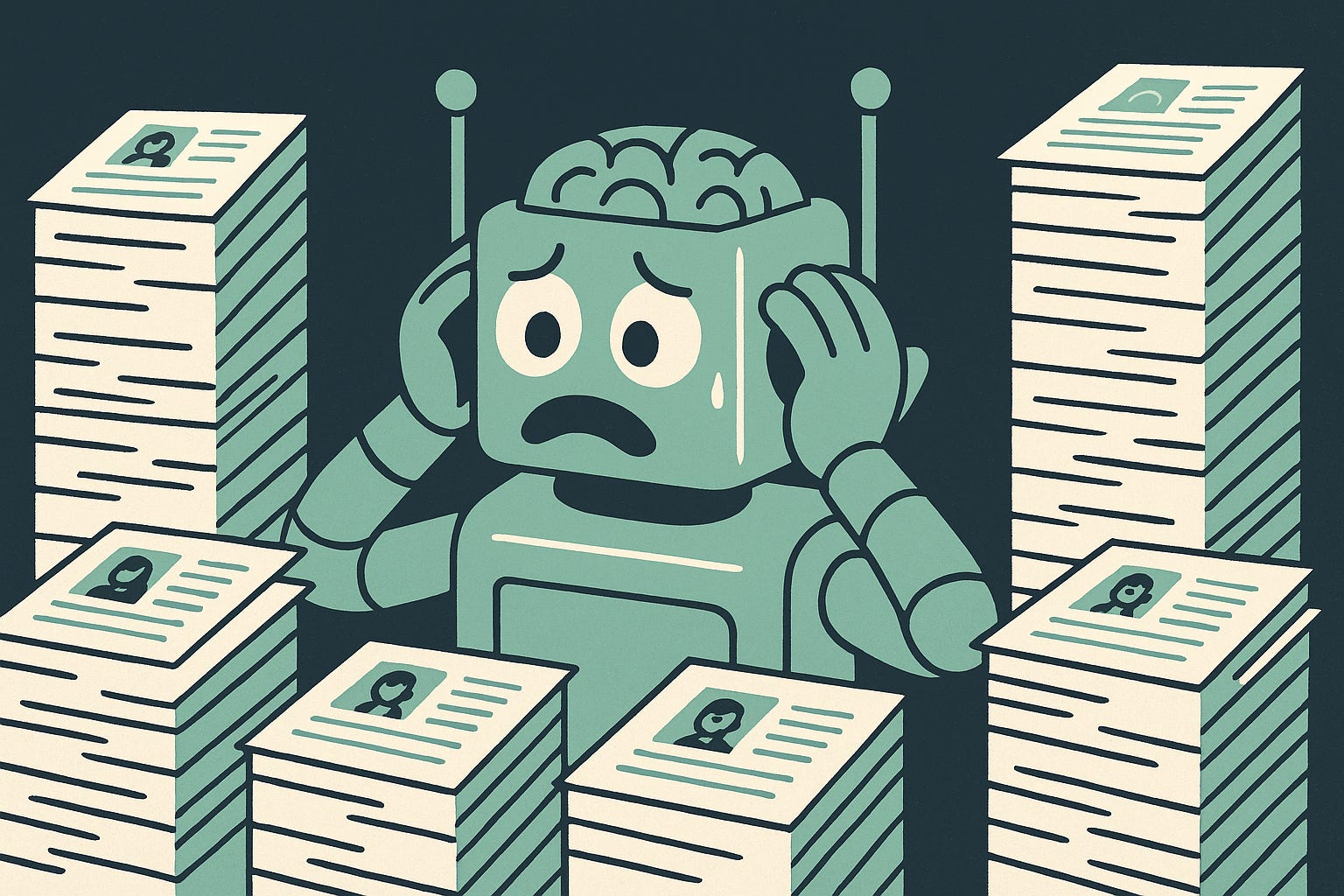
For those of you who aren’t in the know: the current job market is likely the worst we have seen in decades, and the majority of recruiters I know say repeatedly that this is far worse than even the recession in 2008.
We have seen layoffs after layoffs after layoffs in the tech / white collar sector due to tariffs, government instability, and AI. Many government roles and departments have been gutted on a federal level, and non profits are suffering from grant cuts and larger corporations pulling their typical donations.
On top of that, job hunting has become something of an AI minefield.
HR teams and recruiters have long used ATS systems (non-AI software that helps automate managing incoming candidates) to detect whether resumes have all of the required keywords in job descriptions and to rank top candidates.
But now that candidates can ask chatbots like Claude, Gemini, and ChatGPT to optimize their resumes for every job, it’s become impossible for ATS systems and HR managers to differentiate between candidates who are actually a good fit from those who are not.
This has led to a flood of different job hunting websites and apps from brand new startups like my friend Himanshu Laiker’s Mashalot and companies like Indeed partnering with OpenAI to improve their systems.
That said, our current system is broken, and startups, tech giants, and more are on a race to see how people will get jobs in the future.
This has led to a surprising twist.
A few weeks ago, OpenAI announced that they are developing the OpenAI Jobs Platform which is designed to help employers identify their dream talent with top AI skills. Theoretically, participants on this platform will have gotten multiple certificates on OpenAI’s Academy, a free, online learning platform designed to train the next generation on how to master AI tools.
Their ultimate goal appears to be to build a system that helps train the next generation and connect these applicants with their dream employers.
Meanwhile, this past week, Linkedin has updated their latest terms and conditions alerting their users that all of their data on their platform will be used for training their new AI systems unless they decide to opt out ahead of time.
This is a race for who gets to define the future of hiring: LinkedIn, the legacy giant with all the data, or OpenAI, the outsider insurgent trying to rewrite the rules with AI.
While we currently don’t know what these systems will look like, we can make a few assumptions:
First, generative AI systems thrive on pattern recognition and connecting the dots faster and more effectively than humans can.
This means that AI systems would be able to review thousands of documents or applicants in seconds instead of hours, and identify top candidates faster.
Second, these types of systems are great at predictive analysis, but they also are famous for perpetuating existing biases and stereotypes.
For example, researchers recently discovered that 5 leading AI models were advising women and people of color to ask for lower pay in salary negotiations.
Is this happening because AI systems don’t like women or people of color?
No. It’s happening because according to the raw data, women and people of color are statistically more likely to have lower salaries. The AI systems are simply mimicking the patterns of the datasets it has been provided.
Third, generative AI systems are much more likely to identify if certain job skills relate to different skills in different industries or roles.
For example, AI systems would be able to recognize that “Community Management” in nonprofits is essentially the same as “Client Relations” in sales even though they aren’t the exact same keywords.
That said, all of these AI systems can be customizable to a certain extent. Engineers can fine tune their models to try to prevent biases from being perpetuated. They also have the ability to make new hiring systems better than their ATS predecessors.
This is really intriguing to me because to be completely honest, when I'm job hunting I can be a tricky candidate to place.
I have a tremendous amount of skills, I have had a rollercoaster of a career, and many HR reps prefer to promote the "safe" candidate rather than someone who say, used to be a comedian in NYC before serendipitously breaking into venture capital and tech. 😅
ATS systems (and arguably HR) have historically been allergic to me and my resume unless I Frankenstein it to the point where it does not accurately reflect my career.
This causes my job hunting adventures to take longer than average and usually involve extensive social media marketing campaigns, attending dozens of networking events per week, scheduling 50+ calls a week, etc. etc.
It's a lot of work, incredibly time consuming, and challenging to scale.
So the question is, could newly designed AI systems by OpenAI, Linkedin, or a startup we haven’t even heard of transform my experience for the better?
Could that make it easier for hiring teams to find unconventional, intensely creative, but incredibly ambitious job candidates like me?
OR conversely...
Could it perpetuate already existing systems and classify me as a potentially "bad hire" because statistically I get less interviews than people who have followed a narrow yet predictable path?
Honestly, I believe we’ll get both: AI systems that open doors, and others that double down on the status quo due to a lack of vision and creativity for how things could be.
What do I want to see?
I want to see a future where recruiters can write a more fluid prompts that surface talent based on real skills and potential, not arbitrary keywords.
And I want AI systems to spotlight unconventional candidates, the artists turned technologists, the comedians turned founders, who don’t fit the old playbook but could redefine what success looks like.
What do you think?
Will AI hiring systems of the future be able to make our job hunting dreams come true? Will OpenAI overtake Linkedin? Will Linkedin be able to maintain their job hunting dominance? Or will a surprise startup overtake them all?
Let me know in the comments below.
Forget tech support! It’s time for wedding support, with Reverend Shahbaz. The wedding officiant who keeps ceremonies rolling not “loading”. Get hitched with the help of someone who will make it about your love story. Cause who needs one more thing to worry about on their wedding day?
(Sponsored Post)
Swift Start Go’s podcast series is BACK after our month long summer break with a killer episode featuring 6x Emmy Winner and AI Storyteller Extraordinaire Erica Hanna 🎥!!
This is an absolutely phenomenal episode all about AI tools, tricks and truths that can help creatives develop content made by humans, for humans.
Check out the audio version here on Substack or the Youtube video below!
The video resumes we all need to send to defeat LLM hiring systems!
📺 YouTube | 💼 LinkedIn | 📩 Newsletter Archive
You’re receiving this email because you subscribed to my newsletter Swift Start Go which is designed to bridge the gap between AI experts and those just starting on their journey to learn about AI.
No posts
Comments
Nothing yet. Say the first thing.
Sign in to join the conversation.