
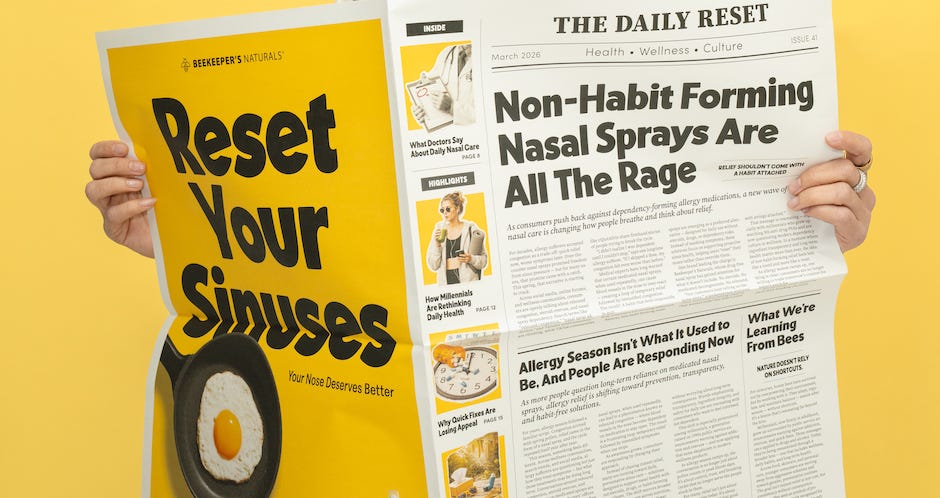
I have a friend whose seasonal allergies are so bad that when she showed me the photo from her scratch test, it looked like a red monster had taken over her entire back. She’s tried every OTC medication on the market. Nothing really works.
She’s not alone. I talk to people about health all day, and seasonal allergies might be the one area where I hear the most universal frustration. Smart, health-conscious people who every spring and fall are completely miserable, popping Zyrtec like candy and getting only the slightest bit of relief.
“I feel like big pharma just hasn’t figured this one out,” my friend Ilan told me recently. I’d amend that a little. I’d say that big pharma has figured out exactly one piece of the puzzle — histamine — and sold it to us as the whole solution.
That gap is what made me want to sit down with Dr. Daniel Clark, an integrative medicine physician on the Beekeeper’s Naturals medical advisory board. I wanted to ask him the questions I keep hearing from friends, readers, and basically everyone I know who dreads pollen season. What’s actually going on when OTC meds don’t work? What does the research say about alternatives? And is there a way to actually address the underlying problem instead of just managing it year after year?
Here’s what he told me.
1. Why do so many people feel like OTC allergy meds just… don’t work? For someone who’s tried everything at the drugstore and still feels miserable, what’s actually going on physiologically. What are they missing?
OTC allergy medications mainly focus on one pathway: histamines. Histamines are a natural compound your immune system produces to trigger inflammation and other symptoms in response to perceived threats. Blocking histamines can alleviate symptoms like itching, sneezing, and watery eyes, but allergic inflammation involves more than just histamine. Other players like leukotrienes, prostaglandins, cytokines, and mast-cell activation are also in the mix. So, if histamine isn’t the main culprit behind someone’s symptoms, antihistamines might not do much. And with ongoing exposure it’s very possible your immune response may evolve into a more complicated, persistent inflammatory state. In either case, antihistamines are just dealing with a fraction of the problem.
Also, for people who have congestion, that’s not just a histamine issue. That stuffy, blocked-nose sensation is mainly caused by vascular swelling and chronic inflammation, rather than histamine itself. This explains why antihistamines can help with sneezing and itching but often do little for nasal congestion unless combined with intranasal anti-inflammatory strategies.
It’s also worth noting that not everything that feels like “allergies” actually is. Conditions like non-allergic rhinitis, mold exposure, air pollution, reflux, hormonal changes, or autonomic dysfunction can all mimic allergic symptoms and won’t respond to antihistamines.
2. Non-drowsy antihistamines sound harmless. Are they? What are the overlooked downsides of taking meds like Claritin, Zyrtec, Allegra every day for months (or years)?
Non-drowsy antihistamines are generally considered safe, and for a lot of folks, they really do provide relief. But just because they’re labeled “safe” doesn’t mean they’re without side effects, especially when taken daily over long periods.
Histamine–the thing these meds are blocking–isn’t just some “allergy chemical.” It’s involved in wakefulness, cognitive function, gut movement, immune responses, and even how we perform during exercise. Blocking these receptors over a long time can subtly disrupt these systems, sometimes leading to fatigue, brain fog, dry eyes, constipation, or a lack of motivation.
If someone finds they need anti-histamines every single day just to get by, it’s usually a good idea to take a step back and consider why their immune system is still on high alert, rather than just continuing to block one pathway indefinitely.
3. Why do habit-forming nasal sprays like Afrin provide such dramatic relief? What’s the biological cost of relying on them? What is rebound congestion, and why is it so hard to break once it starts?
Afrin works wonders not by tackling inflammation, but by cutting off blood flow. Less blood flow means less swelling in the tissues, which leads to suddenly clear airways. It’s a fast fix that’s incredibly effective.
However with repeated use, your body adapts by ramping up its vasodilatory pathways, making it less responsive to the spray. When the effects wear off, the blood vessels can rebound wider than before, leading to even worse congestion. Your nose feels “blocked” until you use the medication again, creating an endless cycle.
Stopping Afrin suddenly means enduring several days of intense congestion while your blood vessels slowly relearn how to regulate themselves. People often relapse because the immediate relief is tempting, while the recovery process is slow and uncomfortable.

4. What alternative approaches to allergy relief do you see your patients having success with? What does the research say about these treatments?
Many patients discover that integrative approaches can provide significant relief, especially when the focus shifts from merely suppressing symptoms to addressing the root causes of allergic inflammation. These methods may not work instantly like flipping a switch, but they often offer longer-lasting benefits.
Intranasal sprays (saline + xylitol + propolis)
These sprays are effective because they target the issue locally rather than systemically.
• Saline helps clear mucus, dilutes allergens, and rehydrates irritated nasal tissues.
• Xylitol seems to reduce the ability of bacteria to stick and form biofilms, which is important since chronic nasal irritation often coincides with a mild microbial imbalance.
• Propolis boasts antimicrobial, antioxidant, and mast-cell-stabilizing properties, potentially helping to reduce local inflammatory signals in the nasal mucosa.
Plausible mechanism:
A lower allergen load, a healthier epithelial barrier, and reduced mast cell activation. In simpler terms, there are fewer triggers affecting a calmer surface.
What the research suggests:
Saline irrigation is well-supported for treating allergic rhinitis. While the evidence for xylitol and propolis is smaller, it’s growing, showing their antimicrobial and anti-inflammatory effects, especially for chronic or recurring nasal symptoms. The strength of this approach lies in its biological plausibility and consistent clinical responses, even if large randomized controlled trials are still limited.
Oral supplements like quercetin, bromelain, propolis, and nettle leafThese can be particularly effective for those dealing with systemic allergic reactions rather than just localized symptoms.
• Quercetin acts as a stabilizer for mast cells and helps to curb histamine release.
• Bromelain might enhance the absorption of flavonoids and has its own
anti-inflammatory properties.
• Propolis aids in immune modulation and boosts antioxidant defenses.
• Nettle leaf offers mild antihistamine and anti-inflammatory effects, with some evidence suggesting it can alleviate symptoms of allergic rhinitis.
Plausible mechanism:
Rather than just blocking histamine after it’s released, these compounds work by reducing mast-cell degranulation and inflammatory signaling earlier in the process, which helps to lessen the overall allergic response.
These solutions won’t completely eliminate allergies, but they can significantly reduce immune overreactions, tissue irritation, and the burden of exposure. When used consistently and with intention, they can often change the allergic landscape itself, not just mask the symptoms on the surface.
5. Is there any evidence that local honey helps with allergies? How about local bee pollen?
The evidence for local honey or bee pollen helping seasonal allergies is mixed. Human studies overall show minimal improvement in allergy symptoms during pollen season; some show small benefits, others no difference. Animal studies are more promising, suggesting reduced mast cell activation and a dampened allergic response, but it’s unclear how well this translates to humans.
Most studies are also short-term, so the idea that long-term exposure to local allergens might “train” the immune system remains theoretical. Anecdotally, many people report improvement, though it’s uncertain whether this reflects immune tolerance, mild anti-inflammatory effects, mast cell stabilization, or placebo.
Honestly, there is better evidence for the integrated, natural solutions like propolis quercetin, bromelain etc. I suggested above than there is for local honey.
6. Do HEPA air filters help with seasonal allergies-or is it just expensive peace of mind? If so, what are some best practices for using these for allergies?
HEPA air filters can be a game-changer for seasonal allergies, but it’s all about choosing and using them the right way.
Best practices for allergy relief
• Keep them running continuously during allergy season (not just when you start sneezing)
• Focus on bedrooms: getting 8 hours of cleaner air can make a big difference
• Keep windows shut when pollen counts are high
• Change the filters regularly (clogged filters can really hurt performance)
Key specs to look for
• True HEPA (H13 or equivalent): captures at least 99.97% of particles that are 0.3 microns or larger
• Right room coverage: make sure the unit fits the size of your space
• High CADR rating (Clean Air Delivery Rate) – the higher, the quicker the air gets cleaned
• Quiet low-speed operation: makes it easier to use them around the clock, especially at night
What they won’t do
They won’t solve problems like outdoor exposure, nasal inflammation, or immune issues all by themselves. But when used as part of a comprehensive approach, they can be really beneficial, especially for those who find their symptoms get worse indoors.
7. Why do allergies often show up early in life? Can kids outgrow them? Are kids more responsive to certain interventions than adults, and are there things we should avoid doing too early?
Allergies often show up early in life because the immune system is still figuring out what’s harmful and what’s not. Many kids outgrow their allergies. As their immune systems mature and learn to tolerate more, symptoms can fade or even vanish, especially with food allergies and some seasonal ones. However, if they keep being exposed to allergens and inflammation continues, it can “lock in” those allergic responses, making them tougher to change later on.
Interventions that cut down on exposure, support barrier health, and promote immune tolerance tend to work better when kids are younger, rather than after years of chronic inflammation.
What tends to help early on:
- Supporting healthy gut and airway barriers
- Reducing the load of allergens instead of just treating symptoms
- Avoiding unnecessary antibiotics and excessive use of antiseptics when possible
- Allowing safe exposure to microbes and the environment to help train the immune system
What to be cautious about:
- Relying too much on daily medications that just suppress symptoms without reevaluating
- Over-sanitizing environments during crucial immune-training years
- Treating every runny nose as a problem instead of a part of immune development
8. What’s your opinion of allergy shots? Given the time investment, are they worth the payoff?
Allergy shots are one of the few treatments that can actually change the course of allergic disease instead of just managing the symptoms.
These shots work by gradually retraining your immune system through controlled exposure to specific allergens. However, there’s a tradeoff: you’ll need to commit to weekly build-up injections followed by monthly maintenance for 3 to 5 years. That’s a significant time investment, and the results aren’t immediate. You typically start to notice benefits after several months, not just a few weeks.
These shots tend to be most beneficial for individuals with moderate to severe allergies, clear triggers, poor responses to medications, or those who experience side effects from their meds. For those with mild or occasional symptoms, the effort often doesn’t seem worth it.

Dr. Daniel Clark is a licensed Naturopathic Doctor with a focus on regenerative and integrative medicine. He’s also a member of the Beekeeper’s Naturals Medical Advisory Board.
Comments
Nothing yet. Say the first thing.
Sign in to join the conversation.