
You may have seen a lot of chatter on your social feeds over the past few days and weeks about Driscoll’s berries contributing to childhood cancer. There’s a lot of alarm over this. The urgency is definitely warranted, but I want to cut through the noise and confusion and give people some clarity.
Why Is This Blowing up?
First, last spring, California launched a first-of-its-kind pesticide notification system called SprayDays. If you live near farmland, you can sign up to get a text before carcinogenic fumigants are sprayed near your home or school. Over 4,300 residents in berry-growing counties including Monterey, Santa Cruz, and Ventura, have enrolled in the past year, and this March, the state published its first annual report, which drew a fresh wave of media attention. Thousands of parents are now living with these alerts as a regular part of their week.
Then last month, the Real Organic Podcast aired an episode featuring Omar Dieguez, who did a 30-day hunger strike in Watsonville (Driscoll’s headquarters) to push for buffer zones between pesticide spraying and schools. The clips took off on TikTok and Instagram.
Finally, the Driscoll’s name is getting people’s attention. Everyone knows them. Driscoll’s supplies roughly a third of the berries sold in America. But the concern is bigger than one company. It’s about a specific class of chemicals called fumigants being used at industrial scale across American agriculture.
Are Berries Giving My Child Cancer?
An EWG analysis found that a non-organic strawberry contains residues from an average of 8 different pesticides. They are the most pesticide-contaminated crops you can eat. So, if you can, you should definitely be buying organic strawberries, which a Mamavation analysis found to be pesticide residue free.
But the panic on social surrounding Driscoll’s berries actually doesn’t have anything to do with the pesticides that end up on the company’s fruit. It’s about the chemicals they spray in their soil, a particular class of agricultural chemicals called fumigants.
What are fumigants, and why should you care?
When you hear “pesticide,” you probably think of something sprayed on a plant. Glyphosate (the active ingredient in Roundup) works that way. It’s absorbed through leaves and kills the plant. Fumigants are a different animal entirely. Think of it more like bug-bombing your house, except it’s an open field. Farmers inject liquid chemicals into the soil before planting. That liquid converts to gas, spreads through the soil, and kills everything including fungi, bacteria, nematodes, weed seeds etc.
The two primary fumigants used on strawberry farms are 1,3-dichloropropene (1,3-D) and chloropicrin. The EPA classifies 1,3-D as a likely human carcinogen. It’s banned in 40 countries. Chloropicrin was originally deployed as a chemical weapon in World War I. California strawberry farms alone use more than 9 million pounds of fumigants statewide, with roughly 80% of all pesticide weight on strawberries coming from fumigants.
And strawberries are just one crop. Fumigants are also used on potatoes, tomatoes, tobacco, cotton, sugar beets, peppers, and nursery stock with over 160 million pounds applied annually across 1,275 counties.
The critical difference between fumigants and something like glyphosate is that fumigants are gases. They volatilize out of the soil and drift through the air, sometimes for miles.
Fumigants and Childhood Cancer
One of the things concerning people is that Santa Cruz County (the heart of Driscoll’s growing region) has one of the highest childhood cancer rates in California. It’s 38% above the state average. While it’s true that the sample size is small enough that this stat is not super reliable, it is more reliable when you consider the other data. Research from the University of Idaho and University of Northern Arizona found that cancer incidence correlated more strongly with fumigants in vegetable/fruit-producing areas than with herbicides in grain-producing areas.
Find Out If Fumigants Are Sprayed In Your County
I asked my team at Beekeeper’s Naturals to put together an interactive map, using publicly available data, of where fumigants are used most in America. Use the map below to find out if your county is one of them.
LA county, where I live, is one of the highest in the country. Yikes.
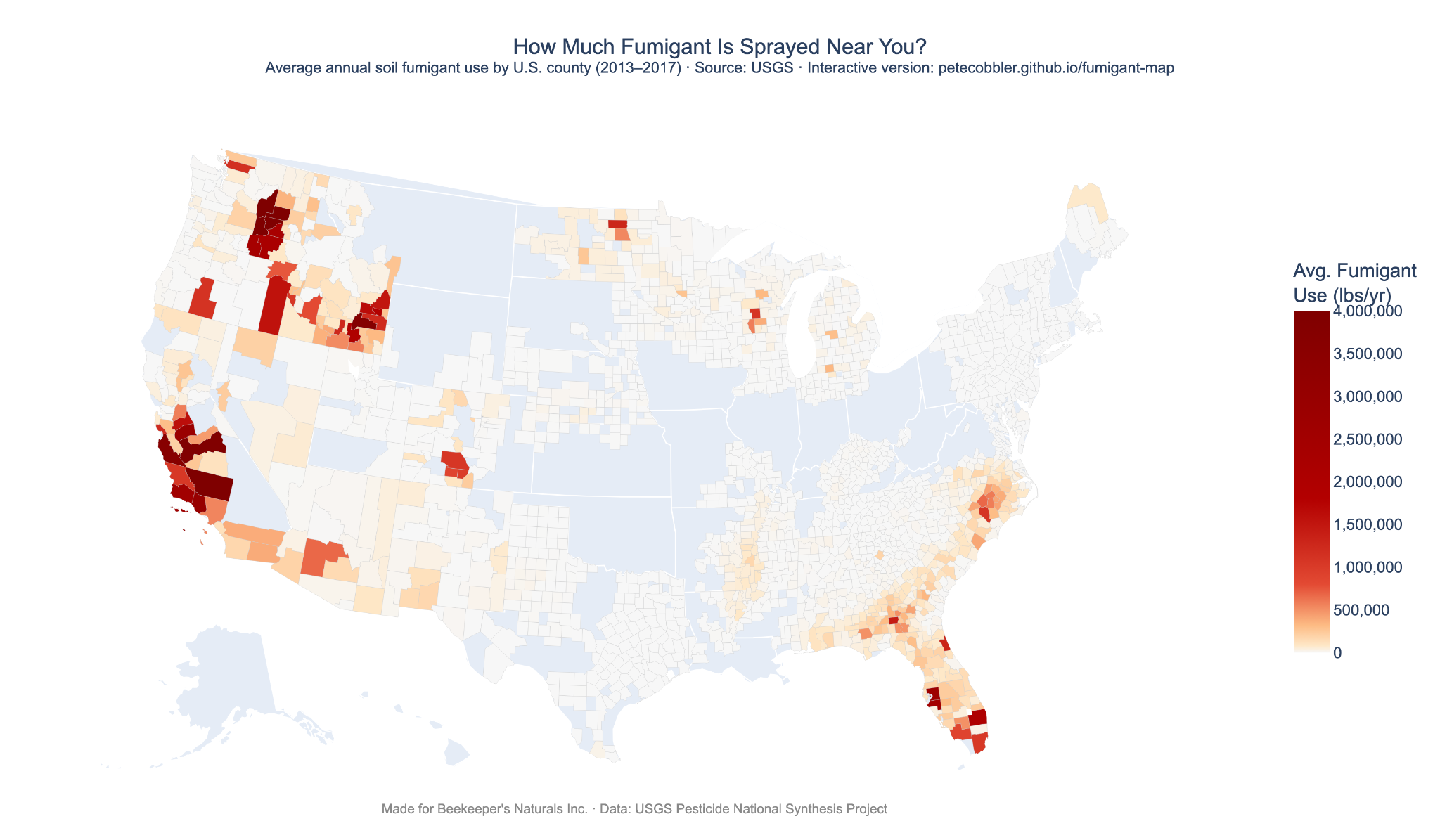
Explore the interactive version here!
What to do
If you live in a fumigant-spraying county:
If you’re in California, sign up for SprayDays alerts.
Close windows during spray events—fumigants are airborne, and that’s the primary exposure route.
Reverse osmosis water filtration is worth having in areas with sandy soil, though air is the bigger concern for fumigants.
Advocate locally! The biggest reason this story broke through is a California law that forced transparency. SprayDays exists because the state required it — not because the industry volunteered. That kind of change starts with your county board of supervisors, your state legislature, your local parent groups. Push for spray notification systems in your state, buffer zones around schools, and public pesticide-use reporting.
If you’re not in a fumigant-spraying county:
Eat organic when you can. I know price (particularly these days) makes this difficult for a lot of people. But organic farming doesn’t use fumigants. The thing is, though, that Driscoll’s is the largest producer of organic berries. While they don’t use fumigants on their organic berries, we still want to show Driscoll’s that their inorganic practices are not okay. Buy locally and seasonally when you can. Summer is approaching, which makes this easier. Local farmers, even inorganic ones, tend to have better pesticide practices.
The Farm Bill just passed the House, where a bipartisan 280-142 vote stripped provisions that would have shielded pesticide companies from state lawsuits. The Senate drafts its version next and there is talk about putting these shields back in. Tell your Senator to keep them out.
A Note About Fumigants and Bees
Those who read me regularly know I’m always concerned about the bees. There is little research about the effects of fumigants on bees. Here’s something that bothers me. Over 70% of native bee species in the US are ground-nesting. Fumigants are designed to turn soil into a gas chamber that kills every living thing in it. And yet there is virtually no research on what fumigation does to ground-nesting bee populations. But the studies we do have on soil pesticides and ground-nesting bees (using neonicotinoids, not fumigants) are ugly. Squash bees exposed to treated soil initiated 85% fewer nests and produced 89% fewer offspring. A 2025 Science paper called this a major regulatory blind spot: risk assessments use honeybees as the test species, and honeybees don’t nest in soil.
We need more research, but what’s out there suggests that fumigants are harming wild bees quite a bit
A Note About the Interactive Map
The data is from 2013-2017, which is the latest available data. Later this year, the USGS is expected to publish data from 2017-2024. We will update this tool when that data is published, but we don’t expect it to change drastically from the older data.
This map is for educational purposes only. It may contain some minor errors that could have occurred during data aggregation and processing.
Sources for this article:
Real Organic Podcast: Omar Dieguez hunger strike episode
Interactive fumigant map (built from USGS data)
Lookout Santa Cruz: Dr. Valerie Bengal on pediatric cancer rates
UCLA Fielding School of Public Health: Childhood brain tumors and maternal pesticide exposure
Nature Health: Pesticide mixtures and cancer risk in Peru
USC Keck Medicine: Fruits, vegetables, and early-onset lung cancer
Mamavation: PFAS and pesticide testing of Driscoll’s strawberries
Comments
Nothing yet. Say the first thing.
Sign in to join the conversation.