
My daughter is only just four, so officially not yet school age but unschooling for me has required a fair amount of effort upfront in order to make sure she has a community of like-minded families and children around her as she starts to express a desire for friends.
I fell in love with the idea of unschooling when my daughter was nine months old, the husband and family got on board after seeing how it was working out for us (very, very grateful to have such a supportive husband and in-laws!) and all of our life choices have been influenced by this decision ever since. Who works, how much, when and where, where we live, how we spend our time and importantly who we get to know and spend time with.
Most of my mum friends are choosing or have already chosen the school route, so I knew I’d have to get out there and mum date to find us a community. I didn’t want Dolores to suddenly find herself without friends at five.
It’s happened throughout her childhood so far. Friends I spent a lot of time with in the early days I see less of now because they work full-time and their kids are in nursery. The next wave was the start of preschool at three and soon the last remaining will be off to school.
So the past two years have been a balance of living our lives and working as usual whilst also trying to build a community of people choosing to educate their children in a similar way.
Home ed is gaining popularity but to find people are who are choosing a more self-directed approach over simply schooling at home can be a challenge. And to find fellow nature focused screen free ‘unschoolers’ is fairly rare. We don’t need our community to be doing things the exact same way but it can be reaffirming to find those doing things similarly.
Here’s the thing. We are more like cave people now than we like to think. Back in the day, we HAD to stick with our clan, we had to make the choices they did, we had to keep absolutely in line. Because otherwise we’d be sent away.
If we were quirky and weird (puts hand up) or made a decision that no one else in the clan agreed with we’d be sent away from the cave, their warming fire and the community that literally kept us alive.
We are STILL evolved to care very much what the people around us think. We are still primed to make choices that all of society approves of.
If you are considering a different life for your family but feeling hesitant or scared, it’s because you are intelligently evolved!
But you really must find a new fire and a clan who can be with you while you make brave choices. People who will cheerlead you in this phase of re-imagining learning for your family. People who will support your questioning of School Fixated Society. - Lucy Disco, newsletter entitled - it’s not hard b/c you are broken - it’s hard b/c you are a cave woman
If you’re not familiar with the term ‘unschooling’ it can sound like doing nothing but in fact it involves a huge amount of work, mostly on my own conditioning. I have been doing and will continue to do a huge amount of unlearning, deconditioning and reprioritising in order to make this way of life work for us all.
Two books which have supported my vision and helped me to remember that simply living life and spending much of it outdoors is all children need are the absolutely beautiful book Homegrown by Benn Hewitt bought for me by my husband a few years ago and Balanced and Barefoot written by occupational therapist, Angela J. Hanscom.
Homegrown tells of the life of a family living rurally and raising their two boys without formal education of any kind. Their boys live the kinds of lives all humans once lived and so few (in the industrialised West get to anymore) and he outlines how much they learn and how they are thriving without any formal teaching.
Balanced and Barefoot has the professional backing of an occupational therapist who runs the outdoor based TimberNook program which uses extended outdoor play for development. Her figures on how much time children of all ages (even into the teenage years) need to spend in unstructured active free play outdoors is eye opening. It’s hours and hours. How many children get access to that? How many of our lives allow us to facilitate this?
When you’re choosing to do something that goes against the societal grain, it’s important to have the right people around you and to have conviction. But I have found even with both of these things in place it can be easy to question our choices. Particularly as we have so few examples of this way of doing things available in our everyday lives.
When I get behind a cause I can be quite (very) stubborn which helps but I think something that’s made it a little easier for us as a family is that my husband and I are both well practiced at going against the grain.
I was painfully shy, wore glasses and loved animals and books (when all of the girls at school were printing off pictures of Brad Pritt in the computer room for their dorms, I was printing off pictures of afghan hounds). My husband and I were both part of the alternative ‘cliques’ at school and went on to tour in alternative bands. We chose to leave the security of employed work to follow our passions in the very insecure realms of self-employment. I birthed my baby at home and a decade ago we moved from bricks and mortar into a caravan so that we could afford to step off of the treadmill and raise our daughter without daycare.
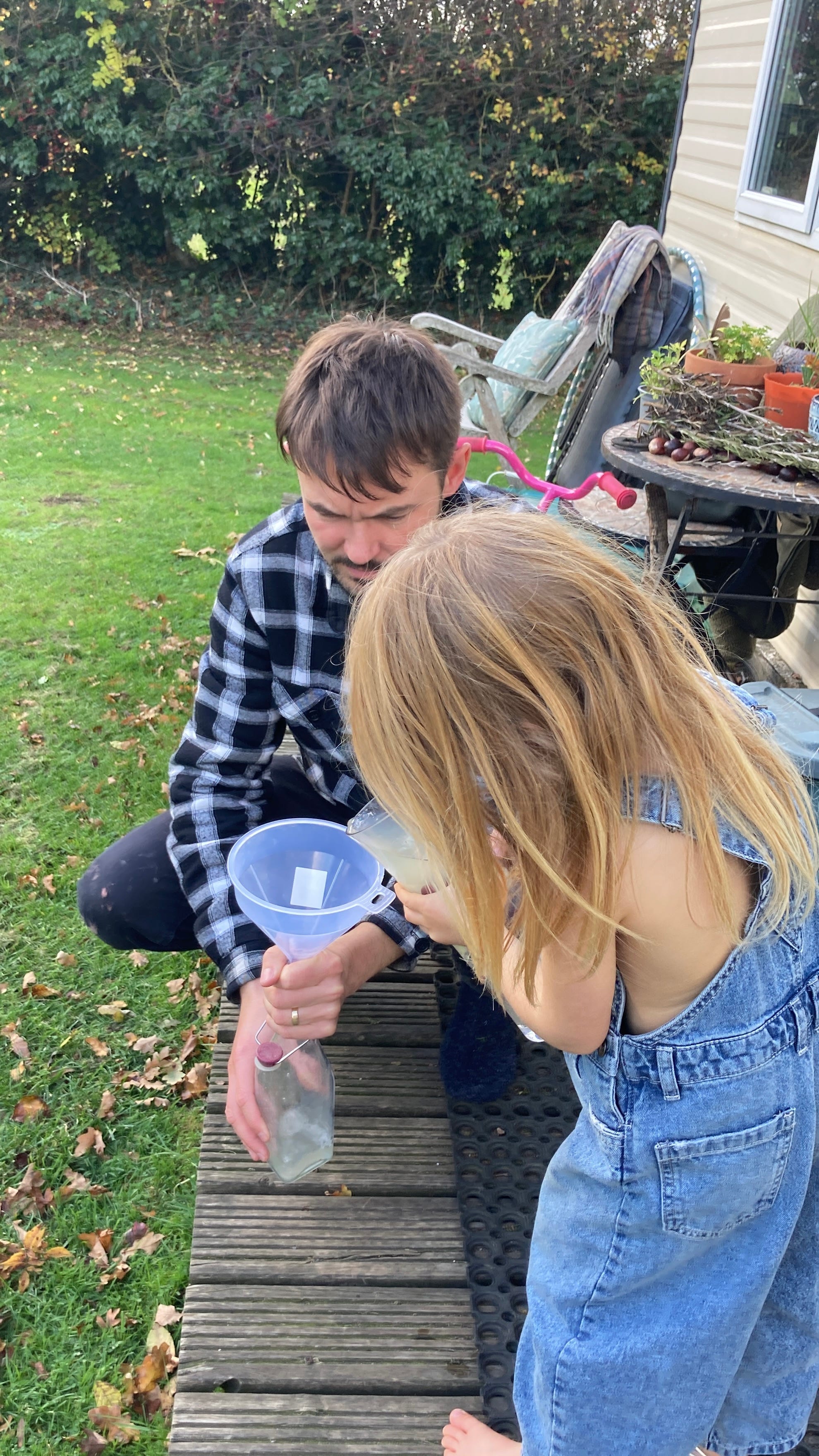
Yet even with all of this in place I still struggle some days to feel secure in our decisions. I imagine if you send your kids to school, it’s easier to feel at ease because even if you’re not sure whether it’s working out for your family, it’s what you’re ‘meant’ to be doing. One less pressure to feel.
One freezing cold midwinter’s day on the farm after my daughter had begged me to stay indoors and I had somehow reluctantly encouraged her out to feed the alpacas and she then proceeded to spend much of the morning screaming. Leaving me questioning what I’m doing.
I immediately convinced myself that she’d be better off at nursery and that I’m making terrible decisions. I flagellated me for my selfishness and felt awful.
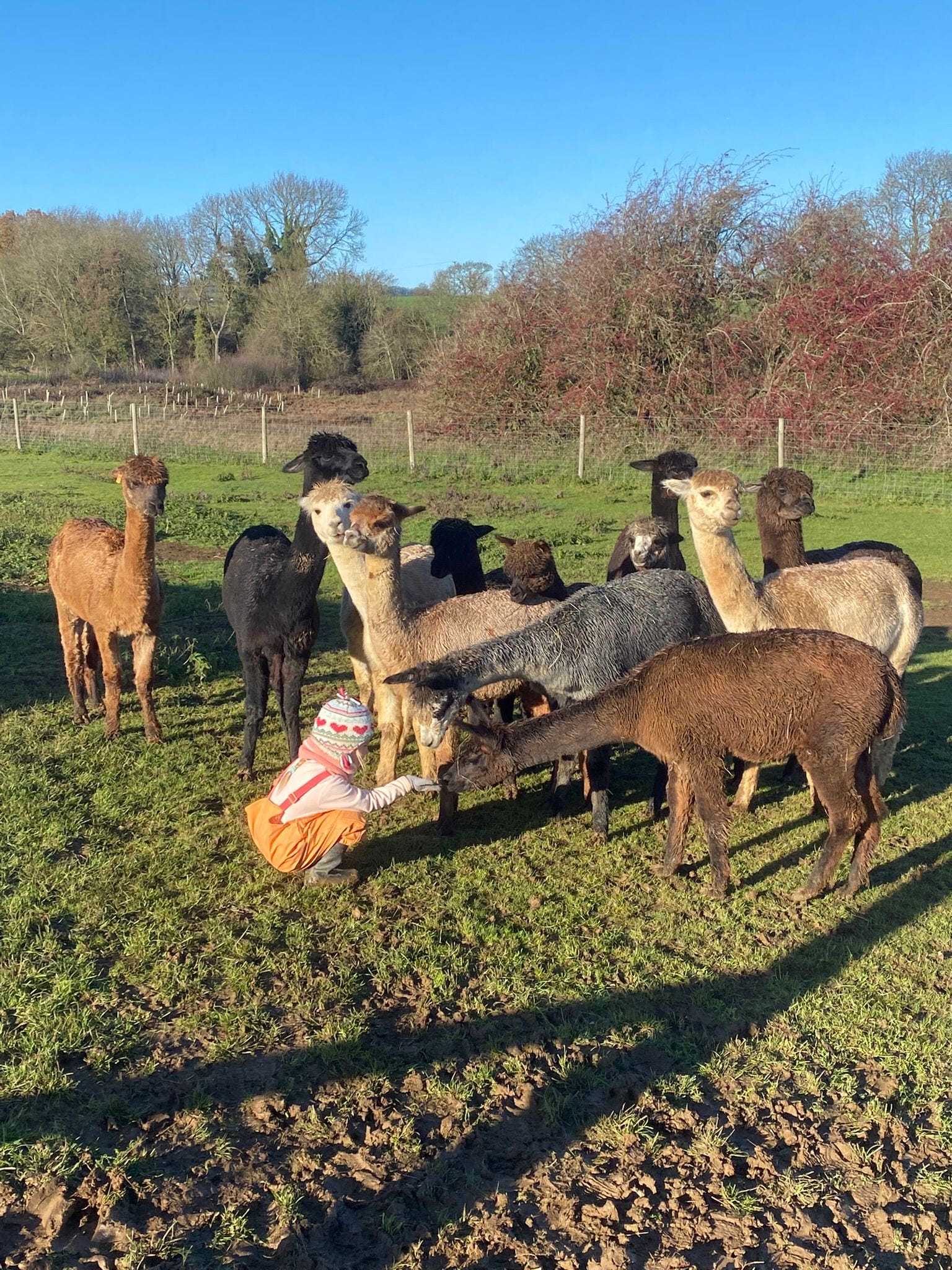
Then an hour later she’s happy as Larry, smashing ice puddles, chatting to her favourite alpacas and poo picking (honestly she loves it).
A totally normal fluctuation in emotions that in any other setting I wouldn’t think anything of but as a working mum with my daughter in tow it makes me second guess myself. (I also wouldn’t have it any other way. I want to be constantly questioning our choices and assessing their impact on my daughter and our family as a whole.)
When I’m feeling more confident and secure in our decisions I remind myself how incredibly modern it is for children to be away from their parents. It’s so easy to forget that for the majority of human history children have been beside their parents, engaged in meaningful work (and play!) and centred in the community. Work often took place in or near to the home and children were involved in it all, whether helping out or playing nearby.
This is now considered neglectful and irresponsible but I am certain that in many situations it would not be. Of course not all professions or situations within a profession allow for children to be present and it wouldn’t be appropriate in all cases. Our insurer wouldn’t love me taking my daughter out on an alpaca walk with customers, so she has to stay back with Amy, my husband or her grandma when we offer those. But general farming work has always involved our children and still does the world over. And I believe it is an absolutely beautiful way for children to grow up offering a huge array of educational and developmental opportunities.
As the weather improves and my daughter once more leaves the house with me of her own volition (thank goodness!), she reminds me that choosing to live this way isn’t just about what’s good for me. It’s good for her too. Last week after a long hard cold spell we were out working in the fields together and she suddenly proclaims ‘it’s so nice living and working on a farm’. On another of the days whilst scrubbing troughs with some of our volunteers, she said to me so sincerely, ‘thank you so much for giving me this work’.
She proudly tells anyone she meets that she ‘works’ on an alpaca farm and she’s not wrong. She does. She has real jobs and real responsibilities. I’ve gradually worked her up from helping me with the hay and poo picking to being responsible for feeding one of our paddocks of weanling male alpacas. She absolutely beams with pride as she walks into the paddock with her bucket of feed and if any adults try to follow her in she firmly tells them to leave her to it.
She has her own wheelbarrow (it was hard to find a real working one her size, hit me up if you’re looking!) and poo picker and her favourite jobs are ‘doing the scoops’ (of feed), ‘mucking out’ and trough cleaning.
Earlier this week I was finished and exhausted by 3:30pm and she begged me to go and do two more barrows of mucking out. How could I say no to that?! At the weekend she was farming with her two besties and fully managed their tasks and responsibilities, shouting out commands and handing out scrubbing brushes.
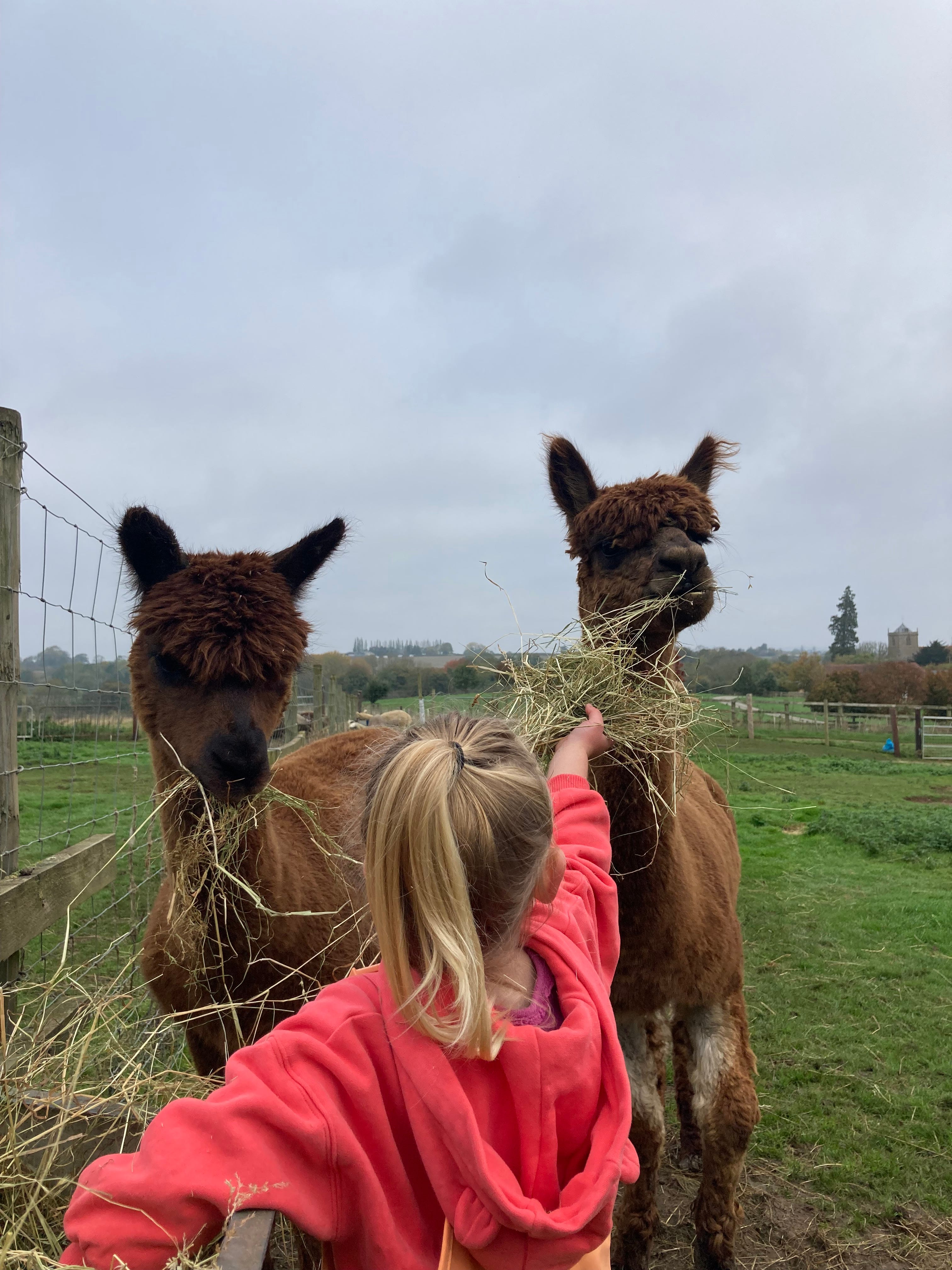
Being small and without much autonomy must be mightily hard and I believe these moments of autonomous responsibility do a huge amount for their self-esteem and wellbeing. I notice a significant change in her behaviour and moods when we spend our time in this way.
We were at the park the other day and she turned to me bemused and asked why the children were asking their parents if they could do things. It made me smile. It’s not that we don’t have boundaries and rules but we’ve tried to give her responsibility and autonomy too.
Without me being able to work, it would be significantly harder for us to choose this path. Her being a part of my working life is important but it is also very good for us both. My workaholic tendencies are tempered and she must learn that there is work to be done and what it means to be responsible.
One of the areas I’ve been challenged by is the laptop element of my work. We are a no/low screens family. We don’t watch TV, she doesn’t have access to a screen or watch any screens but we do need laptops for our work.
I was very grateful to read the incredible book Hunt, Gather, Parent by Michaeleen Doucleff when my daughter was six months old (with a much needed reread when she hit toddlerdom). Michaeleen was role modelling a modern way of working with our kids in tow. And another only child at that. She took her three year old with her on a research trip around the world and then wrote the book with her kid by her side.
So I started occasionally writing with my daughter by my side and I was so heartened by her response. The first day I did this she asked me what I was doing and when I said I was writing she said: ‘so is that your job a bit like Chris’ job is drawing those funny men on horses with his pencil?’.
For context, Chris is one of our good friends and he illustrates comics such as Batman for a living. An important aspect of unschooling for me is to expose her to lots of different kinds of work so we went into Chris’ studio when I was over visiting my friend Laura and she got to see his recent project. I hadn’t explained that this was his work I’d simply walked her in, she’d seen him drawing and connected the dots.
It’s not always easy working and parenting at the same time. It’s a delicate balance. Some days we stay home and I am in homemaker mode, cleaning, baking, cooking and making and she’s pottering, totally immersed in her fantasy world. Other days I have work to do and she needs me 100% and I have to surrender to the fact that it’s not going to happen.
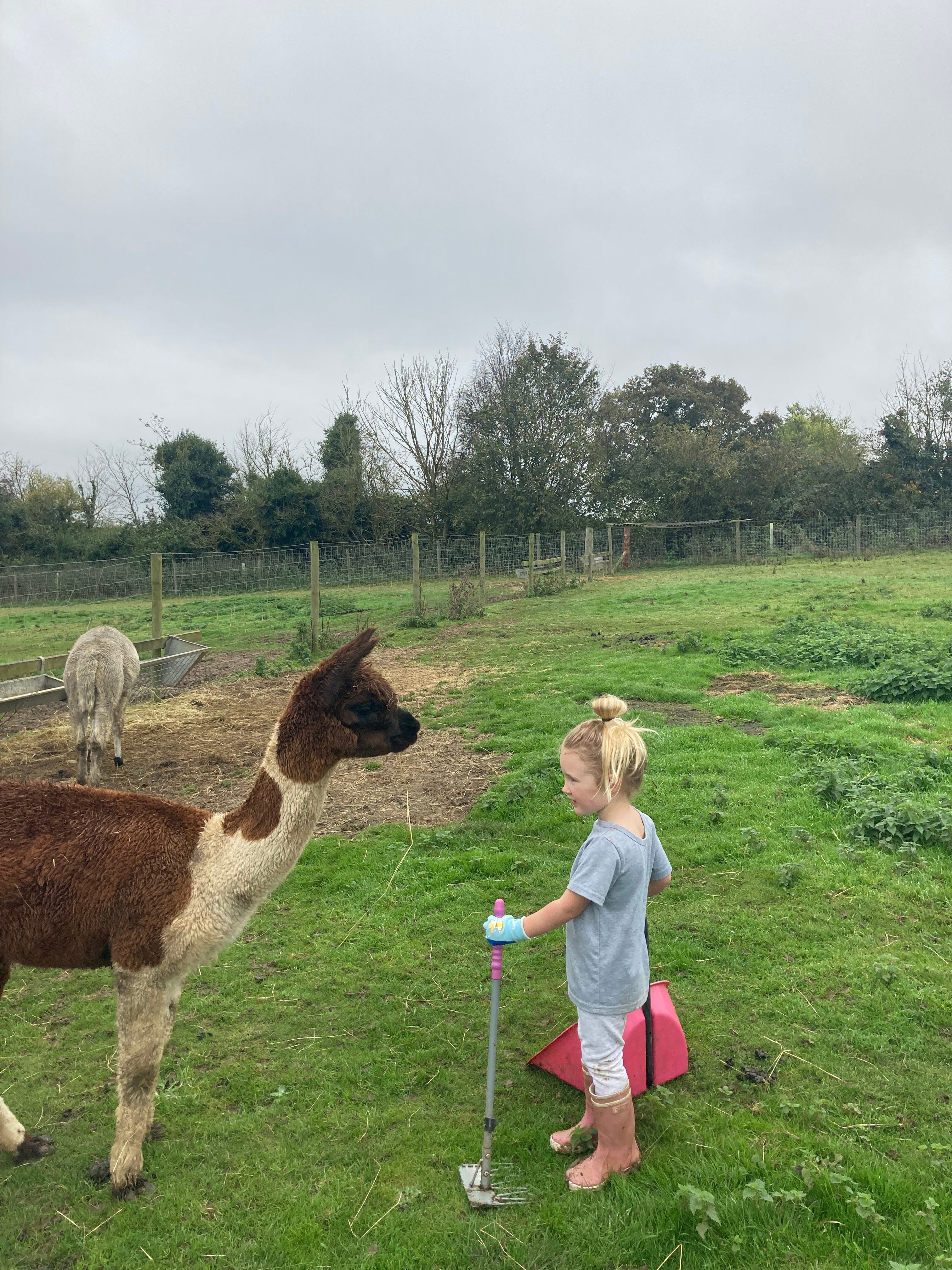
In order to obtain a healthy balance of my life and our life, a huge part of my work as a mother is scheduling. I am constantly looking ahead to ensure that amidst my work and our home life that we are also seeing our home ed friends, maintaining friendships with our school going friends, attending groups and exploring interests.
A friend of mine recently expressed to me that she couldn’t see herself having kids the way our culture expects us to but that she’d happily have them if she could send them off as a pack from morning til night playing freely together whilst she got on with her work. This is now considered neglect despite being the way we’ve raised our children since time immemorial.
I absolutely adored the book ‘The Idle Parent’ by Tom Hodgkinson. It reminded me that by allowing my daughter to be I am doing a good turn by her. Even though everything in our culture tells us otherwise.
Our culture’s approach to children’s lives is so unbelievably managed that I rarely see children being allowed to do a single thing without an adult having something to say about it.
Manifesto of the idle parent
We reject the idea that parenting requires hard work
We pledge to leave our children alone
That should mean that they leave us alone, too
We reject the rampant consumerism that invades children from the moment they are born
We read them poetry and fantastic stories without morals
We drink alcohol without guilt
We reject the inner Puritan
We fill the house with music and laughter
We don’t waste money on family days out and holidays
We lie in bed for as long as possible
We try not to interfere
We push them into the garden and shut the door so that we can clean the house
We both work as little as possible, particularly when the kids are small
Time is more important than money
Happy mess is better than miserable tidiness
Down with school
We fill the house with music and merriment
- Tom Hodgkinson
We are encouraged to be completely child-centred and yet our approach is so rarely child-led. Our lives are meant to revolve around kids groups and soft play and birthday parties and yet children are rarely free to play for longer than a few minutes at a time and usually in some structured activity (at best) or in front of a screen (at worst).
And when you consider the hours and hours of active free play a day that children need to learn and develop mentally, physically, emotionally, intellectually, creatively and socially it’s strange how little time our society offers it.
I really want to stress that I see this as a cultural, societal and structural issue not a failing on parents. Many of us had kids and then suddenly realised the whole world is not set up to support our vision of parenting at all. We then find ourselves simply trying to survive in the best way we can.
I found the months eight to twelve of my daughter’s life incredibly challenging. The first part was hard but I felt fulfilled alongside the stressed. I had only the home and my baby to think of. And then all of a sudden my maternity pay ended and I was expected to do it all and to spend huge portions of the day alone with my baby and my rapidly deteriorating mind.
We choose this unschooling life because it allows us to enjoy parenting and after being separated from my daughter whilst I recovered from a mental health crisis, I value our togetherness so highly that we are rarely apart. I adore her company and couldn’t imagine us doing this another way. At four she has never been in the care of anyone beyond our immediate family and very close chosen family.
Our unschooling life is not particularly child-centred. Most of the time we do our lives and bring our daughter along with us. We do the odd bit of soft play and other kid based things but often find it quite unbearable and her behaviour pretty dire through overwhelm.
I was heartened to read about children simply being included in life as the main way of parenting across many different traditional cultures around the world in Hunt, Gather Parent. There were a whole variety of approaches and nuances but all of the cultures emphasised togetherness, autonomy and minimal interference with children involved in all parts of family life with real roles and responsibilities. This sits in total contrast to our culture’s separation, control and intense interference approach to parenting. An approach that I personally cannot tolerate in any way. It is both painful to me and also unbearably boring and stressful. Directing and managing my daughter’s play seems utterly alien.
In these traditional cultures children are often the centre of attention and adored by their communities yet the lives of others do not revolve around them. In our culture we are mostly parenting in isolation in our little boxes separated from any real sense of community and being asked to give our children complete undivided attention from dusk til dawn. This is unrealistic and totally unprecedented in terms of our human history. Of course school is appealing and ubiquitous.
Our unschooling life is an attempt to get a little closer to times of old when children ran free and communities were strong. Instead of booking onto lots of different groups I spend my time nurturing relationships. I am trying to be a better villager. To give back as I have so gratefully received. To share food and resources and time. To help where I can.
The decision to unschool has fundamentally changed the course of our lives for the better.
Carly x
No posts
Comments
Nothing yet. Say the first thing.
Sign in to join the conversation.