
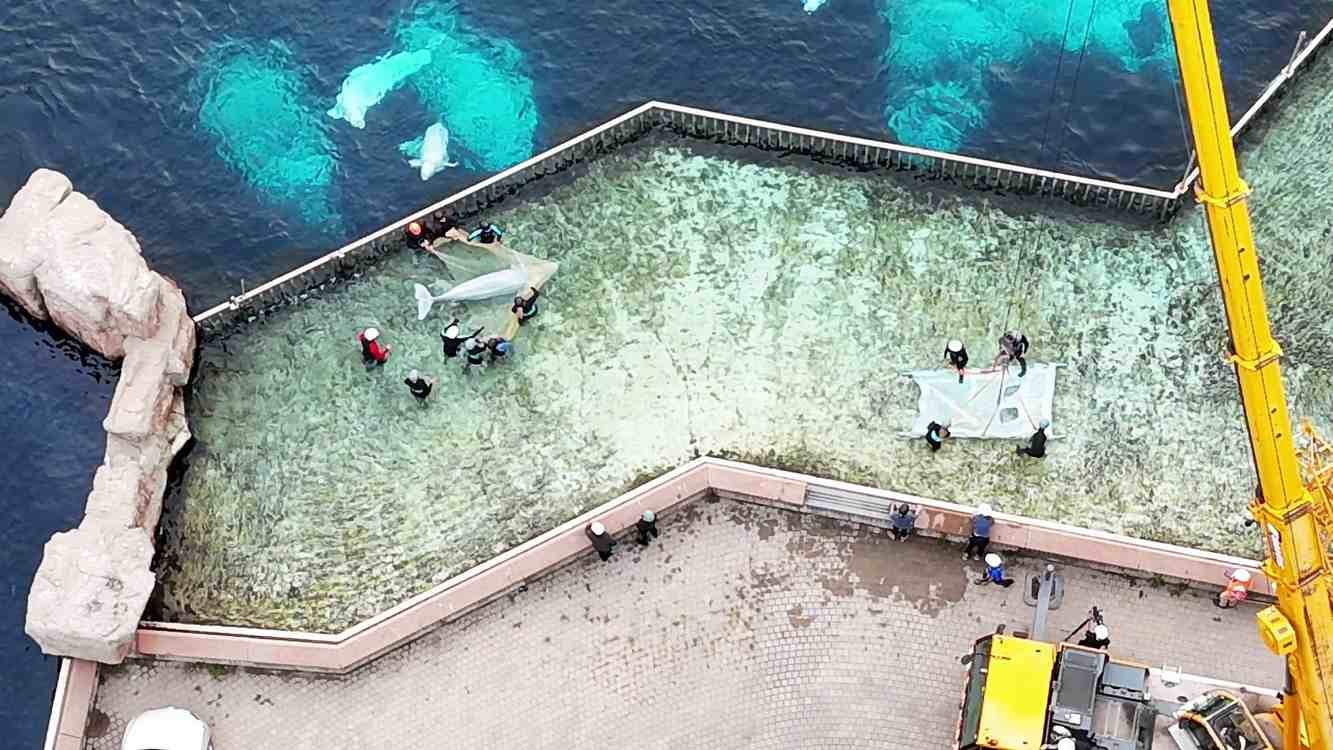
The translocation operation – credit, Tidebreakers via SWNS
Four more beluga whales finally left the empty tanks of a closed Canadian theme park and traveled to Shedd Aquarium in Chicago. This is the biggest captive whale relocation ever attempted.
Thirty belugas once held at Marineland Canada near Niagara Falls spent two years after the park closed in summer 2024 confined to small pools with little stimulation, swimming endless circles. They became the focus of a political and media storm and faced the real threat of euthanasia when the facility ran out of money to care for them.
The story goes back further. Many of these whales were taken from Russian waters, and ended up at Marineland, kept in cramped enclosures on inadequate diets, and used for shows until many died there. The park went up for sale in early 2023 and shut down by late summer 2024. Provincial records show that since 2019, twenty whales, nineteen belugas, and one killer whale died in Marineland Canada’s tanks. These grim statistics highlight the harsh reality faced by marine mammals used for entertainment in captivity and accentuate the acute need for greater awareness of the suffering of cetaceans in marine parks, as well as the global pressures to reduce the number of cetaceans in captivity worldwide.
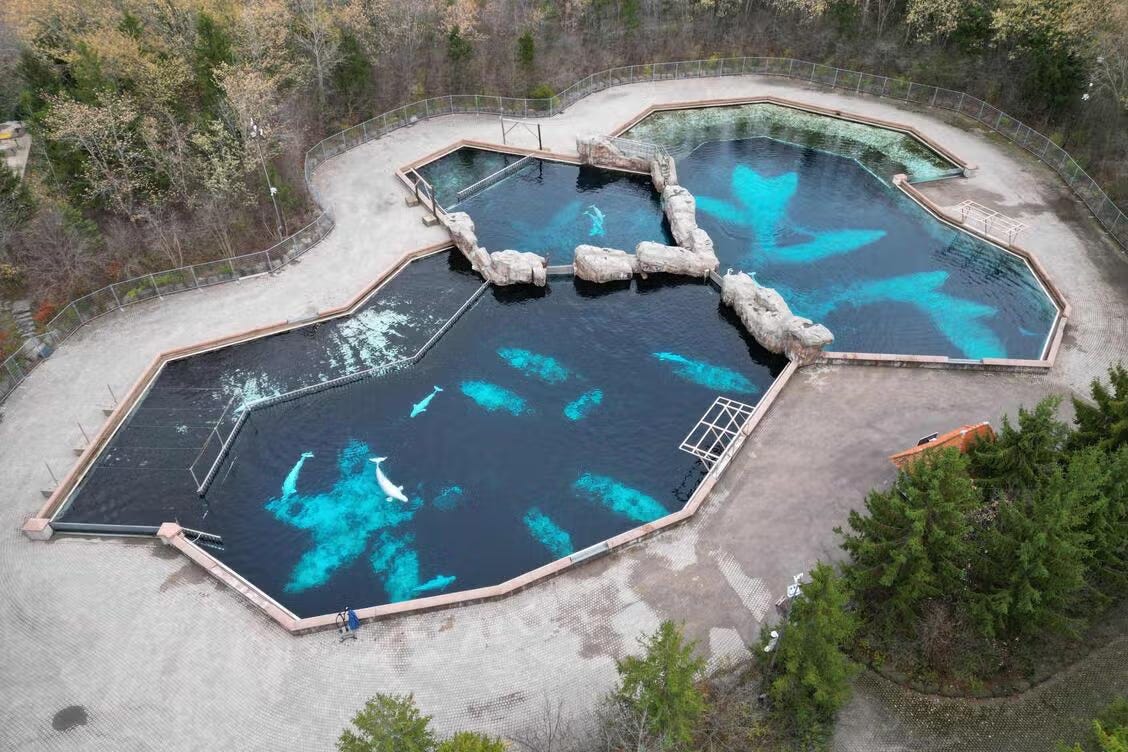
The thirty surviving beluga whales, kept at Marineland Canada near Niagara Falls, had been confined for two years in their small pools, swimming in circles the entire time; while there was a failed attempt to move the whales to China, the threat of euthanasia overshadowed their existence.
A previous plan to ship the surviving cetaceans to China was rejected by the Canadian government. The Ontario government finally closed the park after years of accusations, investigations, and court cases. In July 2026, teams began moving the thirty remaining belugas to accredited aquariums in the United States and Spain.
Months earlier, specialists arrived, met with the last caretakers, reviewed health records, and planned every detail.
“This is a very complex and unprecedented rescue effort. This has never been done before,” said Charlie Jacobsma, director of animal behavior and training at Shedd Aquarium. The challenge was not only the distance but the careful work needed for each animal.
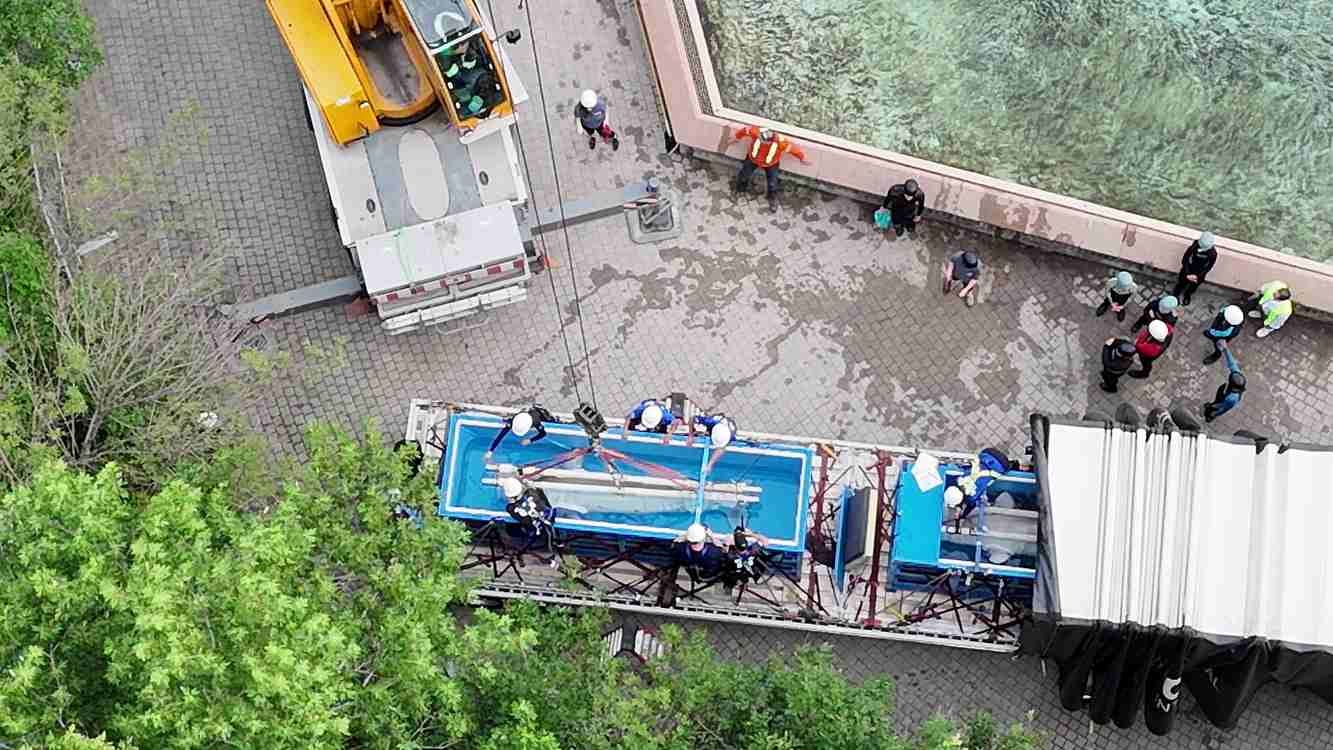
The translocation operation – credit, Tidebreakers via SWNS
Each whale was gently lifted into a custom sling and settled into a temperature-controlled container on a cargo jet, with a veterinarian riding alongside to keep them calm and to monitor them throughout the flight. Caspian, Peekachu, Rain and Secord are the latest to leave Marineland’s deserted pools. They followed four others who made the same journey in July. Shedd staff say there may be room for six more, but right now attention is on these four. The females, aged 27, 26 and 21, had formed a close group, what experts call a sub-pod.
‘‘We are watching closely for the rescued belugas to eat a full diet, socialize with one another, and investigate the habitat, which are encouraging signs of their progress,” Jacobsma said.
These belugas are part of a major rescue effort to give Marineland’s last surviving captive whales a second chance. Their arrival is not just about relocating animals; it is an emotional moment in the larger story of how humans exploit marine life for profit and the toll of suffering that results.
Inside the aquarium, the urgency of rescue gives way to the slow, careful work of helping the belugas adjust. Introductions to resident whales unfold through gates, a cautious ritual where caretakers watch for the first signs of trust. Now, the newcomers share the water with three established belugas, exchanging soft vocalizations and subtle movements, the earliest hints of connection in a species whose lives revolve around social bonds.
“Belugas are very social animals,” Jacobsma said. “It was really special to see some of our animals pairing up with these new companions.” At the same time, Dr. Karisa Tang, Shedd’s lead veterinarian, highlights the constant care. All belugas are watched around the clock. Caretakers track everything from what they eat to how they interact, looking for small signs, such as how easily they swim or even a tiny bruise, to see how they are adjusting.
“Every single day it is an absolute joy to work with belugas,” Tang said, adding that there is “something about them that seems magical.” Their expressive faces and unique personalities make working with them a privilege for the veterinary staff. In the end, these animals are not staying in just one place. They are being moved as part of a plan that includes five major marine parks: Shedd Aquarium in Chicago, Georgia Aquarium in Atlanta, SeaWorld in San Antonio and San Diego, and Oceanogràfic Valencia.
Their rescue does not signal the end of the story, but it should signal the end of capturing wild cetaceans for captivity, and should mark a step toward something greater: a world where captive cetaceans may one day swim freely in the open waters of the Whale Sanctuary Project in Nova Scotia, a vision that is still developing along the Atlantic coast.
Ideally, these whales should never have been captured for captivity in the first place, nor should they be sent to other facilities as a solution. Instead, they should be taken to an open-sea sanctuary, where they are surrounded not by walls, but by the vast ocean. This sanctuary would offer them the best chance at rehabilitation, allowing them to reclaim an oceanic way of life in preparation for experiencing freedom in this final chapter of their lives, as seen in the many success stories of rehabilitated orcas, dolphins, and whales becoming free and wild once again.
by
Carlita Shaw
Coming out soon in 2026: Multidimensional Nature
📘 (2015)The Silent Ecocide: The Environmental Crisis is a Crisis of Human Consciousness
📘 (2020) Surviving Depression in a Depressing World: An Ecological Perspective
📘 The Silent Ecocide Redux (2024 updated edition) → Paperback | Kindle
This Newsletter is entirely reader-supported, allowing me to investigate stories that mainstream media rarely covers, ranging from wildlife conservation and environmental science to consciousness, ancient knowledge, and the implications of the current state of the planet for the future of humanity and the creatures we share this beautiful blue-green planet with. Your support helps fund independent research, field investigations, and the time needed to produce in-depth, evidence-based articles free from corporate influence.
Supporters receive: in-depth subscriber-exclusive investigations, early access to podcast guest question requests, and the hidden archives not seen on the public newsletter website. A vast library of evergreen articles and new books, exclusive healing online consciousness exploration workshops, and live Q&A sessions. Your support shapes future research into some of Earth’s and humanity’s greatest mysteries.
Comments
Nothing yet. Say the first thing.
Sign in to join the conversation.