
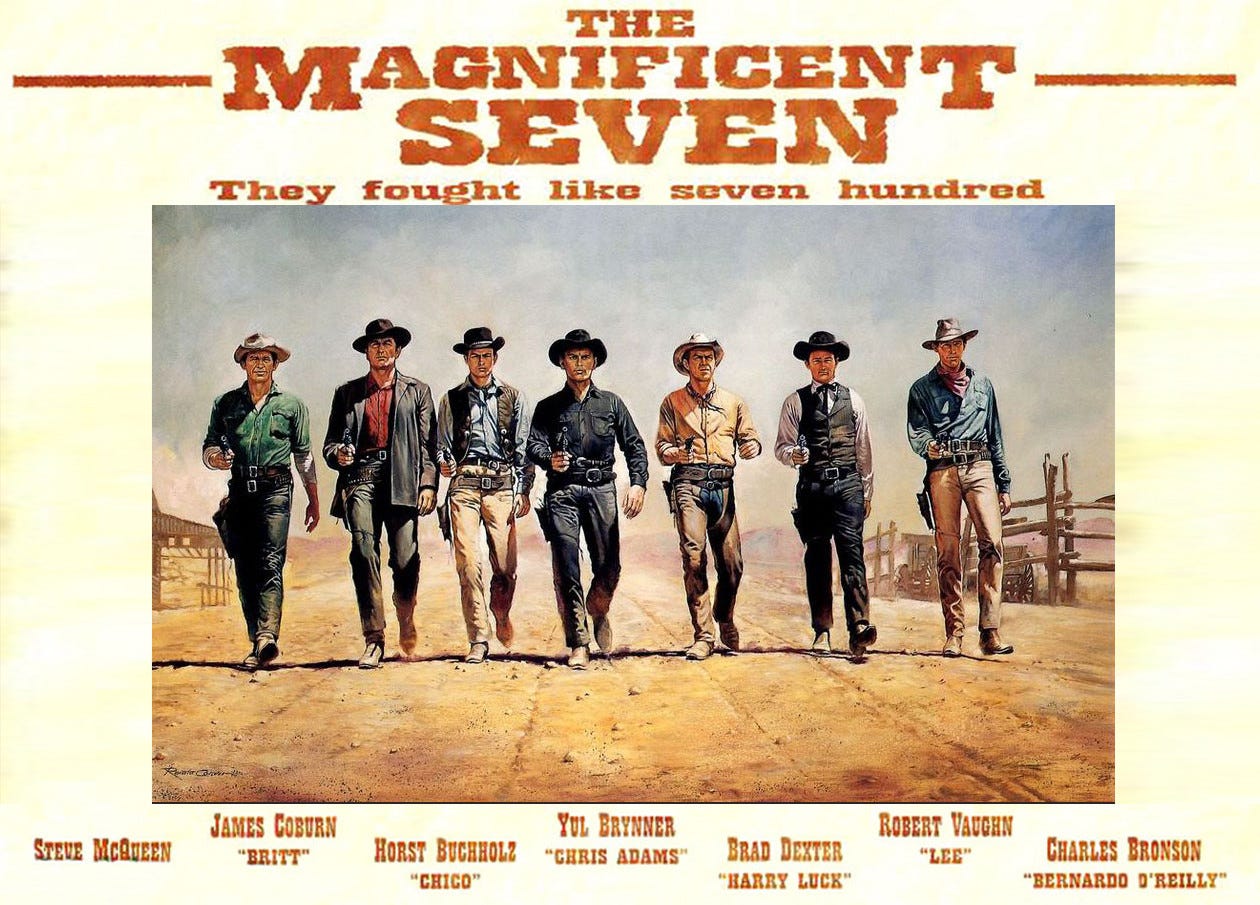
I woke up this morning thinking about two films from my childhood: The Man Who Shot Liberty Valance (1962) and The Magnificent Seven (1960… or any version). Both are stories where communities face down bullies, where right and wrong are crystal clear, where America stands with the good guys. These films, and what they represented about American moral clarity, now feel like artifacts from a lost moral world.
The Stories We Tell Ourselves
Growing up American means growing up with a particular mythology. We’re raised on stories where the good guys win, where justice prevails, where standing up to bullies is not just the right thing to do but the American thing to do. From Superman to Batman, from the Justice League to Disney films, we’ve exported this narrative worldwide: there are heroes and villains, and the heroes always triumph in the end.
This isn’t just entertainment, it’s cultural DNA. The idea of good versus evil, black and white, right and wrong runs through our veins. Even our most sophisticated narratives often circle back to this structure. Sure, we might complicate it (the bad guy becomes good, the anti-hero emerges, the reluctant savior steps forward), but the moral framework remains intact. Someone fights injustice. The bullies get stopped.
The Man Who Shot Liberty Valance, John Ford’s 1962 gem, operates on multiple levels within this tradition. Liberty Valance, played with menacing perfection by Lee Marvin, terrorizes the frontier town of Shinbone. He’s cruel, lawless, represents unchecked power at its worst. Everyone knows he’s the villain. The community understands that he must be stopped.
What makes Ford’s film brilliant is how it examines the mythology itself. Everyone believes that Ransom Stoddard (Jimmy Stewart), the idealistic lawyer from the East, courageously faced down Valance in a gunfight. This “legend” becomes the foundation for Stoddard’s political career, representing civilization triumphing over barbarism. But we learn the truth: Tom Doniphon (John Wayne) actually killed Valance from the shadows, sacrificing his own recognition and happiness for the greater good.
“When the legend becomes fact, print the legend,” the newspaper editor famously declares. The line has become shorthand for how societies choose their myths, but within the film’s context, it isn’t cynical… it’s pragmatic. The myth serves the community’s need for heroes and moral clarity.
The Magnificent Seven and the Willing
The Magnificent Seven, whether Kurosawa’s original Seven Samurai, John Sturges’ Western adaptation, or even the more recent remake on Netflix, tells a different but complementary story. A small group of skilled fighters comes together to defend helpless villagers against bandits. They’re outnumbered, outgunned, and know the odds are against them. But they fight anyway, because it’s the right thing to do.
The beauty of this narrative is its acknowledgment that doing the right thing is costly. These aren’t invulnerable superheroes. They’re flawed individuals who choose courage despite their fears, who risk everything for people who can’t protect themselves.
As I’ve watched the war in Ukraine unfold over the past three years, I keep thinking about these seven. But they’re not American anymore. They’re European. We’ve just seen them gathering on the world stage.
Putin as Liberty Valance
If we’re looking for a real-world Liberty Valance, Vladimir Putin fits the role perfectly. He terrorizes not just a town but nations. He kidnaps children, breaks every agreement he makes, bombs hospitals and schools, commits war crimes with the casual brutality of a frontier villain. Like Valance, he represents the worst of unchecked power: the bully who believes might makes right.
The parallels are uncomfortably precise. Putin’s attack on Ukraine mirrors Valance’s reign of terror in Shinbone with unprovoked violence designed to crush anyone who dares stand up to him. His treatment of Ukrainian children, forcibly relocating them to Russia to be raised as Russian citizens, echoes the worst crimes against humanity we’ve seen. His systematic breaking of ceasefires, agreements, and protocols follows Valance’s pattern of lawlessness.
In any classic American Western, Putin would be the black hat. The mustache-twirling villain whose defeat we’d cheer. The ending would be inevitable: the good guys would rally, face him down, and justice would prevail.
When the Good Guys Forget Their Lines
But there’s a glitch in the script.
America — the country that gave the world Superman, that taught generations about standing up to bullies, that built an entire cultural mythology around the triumph of good over evil, seems to have forgotten which side of the story we’re supposed to be on.
Instead of standing with (or behind with a rifle) the Ransom Stoddards of Ukraine, we’re negotiating with Liberty Valance. Instead of joining the Magnificent Seven, we’re asking the villagers to give up half their land to make the bandits go away.
This isn’t about military strategy or geopolitical complexity. This is about moral clarity, the kind of black-and-white thinking that Americans supposedly excel at. We have a clear aggressor committing clear crimes against a democracy fighting for its life. We have David facing Goliath, Luke Skywalker confronting the Empire, the Magnificent Seven riding to defend the village.
And America is… hedging.
The View from Across the Atlantic
Living in France for over thirty years has given me a particular vantage point on this moral confusion. I’ve watched American cultural influence spread globally, carrying with it our stories about heroism, justice, and standing up to bullies. European friends grew up on American films, absorbed American values about good and evil, learned to expect that in the end, the good guys win. They mocked it sometimes, of course the Disney hero always wins, but I defended it then, and I still do.
Now those same friends watch in bewilderment as America seems to have lost its own mythology. They see Trump treating Putin like a friend rather than an enemy, see American politicians suggesting that Ukraine should just give up territory for a vague promise of “peace,” see the country that defeated fascism in World War II unwilling to confront it in the 21st.
Meanwhile, Europe has become our Magnificent Seven. A coalition of the willing, stepping up to defend the village when the sheriff seems to have lost his nerve. They remember what America taught them about standing up to bullies, even when America itself seems to have forgotten.
The irony is profound. The continent America once helped liberate from tyranny is now carrying forward American values while America retreats into isolationism and moral relativism.
The Complexity Trap
I understand that real life isn’t a Western. Geopolitics requires nuance, competing interests, and unintended consequences add to the complexity. The situation in Ukraine touches on nuclear weapons, energy supplies, economic interdependence, refugee crises, and countless other factors that don’t exist in our heroic narratives.
But here’s what Ford understood in The Man Who Shot Liberty Valance: acknowledging complexity doesn’t mean abandoning moral clarity. Tom Doniphon’s solution wasn’t pure or simple. He killed from the shadows, let another man take credit, and sacrificed his own happiness. The reality was messy, but we never lost sight of who the villain was.
Similarly, standing up to Putin doesn’t require perfect solutions or simple strategies. It requires recognition that some things are simply wrong, and that responding to evil with accommodation only enables more evil.
The Cost of Lost Mythology
When America loses faith in its own heroic narratives, the world loses something too. Not because American exceptionalism is inherently good, but because the stories matter. They create expectations, establish norms, provide frameworks for understanding right and wrong.
If America no longer believes in standing up to bullies, who will? If the country that gave the world Superman now thinks negotiating with Lex Luthor is pragmatic, what does that teach the next generation about moral courage?
This isn’t nostalgia for a simpler time, it’s grief for abandoned principles. The America I grew up in wasn’t perfect, but it at least pretended to believe in its own stated values. It told stories where the good guys won because it was important to believe that good could win.
Printing the Legend
Ford’s newspaper editor chose to print the legend because it served the greater good. The myth of Ransom Stoddard gave the community a hero to believe in, even if the reality was more complicated.
Today we face the opposite choice: do we abandon our heroic myths because reality is complex, or do we find ways to live up to them despite the complexity?
Europe seems to have chosen the latter. They’ve embraced the role of the Magnificent Seven, riding to defend Ukraine even when the odds are long and the costs are high. They remember what America has forgotten: sometimes you fight not because you’re sure you’ll win, but because it’s the right thing to do.
Meanwhile, America debates whether we should even be in the movie at all.
The Morning After
French life continues here as normal, but don’t be fooled, we are watching closely. The war is nearer than America imagines, and it has become vital that the good guys win and that America is on the right side.
“When the legend becomes fact, print the legend.” Maybe it’s time for America to remember its own legends. Not because they’re simple, but because they point toward something true about what we could be.
Putin is Liberty Valance. Ukraine is under siege. Europe has stepped up as the Magnificent Seven.
The question remains: will America remember which side of the story we’re supposed to be on?
No posts
Comments
Nothing yet. Say the first thing.
Sign in to join the conversation.