
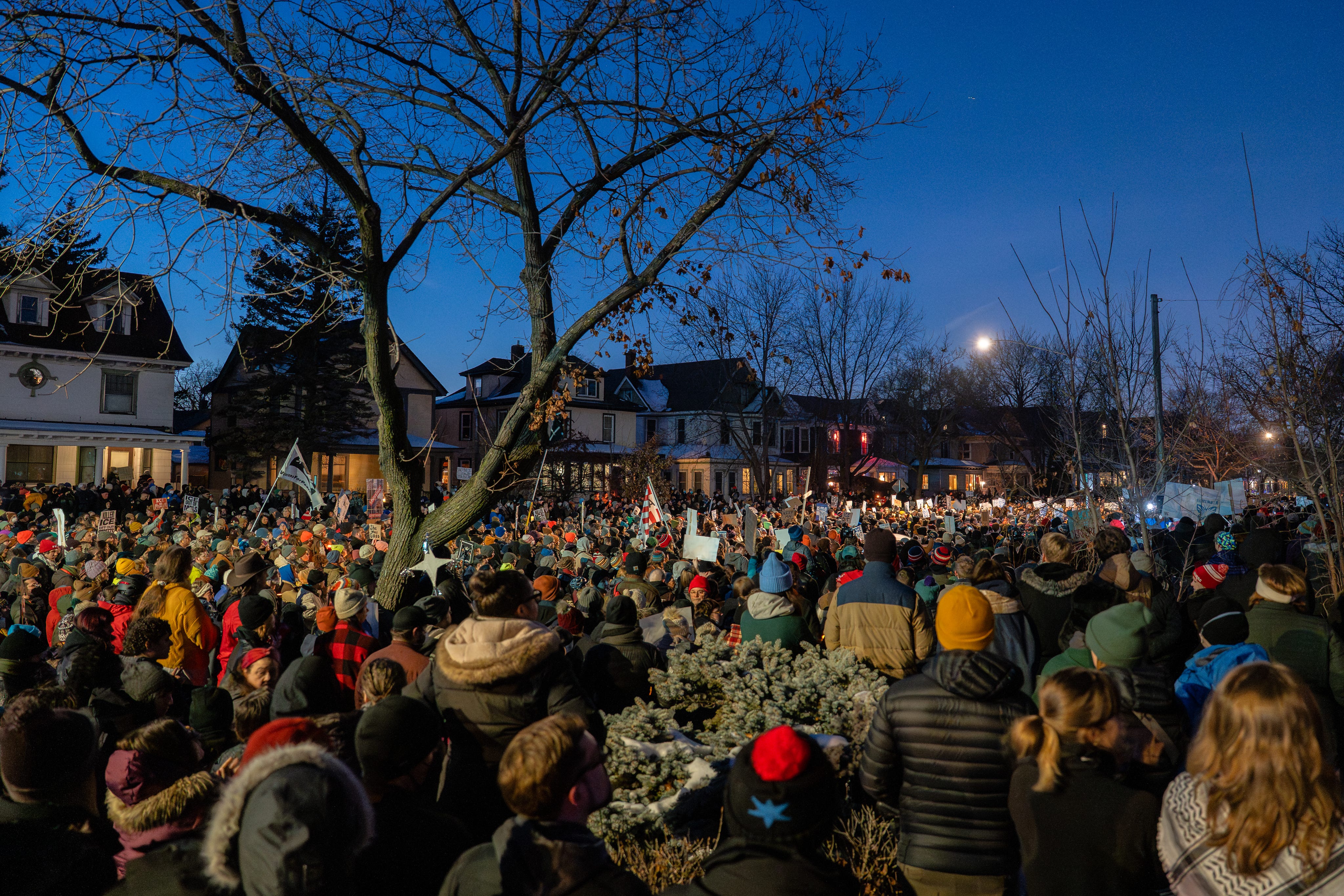
Like most mornings now, there was another. Another brain-breaking dispatch watched in the glow of the phone and the winter dawn. Not from Gaza or Tehran this time, but from the Midwest, a sober statehouse speech from Governor Tim Walz, who spoke of a situation in Minnesota that “defies belief,” of masked ICE agents “going door to door, ordering people to point out where their neighbors of color live.” Of pregnant women being dragged down the streets. Of kidnappings, of Minnesotans picked up at supermarkets and bus stops, of people being shoved into unmarked vans…
Slack-jawed in horror, I scrolled from a transcript of the governor’s speech to a piece on the desperation of the Trump administration, then click on a thoughtful analysis of Trump’s plummeting polls, which led me to the brilliant Status Kuo substack.
An hour passes. My coffee cup’s long drained, my husband leaves for work, and I’m still supine, in now-sweat-soaked pyjamas, clicking, reading, being shocked, and repeating. My country is being ruined in real time, I admonish myself. Start moving more than your thumbs. But still I lie there, gluttonous, gape-mouthed. Dizzy and spacey, I’m hungry for more hits. Jay Kuo’s piece “Bridges Too Far” leads me to indulge myself by watching, for the third time, Philadelphia Sheriff Rochelle Bilal’s warning to ICE, worthy of a Marvel super-heroine. A wash of righteousness melts my earlier knot of panic, but I remain in a fugue state. Alone in bed, no nearer to writing, or doing anything more than feeding off my feed. Now to a piece on Greenland, now to a snapshot of a Nobel Prize winner handing her medal to the president. Bobbing in the warm sea of scrolling, bloated on content, I was buoyed by the floaties of rage and fear.
I’d lost half the morning.
Which is precisely the point. Trump has defined politics as grabbing our attention along with power. The design of digital algorithms to harness our attention leads to a bracing, albeit dangerous, sense of certainty about our own worldviews and opinions. Somewhat paradoxically, scrolling can also lead one to feeling overwhelmed, passive and helpless. Like ICE, the algorithms are pimped up to render us frozen and fearful. America’s authoritarian leaders know how useful it is to keep us busy with scrolling and surfing. Their side effects—dread and loneliness—echo the right-wing’s messages of doom and decline.
The far-right’s news strategy runs on scrolling. “All we have to do is flood the zone,” said the right-wing strategist Steve Bannon, who helped run Trump’s 2016 campaign. “Every day we hit them with three things. They’ll bite on one, and we’ll get all of our stuff done, bang, bang, bang. These guys will never — will never be able to recover. But we’ve got to start with muzzle velocity.” Bannon was speaking of the media, but the Trump Administration’s tactic of using a daily news dump to dazzle, disorient and demotivate holds dangers for anyone with a phone. The more stunned-bunny hours we waste, as I did today, the better for the regime.
So what’s the opposite of scrolling? Or rather, in the interests of avoiding binary thinking, what tactics undercut the mental and democratic passivity it breeds? Governor Walz suggested several at the end of his speech, urging citizens to “protest, loudly, urgently, but also peacefully,” and to “take out that phone and hit record,” to help create a databank of ICE atrocities against Minnesotans. In addition to their vital uses in the quest for justice, protest and witness give us the cohesion, commitment and focus that scrolling won’t, and that those who’d keep us scrolling loathe.
Art can deliver both the nuance and solidarity that scrolling erodes. Screens often numb, but they can also deliver full-blooded stories, as I was powerfully reminded in London on the same day as Governor Walz’s speech. I joined a somber audience gathered for a screening of The Voice of Hind Rajab, based on the true story of the attempts by a team at the Palestine Red Crescent Society to send an ambulance to save a 6-year-old girl in Gaza. Sheltered in a car, surrounded by the corpses of six other family members shot by Israeli soldiers, she is just eight minutes away from a rescue team. The docudrama, which received a 23-minute standing ovation at the Venice Film Festival, which awarded it the Silver Lion Grand Jury Prize, uses the actual emergency center recordings of Hind’s voice over the three hours she waited to be rescued. “Come get me,” she pleads. “I’m scared. Please come.” We hear the Red Crescent staff, played by actors, frantically navigate the deliberately obstructive design of the occupation’s bureaucracy. We watch them, desperate to comfort her until the ambulance arrives. We hear that she is in the Butterfly Class at A Happy Childhood pre-school. We hear her say the soldiers “are shooting.” Her family around her is “sleeping,” she tells the team at first. Then later, “they are dead.”
We hear her last words before she dies.
Hundreds of thousands of people heard Hind Rajab’s voice just days after her murder, when the Red Crescent, unable to confirm her fate, released an audio clip from the call. But acclaimed Tunisian director Kaouther Ben Hania, given access to the entire recording, as well as to the accounts of both the Red Crescent team and Hind’s mother, crafted a masterpiece from the audio, dramatic reconstructions, and footage of the aftermath.
The film was an uncanny blend of the real and the staged, but the discomfort Ben Hania created was complex, a far cry from the quick panicked hit delivered by online content. The story she told was enraging and distressing, but watching it felt a far richer, subtler experience than the hollow solitude of watching clips curated to enrage or distress.
For the film’s hour and a half length, the audience was rapt, collectively living through a tragedy through story. After the lights went up, people wept or sat in stunned silence. Sitting in a room of strangers, then listening to Ben Hania answer their questions, felt profoundly fulfilling. We were watching a screen, but not passively, and not alone. Bearing witness together felt terrible, but not empty. At a moment when machines and men are conspiring to shear off bits of our humanity, it made me feel human in a way I’d not felt in far too long.
More than just moving me, the film inspired me to do. I’ve muted my feeds, and reacquainted myself with the dial button on my phone, using it to call my representatives. It feels pretty lame, given the scope of the activism and sacrifices going on among the people of Gaza, Minneapolis, and other American cities. Still, it’s a start.
No posts
Comments
Nothing yet. Say the first thing.
Sign in to join the conversation.