
It’s been a year. I’ll spare you the recap, not least because I’m swerving from the fast and furious approach of the men—yes, they’re men, almost to a man—hogging the headlines while siphoning off our attention, human rights, and planetary resources. But away from the bombs and the invasions and the cruelty and the all-caps braying, one need only look at the fine print of 2025’s operating instructions to find heroism aplenty. I’m cheered, for example, by the tireless work of American volunteers helping people vulnerable to ICE raids, working through groups like Know Your Rights and the Illinois Coalition for Immigrant & Refugee Rights. In the UK, The Good Law Project is helming legal fights, from blocking Palantir’s incursions into the National Health Service to protecting the rights of pro-Palestinian protestors.
Fear leads you to curl up, getting you little more than a close-up of your own navel. Courage, even simply witnessed, can get you to straighten up and stare out. On a good day, courage sparks more courage, or at least hope. And being hopeful, as Nick Cave writes in his extraordinary Red Hand Files, is “the warrior emotion that can lay waste to cynicism….It says the world and its inhabitants have value and are worth defending. It says the world is worth believing in. In time, we come to find that it is so.”
Angry and frightened by events in the Anglosphere over the last year, I’ve noticed my own cultural laziness, by which I mean a tendency to focus on American and British outrages and inspirations, ignoring struggles abroad. Needing doses of both courage and hope for 2026, I’m hereby looking up and out. Below, a sampling of brave and creative actions over the last decade, taken by ordinary people around the world protesting power grabs and injustice.
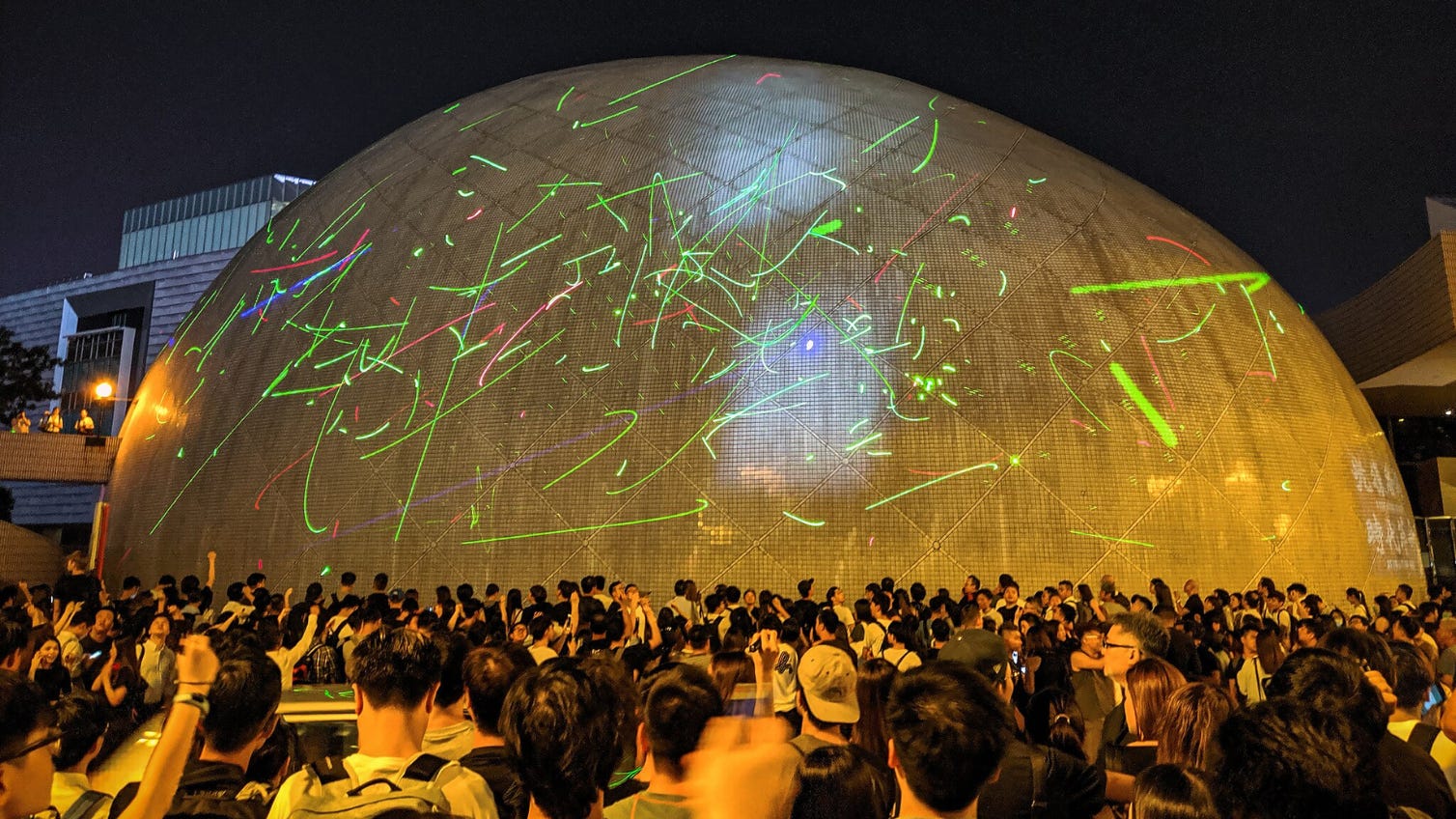
A Bruce Lee Slogan and Post-It Notes: Hong Kong’s 2019 protests against Beijing’s tightening grip over the island were as ingenious as they were courageous. Famously, young protestors embraced the Bruce Lee maxim “Be Water,” in their quest to build a flat, fluid and adaptable movement. The mindset showed in the nimble response to someone being arrested for bringing a laser, deemed an “offensive weapon,” to a protest, whereupon hundreds of protestors joined the protest with lasers of their own, noted a report from the Human Rights Foundation.
Around the territory, sticky notes fluttered in resistance. City walls were decked with pink, yellow and green fluorescent tabs emblazoned with anti-Beijing slogans. Civil servants would write anti-regime messages on them, stick them on their work IDs, and upload them to the internet. When crack-downs came, and the notes went down, restaurants and shops would display blank sticky notes, speaking loudly by saying nothing at all.
Wands and Potter-mania: In 2020, risking arrest under laws against criticizing the monarchy that carried 15-year jail sentences, Thai protestors dressed in Harry Potter costumes and waved wands. Some held photographs of Voldemort, showing that as in JK Rowling’s fantasy world, their country had all-powerful figures “who shall not be named.” To highlight the monarchy’s increasing constitutional powers and to call for a democratic government, the protest by university students was an early show of anti-government dissent from ordinary Thai citizens.
“Amabere Namabina”: (Breasts and Buttocks): In 2024, as part of the anti-corruption protests by young Ugandans three women stripped and painted their bodies. Their actions deployed wrote one protestor, “our last feminine weapon: ‘amabere namabina’ (breasts and buttocks)” in protest against the corruption of the government of President Yoweri Museveni. The young women’s nude march drew on a tradition in which older African women participate in cursing ceremonies, as well as a display of the Ugandan tradition of “radical rudeness” against politicians. “We would be as rude as the corrupt, shameless as those who steal from the poor,” wrote Kemitooma K. Nyina’Nkyenzibo of the protest. She and her fellow protestors were arrested, but in prison, fellow social justice activists celebrated them as heroines: “The Museveni government declared us a common nuisance, but the Ugandan people saw us differently, as women who dared to resist and confront centuries of imposed shame, turning taboo into political language.”
Women in White: In Belarus in 2020, some 250 women protesting police brutality in the wake of a disputed election formed a solidarity chain. Wearing white and holding flowers, the women were making a pointed statement about the violent tactics of the black uniformed OMON, or riot police. When police asked the women to leave, they put their hands behind their heads and started walking in circles, as though arrested. They then formed a human chain, the first of a series of women’s marches. “For some Belarusian women,” wrote Elisabeth Kovtiak, in an essay on “Artivism” in Belarus as a response to state violence, “dressing in white became an implicit expression of resistance, something they could do every day.”
Perreo Combativo: During the 2019 protests against Puerto Rico’s governor Ricardo Rosselló, perreo, a hypermasculine reggaetron dance style—“kind of like twerking from Africa, kind of like Brazilian funk carioca, New Orleans bounce, or the Ivory Coast’s mapouka, but not exactly”—was adopted by LGBTQ+ communities as a form of protest, writes Damaly Gonzalez. After hundreds of sexist and homophobic texts from the governor were leaked, gay, trans and female protestors held nightly perreo parties on the steps of the governor’s mansion in San Juan. Their slogan—“No revolution without perreo,” captured people’s imaginations; it was to the strains of perreo and the sight of thousands of people grinding, one hot July night, that Rosselló announced his resignation. The news was met with a twerkathon on the steps of San Juan Cathedral, and perreo parties in New York, Los Angeles, and Florida.
The tactic proved controversial, observed Jaime O. Bofill Calero in a piece for Musicology Now. Catholic groups objected to the spectacle of a hyper-sexualized dance on cathedral steps, while committed activists felt the party atmosphere trivialized their efforts. Not so for Puerto Rican singer-songwriter Tommy Torres, who declared the day after the governor’s resignation: “Let it be written in the history books that no tyrant can withstand a perreo combativo.”
I chose these examples not because they necessarily succeeded, nor out of a naïve belief that a protest conceived in a Kenyan village will fly in Milwaukee, or that a tactic employed by Maharashtran elders could work in Westminster. My emphasis on creativity is not to trivialize protest, particularly in countries where activists fear prison, torture or even death. Rather, I was bolstered by the wit and daring of these activists, and thought you might be, too.
Heading into 2026, I’m hoping for half the moxie and courage of these inspirational guerrillas.
No posts
Comments
Nothing yet. Say the first thing.
Sign in to join the conversation.