
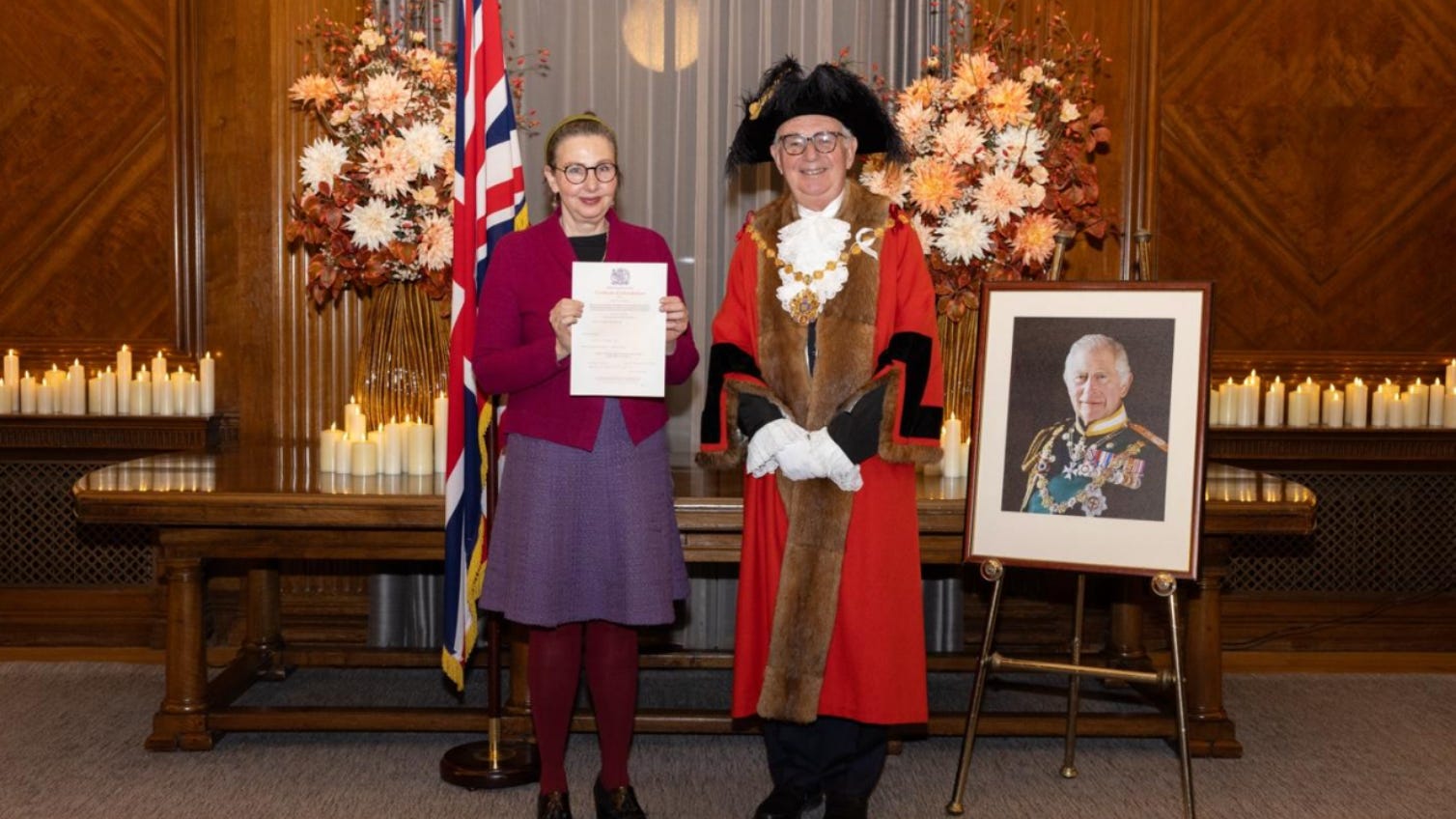
On a recent Tuesday afternoon in London, I became British. I walked into a room in the Marylebone Town Hall an American, and walked out an hour later as a citizen of both the United Kingdom and the United States.
My transformation took place in what felt like a Downton Abbey set. All we would-be Britons filed in to a grand and paneled Edwardian room decorated with flowers and LED candles. Before the ceremony, we were entertained by slide shows on giant screens, featuring luminaries who’d been naturalized as British citizens. (If you ever wondered what links Dua Lipa to T.S. Eliot, now you know.)
Propped up on a stand facing us sat a portrait of King Charles, wearing a pained smile and a chestful of medals. I’m American enough to feel a bit queasy swearing an oath to “be faithful and bear true allegiance to His Majesty King Charles and His Heirs and Successors.” I balked a bit at singing the British national anthem, “God Save the King,” when we warbled our hopes he would reign long over us, victorious. Then again, my No Kings ideals have been savagely undercut by recent American realities. As University of Chicago historian Steve Pincus observes, the 2024 Supreme Court ruling on presidential immunity gives the American president far more power than even King George III had during the American Revolution.
Besides, the true abiding spirit of the ceremony belonged to that other blockbuster British export, the Beatles. Geniuses, like migrants, help a culture see itself anew. Breathing in influences from Chuck Berry and Elvis Presley to Ravi Shankar, then breathing out new imaginings of what the world sounds like, the Beatles put a grey post-war, post-imperial Britain back on the map. Half of the Fab Four had been married at the Marylebone Town Hall, which was keen to advertise the connection. I touched up my lipstick in a Ladies Room decorated with pictures of Paul and Ringo after their weddings; the ceremony’s slideshow included a shot of the just-married McCartneys emerging, surrounded by a scrum of well-wishers.
In its jaunty energy and gentle self-deprecation, the afternoon’s vibe was Best of Britain. Everyone was as polite as Paul’s reputed to be, though outside the rain fell resolutely, and inside the computer system was down. The proceedings ran late, the staff had to scramble to print more certificates, and many friends and family had to stand. Nobody complained. (“You can go if you want to,” I mouthed silently to my daughters.) But they stayed. We future Brits, born in 29 countries, sat patiently, already displaying British stoicism.
We were blissfully spared a short talk on a great national pastime (queuing), which a friend had to endure at her own citizenship ceremony in Oxfordshire. Each new citizen posed with the Lord Mayor of Westminster, as natty as any member of Sgt. Pepper’s band in his red coat and gold livery collar. The mistress of ceremonies invited us to the main hall for a cup of tea and a biscuit, then urged us to celebrate by doing something truly British—“like going to the pub, or out for fish and chips, or eating baked beans on toast.” Mild, modest, and tinged with irony, her list captured the spirit of “Eleanor Rigby.”
One couldn’t turn British along with people born Yemeni and Venezuelan, Nigerian and French, as I did, and not think of “Imagine,” John Lennon’s syrupy ode to peace across borders. As the former American president Jimmy Carter once noted, the song is “used almost equally with national anthems” around the world. Ironically, a ceremony dedicated to nationalism duped me into thinking of its transcendence. In that room, Lennon’s hopes of the world living as one looked almost plausible. All of us—the tech bro in his Chelsea boots, the Muslim mother in the white spangled dress, face covered by niqab, the blue-haired hippie, the Southeast Asian club kid, the sleek American executive—were united by our quest to be British. If Lennon championed the imagination as a weapon against war and division, the political theorist Benedict Anderson, in his classic Imagined Communities, saw imagination as a glue for modern nations. In a world of nation-states, a population not linked by blood or a single place or ethnicity have to imagine themselves into being connected, as members of the same nation-state.
So I imagined myself into Britishness. For that feel-good hour, I forgot that gaining citizenship in a Western nation means joining a club with ever-slimmer acceptance rates. Where populist leaders truck in more sinister imaginings, of invasions by marauders bent on destroying our traditions and stealing our jobs. In that beautiful room, I let myself forget the rising xenophobia outside, where the increasingly popular Reform party promises to deport 600,000 migrants if elected, and the Labour government’s new proposals include cutting off healthcare and other benefits to migrants until they become citizens, and searching migrant children’s mouths for SIM cards on arrival in Britain.
I’ve only been a citizen for a week, but I know that’s not my Britain. Mine is a country of freedom of both movement and the mind, whose glorious, more expansive imaginings include Hamlet and penicillin, Orlando and Frankenstein, a well-funded National Health Service and Ziggy Stardust, the double helix and Charles Dickens.
And the songs of four Liverpudlians, who, like new citizens to an old country, reimagined Britain for the world.
No posts
Comments
Nothing yet. Say the first thing.
Sign in to join the conversation.