
“But how do I know if my child is watching AI slop?”
Said every parent I’ve talked to lately.
Once I started talking about the AI slop that is out there, especially in our kids’ feeds, I get this question constantly.
Sometimes it’s a parent who has just heard about it. Maybe they read the New York Times investigation. Maybe they read some of my work, or they’ve actually seen something weird, like a cow with six legs, or they saw Jesus hanging out with my little pony.
AI-generated video is everywhere on YouTube now. And a lot of it is aimed directly at our kids. The Times and Kapwing estimate that 20 to 40 percent of what shows up in a video feed may now be AI-generated.
YouTube only requires creators to label photorealistic AI content, not “clearly unrealistic content, such as animation or someone riding a unicorn through a fantastical world”, which is the majority of kid videos.
The problem starts when unrealistic animated content is not just fantastical but actually educationally wrong. Or dangerous.
Once again, the burden falls to parents.
It shouldn’t. But until the platforms catch up, here are five ways to recognize slop, AI or not.
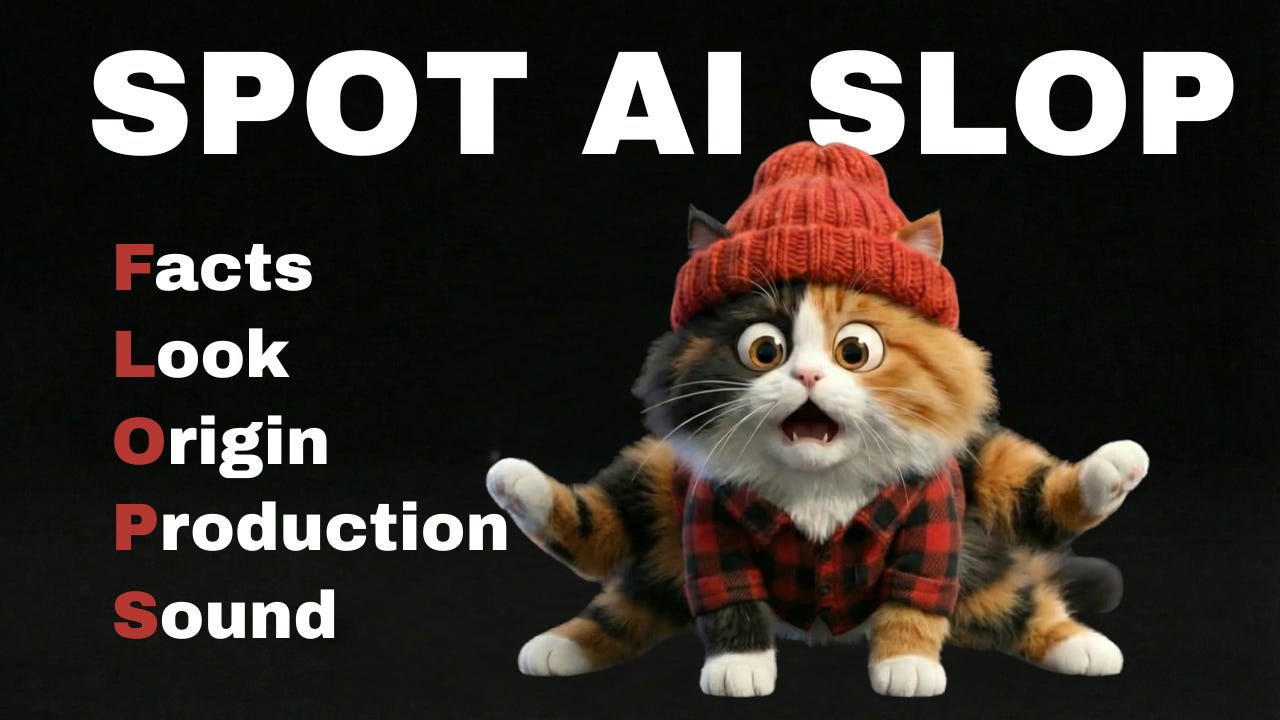
It conveniently spells FLOPS. Because slop flops.
Facts: Is what this video teaching actually true? Is what it shows safe to imitate?
Look: Do the characters look correct and consistent? Is the text readable? Do the actions make sense? Do the characters belong in this world?
Origin: Who made the content? Is there a named human or company? Could you contact them if you wanted? How many videos have they posted?
Production: How much care went into the video creation? Are there symptoms of laziness, like watermarks, black bars, looping content, ultra short format?
Sound: Does it sound right? Do the voices stay consistent and pronounce words correctly? Do lyrics make sense?
I’m Dr. Carla Engelbrecht. I’ve spent 25 years creating education and entertainment media for Sesame Street, Netflix, PBS Kids and more. Now I help families, educators, and creators understand AI and how to make genuinely good things.
As the AI models improve, it will get harder and harder to recognize AI. Critical thinking is more important than ever. The FLOPS acronym may help you remember all the different ways you can spot the slop.
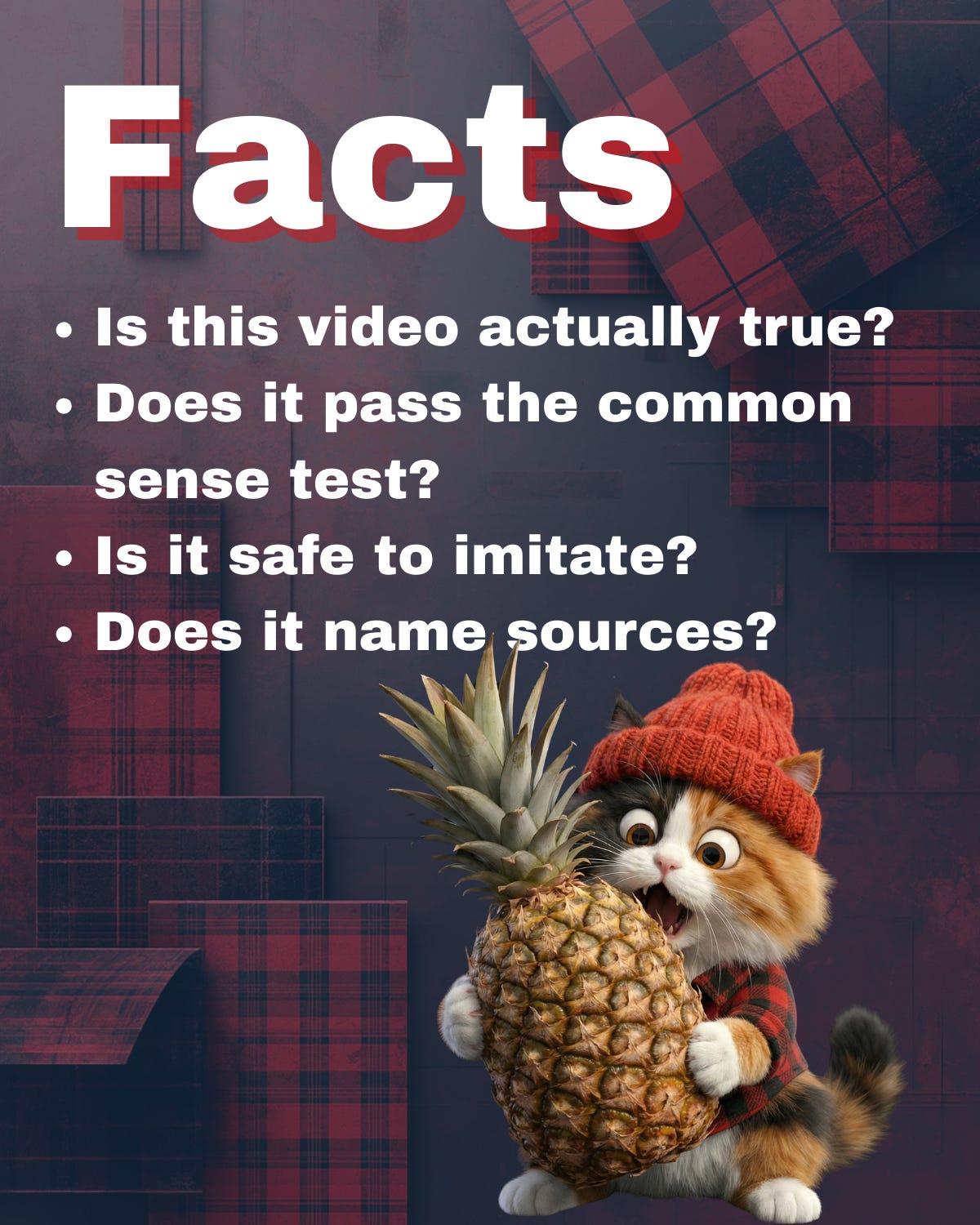
Is what this video teaching actually true? Is what it shows safe to imitate?
Watch for
Wrong letter-sound associations, incorrect colors, numbers, or vocabulary
Dangerous behaviors presented as normal (bare hands on hot surfaces, eating inedible objects)
Photorealistic content where everything looks real but the actions are developmentally impossible
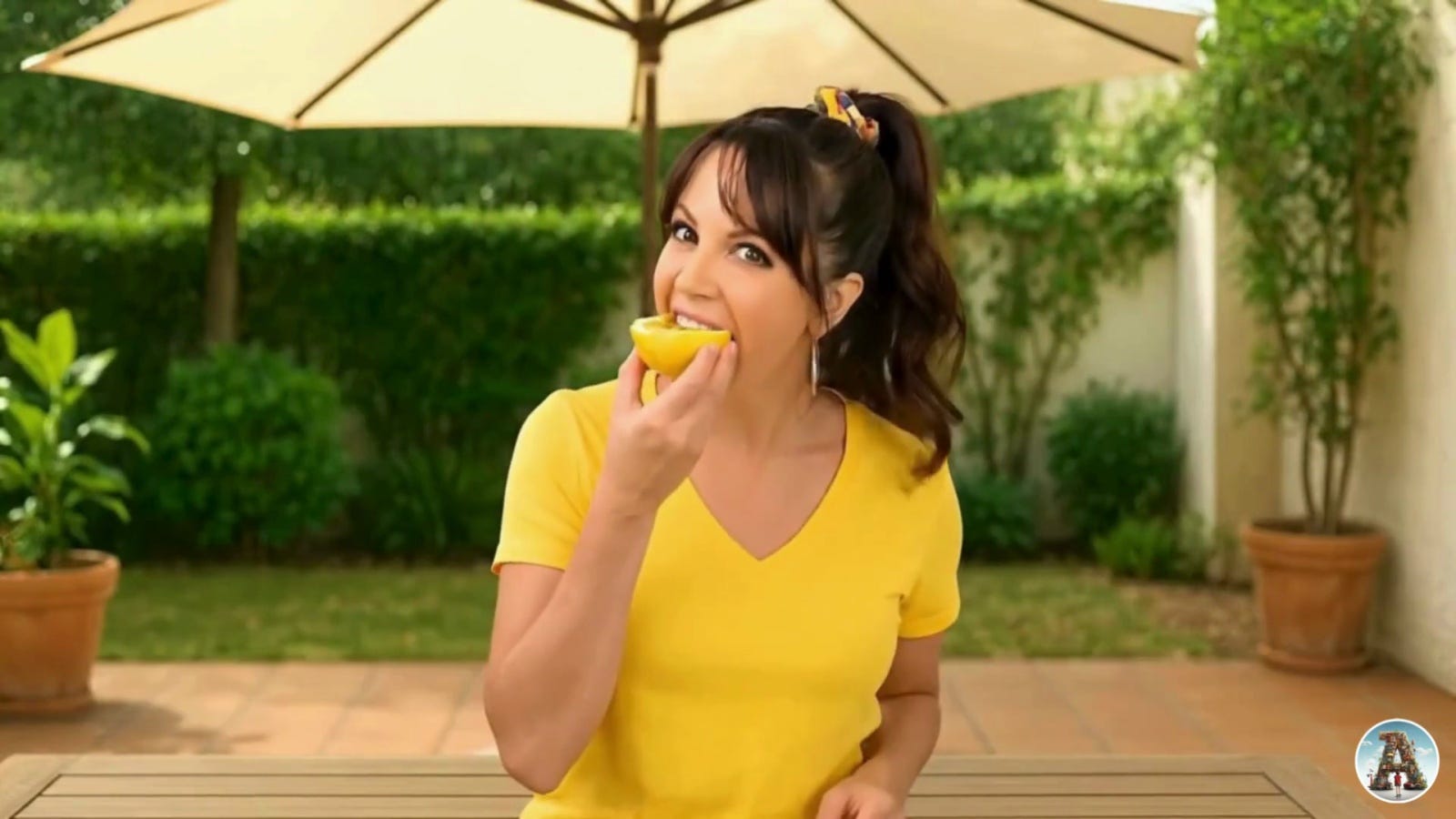
In this video from the channel Fantastic Fun Times, an AI-generated woman cheerfully bites into the rind of a yellow passion fruit. Passion fruit rind is not edible. It's bitter, tough, and can cause digestive problems. No real person would eat it this way. But in the video, it’s presented as normal, and a two-year-old watching has no framework to know that it isn’t.
Kids don’t think “I should double-check that.” They extend full trust to on-screen authority figures. An AI-generated “teacher” with confident delivery and photorealistic visuals gets the same trust as a real educator.
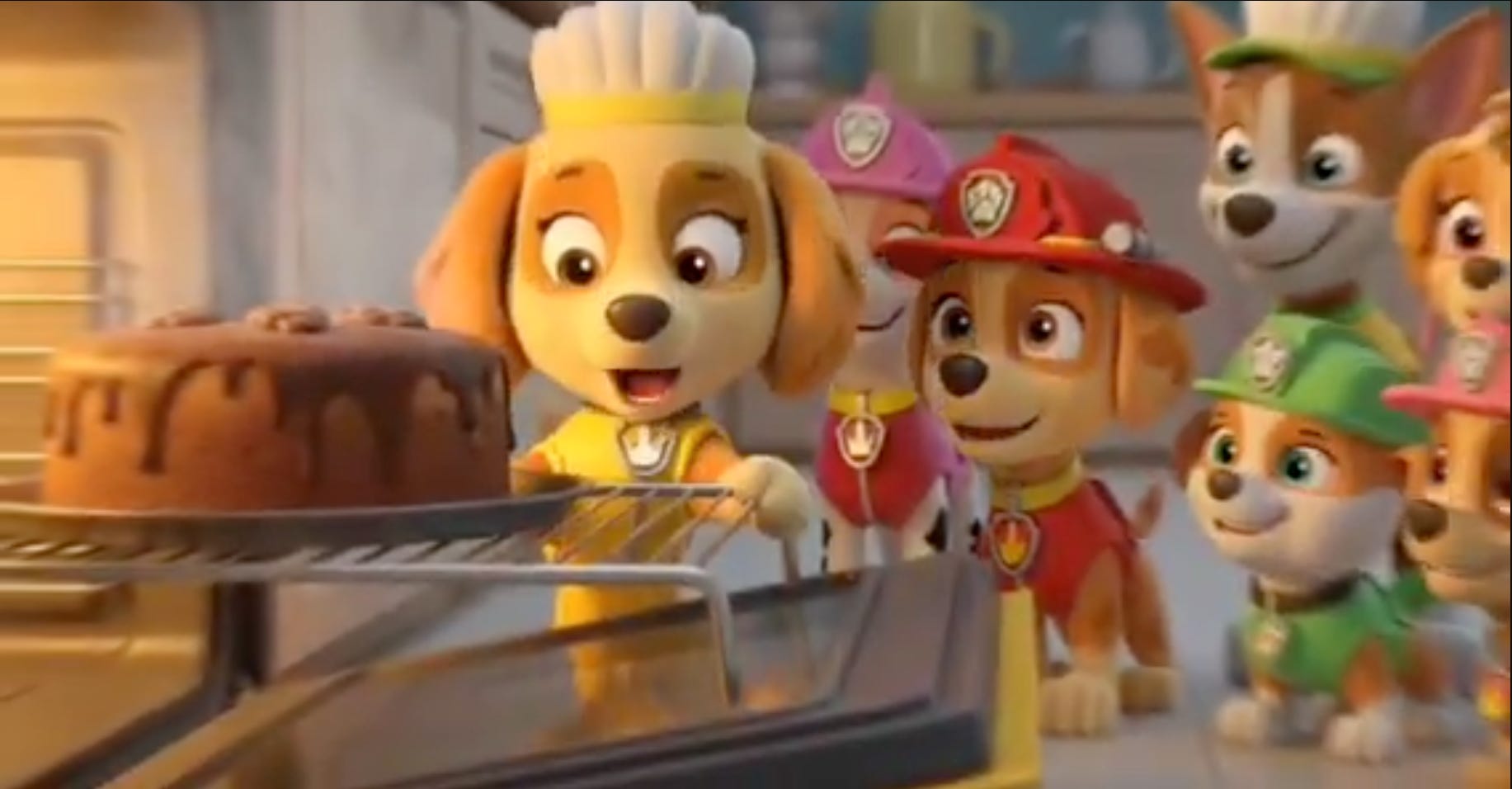
This video has 378 views. It's obviously a cartoon, and a poorly produced one that knocks off Paw Patrol. But it shows a character grabbing a hot cake straight out of the oven with bare hands.
When I made games for Sesame Street, we didn’t use pots and pans as drums because of the risk of a child grabbing a hot pan from the stove. Kids are notorious imitators.
This video has 800 views and shows downright confusing and dangerous behavior. When illustrating J is for Jelly, it shows a woman in the style of a mukbang video pulling a banknote out of jelly with her teeth. Coins are embedded in the jelly.
You might think that 800 views isn’t too worrisome. But that's 40 school buses full of kids who watched a realistic-looking woman eat money.
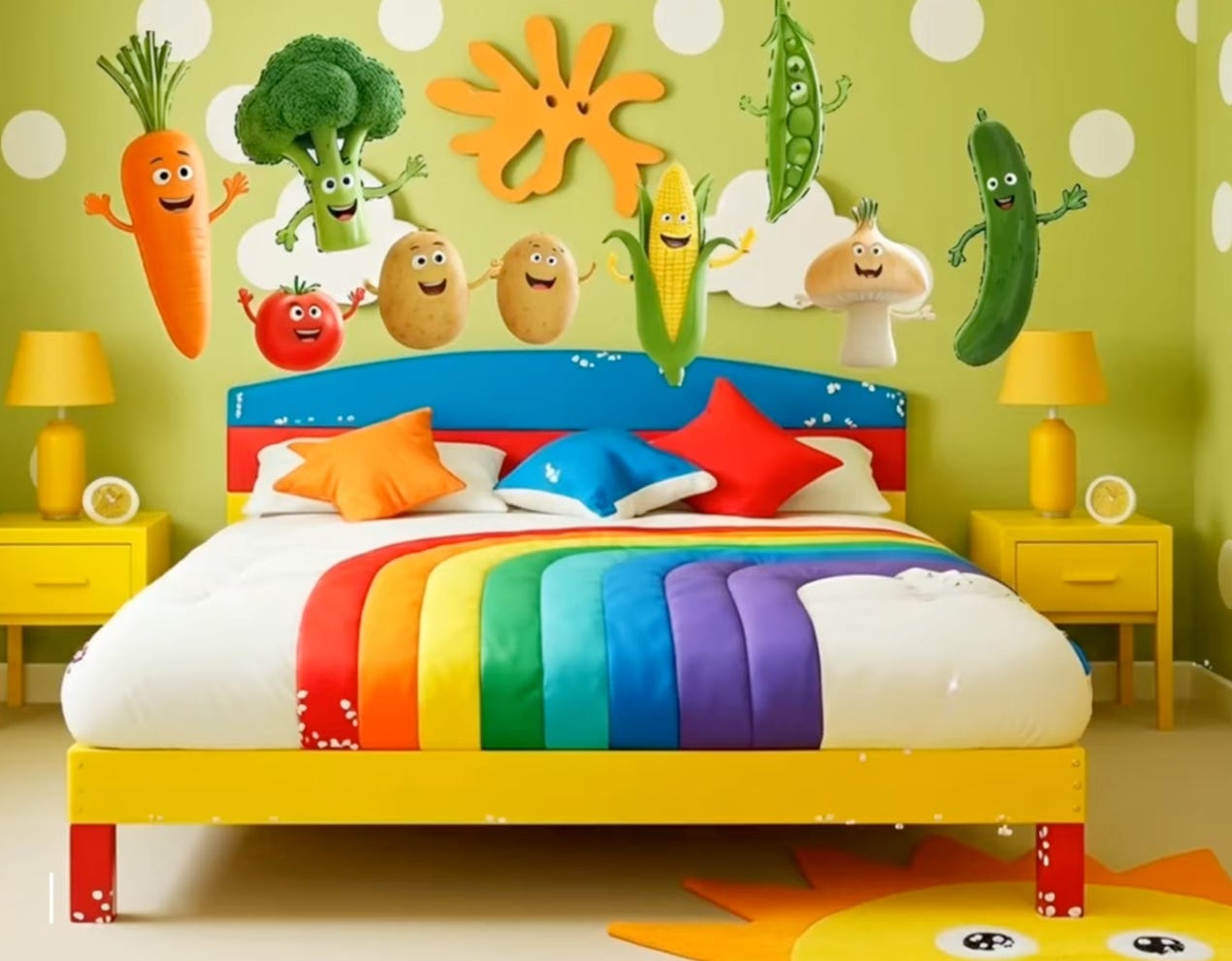
There’s a lot of AI videos out there with big viewership numbers. This video has 109k views. The song says "10 little vegetables jumping on the bed," but only 9 are on screen.
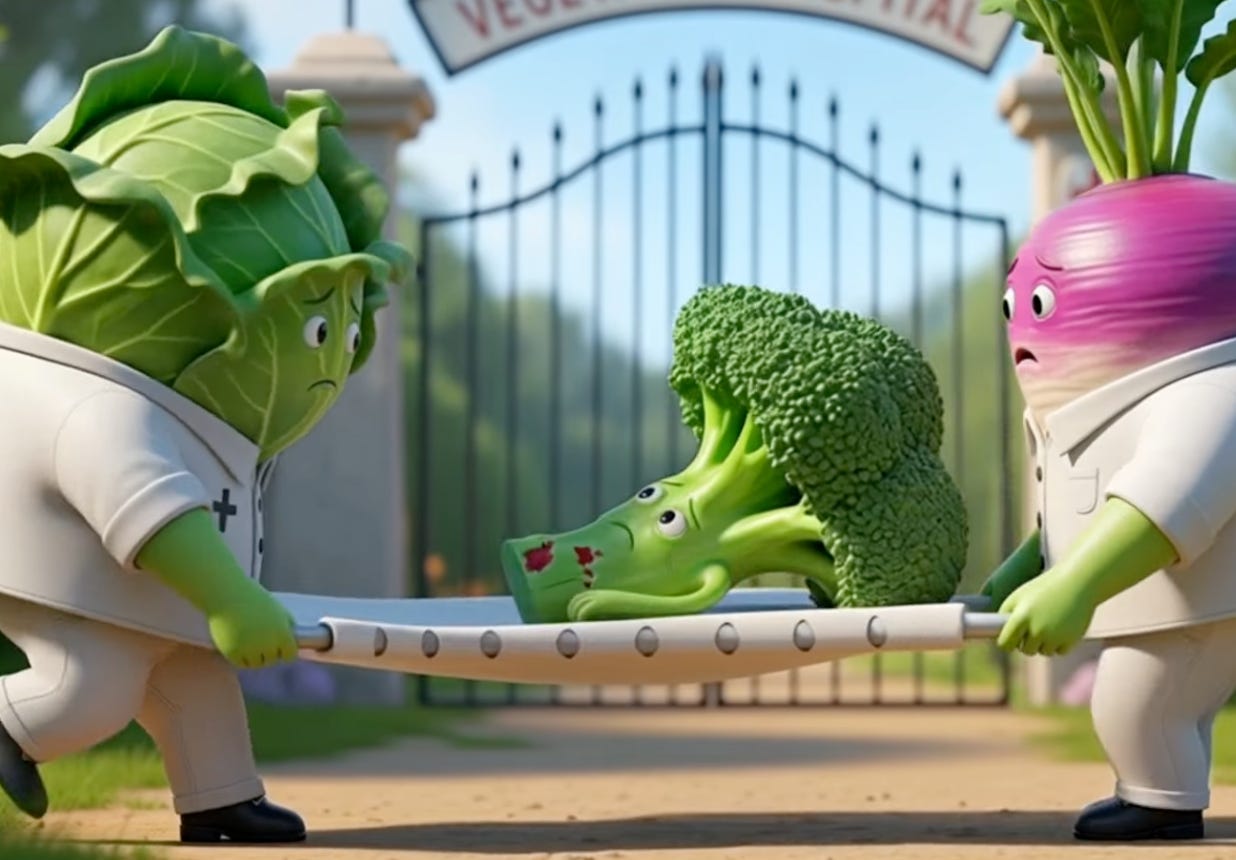
A few moments later, the broccoli has blood on it. When you’re teaching counting, showing the wrong number of objects isn’t a minor glitch. It’s the whole point of the video, and it’s wrong.
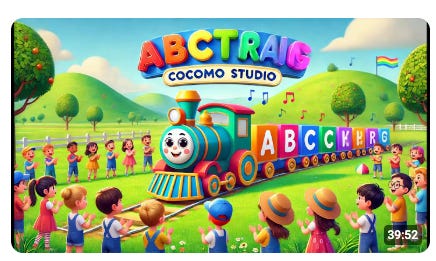
This is the YouTube thumbnail for a compilation video with 7.4k views this week. The letters on the train are gibberish. And the video never actually includes an ABC train. (Or ABCTRAIG, whatever that is.)
Every one of these errors would be caught if a responsible adult creator was motivated to publish good content. Young children are in a critical window for language acquisition, literacy, and foundational numeracy. Wrong information during this window doesn’t just fail to teach. It mis-programs. She has to unlearn that association before she can learn the correct one. Unlearning is harder than learning from scratch.
You’ll also see photorealistic babies doing things no baby can do. Walking runways in heels. Doing choreography that would challenge a backup dancer. An eight-month-old can barely sit unsupported, let alone strut. The AI learned “runway walk” from fashion footage and “baby” from baby footage and combined them. It looks polished enough to scroll past. But for a toddler watching, this isn’t fantasy. It looks real. And their developing brain files it as real.
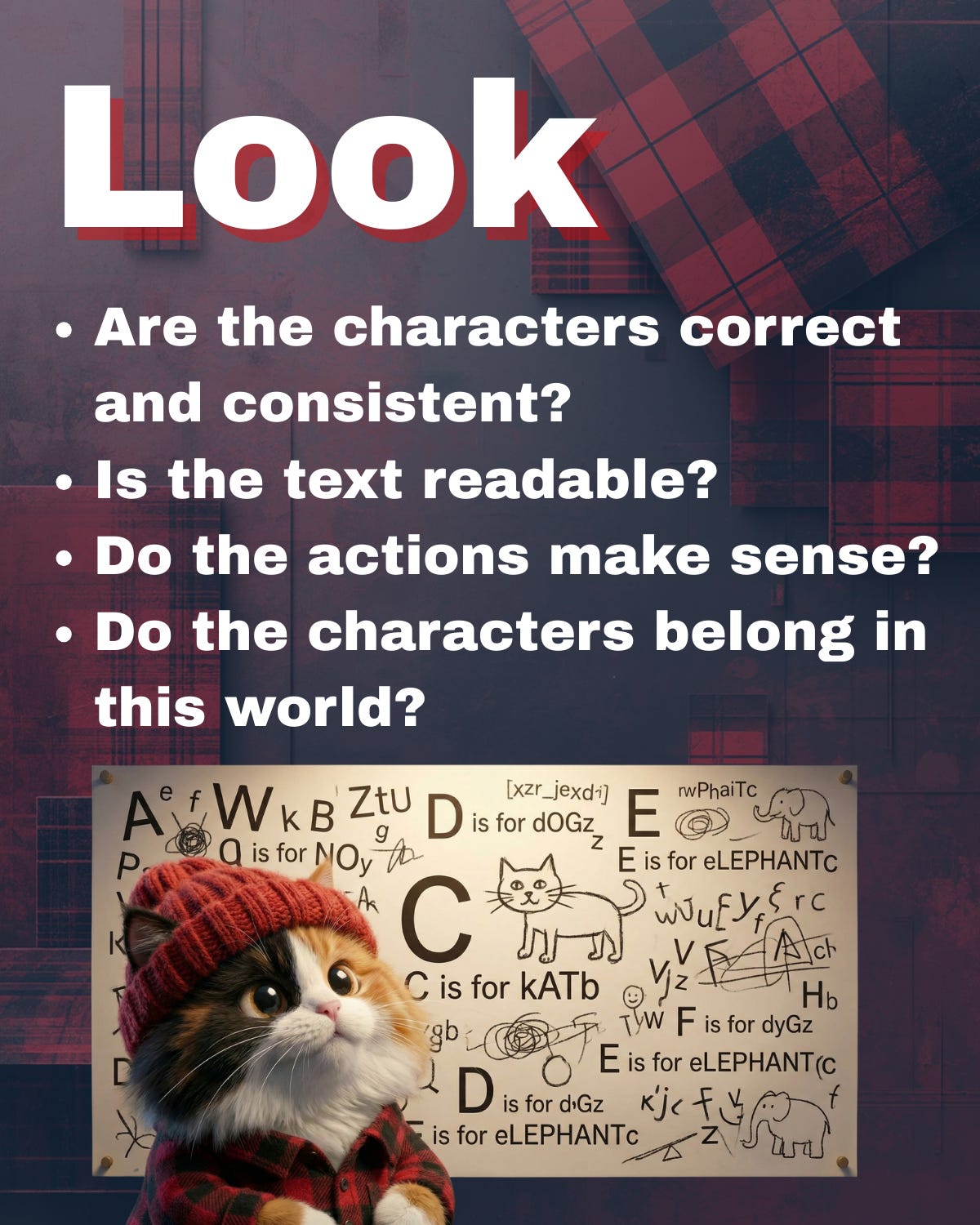
Watch for bodies that don’t add up, text that isn’t readable, physics that break, characters that drift between scenes, and content that makes no conceptual sense.
Signature slop signals
Extra limbs, wrong proportions, mouths in wrong places
Garbled text on signs, blocks, and chalkboards
Objects merging, gravity shifting, impossible physics
Characters changing appearance between shots
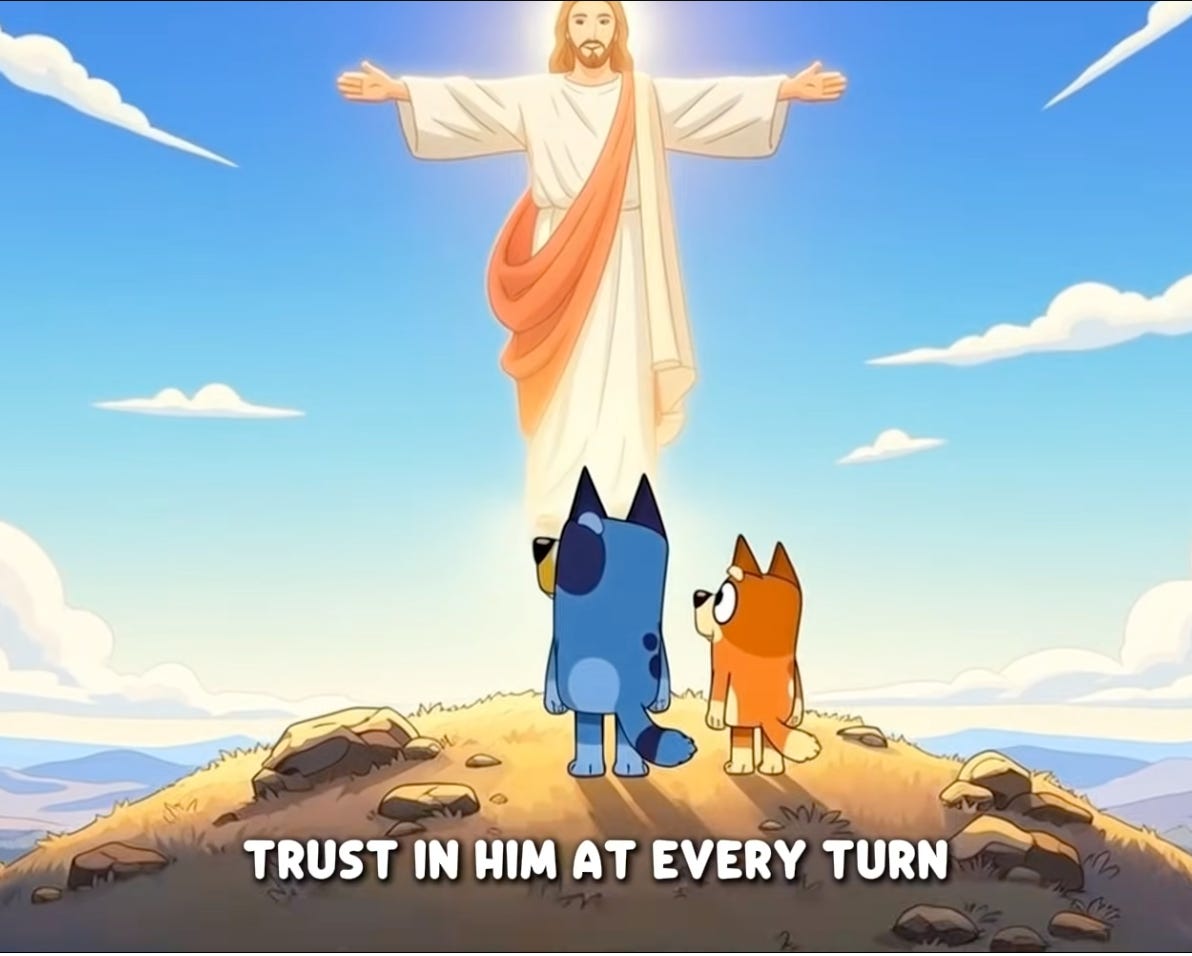
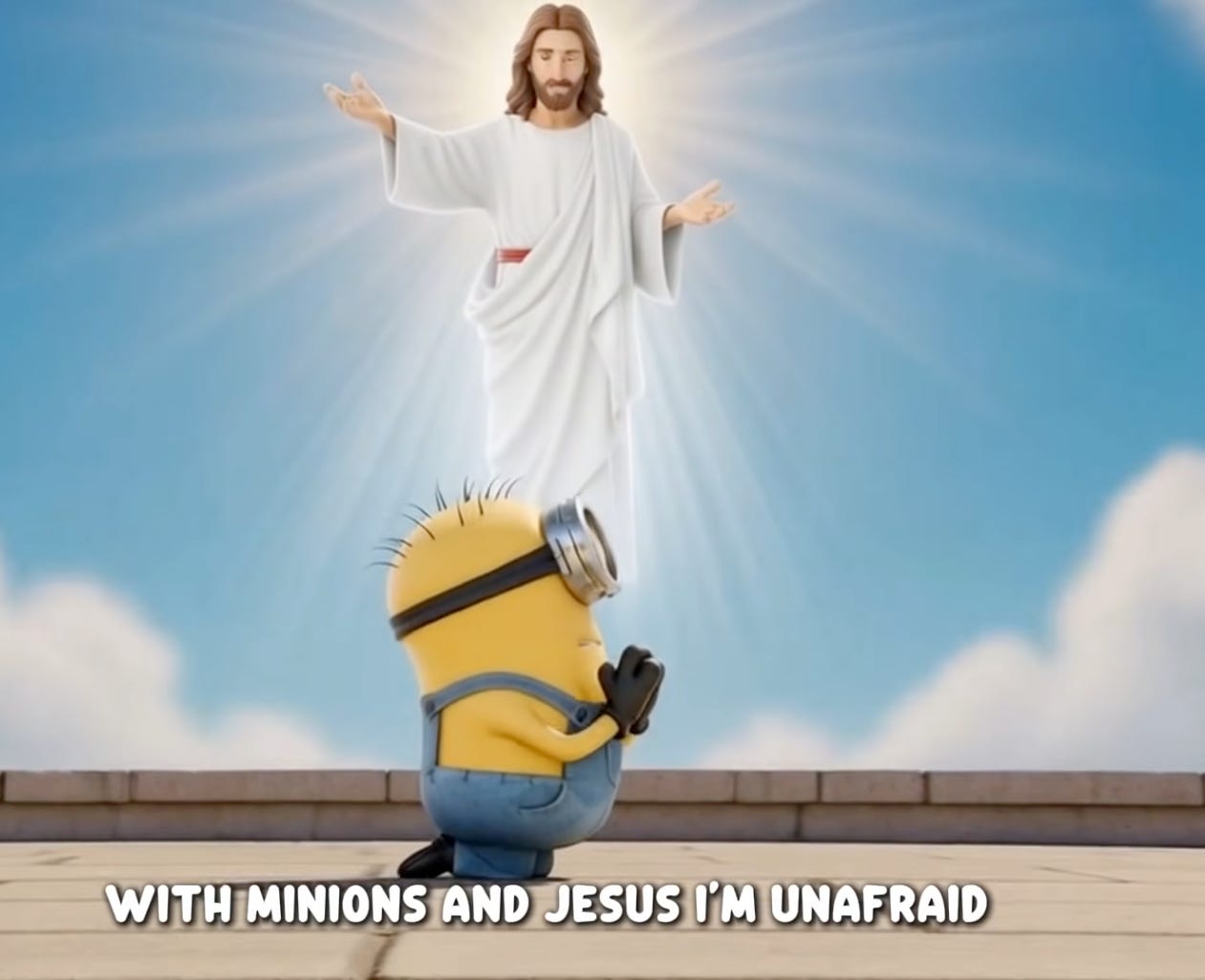
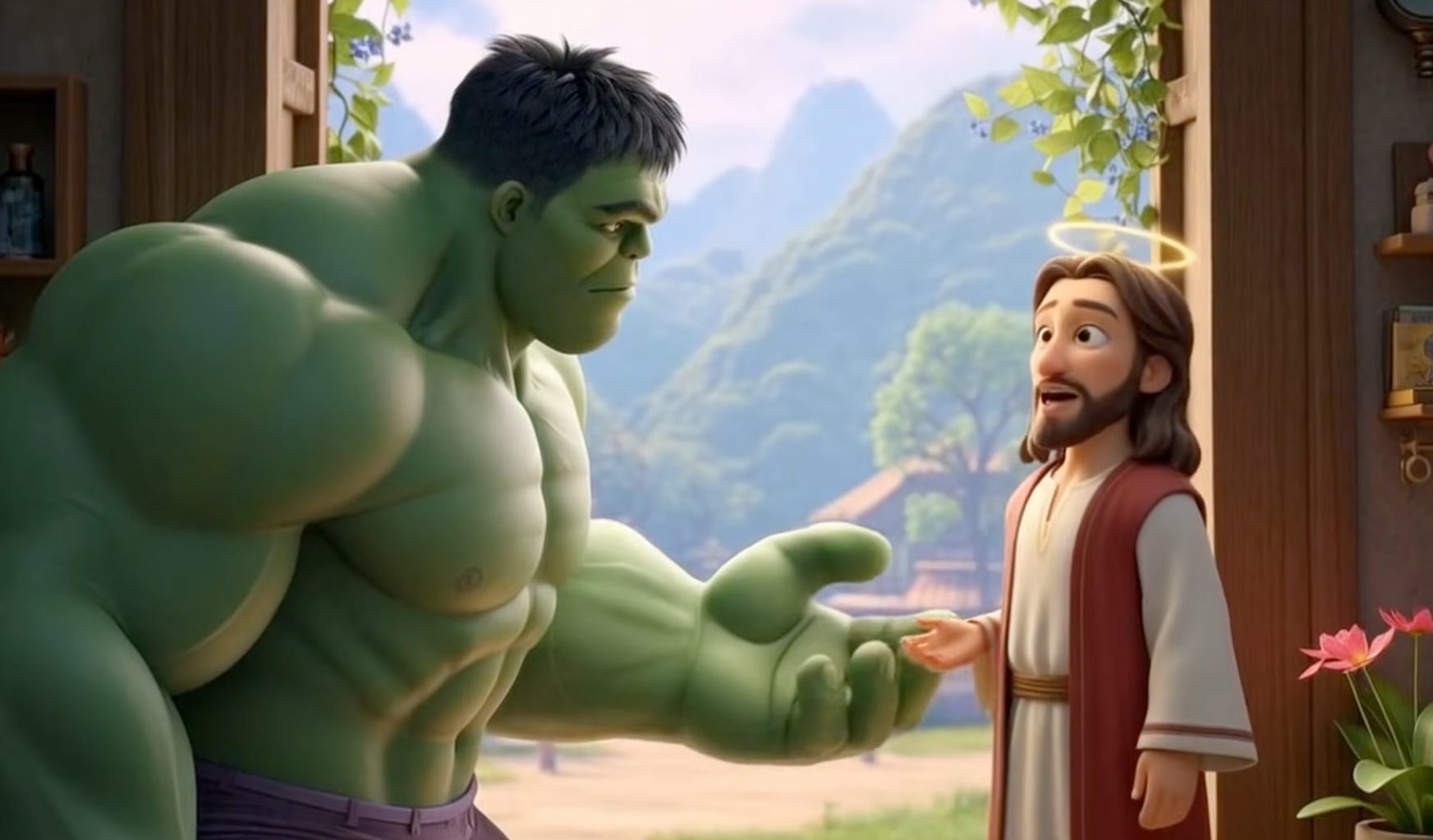
Mashed-up IP (Jesus + My Little Pony, Joker as a dinosaur)
One of the most common tells of AI content is too many limbs. Watch the lamb. Four legs running, plus a fifth one holding the girl's hand. Five-legged lamb. The AI learned "four legs for running" and "one arm for holding hands" and used both. Nobody caught it because nobody watched it.
AI cannot (yet) reliably generate readable text. When you see words on signs, blocks, or chalkboards in a kids’ video, look closely. The model learned the pattern of “text goes here” without ever learning to read. The result is word salad: shapes that resemble letters from a distance but aren’t. Calendars with days of the week that read “Tursday, Wensday, Frinday.” Signs with jumbled letter-shapes that mean nothing. In an alphabet video. For toddlers who are literally learning what letters look like.
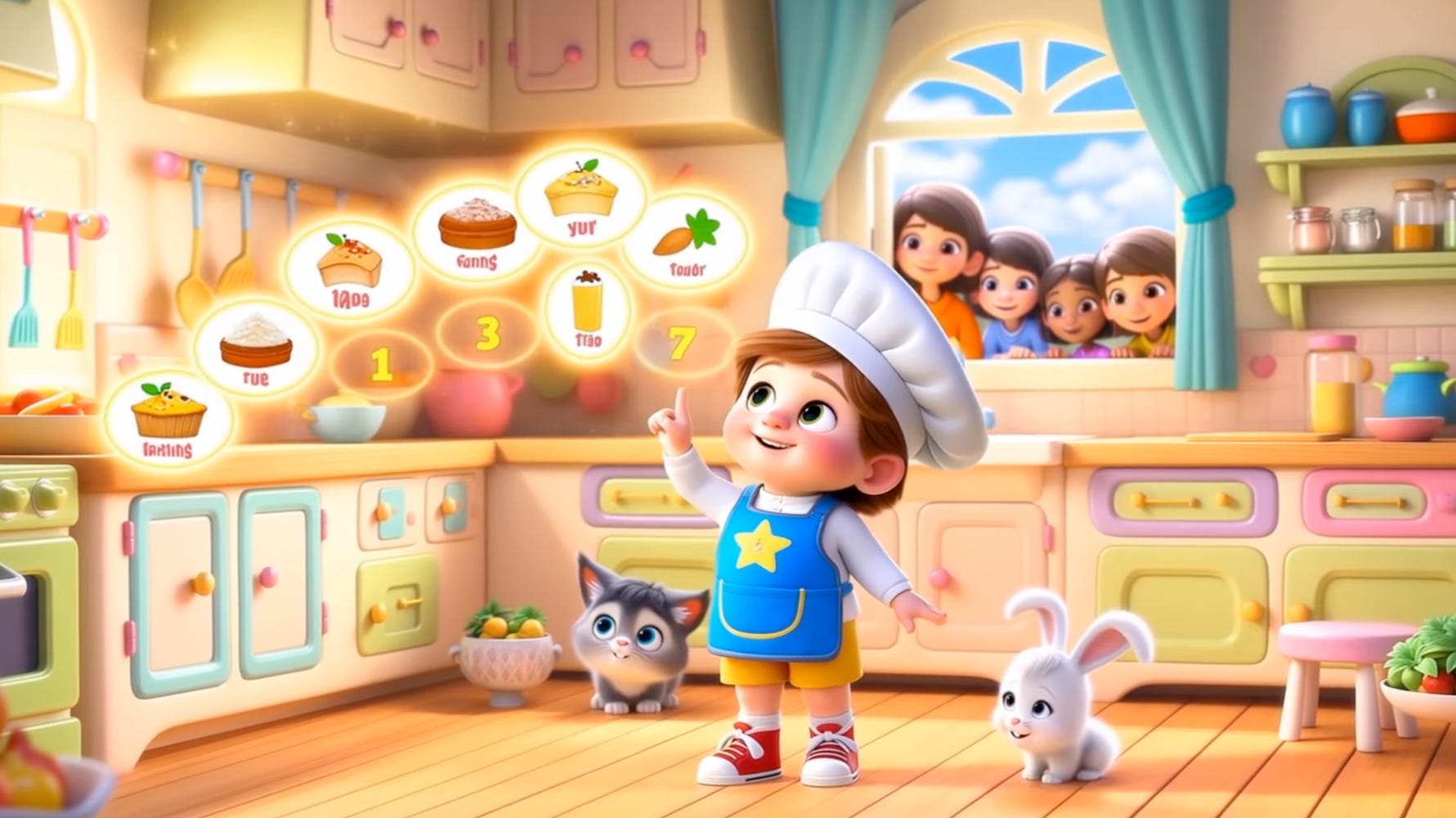
With 3.5k views, this video has the same unsafe cooking behaviors, but look at this frame: a nonsensical pile of ingredients that no recipe would call for.
This telling of Cinderella has 4 million views. It opens with a father spinning his daughter, but watch the motion carefully. The spins don't follow through. Her body moves in ways that ignore momentum. The model is predicting what each frame should look like, not simulating a spin.
With 115k views, this video is a game of spot-what's-wrong. Her feet phase through the blanket. Her brother changes appearance multiple times and then becomes a sister. Her clothes swap between shots. No one watched this before uploading it.
In professionally made animation, character designs are locked: same colors, proportions, and features in every shot. AI-generated characters drift. Clothes that change. Proportions that shift. Each shot was generated independently, because most models have no memory of what the character looked like three seconds ago. It requires more sophisticated creation.
You’ve perhaps heard that Hollywood is concerned that the latest video generation models make it very easy to spoof movie stars. But in the land of AI slop, we get IP mash-ups that do not ever make sense.
Baby Anna and Dinosaur at the Window racked up nearly 21 million views in two weeks by mashing together dinosaurs, a cute baby, superhero costumes, and a lullaby song into one viral fever dream.
AI makes this trivially easy. You type “Baby Shark meets Spiderman” and the model generates it. No licensing. No brand protection.
Lately I’m seeing lots that mix religious figures with popular children’s characters.
This one has Jesus walking alongside Bluey, Hulk, Peppa Pig, and Minions. In the same video.
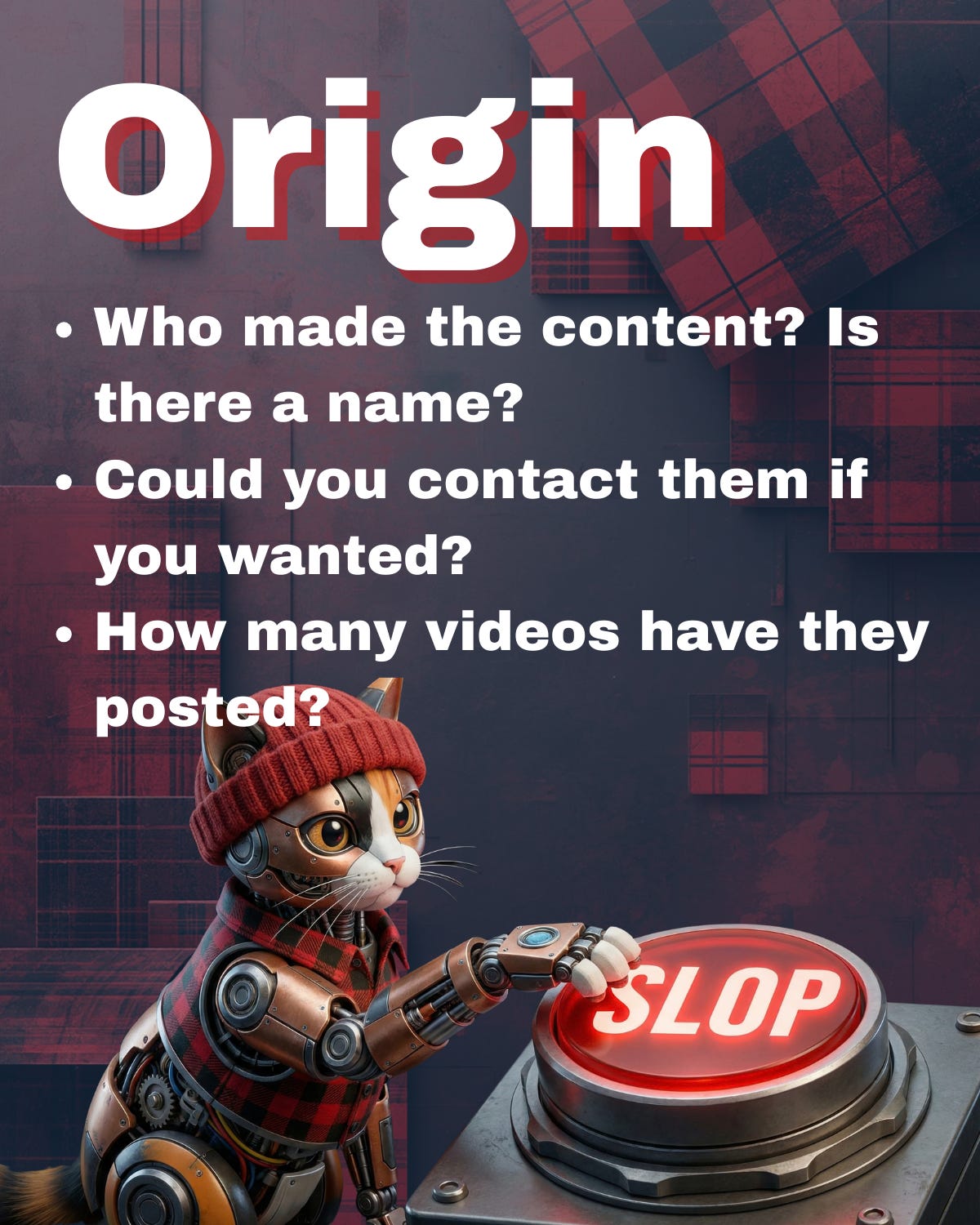
Check the channel information. Who made this? How many videos? When did they start? Is there a human behind it?
Watch for
No name, email, or website on the About page
Thousands of videos from a channel that launched months ago
Thumbnails that are raw frame grabs, not designed images
Multiple channels with identical launch dates and volume
One of the best things you can do is click the channel name, then click “About.” A real creator has a name, an email, a website. The Times found that many channels uploading AI content for children were “largely anonymous with no contact information or identifiable details as to who is behind the account.” When your business model is flooding the zone with mass-produced content, anonymity is a feature. People who care about what they make put their name on it
Check the number of videos posted versus when they launched. Cocomelon has been around since 2006 and has about 1,600 videos.
I found four channels last month that all launched in August 2025 and had thousands of videos each by January:
JoJoFunland: 7,770 videos, 3.1 million views. A new video roughly every 30 minutes for five months.
Animals Tots: 7,860 videos, 2.3 million views.
Bright Tunes: 3,463 videos, 680k views.
LalaloonyTV: 4,053 videos, 1.5 million views.
Cocomo Studio (of ABCTRAIG) mentioned earlier is currently posting a video every 2 hours.
No human team works like that. That’s an automated pipeline, and the economics are simple: when your content costs nothing to produce, why make one good video when you can make five thousand mediocre ones and play the algorithm lottery?
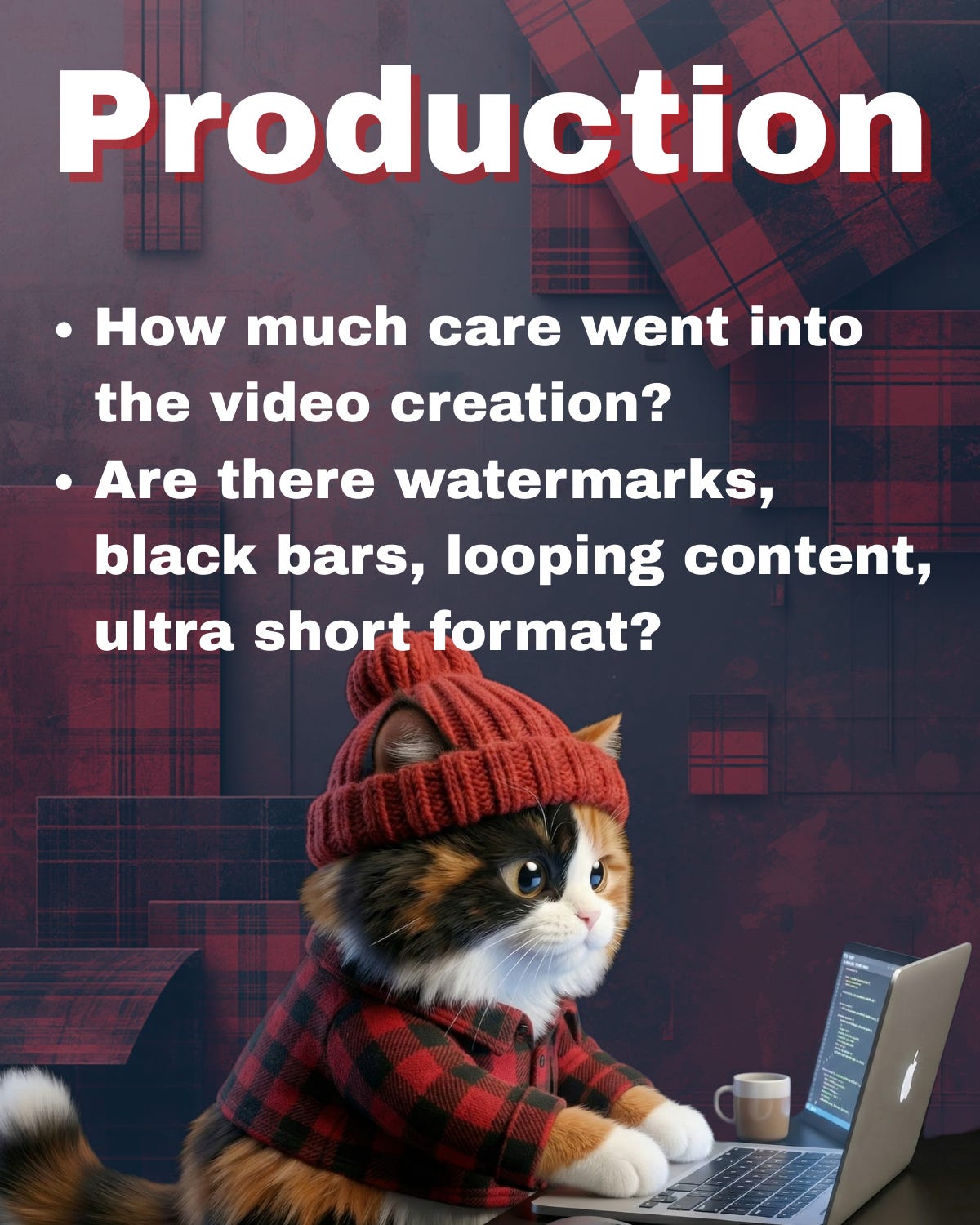
Spot the shortcuts: watermarks, black bars, looped content
Watch for
AI tool watermarks left in the corner
Black bars from uncropped output
Jarring transitions and edits
Content looped to hit 8 minutes (mid-roll ad threshold)
Some AI tools leave watermarks, especially if the person is using a free version of it. If you see a small logo in the corner of a children’s video, the creator didn’t even crop it out. That tells you about the review process: there wasn’t one.
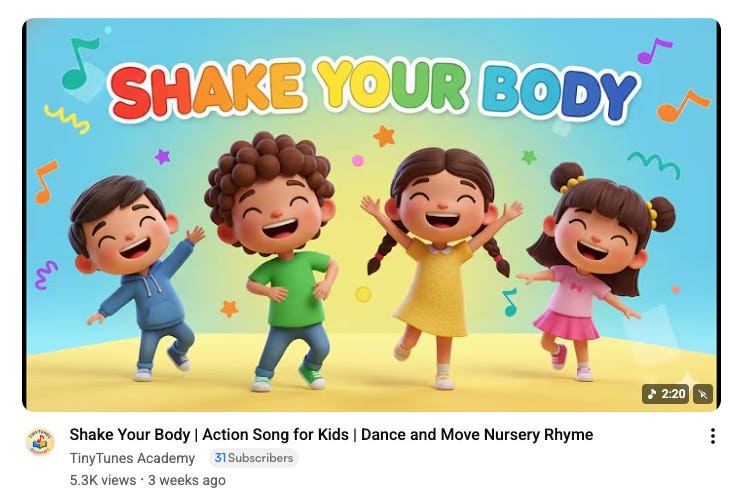
A thin black bar at the edges of an image or video means the content was output at the wrong size and nobody pulled it into an editor to fix it. Many AI tools output images and videos with bars by default. Cropping them takes ten seconds in any editor. If they’re still there, that tells you everything about the review process.
This video has 156k views. Watch the transitions between clips. In professional animation, editors change the camera angle at cut points to mask the edit. Here, each AI-generated clip just slams into the next. You can see the seams because there was no editing pass. Each clip was generated independently and stitched together in sequence, causing jarring breaks.
You might also find videos that say they’re 20 minutes, but just loop the same song over and over. YouTube allows mid-roll ads on videos over 8 minutes. Parents also often bias toward longer form content. So you’ll see channels take 90 seconds of AI-generated animation and loop it four or five times with the same song playing on repeat until the video clears that threshold. The animation repeats. The song repeats. Nothing new happens.
The video exists at that length for exactly one reason: more ad slots. If you notice the same clip cycling or the same song restarting, you’re watching content that was stretched for monetization, not made for your child.
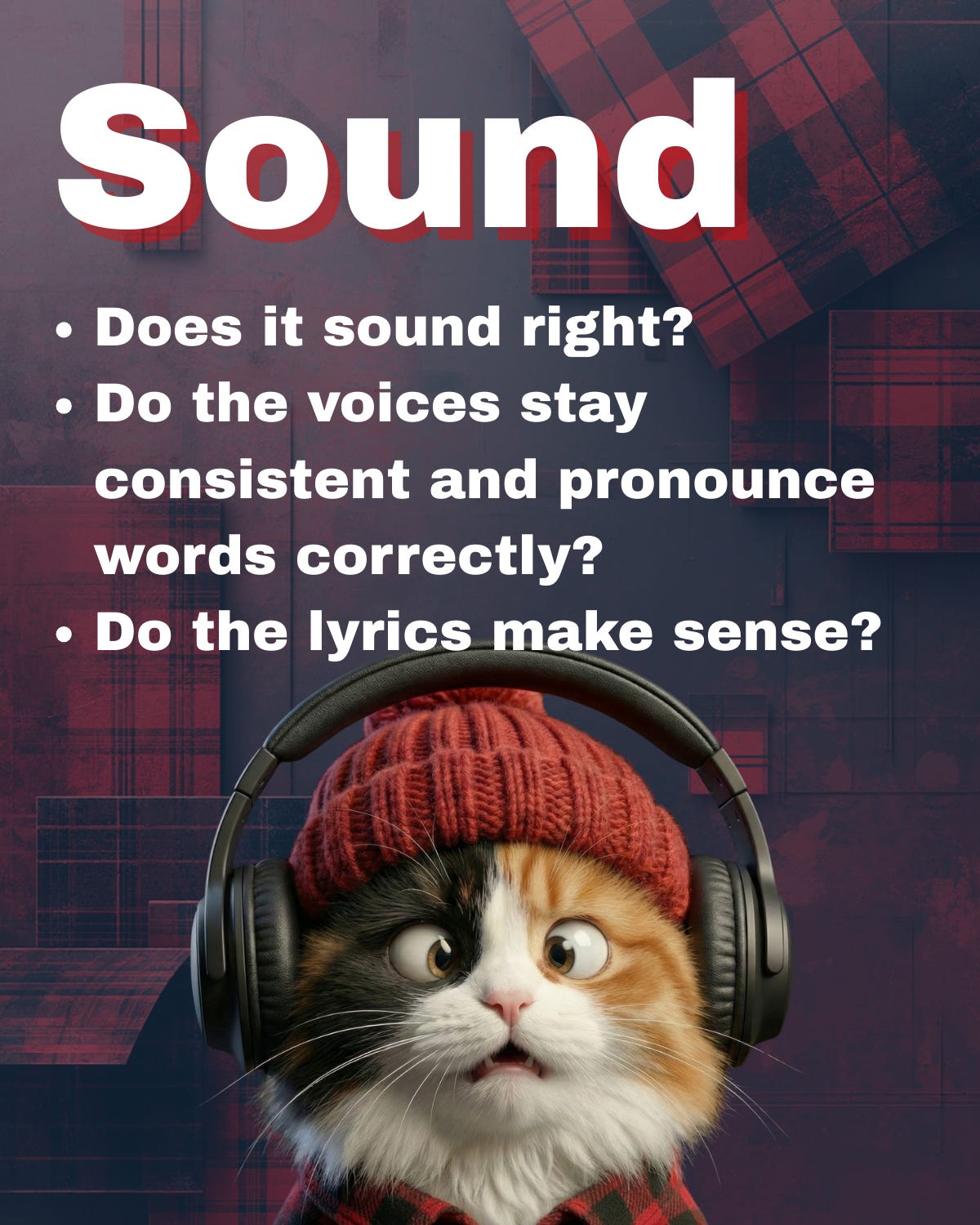
Sometimes simply listening to the content will tell you everything you need to know about whether it’s AI.
Listen for accents that change, words that don’t match the visuals, and voices that sound like they’re reading a teleprompter.
Watch for
Narrators whose accent or voice shifts mid-video
Audio that says one thing while the screen shows another
Flat, emotionless delivery with no variation in pace or warmth
Competing audio tracks (music and voice fighting each other)
We already met Teacher Shan in the Facts section. In another video from the channel, her accent morphs from American to British around the 1:17 mark, when she explains what a saucer is. Each segment was generated separately, and the voice settings drifted between takes.
Listen closely to this video with 729k views (Monster in Junk Food Song).
You'll hear two soundtracks fighting each other: the background music and the AI-generated audio from the video creation process. No one muted the original track before editing. The result is audio chaos.
Listen to any AI-narrated educational video for more than two minutes. The voice stays at the same pitch, the same speed, the same emotional temperature. A real narrator would slow down when introducing a new concept, speed up for something exciting, pause after a question to let a child think. AI narration doesn’t know when the content matters more.
This video has 1.4 million views. Listen for the randomly rolled Rs (common in AI-generated songs), the nonsense words dropped in mid-verse, and lyrics that sound like they mean something but don't actually say anything.
If something feels off, it probably is.
You don’t need to be an AI expert to sense when a video is wrong and you’re watching the uncanny valley effect at work. You already know the feeling. The animation is too smooth but somehow hollow, like a greeting card that moves. A character’s face shifts between scenes. A baby is doing choreography that would impress a backup dancer. The whole thing feels assembled, not made. That instinct is real. Listen to it.
If your kid is watching and you get that feeling, stop the video and give a simple, age-appropriate response. You don’t need a speech. You need a reason to move on.
For a preschooler: “Hmm, that doesn’t look right. Do cats really have six legs? No! The computer made a mistake. Let’s find something better.”
For a school-age kid: “I think this video was made by a computer without a person paying attention. See how the letters on that sign aren’t real words? Sometimes computers get things wrong, and it’s our job to notice.”
That last one is AI literacy in two sentences. Screens can be wrong, and you’re allowed to question them. That’s a skill that will serve them for the rest of their lives, and it doesn’t require explaining neural networks.
You shouldn’t have to be an AI literacy expert to let your kid watch a video. But until YouTube builds the guardrails it already has the technology to build, you’re the last line of defense.
Blue skies,
Carla
What are your questions around AI and kids? What do you do when you encounter slop?
Previously on AI Meets ABCs: 5 Kinds of AI Slop on YouTube Kids | A-B-Sleazy: The brainrot in your toddler’s YouTube feed | F is for Fail: AI Hallucinations in Kids’ Videos
Comments
Nothing yet. Say the first thing.
Sign in to join the conversation.