
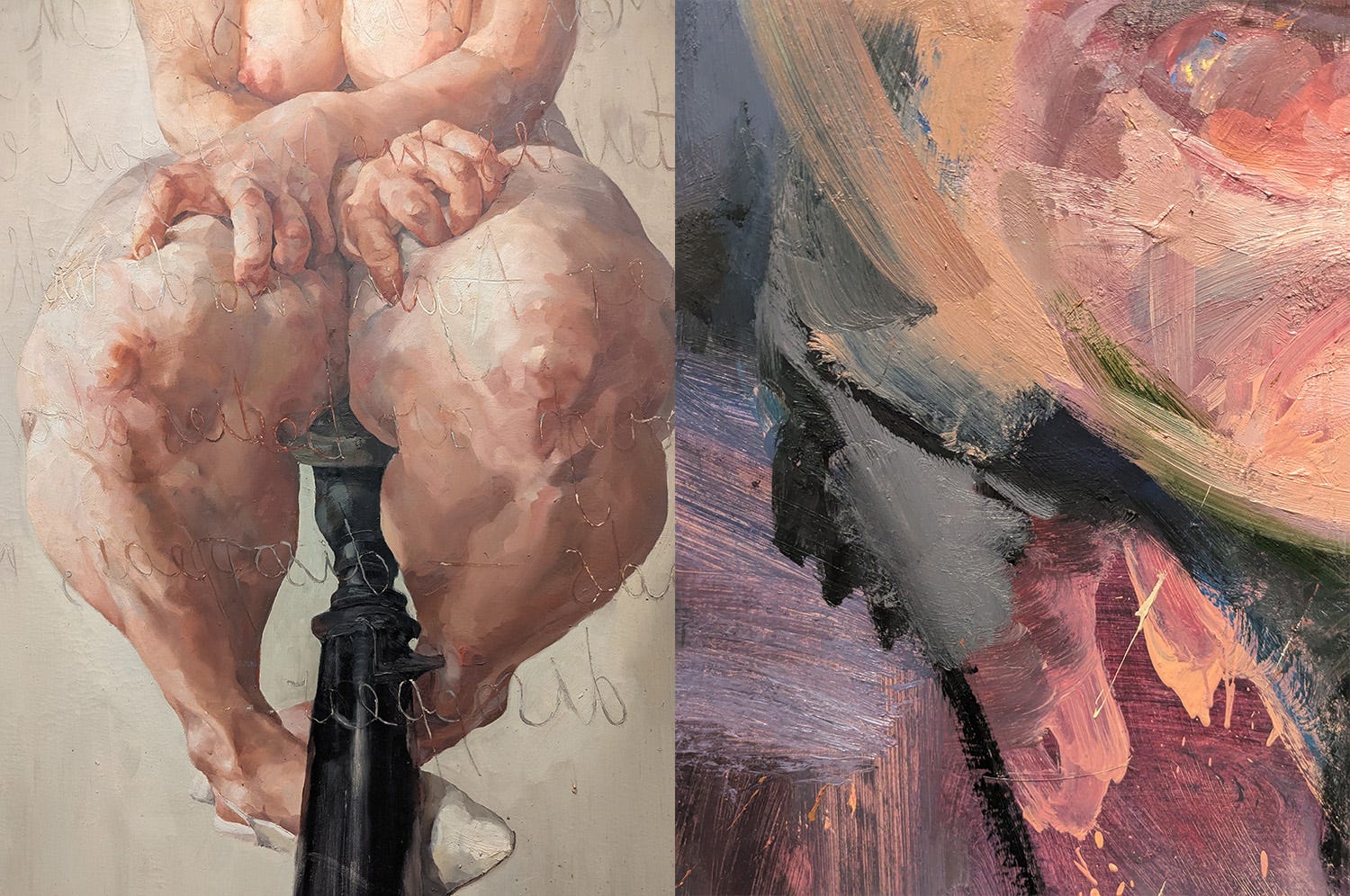
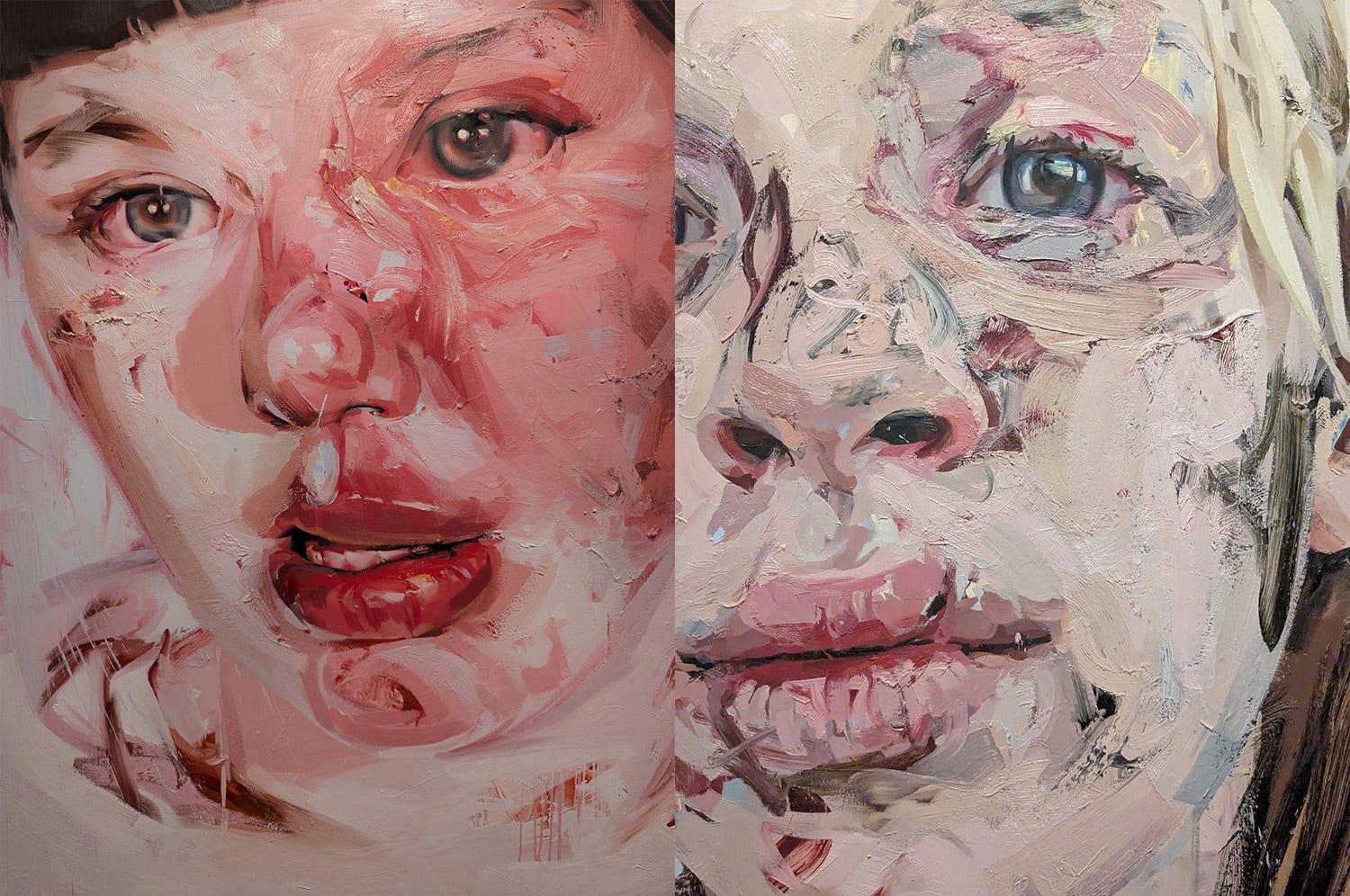
This isn’t an exhibition review per se; first because I possess particular biases, and second, because I recognise that I’m not really in the position of authority to write anything that critiques or celebrates anything beyond personal opinion. These are just some thoughts on mine when we caught the last day of Jenny Saville’s retrospective, The Anatomy of Painting, at the National Portrait Gallery last month.
I’ve been a massive fan of Jenny Saville as one of the first living and working artists whose work I discovered and followed since. She went to the Glasgow School of Art and mounted a degree show that thoroughly captivated Charles Saatchi who offered her enough financial stability for two years in exchange for her painting full-time during that period. The paintings at the end of this period would then be mounted at his gallery1. This wild opportunity gave Jenny (then in her early 20s) the freedom to paint, without the precarity of financial instability looming over her. Even at a young age, her work was magnificent and inspired, and thoroughly unpretentious. She painted bodies — often the type of bodies that people avoided looking at because of discomfort, maybe, or simply the unease of being confronted by such unfamiliarity — but the way she rendered these subjects was so arresting that one felt like there was no other option but to look. To hold the gaze of that painting and really see.
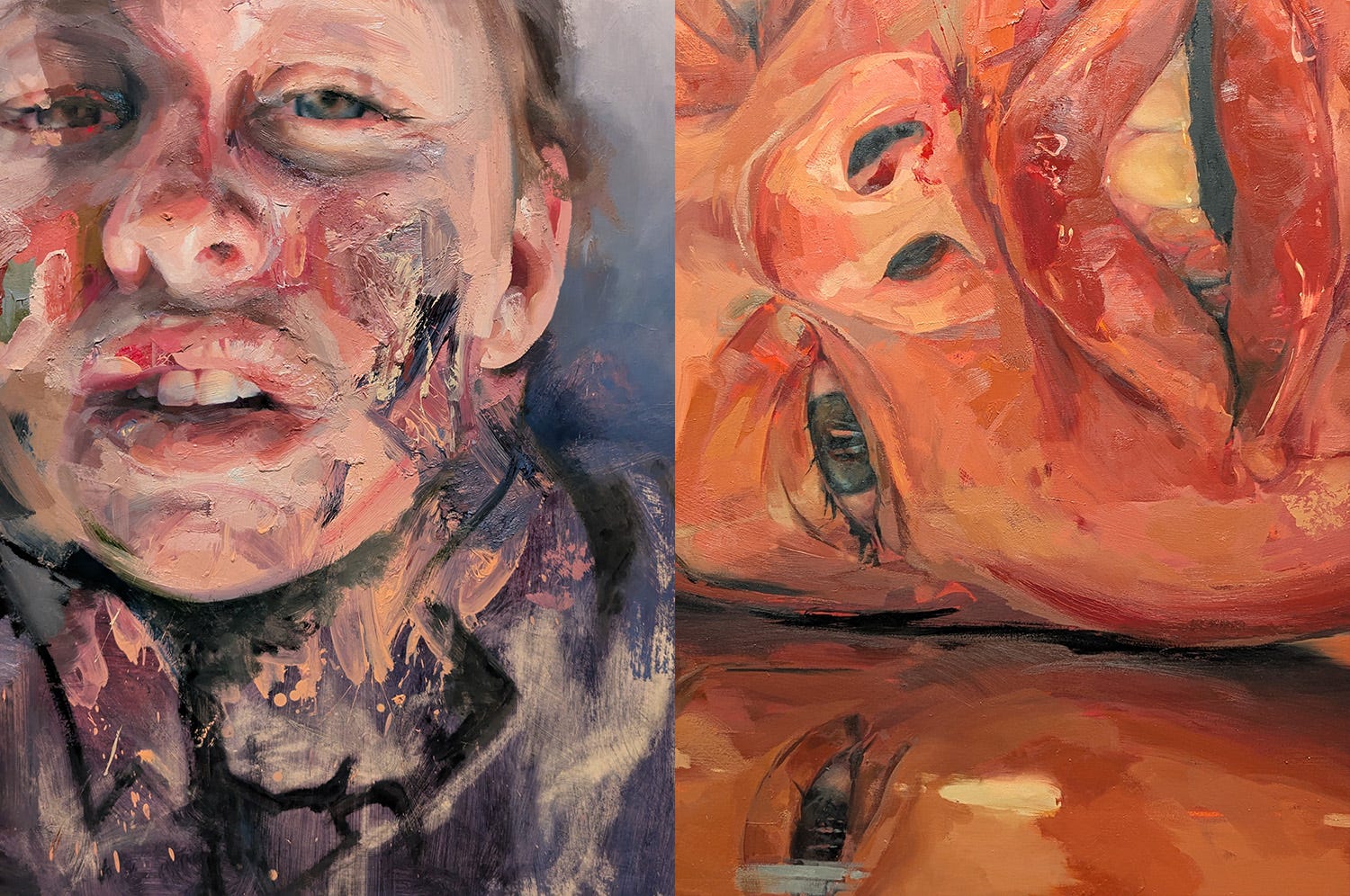
Through her work, and revisiting it in person, I realise the potential and power painting held. That beautiful things need not always be something pleasant or palatable. That rawness and the real — especially when painted in the way that she painted — was beautiful.
I’ve been having my own dilemmas as an artist who primarily paints. Speaking with two gallerists with whom I will be showing soon, I expressed my concerns about only ever really being a painter. I’ve dabbled in things like video art and some installations, sculptures, but truly, my main medium for the past ten years or so (!) has been painting. I think that’s the mode of making that feels most natural to me, in terms of serving as a funnel for all that I want to express. I distill everything — every experience, every thought, every sensation — into colours on a canvas, and even though what I make now is the closest to abstraction than any other “genre”, I feel like these images encapsulate everything that I want to say. I was insecure about being just a painter when there were so many other things an artist could be.
Anyway, they said that that wasn’t necessarily true: that painting was boring, or that it was obvious, a cop-out, almost. They said they did notice that sentiment to be something more prevalent in the U.K., which makes sense as the contemporary art shows I’ve been going to really try and stretch the boundaries of what art is, especially beyond more traditional forms like painting. Certainly, it’s not true in the Philippines, where my audience more or less is anyway. That’s what I get for scrolling through too many region-specific art meme accounts. (Hello, artreviewpower100.)
I came away from The Anatomy of Painting kind of really invigorated. Encouraged. Optimistic about the work I had been doing. Not because my work holds a candle to what she’s doing and what she’s done, but because I could see my work sort of in relation to hers. That there was space, still, for paintings — especially contemporary paintings — to exist in this world that’s oversaturated with images and detritus.
My worry was that painting is the most linked to capitalism and ownership. And that because it’s the easiest digestible medium, it would be dismissed as conceptually barren. So really, all these concerns are mostly my own insecurities of creating work that felt like they had no substance even though that’s not always necessarily true of painting. I think it’s easy to “understand” painting on a surface level, but that doesn’t mean there’s nothing that exists beyond this first initial encounter. Although it is easier to understand and accept than, say, an installation or some esoteric moving image work, it doesn’t mean that painting is inherently devoid of thought or concept.
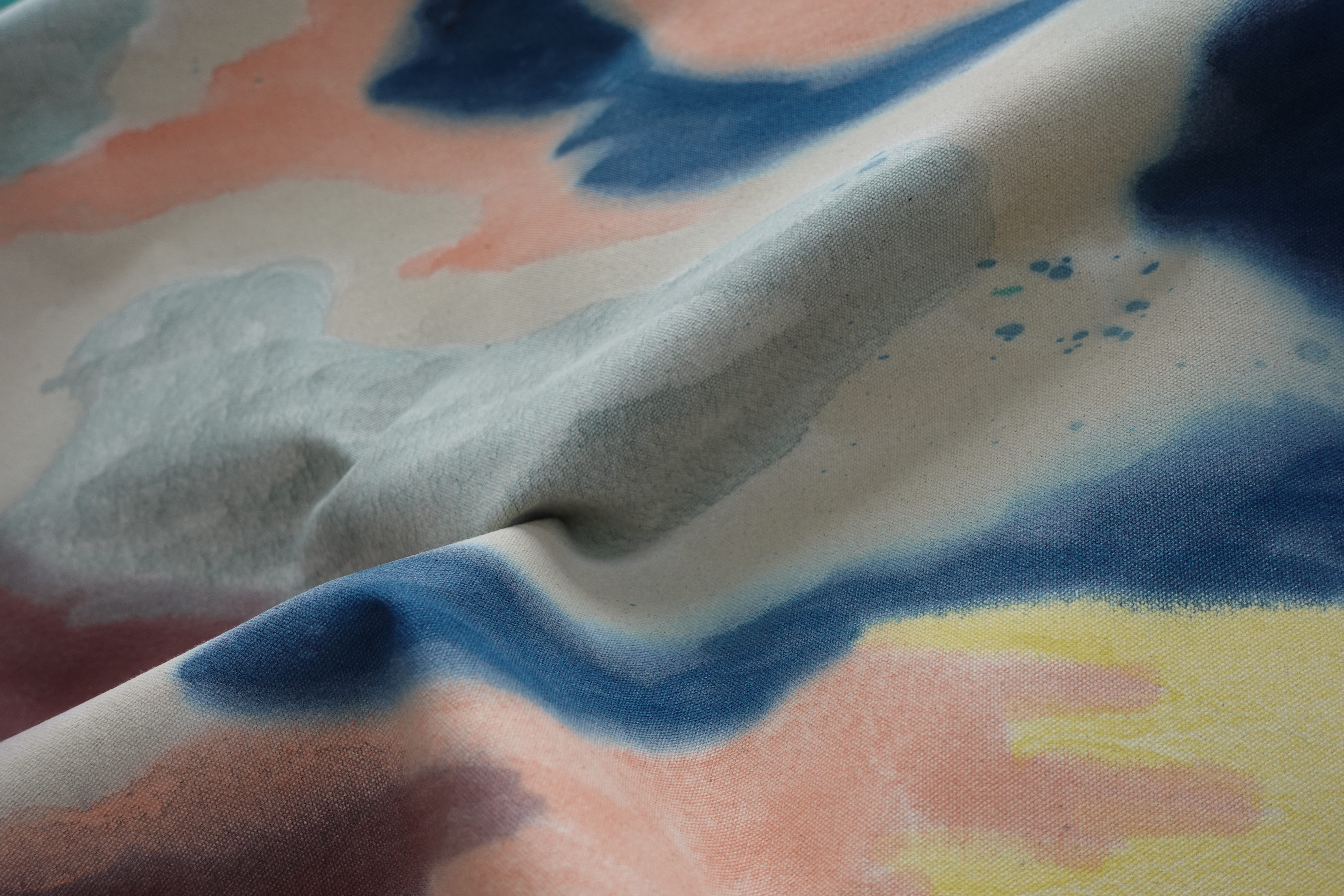
I think that approaching the materiality of the painting — the way the colours converge and interact, not just blending together, but even reacting to different environmental elements like gravity and mixture and the canvas — is such a rich thing to witness, both as an artist and as someone who’s always found the way paint creates something out of many disparate things so mystical.
It can be kind of really magical. I think that I’ve felt pressured to over-intellectualise some parts of my practice that don’t need to be validated in that way. A painting can just be a painting, and a painting can just be beautiful.
Jenny Saville’s newer work didn’t quite resonate with me as much as her earlier pieces. Not aesthetically, at least. But I can see her play with paint and see the joy and wonder involved in the making of these pictures with bursts of colour, not necessarily to create an image or evoke a feeling as an end point. But to paint just because you feel compelled to. To paint because you feel as though you must.
Thanks for reading The Second Structure of Feeling! This post is public so feel free to share it.
No posts
Comments
Nothing yet. Say the first thing.
Sign in to join the conversation.