
At Cannes in 2018, I had the great chance of being swept into Wanuri Kahiu’s entourage. She was there with her film Rafiki, the first Kenyan film to premiere at the French festival. (It was eventually banned in its country of origin1 ; more on that in this interview.) I was there with TIFF programming Arab language and continental African cinema. Because of the purview of my role, Rafiki and Wanuri’s past films2 had been on my radar even though we hadn’t met. Through a mutual friend, we ended up at the same events and then Naomi Campbell’s “Fashion for Relief” fundraiser. It’s not everyday you find yourself in a private jet airport hangar waiting to see Bella Hadid walk. But I did, thanks to Wanuri.
That Cannes remains a favourite, but it was, more importantly, the beginning of what would become an important relationship in my career and creative life. Wanuri, a few years ahead of me and already a mother, became something of a role model. I could see that she knew how to advocate for herself while bringing people in and not alienating them. She saw gaps in the world and envisioned ways to fill them, as she did with Afrobubblegum a genre she coined to embrace “fun, frivolous African art.” She was mothering while making independent films, then studio ones for Netflix (Look Both Ways), and TV for Hulu (Washington Black).
After Sundance 2025 (where she was on the World Dramatic Competition jury with Ava Cahen and Daniel Kaluuya) we hung out in LA and talked about caregiving, a discussion that planed a seed for this newsletter. A year later over Zoom, we talked about how to negotiate as a caregiver, global maternity leaves, and grandparents.
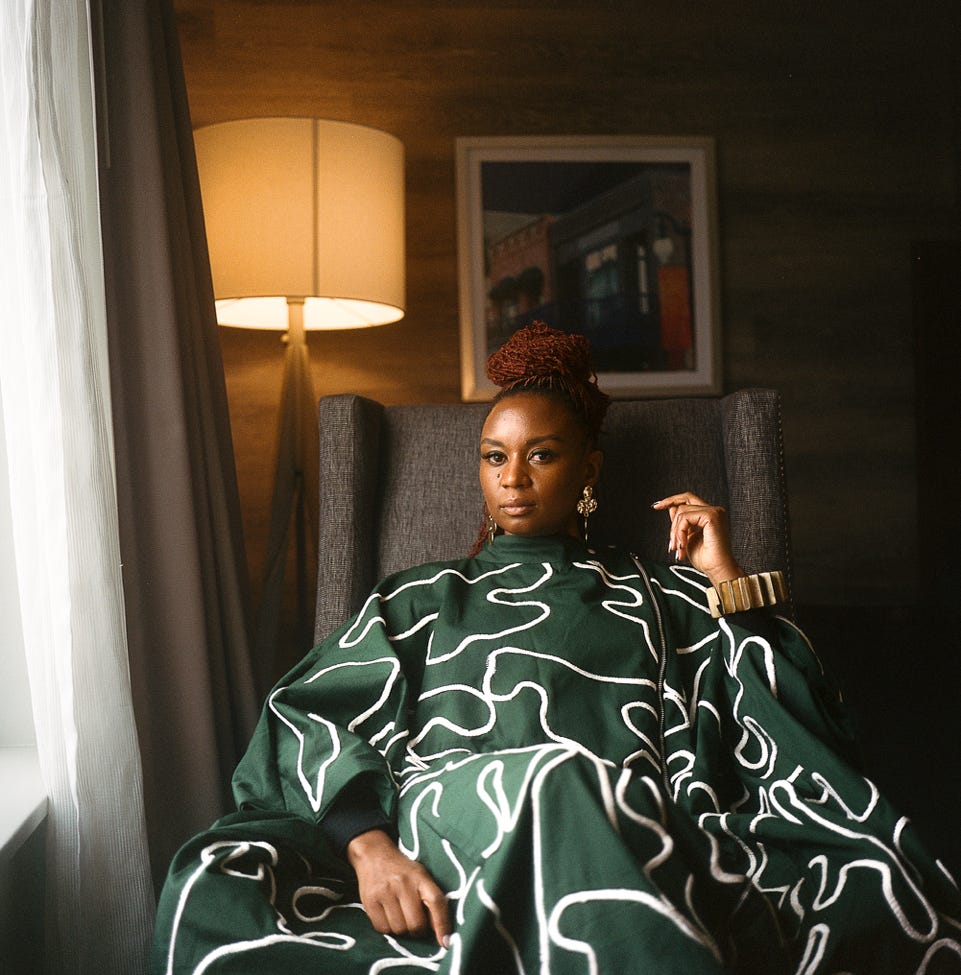
The last time you were in Los Angeles, we were talking about parenting in film and how to get more people interested. You said, “I don’t just talk about it as mothering. I talk about it as caregiving.” You planted a seed. So thank you.
Of course!
Why frame it as “caregiving in film”?
When I started talking about “mothering,” I felt it wasn’t inclusive. I met many fathers who wanted to be part of the lives of their children and couldn’t be because they were on set. On top of that, because of the age that we’re growing into, there were lots of people who were taking care of their parents. That form of caregiving needed to be addressed as well. I wanted to think about how we make space in the industry for people who take care of other people—period. Especially in that crazy American culture, which is weird and strange in its conception of what a woman should be, especially when it comes to being the lead caretakers. There are such hang-ups around having people to help you take care of yourself and your family. I have people say, “Oh, you’re one of those.” Yes, I am. I’ve always been. My mother has been, my grandmother has been, my great grandmother has been. We’ve been one of those.
I’m also not American, and think that idea of the individual is also very much at play here in the idea of mothering on your own. Almost a bootstrap mentality.
Not to mention maternity care. Isn’t America’s maternity leave one of the shortest in the world?
There isn’t any. There’s none.
No.
There’s no federally protected paid maternity leave.3 Rules vary state by state. So for me in California, I negotiated a paid maternity leave in my last contract and I ended up going on state disability for part of it. That’s the other thing: you go on disability insurance to be a caregiver.
That is crazy.
And this is in a country that is actively destroying disability civil rights before our eyes. But to answer your question: There’s no federally protected paid maternity leave. What is it in Kenya?
It’s three months.4 Sorry, but what is the expectation in the US?
You just get back to it? This is why you can see the person who gives birth, usually a woman, ends up leaving the workforce. It’s not sustainable.
That’s what I saw when I was working on that side of the world. Actors not being chosen because they said, “I’ve just had a baby and I can’t show up to work without my baby.” And then the employer replies, “We don’t have insurance for your baby, so I guess you can’t work.” These are companies that are, in theory, family companies; they create family shows. But they’re anti-family in their ethos, in their modes of creation.
There’s so much radical potential in families, in mothering, and in structuring a world around thinking about supporting children.
Yes, and caregivers. It also means that if you take care of families or if you have even affordable childcare, you’re actually earning more for your country. More people are working. Even your capitalism is not making sense at this point! For men to fully understand what loss of income because of caregiving feels like, the maternity leave should be as long for men as it is for women. If you’re three months out, a man is three months out, and then he can see what it feels like not to be in a workforce, to have other people come in and take away your job. Something I struggle with is that I don’t want to be my job. I don’t want to be my career. I also have creative impulses and miss creating and being around artists when I’m not on set. It felt really isolating as part of childbearing and childrearing to be removed from that. If you want to have more equity, there has to be a system that’s trying to create some sense of balance between the entirety of the family and not just letting it fall on the shoulders of one person.
How can we do that?
We could normalize how primary caregivers negotiate their contracts in Hollywood. Kerry Washington and Viola Davis did that on Scandal and How to Get Away With Murder. But it feels like you have to be at such a high level or be above the line. I try as much as possible to add my nanny into a contract. To have a house that is big enough for my children to be in. The thing that I am fighting for now is to have a chef, because you can’t expect me to be on set, work, and then come home and cook for everyone. That’s not good for the film. It’s not good for anyone in that case. On my last Netflix film that’s what I was able to do. I figured out a system for care. My priority is to be a good mother and to be a good filmmaker. Those are my priorities. Everything else is out-sourceable.

Being upfront, advocating, and asking is setting everybody else up for success.
If you’re not well fed and stressed about how your kids or whoever is going to be cared for, it’s going to make it difficult to show up and lock in to direct. It’s going to be really difficult to be 100% on set. Because nobody else on set is caring about that.
How did we get to a point where making films feels so equated with suffering? Is there another way of doing it?
I think it’s about centring care. Mira Nair, before starting the day, would have a yoga session for all cast and crew. That’s self-care, but it’s also team-building. Your day goes better because now you’ve breathed together. An eight, ten hour day with an optional earlier morning yoga class. That’s my ideal set.
I heard The Daniels held a dance party on Everything Everywhere All At Once to start the day.
I love that. Efforts to find points of actual human connection are few and far between.
Does Afrobubblegum feel like a form of caretaking for narratives?
It’s 100% a form of caretaking for myself, not for narrative necessarily, but first of all for myself. If I’m not doing anything that has hope and joy at the end of it, am I really being of service? If it doesn’t have hope and joy in it, then it’s not for me. And that’s become a really clear boundary about what I say yes and no to. I’ve chosen my lane and I’ve made it my thing, my genre. This helps me understand the work that I want to do and I continue to do. Period.
Look Both Ways dealt with becoming a parent. What was that experience like to think about capturing that choice on screen?
I’m sure you feel it like this, but sometimes I’m going about my life and I’m like, “Oh, shit, I’m a mum.” You know what I mean? Even though my daughter is 13, I’ll just be going along with my day, just being myself, not having “mum” as a title. And then remember. That’s what Look Both Ways felt like. These parallel lives that we can have. I think there’s a part of me that still believes that if I put down something in one place, I’ll find it in the same place. It will not be moved by any child or partner. That’s a utopian alternate universe. That’s why you need an office.
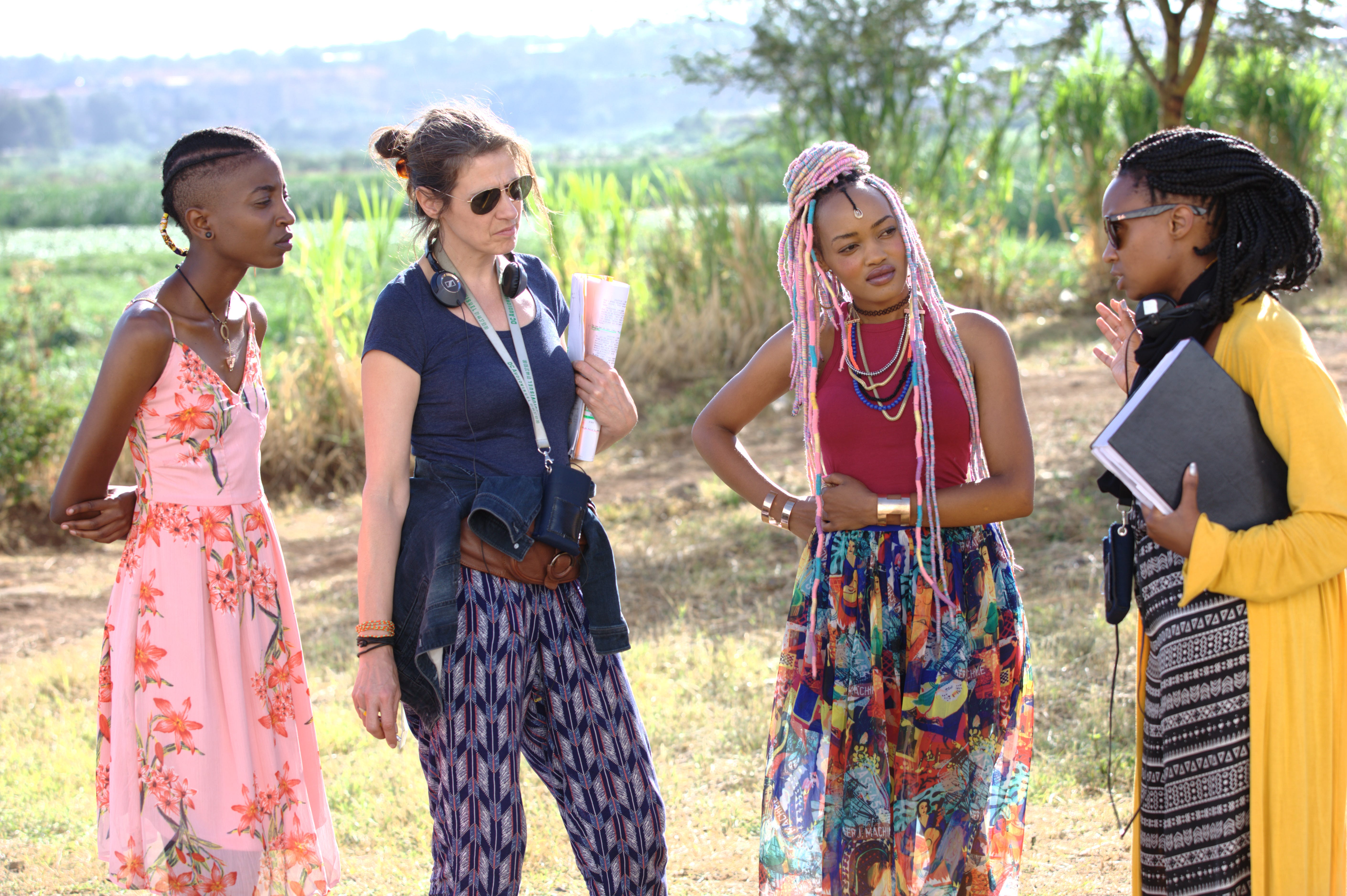
What was that like to jump from making a film in Kenya to the US?
It wasn’t so much moving from Kenya to America. It was moving from independent to studio. In indies, you’re constantly negotiating what you can have. I remember my AD on Look Both Ways kept saying, “Don’t ask. Just say what you want. It’s not a negotiation.” That was a big, huge learning. The clearest way I can explain it is: In Rafiki, we were shooting a scene where the girls are in a tuk-tuk. A tuk-tuk is basically the size of a motorcycle with a hatch. The tiniest of tiniest trunks. I was in the boot, head to crotch with the sound guy, with a screen between us so that I could see the performance—basically while I sniffed his crotch. That was Rafiki. In Look Both Ways, there was a car scene, which already has significantly more space than a tuk-tuk; I could easily have been in the backseat. But instead, I had a gigantic rig and three monitors set up for me to see every camera angle, with a chase car, and a lead car. The scale of what you can do and what you’re able to achieve is unimaginable, but then you still have all the same constraints. You’re still chasing light. You still have to direct then redirect. Everything else is the same.
Did Washington Black feel the same way?
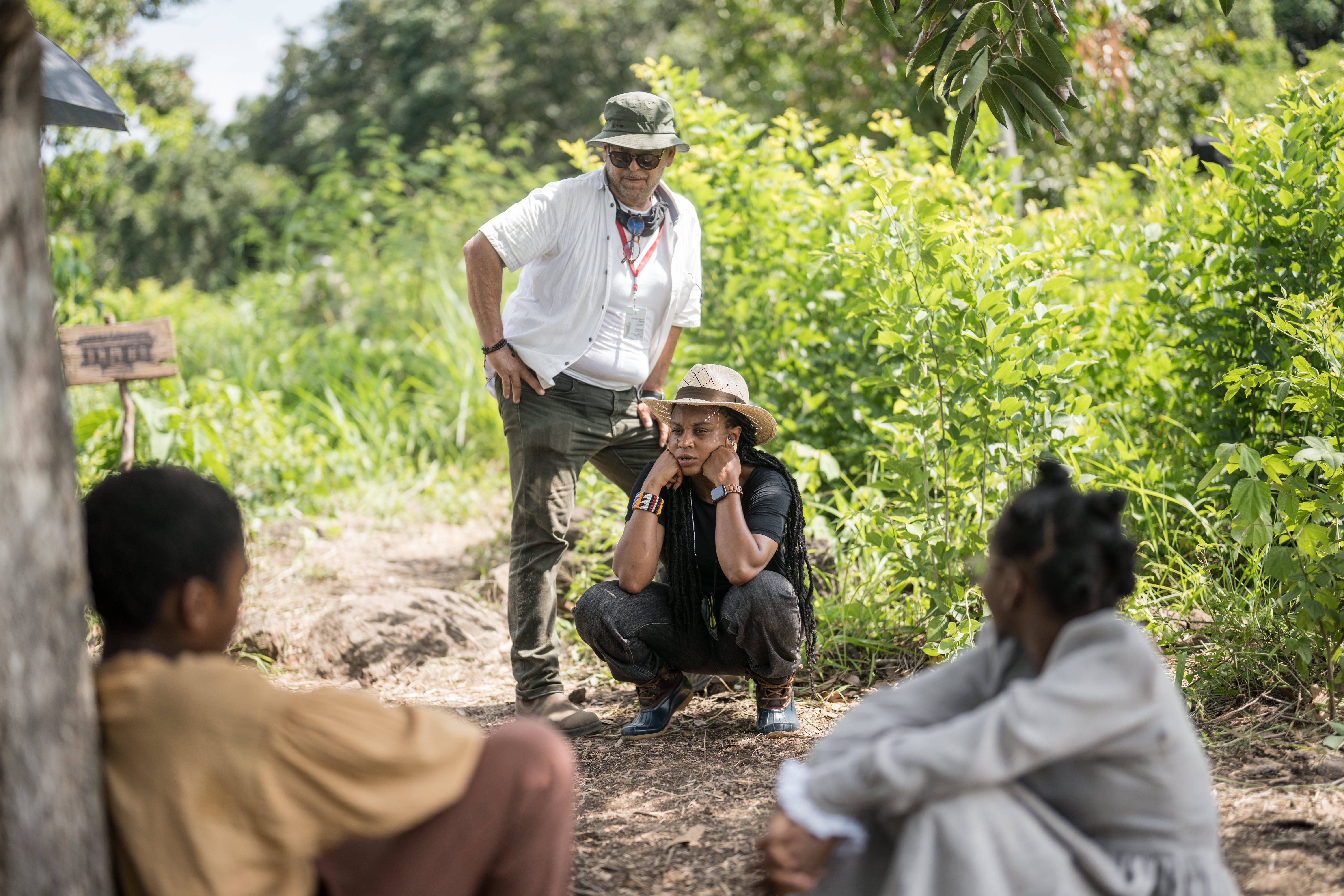
Washington Black was beautiful, but also incredibly hard. On Rafiki, at the very least I got to go home every night to my house. On Look Both Ways, I got to go home every night to my children. On Washington Black, I was away from my children and my home for about nine months because TV takes so much longer. Also, TV does not care about the director. For that reason, I don’t know if I can do TV in the same way again. It cost too much on my mental health and it cost too much for my family. I did work the hardest I’ve ever worked in my life. Every time I land a job, I’m so excited. And then I have to balance that with the anxiety of leaving the country. What if my parents get sick? How quickly could I get home? Can I get home? How many directors have we heard go up at an awards show and say, “My father died while I was making this movie. I didn’t even make the funeral. I knew he would have been proud.” And I’m just like, “Yeah, but are you? Are you really proud?” It has to haunt you. I lost both my grandparents within 16 days of each other while shooting Washington Black and I couldn’t go home. Luckily, I was in Mexico, so the crew had a sense of what it means to lose a grandparent. But the Americans did not. It was just like, “Oh, it’s a grandparent. It’s not your parent.”
I think that goes back to that question of community and who you spend time with. I feel so lucky that I spent my entire summers with my grandparents. Then, I saw my mum take care of them as their caregiver.
And those relationships that are intergenerational are so important. It’s not: “They’re old, they were going to die.” No. This is someone who helped raise me. This is somebody who was foundational to my existence. This was somebody who I’ve learned care from through watching other people care for them. This is the true basis of humanity. We are human because of the people who came before us. Not acknowledging them is heartbreaking. This is why every time I get a film, I celebrate and at the same time, I worry. And maybe that never goes away. I understand why people want to be able to try and take jobs closer to home as much as possible. I think that’s important.
The legal ban on Rafiki was finally lifted—
It was not lifted.
It wasn’t?!
We won in the Court of Appeals, who said that the ban was unconstitutional. But then we had to go to the Ministry under which cinema sits to lift the band. That minister has completely pretended this all doesn’t exist. We’re going into the Supreme Court next. It’s not even about Rafiki anymore. It’s about defending the constitution and the constitution has a very clear clause on freedom of expression. We have not broken any freedom of expression rules. I thought this was going to be a localized or maybe global majority conversation. But now, watching countries break down over rights and laws that are enshrined in their own constitutions…it’s a fucking mind fuck. All of us are now fighting for freedom of expression. Just look at the monopolies that are being created in America—these are anti-freedom of expression. Look at the Paramount merger! I’m glad that there’s activism against it because it’s not only going to dilute the power of the Guilds, but it will fully dictate what is created. Period. This world is not making sense, Kiva. Make it make sense. Maybe it never has. And we’re just seeing it properly with blinders off.
It does it does feel like the blinders are off and that the only to move forward with any kind of sense of sanity is making a space where people know that they can show up and be cared for, whether that’s across the street or on a broader level.
And knowledge sharing, too.
Yes, like you saying what you ask for in contracts. Other people hearing that might think, “I can do that too.” Ask, the worst they do is say no, as my grandpa used to say.
It’s also about more women talking transparently about what is possible and what they want for themselves; what they ask for and what they want to ask for. I have a feeling, because we don’t see lots of contracts, that men ask for some ridiculous things. Transparency. Transparency. Transparency. Even if there was a caregiver template!
I love that. A caregiver’s template. What would that look like? What would the the basics be?
A caregiver template contract would be a resource where you can go in and say, “I am the mother of a child under x. I am a father of a child with these needs. I am a caregiver of a child with x.” And every section is carefully outlined and tells you what to ask for.
This also takes away the pressure of having to ask. Because that alone can be a burden.
Especially when you’re trying to forge a path that hasn’t been done before. Most things can be done, but the how is the hard part. A resource like a caregiver contract template, even just from a legal perspective where you could copy and paste language, would be huge.
Well, now we have a new plan.
I love a plan. You look so beautiful. Your skin is popping.5
Oh, my God. Thank you.
Wanuri Kahiu is an award-winning Kenyan filmmaker, writer, and speaker known for bold, imaginative storytelling that centers African joy and resilience. A graduate of the University of Warwick and UCLA’s MFA program, she is the producing director of Washington Black (Hulu, 2025), directing both the pilot and finale of the acclaimed limited series, which earned a 100% Rotten Tomatoes score.
She previously directed the Netflix hit Look Both Ways (2022), and is currently co-writing and directing Disney’s live-action Once on This Island. Her earlier films helped shape a new wave of African cinema: From a Whisper (2008), Pumzi (2009), and Rafiki (2018)—the first Kenyan feature at Cannes—have all received international acclaim.
Wanuri is a member of the WGA, DGA, and the Academy’s Directors Branch, where she served on the Executive Committee for International Films. She was named to the TIME 100 Next list, and is a Cultural Leader and Young Global Leader of the World Economic Forum. In 2025, she served as a juror for Sundance’s World Cinema Dramatic Competition and for Sørfond (2025 & 2026), supporting global artistic freedom.
You can and should watch Pumzi (2009), Wanuri’s sci-fi short. It’s available here for free.
“There are only eight countries in the world that do not guarantee paid family leave at the national level for men or women. Most of them are classified as low- or middle-income states: Marshall Islands, Micronesia, Nauru, Palau, Papua New Guinea, Suriname, and Tonga. But the eighth country on the list is among the wealthiest in the world: the United States".” Sholar, Megan A. “The History of Family Leave Policies in the United States.” The American Historian. November, 2016.
According to research conducted by The WORLD Policy Analysis Center from 2023: “In Africa, an increasing number of countries are leading the way in expanding maternity leave. 31 out of 54 countries in the region already meet the 14-week standard outlined in ILO’s Maternity Protection Convention (C183). Kenya remains one of the minority of African countries that falls short of this standard, providing 3 months paid leave to mothers of infants.
Two countries in Africa (The Gambia and Djibouti) provide new mothers with 6 months of paid maternity leave – an important form of support for the World Health Organization’s recommended 6 months of exclusive breastfeeding to promote infant health.
Twenty-one middle income countries around the world have shown the feasibility of providing 6 months or more of paid maternity leave.
Leading countries in Africa include Djibouti, Ethiopia, Gambia and South Africa, which offer 4 months or more of paid maternity leave.
“EXTENDING PAID MATERNAL LEAVE: FEASIBLE OPTIONS FOR KENYA” The WORLD Policy Analysis Center. October, 2023.
I obviously had to include this part.
No posts
Comments
Nothing yet. Say the first thing.
Sign in to join the conversation.