
While I remain highly skeptical of algorithmic programming and how much of our lives are determined by ad data suggestions, I am grateful for two moments of a prompted push. The first, was that my now-husband “found” my profile on Hinge. The second, was this platform suggesting Steve Way’s newsletter.
These clearly have different material impacts on my daily existence, but Way’s writing has radically expanded my considerations of care. His words also carry an anger (which we talk about) that I find grounding—especially at a time of genocide, war, and increasing fascism. Who isn’t currently pissed off?1 But Way also offers a path forward: solidarity.
What inspired me to reach out to Steve a few weeks ago was a line in his newsletter: “If your fight is SNAP, learn the Medicaid one. If your fight is your kid’s IEP, learn the HCBS one. They’re the same fight and they want you to think they’re separate.” My learning curve of becoming a parent has included navigating the Regional Centre system, therapies, specialists, and insurance.2 A set of skills that I feel uniquely equipped to deal with as a generally determined person who is unwilling to accept “no” in situations where I feel it fails the recipient. Not everyone is like this. Not everyone has time for this. But maybe we don’t have to do it all alone. In three sentences, Way managed to help me see the forest for the trees.
Way also has a way of making the reality of disability not feel abstract; once you start thinking about it, it really is everywhere. For instance, if you’re a pregnant person reading this (my base; I love you), pregnancy isn’t a disability under the American Disability Act, but conditions related to pregnancy can be. As there is no federally protected maternity leave in the United States, if you’re lucky enough to live in a state that has it, you will be going on disability insurance to collect paid family bonding. (That’s what I did here in California.) Yet again, this is all of our fight.
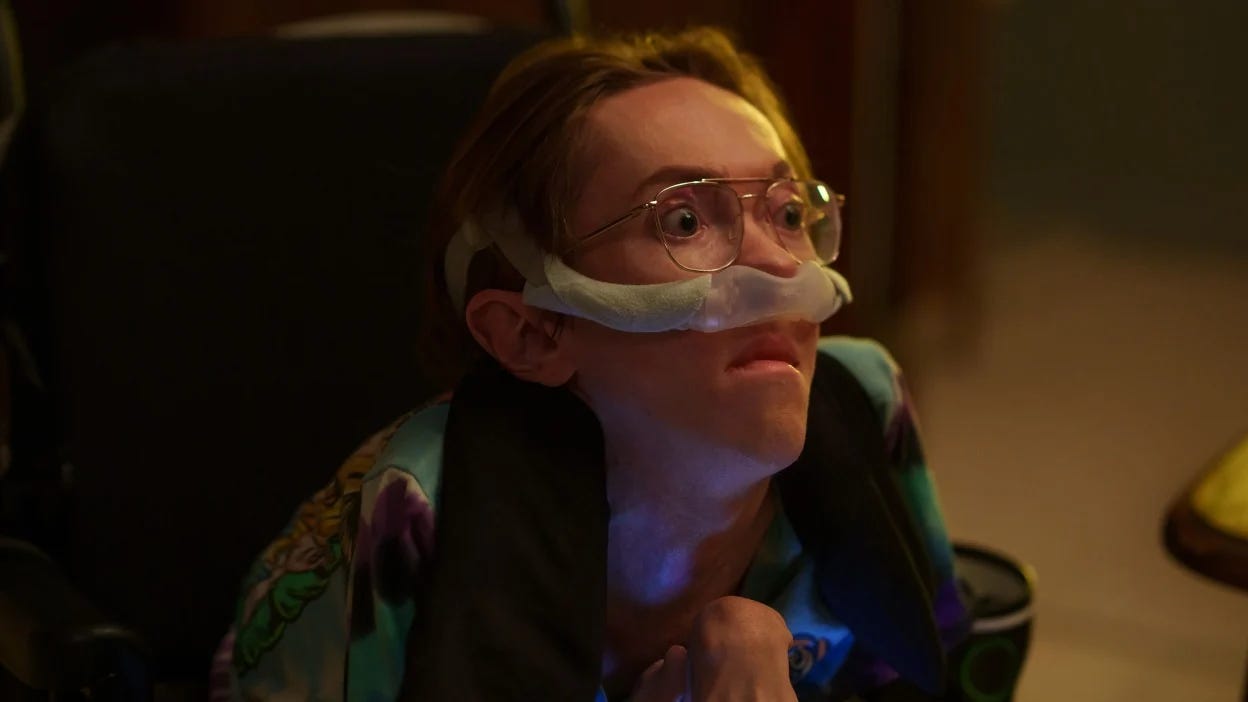
After I emailed Way, I started watching Furious, Elizabeth Meriwether’s Epstein-coded thriller on Hulu, which features Way as the love interest. The show follows Catherine (Lola Petticrew), a victim of a sex-trafficking ring who takes revenge on the rich white men who ran it, and the police officer, Alice (Emmy Rossum), following Catherine’s trail of bodies while grappling with her own trauma. It sounds sensational. But instead, I found myself watching a uniquely nuanced show that pushed the expectations of its genre. Way’s character, Alden, knows Catherine as his nurse and caregiver; his scenes offer moments of levity (to be expected given his comedic pedigree), but also moments of genuine sensuality, connection, and gentleness in an otherwise harsh world that unflinchingly reflects our own. I realized I was watching a show about care.
Way’s discussion below is far-ranging, and covers Furious, how Section 5043 (which requires “a school district to provide a ‘free appropriate public education’ [FAPE] to each qualified student with a disability who is in the school district's jurisdiction”4) connects to Ramy, disabled history, and Christopher Nolan’s The Odyssey. My endless thanks to Way. In his words, solidarity forever.
Congrats on Furious. I hadn’t seen a representation of a caregiver being something much more than just, “I pay this person to help me.” Was that something that you had gravitated to when you first read it?
Funnily enough, in May of last year I was on a panel in New York about caregiving that was set up by Caring Across Generations5. Sitting next to me was Elizabeth Meriwether. About two months later, I got an email from her people staying, “Do you want to be in her show?” and that she wrote a part for me. The beautiful thing about this show is that there are multiple caregiving relationships. Caregiving is not just, “Let me help this disabled guy.” I’m helping her [Catherine]. I’m giving her care. The show is also about seeing abuse survivors for who they truly are. And that’s why it works so well—we don’t judge each other. We love each other for who we are. I think the relationship between Alden and Catherine is the most genuine. And probably the healthiest.
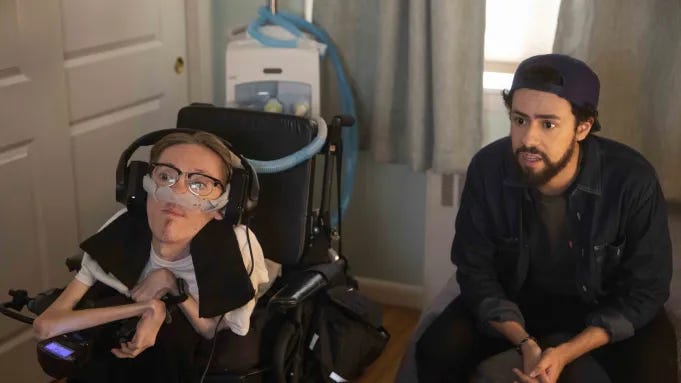
On this topic of reciprocal caregiving, I was also thinking about how you met Ramy Youssef in school—and that you were in the same school because of Section 504. You helped Ramy make that show; he helped you in other ways. In a way, that’s also what we’re seeing in Furious in Catherine and Alden’s relationship. Caregiving isn’t one directional.
With Ramy, it’s a very micro-macro experience. Ramy has helped me go to the bathroom for 25 years. He put food in my mouth, but it’s like, of course you would. Why wouldn’t you? So when he came to me with the role, of course I would, because why wouldn’t I? And because of the friendship, we were able to make such an authentic show together. After almost 10 years since Ramy has been out, people still praise its authenticity.
You also met because we were in the same school. This feels so basic to state, but this administration is trying to take this integration away.
Yes. That’s just one part of the whole plan. It’s dismantle Section 504. It’s taking disabled education from the Department of Education and into Health and Human Services. That right there shows their hand. They’re taking the social muscle—which is disabled children should be integrated in public schools—and turning that into: They’re a disease, they need to be cured and managed. And then you have the Department of Justice citing that the Olmstead decision is not constitutional. Olmstead allows people with disabilities to live in their own homes.6 They’re trying to take away our education. They’re trying to put us back into institutions. In under five months, our healthcare is going to be up for debate. People have already been kicked off food stamps. It’s a very fast and deliberate—but a quiet way—to take away our rights, take away our way of life, and keep us silent. And at the end of the day, we have to call it for what it is. It’s eugenics.
When I think about the education that I received around disability and disability justice, which was already very limited, it was never really framed as civil rights.
You have to make it broad. That’s how you foster solidarity. And you have to foster solidarity because we’re all involved, but we’re so divided. This isn’t a political issue. It’s a human issue. I have friends all over the political spectrum and we’re all going through this: Trouble with SNAP, trouble with Medicaid. They don’t care about ability, disability. They don’t care about Democrat, Republican. If you’re involved, you’re going to be affected by it. That’s it. That’s a fact. And they’re coming for all of us. You can’t be ignorant. The other part is that in America, which is hyper-capitalist, healthcare did not fall under civil rights law, and as we’re seeing civil rights are temporary privileges. It’s deliberately a class war. The $1 trillion that [Trump] wants to be cut from Medicaid protects tax cuts for the wealthiest. We need redistribution of wealth. What’s that called? Socialism. I call it for what it is. Another problem with [this system] is that you have to prove your worthiness for healthcare through labour with the work requirements. The way that the law around work requirements are written means it’s not enough to have a qualified disability. You have to justify why that disability prevents you from working. I’m going to say something that may be triggering. We’ve heard this before: “Work will set you free.”7 You can’t have culture if you have to prove yourself through output by labour. You can’t have that in a just and civilized society. That’s how you murder people.
It feels like once you start thinking about disability—once you pull the thread—everything unravels to the true bare bones of society. I think getting people to that realization is hard because people don’t want to face it.
Another fact that people don’t want to face is you can become disabled at any time. [They don’t want to face it] because we’ve been told for centuries that being disabled is the worst thing that can happen; it’s the end of the world. But if we accept that everyone is disabled, and the future is disabled, we can create a more accessible world. We can set people up for a more comfortable and financial and stable future, and be happier. We can’t do that unless we re-register [the meaning of disability].
As you said on Subway Takes, “Everyone is disabled.”
Shout out my homie Danny Kurtzman whose Subway Takes was: “The future is disabled.” Look at technology. We have robots that can take care of your trash. Why if there was a robot that could put food in the microwave and then feed me? What if we had AI that could write insurance appeals for you? We have to utilize that, but it’s too inaccessible for a lot of people. I hope soon we all get access to it and understand that that technology will help disable people to be independent, work the job they want to, live the lives that they choose, and live in the homes that they choose.
In a newsletter you had said, “Disability is the one minority group anyone can join at any moment, on any ordinary afternoon, in a car, diagnosis or a fall.”
And we are the most welcoming minority, because we have everyone. We don’t discriminate. We welcome you with open arms, as wide as we can open our arms. Which in my case isn’t that much. But come on in! You can’t fight the inevitable. I think about that guy [Bryan Johnson] who spent millions of dollars trying to to extend his life and now he’s got an immune disorder8. I feel bad for him. I feel bad because he was so scared of his body betraying him, and his biggest fear just came true. If we talked, I’d say: “I’ve been doing this my whole life.” I’d tell him how to rewrite the story. Let’s do it together. You’re not alone. You’re not alone. I want to talk to that guy. Truly.
I think about that a lot with systems of care, and just how few there are in the U.S. There’s no morality assigned to disability. Society just makes it so fucking so hard by offering no support.
I make this joke that my elementary school was not wheelchair accessible. There are doctors’ offices in 2026 that are not accessible. Now consider that Stephen Hawking was at Epstein Island…Epstein Island was accessible. Which, one, is a beautiful thing to do for your friends and we can all be like that. Help your friends who are disabled! But two, it shows it’s a choice. The island where some of the most heinous crimes were committed was wheelchair accessible, but a doctor’s office in New Jersey isn’t? That’s a choice.
I wanted to go back to Furious and visibility. We’ve learned visibility is not justice, but it also feels like disability has been hidden away for so long in America. How do we negotiate that visibility with accountability?
Visibility is performance without action. You want to have real disability representation? Give me an Emmy. I’ll settle for a Globe. But give me an Emmy. You can’t have people like me on TV and do nothing to help us get healthcare. We saw the Oscars campaign that talked about every minority that was underrepresented, except for one—disabled people. It’s performance and ultimately goes nowhere.
I was struck by how the tone of your newsletter is different than your other work. It’s still funny, but did you find it was a different voice you wanted to access?
Yes, it’s a voice I’ve always had when I’m on stage, but I’ve never done through writing. So I figured: Why not try it? I think the time that we’re living in calls for it. And I think it’s working. I’m getting the word out. There’s a lot going on everyday. The news cycle is constantly refreshing, so it’s hard to keep up. My goal is to keep everything in one central place.
It’s also angry in a way that I really like and relate to. I’m angry all the time. I want to know other people are, too.
I’ll be honest with you: I’m holding back. The point has always been to push disabled people out of sight, out of mind. Nursing homes, institutions, separate classrooms. Guess what? They’re trying to do that again right now.
When you’re asked to talk about film, I’m sure it’s often to talk about representation. Do you ever just want to be asked about, say, The Odyssey?
I’m always happy to do it. But, let’s get deeper with it. And I’ll talk about The Odyssey. Here’s my hot take: I don’t like how the story was told. I don’t believe The Odyssey can be told by jumping around. And I loved John Leguizamo’s performance, but he’s not blind. I’ll leave it at that.
Steve Way is an actor, comedian, writer, and speaker. He was born with Muscular Dystrophy and is an advocate for disability awareness. Steve performs stand up comedy in the NJ/NY area, public speeches around the country, and can be seen in the Hulu show Ramy and Furious.
I was so angry for a lot of my pregnancy. I couldn’t believe how frustrating the medical system, or marketplace, is here. This anger was a part of wanting to start Care Takes. On this note, I learned on TikTok to call the hospital after giving birth to ask for an itemized receipt; I did, and Cedars took off $2,000. So if you just gave birth, call hospital billing!!!
To quote Hannah May: “If you’re going to have a disabled kid, California is one of the best places to do it.”
Section 504, is part of the Rehabilitation Act of 1973, which federally protects (on paper, at least) the civil rights of people with disabilities from discrimination because of their disability.
“Olmstead affirmed that the Americans with Disabilities Act (ADA) grants people with disabilities the right to live, work, and participate in their communities with the supports they need. That’s why we found it especially egregious that the U.S. Department of Justice (DOJ) released a legal memo last month coinciding with the decision’s anniversary, calling into question the established right of people with disabilities to receive services in the most integrated setting possible. The memo doesn’t change the law, but it seeks to erode decades of settled civil rights protections.” Merrill, Barbara and Tony Coelho. “The Promise We Made to Americans with Disabilities Is Under Attack".” Time.com. Aug 11, 2026.
No posts
Comments
Nothing yet. Say the first thing.
Sign in to join the conversation.